Choosing the right adjectives to describe a CEO is crucial in various contexts, from performance reviews to company communications. The adjectives you select can shape perceptions, influence morale, and accurately reflect the leadership style and effectiveness of the chief executive officer.
This article provides a comprehensive guide to adjectives that effectively describe a CEO, enhancing your communication and understanding of leadership qualities. Whether you’re a business professional, a student learning about leadership, or simply interested in improving your vocabulary, this guide will equip you with the tools to describe CEOs with precision and impact.
We’ll explore a wide range of adjectives, categorized by different aspects of leadership, such as strategic thinking, communication skills, integrity, and innovation. By understanding these categories and the nuances of each adjective, you can better articulate the strengths and areas for development of a CEO.
This article aims to be a valuable resource for anyone looking to communicate effectively about leadership in a business environment.
Table of Contents
- Definition of Adjectives for a CEO
- Classification and Function
- Structural Breakdown
- Types and Categories of Adjectives
- Examples of Adjectives for a CEO
- Usage Rules
- Common Mistakes
- Practice Exercises
- Advanced Topics
- FAQ
- Conclusion
Definition of Adjectives for a CEO
Adjectives used to describe a CEO are words that modify nouns or pronouns related to the chief executive officer, providing descriptive details about their qualities, attributes, and characteristics. These adjectives help paint a clearer picture of the CEO’s leadership style, skills, and overall effectiveness.
They serve to highlight specific traits that are relevant to their role and responsibilities within an organization.
In essence, adjectives for a CEO add depth and context to discussions, evaluations, and reports concerning their performance and impact. They are critical in shaping perceptions and conveying specific information about the leader’s capabilities and personality.
The selection of appropriate adjectives is essential for accurate and meaningful communication.
Classification and Function
Adjectives can be classified into several categories based on their function. Descriptive adjectives provide information about the qualities or characteristics of the CEO, such as “visionary,” “decisive,” or “innovative.” Evaluative adjectives express a judgment or opinion about the CEO, such as “effective,” “inefficient,” or “successful.” Limiting adjectives restrict the noun they modify, such as “the former CEO” or “the current CEO.”
The primary function of these adjectives is to enhance understanding and provide a more detailed portrayal of the CEO. They also play a crucial role in conveying the speaker or writer’s perspective or evaluation of the CEO’s performance and leadership qualities.
Selecting the right adjective can significantly impact how the CEO is perceived.
Structural Breakdown
Structurally, adjectives typically precede the noun they modify (e.g., “a strategic CEO”) or follow a linking verb (e.g., “The CEO is confident“). Adjectives can also be part of adjective phrases, which include modifiers that further describe the adjective (e.g., “a highly effective CEO”). Understanding these structural elements allows for more precise and nuanced descriptions.
Adjectives can also be modified by adverbs to intensify or qualify their meaning. For example, “an extremely dedicated CEO” uses the adverb “extremely” to strengthen the adjective “dedicated.” These structural nuances enable more sophisticated and descriptive language.
Types and Categories of Adjectives
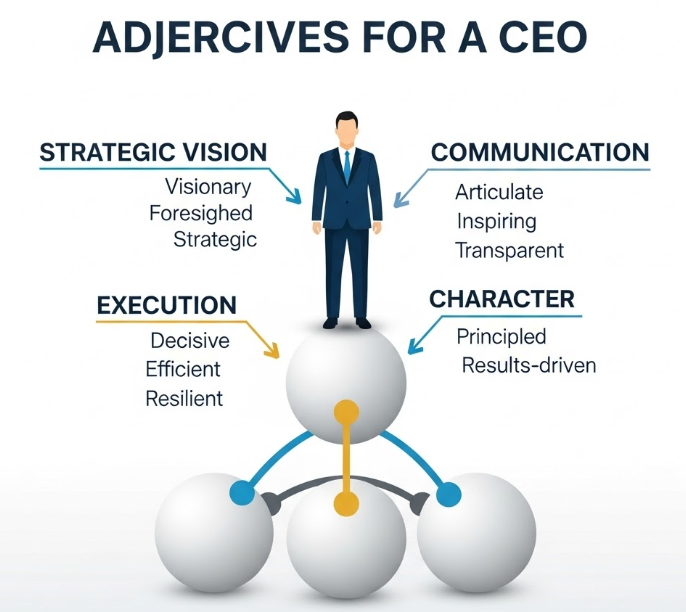
Adjectives used to describe CEOs can be categorized based on different aspects of their leadership and capabilities. Here are some key categories:
Strategic Thinking
These adjectives describe the CEO’s ability to develop and implement effective strategies for the organization’s success. They relate to their foresight, planning skills, and ability to anticipate future trends.
- Visionary: Having a clear and compelling vision for the future.
- Strategic: Skilled in developing and implementing effective strategies.
- Foresighted: Able to anticipate future trends and challenges.
- Analytical: Capable of analyzing complex information and making sound decisions.
- Innovative: Introducing new ideas and approaches to strategy.
Communication Skills
These adjectives describe the CEO’s ability to communicate effectively with various stakeholders, including employees, investors, and the public. They relate to their clarity, persuasiveness, and ability to inspire.
- Articulate: Expressing ideas clearly and effectively.
- Persuasive: Able to convince others to support their ideas.
- Eloquent: Fluent and graceful in speaking.
- Communicative: Open and effective in sharing information.
- Inspiring: Motivating others through their communication.
Integrity and Ethics
These adjectives describe the CEO’s adherence to ethical principles and their commitment to honesty and transparency. They relate to their trustworthiness, moral character, and ethical decision-making.
- Ethical: Adhering to high moral principles.
- Honest: Truthful and sincere in their dealings.
- Transparent: Open and clear in their communication and actions.
- Principled: Guided by strong moral principles.
- Upright: Honorable and just in their conduct.
Innovation and Creativity
These adjectives describe the CEO’s ability to foster innovation and creativity within the organization. They relate to their openness to new ideas, their willingness to take risks, and their ability to inspire others to think creatively.
- Innovative: Introducing new ideas and approaches.
- Creative: Imaginative and original in their thinking.
- Forward-thinking: Anticipating future trends and opportunities.
- Inventive: Skilled at creating new solutions and products.
- Resourceful: Able to find creative ways to overcome challenges.
Operational Excellence
These adjectives describe the CEO’s ability to manage operations efficiently and effectively. They relate to their attention to detail, their organizational skills, and their ability to drive performance.
- Efficient: Achieving maximum productivity with minimum wasted effort or expense.
- Effective: Successful in producing a desired or intended result.
- Organized: Systematic and efficient in arranging and managing resources.
- Disciplined: Showing a controlled form of behavior or way of working.
- Pragmatic: Dealing with things sensibly and realistically in a way that is based on practical considerations.
Leadership Style
These adjectives describe the CEO’s approach to leading and managing their team. They relate to their ability to motivate, delegate, and empower others.
- Authoritative: Confident and assertive in their leadership.
- Collaborative: Working effectively with others.
- Empowering: Giving others the authority to make decisions.
- Supportive: Providing encouragement and assistance to their team.
- Transformational: Inspiring significant change and growth.
Personal Attributes
These adjectives describe the CEO’s individual qualities and characteristics that contribute to their leadership effectiveness. They relate to their personality, work ethic, and interpersonal skills.
- Resilient: Able to recover quickly from difficulties.
- Determined: Firmly resolved to achieve a goal.
- Adaptable: Able to adjust to changing circumstances.
- Decisive: Able to make quick and effective decisions.
- Courageous: Brave and willing to take risks.
Examples of Adjectives for a CEO
The following tables provide examples of adjectives used to describe a CEO, categorized by different aspects of their leadership. Each table includes several examples to illustrate the variety of adjectives that can be used.
The table below focuses on adjectives that describe a CEO’s strategic thinking capabilities. These are essential for understanding their ability to guide the company towards long-term success.
| Adjective | Example Sentence |
|---|---|
| Visionary | The visionary CEO transformed the company into a market leader. |
| Strategic | Our strategic CEO implemented a plan that doubled profits in three years. |
| Foresighted | A foresighted CEO anticipated the market crash and adjusted the company’s investments accordingly. |
| Analytical | The analytical CEO identified key performance indicators that drove operational improvements. |
| Innovative | The innovative CEO encouraged the team to develop groundbreaking products. |
| Astute | An astute CEO quickly recognized and capitalized on emerging market trends. |
| Prudent | The prudent CEO managed the company’s finances with exceptional care, ensuring long-term stability. |
| Deliberate | The deliberate CEO carefully considered all options before making critical decisions. |
| Calculated | A calculated CEO took measured risks that ultimately led to significant growth. |
| Insightful | The insightful CEO understood the underlying dynamics of the industry better than anyone else. |
| Imaginative | The imaginative CEO devised unconventional strategies that set the company apart from its competitors. |
| Discerning | A discerning CEO was able to identify and develop talented individuals within the organization. |
| Resourceful | The resourceful CEO found innovative ways to overcome challenges with limited resources. |
| Tenacious | A tenacious CEO pursued ambitious goals with unwavering determination. |
| Persistent | The persistent CEO never gave up on the company’s vision, even in the face of adversity. |
| Creative | The creative CEO inspired the team to think outside the box and generate novel solutions. |
| Inventive | An inventive CEO fostered a culture of experimentation and innovation within the company. |
| Pioneering | The pioneering CEO led the company into uncharted territories, establishing it as a leader in the industry. |
| Groundbreaking | A groundbreaking CEO challenged conventional wisdom and introduced disruptive technologies. |
| Revolutionary | The revolutionary CEO transformed the industry with bold and innovative strategies. |
| Adaptive | The adaptive CEO quickly adjusted the company’s strategies to respond to changing market conditions. |
| Flexible | A flexible CEO was willing to modify plans as needed to achieve the company’s objectives. |
| Agile | The agile CEO led the company with speed and responsiveness in a dynamic environment. |
| Nimble | A nimble CEO navigated the competitive landscape with skill and precision. |
This table showcases adjectives related to a CEO’s communication skills. These are crucial for effectively conveying ideas and motivating teams.
| Adjective | Example Sentence |
|---|---|
| Articulate | The articulate CEO clearly explained the company’s strategy to the investors. |
| Persuasive | A persuasive CEO convinced the board to invest in a new market. |
| Eloquent | The eloquent CEO delivered a speech that inspired the entire company. |
| Communicative | Our communicative CEO keeps employees informed about company progress. |
| Inspiring | The inspiring CEO motivated the team to exceed their sales targets. |
| Well-spoken | The well-spoken CEO always delivers clear and engaging presentations. |
| Expressive | An expressive CEO uses body language effectively to convey enthusiasm. |
| Clear | The clear CEO provided concise instructions that were easy to follow. |
| Concise | A concise CEO gets straight to the point, making meetings more efficient. |
| Engaging | The engaging CEO captivates the audience with their storytelling abilities. |
| Charismatic | The charismatic CEO has a natural ability to connect with people. |
| Magnetic | A magnetic CEO attracts top talent to the organization. |
| Passionate | The passionate CEO’s enthusiasm is contagious. |
| Animated | An animated CEO brings energy to every presentation. |
| Poised | The poised CEO handles difficult questions with grace and confidence. |
| Diplomatic | A diplomatic CEO skillfully navigates sensitive situations. |
| Tactful | The tactful CEO knows how to deliver constructive criticism without causing offense. |
| Empathetic | An empathetic CEO understands and responds to the needs of their employees. |
| Understanding | The understanding CEO listens carefully to employee concerns. |
| Responsive | A responsive CEO promptly addresses employee inquiries. |
| Open | The open CEO welcomes feedback and suggestions from all levels of the organization. |
| Accessible | An accessible CEO makes themselves available to employees. |
| Transparent | The transparent CEO shares information openly and honestly. |
| Forthright | A forthright CEO communicates directly and honestly. |
This table presents adjectives that describe a CEO’s integrity and ethical standards. These are crucial for building trust and maintaining a positive reputation.
| Adjective | Example Sentence |
|---|---|
| Ethical | The ethical CEO always made decisions that were in the best interest of all stakeholders. |
| Honest | An honest CEO built a culture of trust and transparency within the company. |
| Transparent | The transparent CEO openly shared financial information with employees and investors. |
| Principled | Our principled CEO refused to compromise on their values, even when faced with difficult choices. |
| Upright | The upright CEO always conducted business with integrity and fairness. |
| Just | A just CEO ensured that all employees were treated fairly and equitably. |
| Fair | The fair CEO created a level playing field for all employees. |
| Impartial | An impartial CEO made decisions based on merit, not favoritism. |
| Objective | The objective CEO evaluated performance based on data, not personal biases. |
| Unbiased | A unbiased CEO treated all employees with respect, regardless of their background. |
| Honorable | The honorable CEO kept their promises and commitments. |
| Trustworthy | An trustworthy CEO inspired confidence in their leadership. |
| Reliable | The reliable CEO could always be counted on to follow through. |
| Dependable | A dependable CEO consistently delivered results. |
| Sincere | The sincere CEO genuinely cared about the well-being of their employees. |
| Authentic | An authentic CEO was true to themselves and their values. |
| Genuine | The genuine CEO built strong relationships with employees based on trust and respect. |
| Veracious | A veracious CEO always told the truth, even when it was difficult. |
| Candid | The candid CEO provided honest feedback to employees. |
| Straightforward | An straightforward CEO communicated directly and clearly. |
| Scrupulous | The scrupulous CEO paid meticulous attention to detail to ensure ethical compliance. |
| Conscientious | A conscientious CEO took their responsibilities seriously. |
| Responsible | The responsible CEO held themselves accountable for their actions. |
| Accountable | An accountable CEO accepted responsibility for both successes and failures. |
Usage Rules
When using adjectives to describe a CEO, it’s important to consider the context and audience. Use positive and constructive adjectives when providing feedback or recommendations. Avoid using overly critical or negative adjectives that could be perceived as unfair or disrespectful. Ensure that the adjectives you choose accurately reflect the CEO’s qualities and capabilities.
Pay attention to the intensity of the adjective. For example, “effective” is a moderate adjective, while “highly effective” is more intense. Choose the adjective that best reflects the degree to which the CEO exhibits the quality you are describing. It’s also crucial to use adjectives that are specific and measurable whenever possible. Instead of saying “a good CEO,” specify what makes them good, such as “an effective CEO who increased sales by 20%.”
Common Mistakes
One common mistake is using vague or generic adjectives that don’t provide specific information about the CEO. For example, saying a CEO is “nice” doesn’t convey much about their leadership skills. Another mistake is using clichés or overused adjectives that have lost their impact. Avoid phrases like “thinking outside the box” or “a team player” unless you can provide specific examples to support your claims. Finally, be careful not to use adjectives that are subjective or based on personal opinions rather than objective observations.
Incorrect: The CEO is good.
Correct: The CEO is a strategic leader who effectively implemented a cost-saving strategy.
Incorrect: The CEO is a team player.
Correct: The CEO fosters collaboration by holding weekly team meetings and encouraging open communication.
Practice Exercises
Complete the following sentences by choosing the most appropriate adjective from the options provided.
Exercise 1: Choose the best adjective to describe the CEO’s strategic abilities.
| Question | Options | Answer |
|---|---|---|
| The CEO is known for being a ________ leader who always has a clear plan for the future. | a) friendly, b) strategic, c) lazy | b) strategic |
| Our CEO is ________, always anticipating market trends and preparing the company for changes. | a) foresighted, b) oblivious, c) careless | a) foresighted |
| The ________ CEO implemented a new vision that revitalized the company’s growth. | a) visionary, b) shortsighted, c) indifferent | a) visionary |
| The CEO is highly ________ in their decision-making, carefully considering all possible outcomes. | a) analytical, b) impulsive, c) irrational | a) analytical |
| Our ________ CEO always seeks new and creative solutions to complex problems. | a) innovative, b) traditional, c) stagnant | a) innovative |
| The CEO is an ________ thinker, always coming up with unique strategies. | a) imaginative, b) uninspired, c) ordinary | a) imaginative |
| The ________ CEO recognized the potential in a new market before anyone else. | a) astute, b) dense, c) ignorant | a) astute |
| Our CEO is ________ in managing the company’s finances, ensuring long-term stability. | a) prudent, b) reckless, c) wasteful | a) prudent |
| The CEO is ________ in their approach, carefully weighing all options before acting. | a) deliberate, b) hasty, c) spontaneous | a) deliberate |
| A ________ CEO takes calculated risks that lead to substantial growth for the company. | a) calculated, b) erratic, c) haphazard | a) calculated |
Exercise 2: Choose the best adjective to describe the CEO’s communication abilities.
| Question | Options | Answer |
|---|---|---|
| The CEO is ________, expressing ideas clearly and effectively. | a) articulate, b) mumbled, c) incoherent | a) articulate |
| Our CEO is ________, able to convince others to support their ideas. | a) persuasive, b) unconvincing, c) dissuasive | a) persuasive |
| The ________ CEO delivered a speech that inspired the entire company. | a) eloquent, b) inarticulate, c) stammering | a) eloquent |
| The CEO is ________, keeping everyone informed about company progress. | a) communicative, b) secretive, c) reserved | a) communicative |
| The ________ CEO motivates the team to exceed their goals with inspiring speeches. | a) inspiring, b) discouraging, c) unmotivated | a) inspiring |
| The CEO is very ________ and always delivers presentations clearly and confidently. | a) well-spoken, b) tongue-tied, c) quiet | a) well-spoken |
| An ________ CEO uses their body language to show their enthusiasm. | a) expressive, b) impassive, c) stoic | a) expressive |
| The CEO provides ________ instructions that are easy for everyone to understand. | a) clear, b) ambiguous, c) vague | a) clear |
| A ________ CEO gets right to the point, making the meetings very efficient. | a) concise, b) verbose, c) rambling | a) concise |
| The ________ CEO captivates the audience with their storytelling. | a) engaging, b) boring, c) dull | a) engaging |
Advanced Topics
For advanced learners, exploring the use of figurative language, such as metaphors and similes, can add depth to descriptions of a CEO. For example, comparing a CEO to a “lion” implies strength and courage. Additionally, studying the historical context of leadership terminology can provide a richer understanding of the evolution of leadership qualities and expectations. Finally, analyzing cross-cultural differences in leadership styles and terminology can enhance global communication effectiveness.
Understanding the nuances of compound adjectives (e.g., “results-driven CEO”) and their impact on conveying specific qualities is also crucial. Exploring the use of abstract nouns modified by adjectives (e.g., “visionary leadership”) can further refine your descriptive capabilities.
FAQ
Q1: What are the most important adjectives to use when describing a CEO?
A1: The most important adjectives depend on the specific context and the qualities you want to emphasize. However, some generally important adjectives include “strategic,” “ethical,” “communicative,” and “visionary.”
Q2: How can I avoid using clichés when describing a CEO?
A2: To avoid clichés, focus on providing specific examples and details that support your descriptions. Instead of saying “a team player,” describe how the CEO fosters collaboration and teamwork.
Q3: Is it appropriate to use negative adjectives when describing a CEO?
A3: It’s generally best to avoid overly negative adjectives, especially in formal settings. If you need to address areas for improvement, use constructive language and focus on specific behaviors or actions.
Q4: How can I ensure that my descriptions of a CEO are accurate and objective?
A4: Base your descriptions on objective observations and data rather than personal opinions. Gather feedback from multiple sources and use specific examples to support your claims.
Q5: What’s the difference between “effective” and “efficient” when describing a CEO?
A5: “Effective” means successful in producing a desired result, while “efficient” means achieving maximum productivity with minimum wasted effort or expense. An effective CEO might achieve great results, while an efficient CEO does so with minimal resources.
Q6: How can I improve my vocabulary for describing leaders?
A6: Read articles and books about leadership, pay attention to the language used in business publications, and use a thesaurus to find synonyms for common adjectives. Practice using new adjectives in your writing and speaking.
Q7: Are there cultural differences in how CEOs are described?
A7: Yes, different cultures may place different values on certain leadership qualities. For example, some cultures may emphasize collaboration and consensus-building, while others may value assertiveness and decisiveness. Be mindful of these differences when communicating in a global context.
Q8: How do I choose adjectives to describe a CEO in a performance review?
A8: In a performance review, use adjectives that are specific, measurable, achievable, relevant, and time-bound (SMART). Focus on behaviors and results that can be objectively assessed. Provide examples to illustrate your points and offer constructive feedback for improvement.
Conclusion
Mastering the use of adjectives to describe a CEO is a valuable skill for effective communication in business and leadership contexts. By understanding the different categories of adjectives, their structural elements, and usage rules, you can articulate the qualities and capabilities of a CEO with precision and impact.
Avoid common mistakes, practice using new adjectives, and be mindful of the context and audience when making your descriptions.
Remember that the right adjectives can shape perceptions, influence morale, and accurately reflect the leadership style and effectiveness of a CEO. Continue to expand your vocabulary and refine your understanding of leadership terminology to enhance your communication skills and contribute to more meaningful discussions about leadership in your organization.