Understanding how to describe chaos is crucial for effective communication, whether you’re writing a novel, reporting news, or simply explaining a situation. Adjectives are the key to vividly portraying the degree and nature of disorder.
This article provides a comprehensive guide to using adjectives to describe chaos, covering various types, usage rules, common mistakes, and advanced applications. From basic vocabulary to nuanced expressions, this resource is designed for English learners of all levels seeking to enhance their descriptive abilities.
This guide will benefit students, writers, and anyone looking to improve their vocabulary and descriptive skills. By exploring a wide range of adjectives and their specific connotations, you’ll be able to paint a more accurate and compelling picture of chaotic scenarios.
Table of Contents
- Definition of Chaos and Adjective Usage
- Structural Breakdown of Adjective Usage
- Types and Categories of Adjectives for Chaos
- Examples of Adjectives for Chaos
- Usage Rules for Adjectives of Chaos
- Common Mistakes When Using Adjectives for Chaos
- Practice Exercises
- Advanced Topics: Nuances and Connotations
- Frequently Asked Questions
- Conclusion
Definition of Chaos and Adjective Usage
Chaos, in its broadest sense, refers to a state of complete disorder and confusion. It implies a lack of predictability, structure, and control. In everyday language, it can describe anything from a messy room to a societal breakdown. The power of language lies in choosing the right adjectives to convey the specific nature and intensity of the chaos.
Adjectives are words that describe or modify nouns, providing additional information about their qualities or characteristics. When describing chaos, adjectives help to paint a vivid picture of the scene or situation, conveying the degree of disorder, the emotions involved, and the overall impact. They can specify whether the chaos is physical, emotional, social, or even abstract. Selecting the strongest and most fitting adjective is essential for effective communication.
Adjectives can be classified based on their function and the type of information they provide. Descriptive adjectives, which are particularly useful for describing chaos, denote qualities, attributes, or characteristics of the noun they modify. For instance, in the phrase “a tumultuous storm,” the adjective “tumultuous” describes the nature of the storm, indicating its chaotic and violent characteristics. Other adjective types, such as quantitative adjectives (e.g., “many,” “few”) and demonstrative adjectives (e.g., “this,” “that”), can also contribute to describing chaotic situations by specifying the extent or proximity of the chaos.
Structural Breakdown of Adjective Usage
The structure of adjective usage in English is relatively straightforward, but understanding the rules can improve clarity and precision. Adjectives typically precede the noun they modify, as in “a disorganized desk.” However, they can also follow a linking verb (such as be, seem, appear), acting as a subject complement, as in “The situation was frenzied.”
Adjectives can be modified by adverbs to intensify or soften their meaning. For instance, “very chaotic” emphasizes the degree of chaos, while “somewhat disordered” suggests a milder form. The choice of adverb can significantly impact the overall impression conveyed. Also, multiple adjectives can be used to describe the same noun, providing a more detailed and nuanced description. For example, “a noisy, crowded, chaotic marketplace” uses three adjectives to convey the intensity and multifaceted nature of the scene.
The order of adjectives also follows certain conventions. Generally, opinion adjectives (e.g., beautiful, terrible) come before fact-based adjectives (e.g., size, color). When describing chaos, adjectives related to its intensity or impact often precede those describing its physical characteristics. For example, “a terrifying, disheveled room” places emphasis on the emotional impact before describing the physical state of the room.
Types and Categories of Adjectives for Chaos
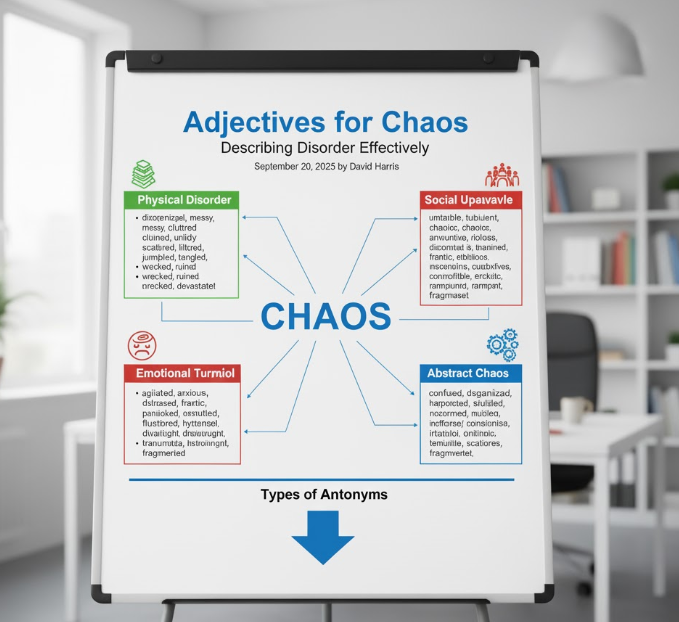
Adjectives for chaos can be categorized based on the type of chaos they describe. Here are some key categories:
Adjectives Describing Physical Disorder
These adjectives describe a state of messiness, disarray, and lack of organization in physical spaces or objects. They focus on tangible elements that contribute to a chaotic environment.
Adjectives Describing Emotional Turmoil
These adjectives describe inner states of confusion, distress, and agitation. They focus on the emotional impact of chaotic situations on individuals.
Adjectives Describing Social Upheaval
These adjectives describe disruptions and instability in social structures, systems, or events. They focus on the impact of chaos on groups and communities.
Adjectives Describing Abstract Chaos
These adjectives describe chaos in non-physical or conceptual contexts, such as plans, ideas, or situations that lack order or coherence. They focus on the intangible aspects of disorder.
Examples of Adjectives for Chaos
The following tables provide examples of adjectives for chaos, categorized by the type of chaos they describe. Each table includes a wide range of adjectives with varying intensities and connotations.
Examples for Physical Disorder
This table highlights adjectives that describe physical chaos, ranging from mild disarray to extreme messiness. Each adjective is accompanied by a sentence illustrating its usage.
| Adjective | Example Sentence |
|---|---|
| Disorganized | Her desk was disorganized, with papers scattered everywhere. |
| Messy | The child’s room was incredibly messy after the playdate. |
| Cluttered | The attic was cluttered with boxes and old furniture. |
| Untidy | His appearance was untidy, with his shirt unbuttoned and hair uncombed. |
| Disheveled | After the accident, the car was left disheveled on the roadside. |
| Scattered | The documents were scattered across the floor after the explosion. |
| Littered | The park was littered with trash after the concert. |
| Jumbled | The beads were jumbled together in a box. |
| Tumbled | The clothes were tumbled out of the suitcase. |
| Rambunctious | The children created a rambunctious mess in the kitchen while baking. |
| Haywire | The wires were all haywire after the accident. |
| Unkempt | The garden was unkempt, with weeds growing everywhere. |
| Deranged | The arrangement of books was deranged, as if someone had frantically searched for something. |
| Awry | After the earthquake, everything in the house was awry. |
| Disarranged | The furniture was disarranged after the party. |
| Muddled | The files were muddled and hard to sort through. |
| Tangled | The yarn was tangled into a giant knot. |
| Disarrayed | The office was disarrayed after the sudden departure of the team. |
| Riotous | The party turned into a riotous mess by midnight. |
| Inordinate | There was an inordinate amount of trash scattered around the stadium. |
| Wrecked | The hurricane left the coastline utterly wrecked. |
| Ruined | The flood ruined everything in the basement. |
| Devastated | The tornado left a devastated landscape in its wake. |
Examples for Emotional Turmoil
This table presents adjectives that describe emotional chaos, reflecting the inner turmoil and distress experienced by individuals. The examples showcase how these adjectives can be used to depict emotional states.
| Adjective | Example Sentence |
|---|---|
| Agitated | She became agitated when she couldn’t find her keys. |
| Anxious | He felt anxious about the upcoming presentation. |
| Distressed | The news left her feeling deeply distressed. |
| Frantic | She was frantic when she realized her child was missing. |
| Panicked | The crowd became panicked during the fire alarm. |
| Turbulent | Her emotions were turbulent after the argument. |
| Tumultuous | His inner thoughts were tumultuous during the crisis. |
| Chaotic | Her mind felt chaotic after the stressful day. |
| Unsettled | She felt unsettled by the strange news. |
| Discomposed | He was visibly discomposed by the interruption. |
| Perturbed | She seemed perturbed by the unexpected question. |
| Flustered | He became flustered when he dropped his notes. |
| Hysterical | She became hysterical upon hearing the tragic news. |
| Overwrought | She was overwrought with worry about her sick mother. |
| Distraught | He was distraught after losing his job. |
| Frenzied | Her efforts to find a solution became frenzied as the deadline approached. |
| Unraveled | His composure unraveled under the intense pressure. |
| Wrung | She felt emotionally wrung after the difficult conversation. |
| Rattled | He was rattled by the sudden loud noise. |
| Unnerved | She felt unnerved by the stranger’s gaze. |
| Traumatized | The victims were traumatized by the violent event. |
| Shattered | His dreams were shattered after the rejection. |
| Fragmented | Her thoughts felt fragmented and disconnected after the shock. |
Examples for Social Upheaval
This table provides adjectives describing social chaos, focusing on disruptions and instability within societies and communities. The examples illustrate how these adjectives depict large-scale disorder.
| Adjective | Example Sentence |
|---|---|
| Unstable | The political situation was becoming increasingly unstable. |
| Turbulent | The country experienced a turbulent period of social unrest. |
| Chaotic | The city descended into a chaotic state after the riots. |
| Disruptive | The protests were disruptive to daily life in the city. |
| Tumultuous | The revolution marked a tumultuous era in the nation’s history. |
| Anarchic | The region was described as anarchic, with no functioning government. |
| Lawless | The town became lawless after the sheriff resigned. |
| Disordered | The social structure became disordered after the mass migration. |
| Riotous | The crowd became riotous after the controversial verdict. |
| Uproarious | The meeting turned into an uproarious shouting match. |
| Frantic | There was a frantic rush to evacuate the city before the hurricane. |
| Pandemonic | The stock market crash caused a pandemonic reaction among investors. |
| Unruly | The students were unruly during the substitute teacher’s class. |
| Rebellious | The citizens became rebellious against the oppressive regime. |
| Insurrectionary | The movement turned insurrectionary, leading to armed conflict. |
| Revolutionary | The country underwent a revolutionary transformation. |
| Subversive | The group engaged in subversive activities to undermine the government. |
| Uncontrolled | The spread of misinformation online was uncontrolled. |
| Unbridled | The celebration turned into an unbridled display of public drunkenness. |
| Rampant | Corruption was rampant throughout the government. |
| Unchecked | The spread of the disease was unchecked due to lack of resources. |
| Disintegrated | The society disintegrated due to internal conflicts. |
| Fragmented | The political landscape became fragmented after the election. |
Examples for Abstract Chaos
This table features adjectives that describe abstract chaos, applicable to non-physical situations like plans, ideas, or systems. The examples illustrate how these adjectives convey a lack of order and coherence in abstract contexts.
| Adjective | Example Sentence |
|---|---|
| Disorganized | The project was disorganized from the start, leading to its failure. |
| Chaotic | The meeting was chaotic, with no clear agenda or direction. |
| Confused | The instructions were confused and difficult to follow. |
| Muddled | His explanation was muddled, making it hard to understand. |
| Garbled | The message was garbled and incomprehensible. |
| Incoherent | Her speech was incoherent, suggesting she was under duress. |
| Inconsistent | The data was inconsistent, making it unreliable for analysis. |
| Erratic | His behavior was erratic, making it difficult to predict his actions. |
| Unpredictable | The weather patterns have become unpredictable in recent years. |
| Volatile | The stock market is known for its volatile nature. |
| Haphazard | The plan was haphazard and lacked strategic thinking. |
| Random | The selection process was completely random. |
| Arbitrary | The decision seemed arbitrary, with no clear justification. |
| Unstructured | The course was too unstructured for the students to learn effectively. |
| Formless | Her ideas were still formless and needed further development. |
| Amorphous | The organization’s goals were amorphous and lacked clear definition. |
| Jumbled | His thoughts were jumbled, making it hard to articulate his feelings. |
| Tangled | The legal issues became tangled and complex. |
| Knotty | The problem was particularly knotty and difficult to resolve. |
| Convoluted | The explanation was so convoluted that nobody could understand it. |
| Byzantine | The bureaucracy was Byzantine in its complexity. |
| Rambling | His argument was rambling and lacked focus. |
| Desultory | The conversation was desultory, jumping from topic to topic. |
Usage Rules for Adjectives of Chaos
Using adjectives effectively requires understanding the rules that govern their usage. These rules ensure clarity, precision, and grammatical correctness.
Agreement and Placement
Adjectives must agree in number and gender with the nouns they modify in some languages, but this is not a concern in English. However, placement is crucial. Adjectives typically precede the noun, but can follow linking verbs. For example: “The chaotic scene” (before noun) vs. “The scene was chaotic” (after linking verb).
When using multiple adjectives, the order generally follows a pattern: opinion, size, age, shape, color, origin, material, and purpose. For example: “a beautiful, large, old, round, red, Italian, wooden table.” While this is a general guideline, context and emphasis can influence the order.
Using Intensifiers
Intensifiers are adverbs that modify adjectives, increasing or decreasing their intensity. Common intensifiers include very, extremely, quite, somewhat, and slightly. For example: “very chaotic,” “slightly disordered.” The choice of intensifier depends on the desired degree of emphasis.
Some adjectives have inherent intensity and do not require intensifiers. For instance, “devastated” already implies a high degree of destruction, so “very devastated” would be redundant.
Similarly, using “slightly anarchic” could be contradictory, as anarchy implies a complete absence of order.
Formal vs. Informal Usage
Some adjectives are more appropriate for formal contexts, while others are better suited for informal settings. For example, “tumultuous” and “anarchic” are generally used in more formal writing or speech, while “messy” and “disorganized” are common in everyday conversation.
The choice of adjective should also align with the overall tone and style of the communication. Using overly formal language in an informal setting can sound pretentious, while using informal language in a formal setting can appear unprofessional.
Consider your audience and purpose when selecting adjectives.
Common Mistakes When Using Adjectives for Chaos
Even experienced English speakers can make mistakes when using adjectives for chaos. Being aware of these common errors can help you avoid them.
| Incorrect | Correct | Explanation |
|---|---|---|
| The situation was very devastated. | The situation was devastated. | “Devastated” already implies a high degree of intensity; “very” is redundant. |
| A chaotic of mess. | A chaotic mess. | “Chaotic” is an adjective and should directly modify the noun “mess.” |
| He felt anxiety. | He felt anxious. | “Anxiety” is a noun; the adjective “anxious” is needed to describe his feeling. |
| The city was anarchical. | The city was anarchic. | “Anarchic” is the correct adjective form of anarchy. |
| The room was mess. | The room was messy. | “Mess” is a noun; the adjective “messy” is needed to describe the room. |
| She was distress. | She was distressed. | “Distress” is a noun; the adjective “distressed” is needed to describe her state. |
| The situation was very tumultuous and chaotic also. | The situation was tumultuous and chaotic. | Avoid unnecessary words like “also” that don’t add value. The adjectives are already strong enough. |
| The plan was disorganized and chaos. | The plan was disorganized and chaotic. | Maintain consistency by using adjectives in a series. “Chaos” is a noun and doesn’t fit. |
| He felt very agitated and also anxious. | He felt very agitated and anxious. | Avoid redundant use of “also” when listing adjectives describing a similar state. |
Practice Exercises
Test your understanding of adjectives for chaos with these practice exercises. Choose the best adjective to complete each sentence.
Exercise 1: Fill in the blanks with the most appropriate adjective.
| Question | Options | Answer |
|---|---|---|
| The _______ state of the office made it difficult to find anything. | (a) disorganized (b) organization (c) organize | (a) disorganized |
| After the storm, the streets were _______ with debris. | (a) litter (b) littered (c) littering | (b) littered |
| She felt _______ about the upcoming exam. | (a) anxious (b) anxiety (c) anxiously | (a) anxious |
| The political climate was becoming increasingly _______. | (a) unstable (b) stability (c) stably | (a) unstable |
| His explanation was _______ and difficult to understand. | (a) muddle (b) muddled (c) muddling | (b) muddled |
| The crowd became _______ after the controversial decision. | (a) riot (b) rioted (c) riotous | (c) riotous |
| The instructions were _______ and confusing. | (a) garble (b) garbled (c) garbling | (b) garbled |
| Her thoughts were _______ after the accident. | (a) fragmented (b) fragment (c) fragmenting | (a) fragmented |
| The meeting was _______, with no clear agenda. | (a) chaos (b) chaotic (c) chaotically | (b) chaotic |
| The situation was _______ with no hope of resolution. | (a) tumultuous (b) tumult (c) tumultuously | (a) tumultuous |
Exercise 2: Rewrite the following sentences using a stronger or more descriptive adjective for chaos.
| Original Sentence | Rewritten Sentence |
|---|---|
| The room was messy. | The room was utterly disheveled. |
| He felt worried about the news. | He felt distraught about the news. |
| The city was in disorder. | The city was in anarchic disarray. |
| The plan was confusing. | The plan was convoluted and incoherent. |
| The crowd was loud. | The crowd was riotous and unruly. |
| The market was crowded. | The market was a frenzied, chaotic scene. |
| She was upset. | She was overwrought with emotion. |
| The garden was untidy. | The garden was unkempt and overgrown. |
| His thoughts were mixed up. | His thoughts were jumbled and muddled. |
| The situation was bad. | The situation was a tumultuous disaster. |
Advanced Topics: Nuances and Connotations
For advanced learners, understanding the nuances and connotations of adjectives for chaos is crucial for precise and impactful communication. Some adjectives, while similar in meaning, carry different emotional weights or imply different types of disorder.
For example, “disorganized” suggests a lack of planning or structure, while “chaotic” implies a more active and disruptive state of disorder.
Exploring the etymology of adjectives can also provide deeper insights into their meanings. For instance, “tumultuous” comes from the Latin word “tumultus,” meaning “uproar” or “commotion,” which adds a sense of forceful disturbance to its meaning.
Similarly, “anarchic” derives from the Greek word “anarchos,” meaning “without a ruler,” highlighting the absence of authority and control.
Furthermore, the use of figurative language, such as metaphors and similes, can enhance the descriptive power of adjectives for chaos. For example, “Her mind was a tangled web of thoughts” uses a metaphor to convey the complexity and confusion of her mental state.
Similarly, “The city was like a riotous storm” uses a simile to compare the city’s disorder to the intensity of a storm.
Frequently Asked Questions
Here are some frequently asked questions about using adjectives for chaos:
- What’s the difference between “disorganized” and “chaotic”?“Disorganized” implies a lack of structure or planning, while “chaotic” suggests a more active and disruptive state of disorder. A disorganized desk might be messy, but a chaotic scene involves active disruption and confusion.
- How do I choose the right adjective for chaos?Consider the specific type of chaos you want to describe (physical, emotional, social, or abstract), the intensity of the chaos, and the emotional tone you want to convey. Use a thesaurus to explore synonyms and their nuances.
- Can I use multiple adjectives to describe chaos?Yes, using multiple adjectives can provide a more detailed and nuanced description. However, avoid redundancy and ensure that the adjectives complement each other.
- Are there any adjectives for chaos that should be avoided in formal writing?Some informal adjectives, such as “messy” or “jumbled,” might be less appropriate for formal writing. Opt for more sophisticated and precise adjectives like “tumultuous” or “anarchic.”
- How can I intensify the meaning of an adjective for chaos?Use adverbs like “very,” “extremely,” or “utterly” to intensify the meaning. However, be mindful of redundancy and choose intensifiers that align with the adjective’s connotation.
- What is the correct order when using multiple adjectives?The general order is: opinion, size, age, shape, color, origin, material, and purpose. However, context and emphasis can influence the order.
- Can adjectives for chaos be used figuratively?Yes, adjectives for chaos can be used figuratively to describe non-literal situations or emotions, adding depth and vividness to your writing.
- How do I avoid using clichés when describing chaos?Avoid overused phrases and try to find fresh and original ways to describe the scene. Use specific details and sensory language to create a unique and memorable impression.
Conclusion
Mastering the use of adjectives for chaos is essential for effective and vivid communication. By understanding the different types of adjectives, their usage rules, and their nuances, you can paint a more accurate and compelling picture of disorder.
Remember to consider the context, audience, and desired tone when choosing adjectives. Practice using a variety of adjectives in your writing and speaking to enhance your descriptive abilities.
The key takeaways from this article include the importance of selecting adjectives that accurately reflect the type and intensity of chaos, understanding the rules of adjective placement and modification, and avoiding common mistakes. By applying these principles, you can transform your descriptions of chaos from vague and generic to specific and impactful.
Continue to expand your vocabulary and explore the rich landscape of adjectives to become a more skilled and articulate communicator.