Understanding how to use adjectives effectively to describe corn is crucial for clear and vivid communication. Whether you’re a food blogger, a culinary student, or simply someone who enjoys talking about food, mastering the art of using adjectives to describe corn will greatly enhance your ability to express yourself.
This article will break down the various types of adjectives you can use, provide numerous examples, and offer practice exercises to solidify your understanding. By the end of this guide, you’ll be able to paint a vivid picture of corn in all its forms.
This article is designed for English language learners, food enthusiasts, and anyone looking to improve their descriptive writing skills. We will explore the different categories of adjectives, their proper usage, and common mistakes to avoid.
With clear explanations, examples, and interactive exercises, you’ll be well-equipped to describe corn with precision and flair.
Table of Contents
- What are Adjectives?
- Structural Breakdown of Adjectives
- Types of Adjectives for Describing Corn
- Examples of Adjectives for Corn
- Usage Rules for Adjectives
- Common Mistakes with Adjectives
- Practice Exercises
- Advanced Topics
- Frequently Asked Questions
- Conclusion
What are Adjectives?
Adjectives are words that describe or modify nouns or pronouns. They provide additional information about the qualities, characteristics, or attributes of the nouns they modify.
Adjectives answer questions such as “What kind?”, “Which one?”, “How many?”, or “How much?” In the context of describing corn, adjectives help us convey specific details about its appearance, taste, texture, origin, and more. Understanding adjectives is fundamental to building a rich and descriptive vocabulary.
Adjectives can be classified based on their function. Descriptive adjectives specify qualities (e.g., yellow corn). Quantitative adjectives indicate quantity (e.g., many ears of corn). Demonstrative adjectives point out specific nouns (e.g., this corn). Possessive adjectives show ownership (e.g., farmer’s corn). Interrogative adjectives are used in questions (e.g., which corn?). Proper adjectives are derived from proper nouns (e.g., Mexican corn). Finally, compound adjectives are formed by combining two or more words (e.g., sun-dried corn).
Structural Breakdown of Adjectives
Adjectives typically precede the nouns they modify, but they can also follow linking verbs (such as is, are, was, were, seem, become). When adjectives precede the noun, they are called attributive adjectives. When they follow a linking verb, they are called predicative adjectives. Understanding this distinction is crucial for constructing grammatically correct and natural-sounding sentences.
The structure of adjective phrases can vary. A simple adjective phrase might consist of a single adjective (e.g., sweet corn). More complex adjective phrases might include adverbs that modify the adjective (e.g., very sweet corn) or prepositional phrases that provide additional information (e.g., corn with a buttery flavor). Mastering these structures allows for greater nuance and precision in descriptive writing.
Adjectives can also be used in comparative and superlative forms to show degrees of quality. The comparative form is used to compare two things (e.g., sweeter corn). The superlative form is used to compare three or more things (e.g., sweetest corn). These forms are essential for expressing relative degrees of characteristics.
Types of Adjectives for Describing Corn
Descriptive Adjectives
Descriptive adjectives are used to describe the qualities or characteristics of a noun. They provide information about color, size, shape, texture, taste, and other sensory attributes.
When describing corn, descriptive adjectives are invaluable for conveying its unique features.
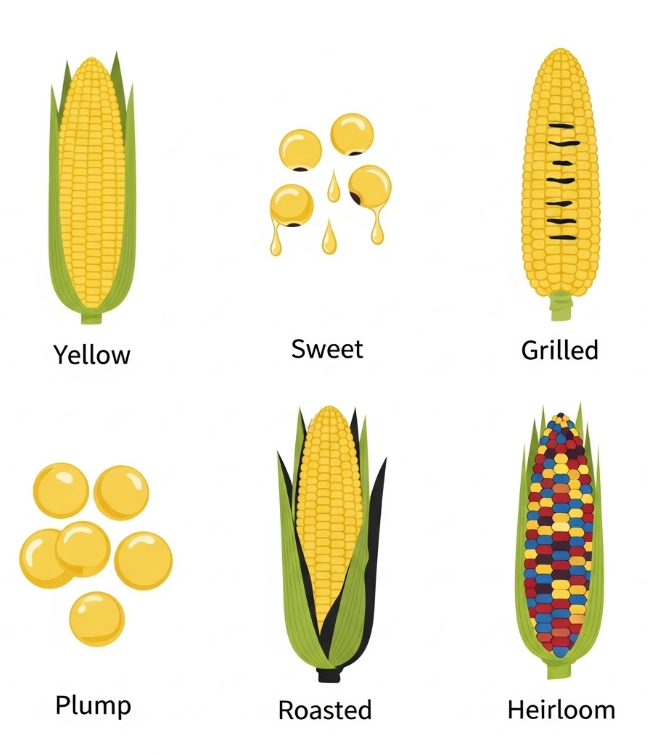
Examples of descriptive adjectives for corn include: yellow, white, sweet, juicy, plump, tender, fresh, ripe, creamy, golden, starchy, flavorful, delicious, buttery, charred, roasted, grilled, boiled, steamed, organic, heirloom.
Quantitative Adjectives
Quantitative adjectives indicate the quantity or amount of something. They answer the question “How many?” or “How much?” When describing corn, quantitative adjectives can be used to specify the number of ears, kernels, or servings.
Examples of quantitative adjectives for corn include: many, few, several, some, all, whole, half, much, little, enough, one, two, three, dozen, abundant, plentiful, scarce, numerous, countless, substantial.
Demonstrative Adjectives
Demonstrative adjectives point out specific nouns. They answer the question “Which one?” or “Which ones?” The four demonstrative adjectives are: this, that, these, and those. They are used to indicate whether the noun is near or far in proximity or time.
Examples of demonstrative adjectives for corn include: this ear of corn, that field of corn, these kernels of corn, those stalks of corn.
Possessive Adjectives
Possessive adjectives indicate ownership or possession. They show who or what something belongs to. Common possessive adjectives include: my, your, his, her, its, our, and their.
Examples of possessive adjectives for corn include: my corn, your corn, his corn, her corn, its corn, our corn, their corn, farmer’s corn, market’s corn.
Interrogative Adjectives
Interrogative adjectives are used to ask questions about nouns. The three interrogative adjectives are: what, which, and whose. They are always followed by a noun.
Examples of interrogative adjectives for corn include: what kind of corn?, which corn is the sweetest?, whose corn won the competition?.
Proper Adjectives
Proper adjectives are formed from proper nouns and modify other nouns. They often describe the origin, style, or type of something.
Proper adjectives are usually capitalized.
Examples of proper adjectives for corn include: Mexican corn, Peruvian corn, American corn, Iowa corn, sweet corn (as a specific type), Indian corn.
Compound Adjectives
Compound adjectives are formed by combining two or more words, often connected by a hyphen. They function as a single adjective to describe a noun.
Examples of compound adjectives for corn include: sun-dried corn, freshly-picked corn, slow-cooked corn, farm-fresh corn, hand-picked corn, sweet-tasting corn, richly-flavored corn, deep-fried corn, butter-soaked corn.
Examples of Adjectives for Corn
Here are several examples of adjectives used to describe corn, categorized by type, to help illustrate their usage.
The following table provides examples of descriptive adjectives used to describe corn. Notice how each adjective adds specific details about the corn’s qualities.
| Adjective | Example Sentence |
|---|---|
| Yellow | The yellow corn glistened in the sunlight. |
| White | She preferred the white corn for its delicate flavor. |
| Sweet | The sweet corn was a summer delicacy. |
| Juicy | Each bite of the juicy corn burst with flavor. |
| Plump | The plump kernels were a sign of a good harvest. |
| Tender | The tender corn was easy to eat. |
| Fresh | We bought fresh corn from the farmer’s market. |
| Ripe | The ripe corn was perfect for grilling. |
| Creamy | The creamy corn soup was a comforting meal. |
| Golden | The golden corn fields stretched as far as the eye could see. |
| Starchy | The starchy corn was used to make polenta. |
| Flavorful | The flavorful corn enhanced the taste of the salad. |
| Delicious | This delicious corn on the cob is the best I’ve ever had. |
| Buttery | The buttery corn was a crowd favorite. |
| Charred | The charred corn had a smoky flavor. |
| Roasted | The roasted corn was served with chili powder. |
| Grilled | The grilled corn was a perfect side dish for the barbecue. |
| Boiled | The boiled corn was a simple and satisfying snack. |
| Steamed | The steamed corn retained its natural sweetness. |
| Organic | We prefer to buy organic corn whenever possible. |
| Heirloom | The farmer proudly displayed his heirloom corn varieties. |
| Sugary | The children loved the sugary taste of the freshly picked corn. |
| Earthy | The earthy flavor of the corn complemented the grilled vegetables. |
| Tough | The tough corn stalks were difficult to cut down. |
| Silky | The silky tassels of the corn swayed in the breeze. |
The following table showcases examples of quantitative adjectives used with corn. These adjectives specify the amount or quantity of corn being described.
| Adjective | Example Sentence |
|---|---|
| Many | There were many ears of corn in the basket. |
| Few | Only a few kernels remained on the cob. |
| Several | We harvested several rows of corn today. |
| Some | Some of the corn was damaged by the storm. |
| All | All of the corn was sold at the market. |
| Whole | He ate a whole ear of corn in one sitting. |
| Half | She only wanted half an ear of corn. |
| Much | There wasn’t much corn left in the field. |
| Little | A little bit of corn was enough to make the cornbread. |
| Enough | We had enough corn to feed the entire family. |
| One | He picked one perfect ear of corn. |
| Two | She bought two ears of corn for dinner. |
| Three | The recipe called for three cups of corn kernels. |
| Dozen | They sold a dozen ears of corn for five dollars. |
| Abundant | The harvest was abundant this year. |
| Plentiful | The corn crop was plentiful, thanks to the rain. |
| Scarce | Corn was scarce due to the drought. |
| Numerous | There were numerous kernels on each cob. |
| Countless | The farmer had countless acres of corn. |
| Substantial | A substantial amount of corn was needed for the festival. |
| Few | Few farmers are still growing this variety of corn. |
| Several | Several corn varieties are suitable for making tortillas. |
| Each | Each ear of corn was carefully inspected for quality. |
| Every | Every kernel of corn was plump and juicy. |
| A lot of | There is a lot of corn growing in the Midwest. |
This table provides examples of demonstrative, possessive, interrogative, proper, and compound adjectives used with corn, illustrating their different functions in describing corn.
| Adjective Type | Adjective | Example Sentence |
|---|---|---|
| Demonstrative | This | This corn is the sweetest I’ve ever tasted. |
| Demonstrative | That | That corn field is ready for harvest. |
| Demonstrative | These | These kernels are perfect for making popcorn. |
| Demonstrative | Those | Those stalks of corn are taller than me! |
| Possessive | My | My corn crop was successful this year. |
| Possessive | Your | Your corn on the cob looks delicious. |
| Possessive | His | His corn won first prize at the fair. |
| Possessive | Her | Her corn recipe is a family secret. |
| Possessive | Its | The corn plant uses its leaves to capture sunlight. |
| Possessive | Our | Our corn harvest was the best in years. |
| Possessive | Their | Their corn field is vast and impressive. |
| Possessive | Farmer’s | The farmer’s corn was sold fresh at the market. |
| Interrogative | What | What kind of corn is used to make masa? |
| Interrogative | Which | Which corn variety is the most drought-resistant? |
| Interrogative | Whose | Whose corn stalks are these by the roadside? |
| Proper | Mexican | Mexican corn is often used in tamales. |
| Proper | Peruvian | Peruvian corn has large kernels. |
| Proper | American | American corn is a staple crop. |
| Compound | Sun-dried | Sun-dried corn can be stored for a long time. |
| Compound | Freshly-picked | The freshly-picked corn tasted amazing. |
| Compound | Slow-cooked | The slow-cooked corn was incredibly tender. |
| Compound | Farm-fresh | We bought farm-fresh corn directly from the grower. |
| Compound | Hand-picked | The hand-picked corn was of the highest quality. |
Usage Rules for Adjectives
Adjectives usually come before the noun they modify. For example: sweet corn, yellow kernels. However, when used with linking verbs (such as is, are, was, were, seem, become), adjectives come after the verb. For example: The corn is sweet. The kernels are yellow.
When using multiple adjectives to describe a noun, there is a general order to follow, although it’s not a rigid rule and can be flexible depending on the context and emphasis. The typical order is: opinion, size, age, shape, color, origin, material, and purpose. For example: delicious sweet yellow American corn.
Coordinate adjectives are adjectives that equally modify the same noun. They are separated by commas. If you can insert “and” between the adjectives and the sentence still makes sense, they are coordinate. For example: The corn was sweet, juicy, and tender. (You can say “sweet and juicy and tender”). However, delicious sweet corn does not require a comma because “delicious and sweet corn” doesn’t sound natural.
Some adjectives have irregular comparative and superlative forms. For example, good becomes better and best. It’s important to learn these irregular forms to use adjectives correctly. For example: “This corn is good, but that corn is better, and the corn from the farmer’s market is the best.”
Common Mistakes with Adjectives
One common mistake is using adjectives as adverbs. Adjectives modify nouns, while adverbs modify verbs, adjectives, or other adverbs. Incorrect: He cooked the corn quick. Correct: He cooked the corn quickly.
Another mistake is using the wrong comparative or superlative form. For adjectives with one or two syllables, use -er and -est (e.g., sweeter, sweetest). For adjectives with three or more syllables, use more and most (e.g., more flavorful, most flavorful). Incorrect: This corn is more sweeter than that corn. Correct: This corn is sweeter than that corn.
Misplacing adjectives can also lead to confusion. Make sure the adjective is close to the noun it modifies. Incorrect: The farmer sold corn that was fresh at the market. Correct: The farmer sold fresh corn at the market.
Here are some examples of common mistakes and their corrections, presented in a table for clarity:
| Incorrect | Correct | Explanation |
|---|---|---|
| He wanted a much corn. | He wanted much corn. | “Much” is used with uncountable nouns; “many” with countable nouns. |
| The corn was more sweeter. | The corn was sweeter. | Avoid double comparatives; use “-er” for one-syllable adjectives. |
| The farmer sold corn that was fresh. | The farmer sold fresh corn. | Place the adjective close to the noun it modifies. |
| The corn is goodly. | The corn is good. | “Good” is the adjective; “goodly” is archaic or used in specific contexts. |
| What kind corn is this? | What kind of corn is this? | Include the preposition “of” after “kind.” |
| I ate a whole of corn. | I ate a whole ear of corn. | “Whole” should be followed by the specific item (ear). |
| The corn was very tastier. | The corn was very tasty. | Do not use “very” with comparative adjectives. |
| This is the most sweetest corn. | This is the sweetest corn. | Avoid double superlatives; use “-est” for one-syllable adjectives. |
Practice Exercises
Complete the following sentences with appropriate adjectives. Choose adjectives that best describe the corn in each context.
- The _______ corn on the cob was grilled to perfection.
- We bought _______ ears of corn from the farmer’s market.
- _______ corn is often used to make tortillas.
- _______ kernels are perfect for making popcorn.
- _______ corn crop was the best we’ve ever had.
- _______ kind of corn is this?
- The _______ corn was a delightful treat on a summer evening.
- He prefers the _______ corn for its unique flavor.
- _______ corn is a staple in many diets around the world.
- The _______ corn field stretched out before us, ready for harvest.
Answers:
- The sweet/buttery/charred corn on the cob was grilled to perfection.
- We bought several/many/fresh ears of corn from the farmer’s market.
- Mexican corn is often used to make tortillas.
- These/Plump kernels are perfect for making popcorn.
- Our/This year’s corn crop was the best we’ve ever had.
- What kind of corn is this?
- The delicious/fresh/roasted corn was a delightful treat on a summer evening.
- He prefers the white/heirloom corn for its unique flavor.
- American corn is a staple in many diets around the world.
- The golden/vast corn field stretched out before us, ready for harvest.
Rewrite the following sentences, adding at least two adjectives to describe the corn. Be creative and use a variety of adjective types.
- The corn was delicious.
- We bought the corn.
- The corn field was vast.
- The kernels were plump.
- The corn is used for cooking.
- The corn grew tall.
- He ate the corn.
- The corn was harvested.
- The corn is a popular food.
- She planted the corn.
Answers:
- The sweet, juicy corn was delicious.
- We bought the fresh, organic corn.
- The vast, golden corn field was vast.
- The plump, yellow kernels were plump.
- The versatile, Mexican corn is used for cooking.
- The tall, green corn grew tall.
- He ate the buttery, grilled corn.
- The ripe, abundant corn was harvested.
- The sweet, nutritious corn is a popular food.
- She planted the heirloom, colorful corn.
Identify the adjectives in the following sentences and classify them by type (descriptive, quantitative, demonstrative, possessive, interrogative, proper, compound).
- This sweet corn is the best I’ve ever had.
- Many farmers grow American corn.
- What kind of corn do you prefer?
- Our farm-fresh corn is available at the market.
- Those yellow kernels look delicious.
- Her corn recipe is a family secret.
- Few crops are as important as corn.
- Which corn variety is the most profitable?
- Their sun-dried corn is perfect for winter.
- The juicy, tender corn was a summer favorite.
Answers:
- This (demonstrative), sweet (descriptive)
- Many (quantitative), American (proper)
- What (interrogative)
- Our (possessive), farm-fresh (compound)
- Those (demonstrative), yellow (descriptive)
- Her (possessive)
- Few (quantitative)
- Which (interrogative)
- Their (possessive), sun-dried (compound)
- Juicy (descriptive), tender (descriptive)
Advanced Topics
Adjective clauses, also known as relative clauses, provide additional information about a noun. They begin with relative pronouns (who, whom, which, that) or relative adverbs (where, when, why). For example: “The corn that was grown in Iowa is known for its quality.” The clause “that was grown in Iowa” modifies the noun “corn.”
Participial adjectives are formed from verbs and function as adjectives. Present participles (ending in -ing) describe an ongoing action or state. Past participles (usually ending in -ed or -en) describe a completed action or state. For example: “The growing corn field was a beautiful sight.” (present participle) “The roasted corn had a smoky flavor.” (past participle)
Nominal adjectives are adjectives that function as nouns. They usually refer to a general group or category. For example: “The sweet is often preferred over the starchy.” Here, “sweet” and “starchy” refer to sweet corn and starchy corn in general.
Frequently Asked Questions
- What is the difference between an adjective and an adverb?Adjectives modify nouns or pronouns, describing their qualities or characteristics. Adverbs modify verbs, adjectives, or other adverbs, describing how, when, where, or to what extent something is done. For example, in the sentence “The sweet corn grew quickly,” “sweet” is an adjective describing the corn, while “quickly” is an adverb describing how the corn grew.
- Can I use multiple adjectives to describe a noun?Yes, you can use multiple adjectives to describe a noun, but it’s important to follow the correct order and use commas appropriately between coordinate adjectives. For example, “delicious, sweet, yellow corn” is correct, while “yellow sweet delicious corn” sounds awkward. Remember the general order: opinion, size, age, shape, color, origin, material, purpose.
- What are some common mistakes to avoid when using adjectives?Common mistakes include using adjectives as adverbs (e.g., “He cooked the corn quick” instead of “quickly”), using the wrong comparative or superlative form (e.g., “more sweeter” instead of “sweeter”), and misplacing adjectives so that they don’t clearly modify the intended noun.
- How do I know when to use a comma between adjectives?Use a comma between coordinate adjectives, which are adjectives that equally modify the same noun. You can test if adjectives are coordinate by inserting “and” between them. If the sentence still makes sense, use a comma. For example, “sweet, juicy corn” is correct because “sweet and juicy corn” sounds natural. However, “delicious sweet corn” does not need a comma because “delicious and sweet corn” sounds less natural.
- What is a proper adjective, and how is it used?A proper adjective is formed from a proper noun and modifies another noun. It is usually capitalized. For example, “Mexican corn” is a proper adjective because it is derived from the proper noun “Mexico” and describes the origin of the corn.
- Can a verb be used as an adjective?Yes, verbs can be used as adjectives in the form of participles. Present participles (ending in -ing) and past participles (usually ending in -ed or -en) can function as adjectives. For example, “growing corn” uses the present participle “growing” as an adjective, and “roasted corn” uses the past participle “roasted” as an adjective.
- How can I improve my use of adjectives in writing?To improve your use of adjectives, practice expanding your vocabulary by reading widely and noting descriptive words. Pay attention to how different adjectives affect the tone and imagery of your writing. Also, practice using adjectives in your own writing and seek feedback from others.
- What are some less common but interesting adjectives to describe corn?Some less common adjectives that can add depth to your descriptions of corn include: succulent, ambrosial, nixtamalized, dented, flinty, multicoloured, waxy. These can provide a more specific and nuanced understanding of the corn being described.
Conclusion
Mastering the use of adjectives to describe corn can significantly enhance your communication skills, whether you’re writing recipes, discussing agricultural practices, or simply sharing your love for this versatile grain. By understanding the different types of adjectives, their proper usage, and common pitfalls to avoid, you can paint vivid and accurate pictures with your words.
Remember to practice using adjectives in your writing and speaking, and don’t be afraid to experiment with different combinations to find the most effective ways to convey your message. With consistent effort and attention to detail, you’ll become a proficient and articulate communicator, capable of describing corn and countless other subjects with precision and flair.
So go forth and describe the world, one adjective at a time!