Understanding the nuances of language used to describe evil is crucial for effective communication and a deeper appreciation of literature, history, and even everyday interactions. Adjectives are powerful tools that allow us to paint vivid pictures and convey the intensity of malevolence.
This article provides a comprehensive guide to adjectives that describe evil, their structural usage, variations, and how to use them correctly. Whether you’re a student, writer, or simply an English language enthusiast, this guide will equip you with the vocabulary and knowledge to express the concept of evil with precision and impact.
Table of Contents
- Definition of Adjectives for Evil
- Structural Breakdown
- Types and Categories of Adjectives for Evil
- Examples of Adjectives for Evil
- Usage Rules for Adjectives for Evil
- Common Mistakes When Using Adjectives for Evil
- Practice Exercises
- Advanced Topics
- Frequently Asked Questions (FAQ)
- Conclusion
Definition of Adjectives for Evil
Adjectives for evil are words used to describe something or someone characterized by profound immorality, wickedness, or harmful intent. They add detail and specificity to nouns, helping to convey the degree, nature, and impact of the evil being described.
These adjectives can range from relatively mild terms indicating a lack of good to extremely strong words suggesting utter depravity and maliciousness.
The function of these adjectives is primarily descriptive, but they also carry significant emotional weight. They can evoke feelings of fear, disgust, anger, or sadness in the reader or listener.
Understanding the connotations and nuances of different adjectives for evil is essential for choosing the most appropriate word to convey the intended meaning and emotional impact.
Context plays a crucial role in the selection and interpretation of adjectives for evil. The same adjective can have different implications depending on the situation, the subject being described, and the overall tone of the communication.
For instance, describing a minor transgression as “atrocious” would be an overstatement, while describing genocide as “bad” would be a gross understatement. Therefore, careful consideration of context is paramount when using these adjectives.
Structural Breakdown
Adjectives generally precede the nouns they modify. However, they can also follow linking verbs such as is, are, was, were, seems, and appears. Understanding the structural placement of adjectives is crucial for constructing grammatically correct and effective sentences.
Attributive Position: When adjectives appear directly before the noun they modify, they are said to be in the attributive position. This is the most common placement for adjectives.
Example: The wicked witch cast a spell.
Predicative Position: When adjectives follow a linking verb and describe the subject of the sentence, they are in the predicative position.
Example: The witch was wicked.
Adjectives can also be modified by adverbs to further intensify or qualify their meaning. For example, “extremely evil” or “somewhat malevolent.” This allows for even greater precision in describing the nature and degree of the evil being portrayed.
Furthermore, adjectives can be used in comparative and superlative forms to compare the degree of evil between different subjects. For example, “more evil” or “the most evil.” This allows for nuanced comparisons and rankings of malevolence.
Types and Categories of Adjectives for Evil
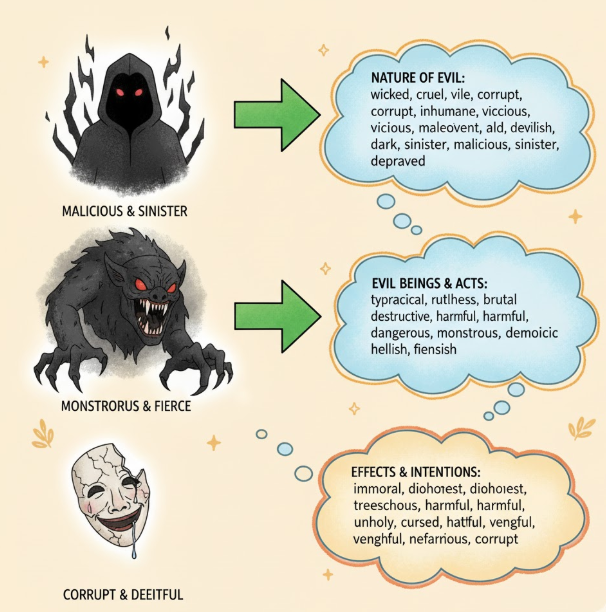
Adjectives for evil can be categorized based on their intensity and the specific type of evil they describe. Here are some broad categories:
1. Mildly Negative Adjectives
These adjectives suggest a minor degree of negativity or a lack of good, but do not necessarily imply active malevolence.
- Bad
- Naughty
- Unpleasant
- Awful
- Terrible
2. Moderately Negative Adjectives
These adjectives indicate a more significant degree of harm or immorality, suggesting a conscious choice to do wrong.
- Wicked
- Mean
- Cruel
- Unkind
- Vicious
3. Strongly Negative Adjectives
These adjectives convey a high degree of malevolence, suggesting a deep-seated depravity and a willingness to inflict severe harm.
- Evil
- Malevolent
- Sinister
- Diabolical
- Atrocious
4. Adjectives Describing Moral Corruption
These adjectives focus on the corruption of character and the violation of moral principles.
- Immoral
- Corrupt
- Depraved
- Unethical
- Base
5. Adjectives Describing Intent to Harm
These adjectives emphasize the deliberate intention to cause harm or suffering.
- Malicious
- Spiteful
- Vindictive
- Baleful
- Nefarious
6. Adjectives Describing Actions of Great Evil
These adjectives are used to describe actions or events that are exceptionally evil and reprehensible.
- Heinous
- Monstrous
- Abominable
- Outrageous
- Flagrant
Examples of Adjectives for Evil
The following tables provide examples of adjectives for evil used in sentences, categorized by their intensity and type.
Table 1: Mildly Negative Adjectives
This table showcases how mildly negative adjectives can be used to describe situations or behaviors that are undesirable but not inherently evil.
| Adjective | Example Sentence |
|---|---|
| Bad | He had a bad feeling about the dark alley. |
| Naughty | The child was being naughty and wouldn’t listen to his mother. |
| Unpleasant | The unpleasant smell made her wrinkle her nose. |
| Awful | The weather was awful, with constant rain and wind. |
| Terrible | He had a terrible headache after staring at the screen all day. |
| Poor | The team played a poor game, making many mistakes. |
| Unfortunate | It was an unfortunate accident that no one could have predicted. |
| Regrettable | His decision was regrettable, as it led to negative consequences. |
| Disappointing | The movie was disappointing, failing to live up to the hype. |
| Inferior | The product was of inferior quality compared to its competitors. |
| Substandard | The service at the restaurant was substandard and slow. |
| Deficient | The report was deficient in key details and analysis. |
| Lamentable | The state of the old building was lamentable, showing years of neglect. |
| Detrimental | Smoking has a detrimental effect on your health. |
| Harmful | The chemical spill was harmful to the environment. |
| Unsatisfactory | The results of the experiment were unsatisfactory. |
| Unfavorable | The economic forecast was unfavorable, predicting a recession. |
| Adverse | The drug had several adverse side effects. |
| Unhealthy | Eating too much junk food is unhealthy. |
| Grim | The outlook for the company was grim after the financial losses. |
| Bleak | The future looked bleak for the refugees. |
| Dismal | The weather report predicted a dismal weekend. |
| Depressing | The news was depressing, full of stories of suffering. |
Table 2: Moderately Negative Adjectives
This table illustrates how moderately negative adjectives are used to describe more deliberate and harmful actions or characteristics.
| Adjective | Example Sentence |
|---|---|
| Wicked | The wicked stepmother made Cinderella’s life miserable. |
| Mean | He was being mean to his younger brother. |
| Cruel | The cruel dictator oppressed his people. |
| Unkind | It was unkind of her to spread rumors about him. |
| Vicious | The vicious dog attacked the mailman. |
| Brutal | The brutal regime showed no mercy to its opponents. |
| Ruthless | The ruthless businessman would do anything to make a profit. |
| Callous | His callous disregard for her feelings was hurtful. |
| Heartless | The heartless landlord evicted the family in the middle of winter. |
| Merciless | The merciless storm destroyed everything in its path. |
| Remorseless | The killer was remorseless, showing no regret for his actions. |
| Barbaric | The barbaric practices of the tribe shocked the world. |
| Savage | The savage attack left the victim severely injured. |
| Fiendish | The fiendish plot was designed to cause maximum chaos. |
| Terrible | He made a terrible mistake when he betrayed his friends. |
| Awful | The accident was an awful tragedy for the entire community. |
| Nasty | She had a nasty temper and was quick to anger. |
| Ugly | The situation turned ugly when the argument escalated. |
| Grim | The news of the layoffs painted a grim picture for the future. |
| Dire | The refugees were in dire need of food and shelter. |
| Serious | The company faced serious financial problems. |
| Grave | The politician made a grave error in judgment. |
Table 3: Strongly Negative Adjectives
This table provides examples of how strongly negative adjectives are used to describe profound and deeply disturbing acts or characters.
| Adjective | Example Sentence |
|---|---|
| Evil | The evil sorcerer sought to conquer the world. |
| Malevolent | The malevolent spirit haunted the old house. |
| Sinister | There was a sinister atmosphere surrounding the abandoned mansion. |
| Diabolical | The villain concocted a diabolical plan to destroy the city. |
| Atrocious | The dictator committed atrocious crimes against humanity. |
| Heinous | The heinous act of terrorism shocked the world. |
| Monstrous | The monstrous creature emerged from the depths of the sea. |
| Abominable | The abominable conditions in the prison were a violation of human rights. |
| Nefarious | The nefarious organization was involved in illegal activities. |
| Vile | The vile rumors spread quickly through the town. |
| Depraved | The depraved acts of the cult leader were beyond comprehension. |
| Wicked | The wicked queen plotted to overthrow her rival. |
| Corrupt | The corrupt official accepted bribes to look the other way. |
| Immoral | His immoral behavior led to his downfall. |
| Malicious | The malicious gossip was intended to ruin her reputation. |
| Baleful | The baleful glare of the demon sent shivers down his spine. |
| Vindictive | Her vindictive nature drove her to seek revenge. |
| Fiendish | The fiendish laughter echoed through the dark corridors. |
| Ghastly | The ghastly sight of the battlefield was unforgettable. |
| Macabre | The macabre decorations were fitting for the haunted house. |
| Unholy | The unholy ritual was performed under the light of the full moon. |
| Perverse | The perverse nature of his desires was disturbing. |
| Satanic | The Satanic symbols were etched into the stone. |
Usage Rules for Adjectives for Evil
Using adjectives for evil correctly involves understanding their connotations and applying them appropriately to the context. Here are some key rules to follow:
- Choose the Right Intensity: Select an adjective that accurately reflects the degree of evil you want to convey. Avoid using overly strong adjectives for minor offenses or overly weak adjectives for serious transgressions.
- Consider the Connotation: Be aware of the emotional associations and cultural implications of each adjective. Some adjectives may have stronger or more specific connotations than others.
- Avoid Overuse: Using too many adjectives for evil can diminish their impact. Choose adjectives sparingly and strategically to maximize their effect.
- Pay Attention to Context: The context in which an adjective is used can significantly alter its meaning. Consider the subject being described, the tone of the communication, and the overall situation.
- Use Variety: Avoid using the same adjective repeatedly. Expand your vocabulary to include a variety of adjectives for evil to add depth and nuance to your writing.
Common Mistakes When Using Adjectives for Evil
Here are some common mistakes to avoid when using adjectives for evil:
- Misusing Intensity: Using a word like “atrocious” to describe a minor inconvenience is incorrect.
Incorrect: The traffic was atrocious this morning.
Correct: The traffic was terrible this morning. - Incorrect Connotation: Using an adjective that doesn’t fit the specific nuance of the situation.
Incorrect: He was a naughty dictator.
Correct: He was a cruel dictator. - Overuse of Adjectives: Cluttering sentences with too many adjectives weakens their impact.
Incorrect: The evil, wicked, malevolent villain laughed.
Correct: The evil villain laughed. - Ignoring Context: Failing to consider the subject and situation when choosing an adjective.
Incorrect: The flower was sinister.
Correct: The plan was sinister.
Practice Exercises
Test your understanding of adjectives for evil with these exercises. Choose the best adjective from the options provided to complete each sentence.
Exercise 1: Choosing the Right Adjective
Select the most appropriate adjective from the options provided to complete each sentence.
| Question | Options | Answer |
|---|---|---|
| 1. The ________ wizard cast a dark spell. | (a) bad (b) wicked (c) unpleasant | (b) wicked |
| 2. The ________ dictator oppressed his people with brutality. | (a) mean (b) cruel (c) unkind | (b) cruel |
| 3. The ________ crime shocked the nation. | (a) awful (b) atrocious (c) terrible | (b) atrocious |
| 4. He had a ________ feeling about the abandoned house. | (a) bad (b) sinister (c) naughty | (b) sinister |
| 5. The ________ plot was designed to cause chaos and destruction. | (a) diabolical (b) unpleasant (c) terrible | (a) diabolical |
| 6. Her ________ intentions were clear from her manipulative actions. | (a) poor (b) malicious (c) unfortunate | (b) malicious |
| 7. The ________ conditions in the refugee camp were heartbreaking. | (a) naughty (b) abominable (c) disappointing | (b) abominable |
| 8. The ________ organization was involved in illegal arms dealing. | (a) regrettable (b) nefarious (c) inferior | (b) nefarious |
| 9. The ________ sight of the battlefield haunted him for years. | (a) dismal (b) ghastly (c) grim | (b) ghastly |
| 10. His ________ disregard for the rules led to his expulsion from the club. | (a) substandard (b) flagrant (c) deficient | (b) flagrant |
Exercise 2: Identifying the Correct Usage
Determine whether the adjective is used correctly in each sentence. If not, rewrite the sentence with a more appropriate adjective.
| Sentence | Correct/Incorrect | Corrected Sentence (if incorrect) |
|---|---|---|
| 1. The traffic jam was atrocious. | Incorrect | The traffic jam was terrible. |
| 2. The evil villain twirled his mustache. | Correct | N/A |
| 3. She had a naughty idea for a prank. | Correct | N/A |
| 4. The flower had a sinister smell. | Incorrect | The potion had a sinister smell. |
| 5. The atrocious weather ruined our picnic. | Incorrect | The terrible weather ruined our picnic. |
| 6. The food was abominable. | Correct | N/A |
| 7. The mean dictator imprisoned his enemies. | Correct | N/A |
| 8. The nefarious plan involved stealing candy from children. | Incorrect | The nefarious plan involved stealing state secrets. |
| 9. The ghastly sunset painted the sky with vibrant colors. | Incorrect | The beautiful sunset painted the sky with vibrant colors. |
| 10. His vindictive nature led him to seek revenge. | Correct | N/A |
Advanced Topics
For advanced learners, exploring the etymology and historical usage of adjectives for evil can provide deeper insights into their meanings and connotations. Studying the use of these adjectives in literature and historical texts can also enhance understanding and appreciation.
Etymology: The origins of words like “evil,” “wicked,” and “malevolent” can reveal their historical and cultural associations. For example, “evil” comes from the Old English “yfel,” meaning bad or wicked. “Malevolent” comes from the Latin “malevolens,” meaning ill-wishing.
Literary Usage: Analyzing how authors use adjectives for evil in their works can provide valuable lessons in effective writing. For example, Shakespeare’s use of “villainous” and “pernicious” in his tragedies adds depth and complexity to his characters.
Figurative Language: Exploring the use of metaphors and similes involving adjectives for evil can enhance creative writing skills. For example, describing someone as “a serpent’s tongue” uses figurative language to convey their deceitful and harmful nature.
Frequently Asked Questions (FAQ)
Here are some frequently asked questions about adjectives for evil:
- What is the difference between “evil” and “wicked”?While both words describe immorality, “evil” typically implies a deeper and more profound level of depravity than “wicked.” “Evil” often suggests a force that is actively destructive and harmful on a grand scale, whereas “wicked” can refer to more personal or petty acts of wrongdoing.
- How do I choose the right adjective for evil?Consider the specific context, the degree of evil you want to convey, and the connotations of the adjective. Think about the subject being described and the overall tone of your communication. Consult a thesaurus and research the usage of different adjectives to find the most appropriate word.
- Can an adjective for evil be used in a positive context?Rarely. Adjectives for evil are almost exclusively used in negative contexts. However, in some rare cases, they might be used ironically or humorously. For example, someone might jokingly describe a delicious dessert as “wickedly good.”
- What are some synonyms for “evil”?Some synonyms for “evil” include wicked, malevolent, sinister, diabolical, nefarious, and depraved. The best synonym to use will depend on the specific context and the nuance you want to convey.
- How can I improve my vocabulary of adjectives for evil?Read widely, paying attention to the adjectives that authors use to describe evil characters and situations. Use a thesaurus to explore synonyms and related words. Practice using these adjectives in your own writing and speaking.
- Is it appropriate to use adjectives for evil in everyday conversation?It depends on the context and your audience. Using strong adjectives like “atrocious” or “diabolical” might be inappropriate in casual conversation, but more moderate adjectives like “bad” or “unpleasant” are generally acceptable. Consider your audience and the potential impact of your words.
- What is the difference between “malicious” and “vindictive”?“Malicious” describes a general desire to cause harm or suffering, while “vindictive” specifically refers to a desire for revenge. A malicious person might harm others for no particular reason, while a vindictive person seeks to retaliate for a perceived wrong.
- How do adjectives for evil contribute to the overall tone of a piece of writing?Adjectives for evil can significantly impact the tone of a piece of writing by creating a sense of fear, suspense, disgust, or outrage. The choice of adjectives can set the mood and influence the reader’s emotional response to the story or situation.
Conclusion
Mastering the use of adjectives for evil is essential for expressing nuanced and impactful descriptions of malevolence. By understanding the different types, their structural placement, and the rules governing their usage, you can effectively convey the degree and nature of evil in your communication.
Careful consideration of context and connotation is crucial for choosing the most appropriate adjective and avoiding common mistakes. Practice and continued learning will further enhance your ability to use these powerful words with precision and impact.