Fries, those golden sticks of potato perfection, are a universal comfort food. But how do you describe them beyond simply “good”?
Mastering the art of using adjectives to describe fries can elevate your vocabulary and make your descriptions more vivid and appealing. This article explores a wide range of adjectives perfect for portraying the texture, taste, appearance, and overall experience of eating fries.
Whether you’re writing a restaurant review, crafting a menu, or simply sharing your love of fries with friends, this guide will provide you with the tools to express yourself with precision and flair.
This article is designed for English language learners of all levels, food enthusiasts, and anyone who wants to improve their descriptive writing skills. By understanding the nuances of adjectives and how they apply to fries, you’ll gain a deeper appreciation for the English language and the simple pleasure of a well-made fry.
Table of Contents
- What are Adjectives?
- Adjective Placement and Structure
- Types of Adjectives for Fries
- Examples of Adjectives for Fries
- Usage Rules for Adjectives
- Common Mistakes with Adjectives
- Practice Exercises
- Advanced Topics: Compound Adjectives and Figurative Language
- Frequently Asked Questions
- Conclusion
What are Adjectives?
Adjectives are words that describe or modify nouns (people, places, things, or ideas). They provide more information about the noun, adding detail and specificity.
Adjectives answer questions like “What kind?”, “Which one?”, “How many?”, or “How much?” They are essential for creating vivid and descriptive language.
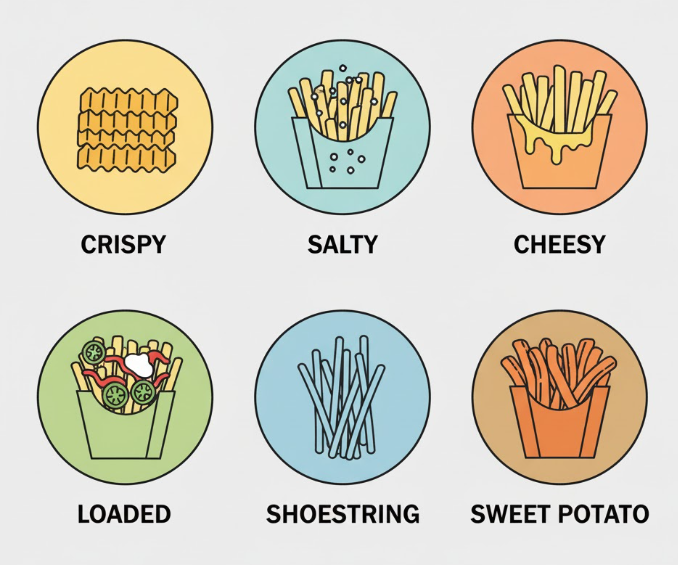
In the context of describing fries, adjectives can help us paint a picture of their texture (crispy, soft), taste (salty, savory), appearance (golden, thin), and overall quality (delicious, satisfying).
Adjective Placement and Structure
Adjectives typically appear before the noun they modify (attributive adjectives): “the crispy fries”. However, they can also appear after a linking verb (such as be, seem, become, look, feel, taste, smell, sound) (predicative adjectives): “The fries are delicious.”
Multiple adjectives can be used to describe a single noun. When using multiple adjectives, there is a general order to follow, although it’s not a rigid rule. The typical order is: opinion, size, age, shape, color, origin, material, and purpose. For example: “delicious small golden Belgian fries”.
Types of Adjectives for Fries
To effectively describe fries, we can categorize adjectives based on what aspect of the fries they highlight.
Texture Adjectives
Texture adjectives describe how the fries feel in your mouth. These are crucial for conveying the sensory experience of eating them.
Taste Adjectives
Taste adjectives describe the flavor profile of the fries. These help to evoke the specific sensations that the fries provide.
Appearance Adjectives
Appearance adjectives describe how the fries look. These are important for setting the stage and creating a visual impression.
Overall Impression Adjectives
Overall impression adjectives describe the general quality or feeling associated with the fries. These provide a summary judgment of the fries.
Examples of Adjectives for Fries
Below are tables containing many adjectives to describe fries, categorized by type. Each table contains numerous examples to help you expand your vocabulary and descriptive abilities.
Table 1: Texture Adjectives for Fries
This table showcases adjectives that describe the texture, or feel, of fries. These adjectives are essential for conveying the physical experience of eating them.
| Adjective | Example Sentence |
|---|---|
| Crispy | The crispy fries crackled with each bite. |
| Crunchy | These crunchy fries are perfect with ketchup. |
| Soft | The soft fries melted in my mouth. |
| Fluffy | These fluffy fries are light and airy. |
| Creamy | The inside of the fry was surprisingly creamy. |
| Tender | The tender fries were easy to eat. |
| Chewy | The chewy fries were a bit undercooked. |
| Starchy | The starchy fries filled me up quickly. |
| Greasy | The greasy fries left a film on my fingers. |
| Oily | The oily fries dripped with fat. |
| Well-done | I prefer my fries well-done and crispy. |
| Undercooked | These fries are a little undercooked and soggy. |
| Soggy | The soggy fries were disappointing. |
| Limp | The limp fries lacked any crispness. |
| Firm | The firm fries held their shape well. |
| Rough | The rough texture of the fries added to their rustic charm. |
| Smooth | The smooth fries were surprisingly delicate. |
| Grainy | The grainy texture suggested they were made from a different type of potato. |
| Mealy | The mealy fries were a bit dry. |
| Pasty | The pasty fries stuck to the roof of my mouth. |
| Crumbly | The crumbly fries fell apart easily. |
| Brittle | The brittle fries snapped with a loud crunch. |
| Hard | Some of the hard fries were difficult to bite. |
| Rubbery | The rubbery fries had an unpleasant texture. |
| Springy | The springy fries bounced back when pressed. |
| Tough | The tough fries were hard to chew. |
Table 2: Taste Adjectives for Fries
This table provides adjectives that describe the taste of fries. These are crucial for conveying the flavor experience.
| Adjective | Example Sentence |
|---|---|
| Salty | The salty fries were perfectly seasoned. |
| Savory | The savory fries had a rich, umami flavor. |
| Sweet | These sweet potato fries are surprisingly delicious. |
| Spicy | The spicy fries had a kick to them. |
| Tangy | The tangy fries were dipped in a vinegar-based sauce. |
| Garlicky | The garlicky fries were infused with flavor. |
| Herbaceous | The herbaceous fries were sprinkled with rosemary and thyme. |
| Buttery | The buttery fries were rich and decadent. |
| Earthy | The earthy fries had a distinct potato flavor. |
| Smoky | The smoky fries were grilled over an open flame. |
| Sharp | The sharp taste of vinegar complimented the fries well. |
| Mild | The mild flavor made these fries a good choice for kids. |
| Rich | The rich flavor of truffle oil elevated the simple fries. |
| Zesty | A zesty lemon aioli paired perfectly with the fries. |
| Peppery | The peppery fries had a pleasant bite. |
| Bland | The bland fries needed more seasoning. |
| Flavorful | The flavorful fries were a delight to eat. |
| Delicious | These are some of the most delicious fries I’ve ever had. |
| Tasty | The tasty fries disappeared quickly. |
| Appetizing | The appetizing aroma of the fries made my mouth water. |
| Mouthwatering | The mouthwatering fries were irresistible. |
| Palatable | The palatable fries pleased even the pickiest eaters. |
| Unsavory | The unsavory fries had an off-putting taste. |
| Disgusting | The disgusting fries were inedible. |
| Artificial | The artificial flavoring ruined the fries. |
| Chemical | The fries had a strange, chemical aftertaste. |
Table 3: Appearance Adjectives for Fries
This table lists adjectives that describe the appearance of fries. These are useful for creating a visual impression.
| Adjective | Example Sentence |
|---|---|
| Golden | The golden fries looked perfectly cooked. |
| Brown | The brown fries were slightly overcooked. |
| Pale | The pale fries looked undercooked. |
| Thin | The thin fries were crispy and delicate. |
| Thick | The thick fries were hearty and filling. |
| Long | The long fries were perfect for dipping. |
| Short | The short fries were easy to manage. |
| Curly | The curly fries were fun to eat. |
| Straight | The straight fries were neatly arranged. |
| Waffle-cut | The waffle-cut fries had a unique texture. |
| Crinkle-cut | The crinkle-cut fries held more sauce. |
| Shoestring | The shoestring fries were thin and crispy. |
| Chunky | The chunky fries were more like potato wedges. |
| Well-seasoned | The well-seasoned fries were covered in spices. |
| Unseasoned | The unseasoned fries looked plain. |
| Appetizing | The appetizing fries were arranged artfully on the plate. |
| Uniform | The uniform fries were all the same size and shape. |
| Uneven | The uneven fries varied in size and crispness. |
| Perfectly-cooked | The perfectly-cooked fries were a beautiful golden brown. |
| Overcooked | The overcooked fries were dark and burnt. |
| Underdone | The underdone fries were pale and unappealing. |
| Rustic | The rustic fries looked homemade and wholesome. |
| Glistening | The glistening fries shimmered with oil. |
| Matte | The matte fries had a dry, powdery appearance. |
| Dusted | The dusted fries were lightly coated with seasoning. |
| Battered | The battered fries had a thick, crispy coating. |
Table 4: Overall Impression Adjectives for Fries
This table offers adjectives that describe the overall quality or feeling associated with the fries.
| Adjective | Example Sentence |
|---|---|
| Delicious | These delicious fries are my favorite. |
| Satisfying | The satisfying fries hit the spot. |
| Addictive | These addictive fries are hard to stop eating. |
| Amazing | The amazing fries were the highlight of the meal. |
| Excellent | The excellent fries were perfectly prepared. |
| Wonderful | The wonderful fries were a delightful treat. |
| Fantastic | The fantastic fries were cooked to perfection. |
| Exceptional | The exceptional fries stood out from the rest. |
| Unforgettable | The unforgettable fries were truly special. |
| Mediocre | The mediocre fries were nothing special. |
| Ordinary | The ordinary fries were just average. |
| Disappointing | The disappointing fries didn’t live up to expectations. |
| Terrible | The terrible fries were a waste of money. |
| Awful | The awful fries were the worst I’ve ever had. |
| Unpleasant | The unpleasant fries had an off-putting taste and texture. |
| Enjoyable | The enjoyable fries were a great snack. |
| Pleasant | The pleasant fries were a welcome addition to the meal. |
| Memorable | The memorable fries made a lasting impression. |
| Remarkable | The remarkable fries were truly outstanding. |
| Sublime | The sublime fries were heavenly. |
| Divine | These fries were simply divine. |
| Superb | The superb fries were cooked with great care. |
| Exquisite | The exquisite fries were a culinary masterpiece. |
| Inferior | The inferior fries were clearly made with low-quality ingredients. |
| Substandard | The substandard fries did not meet my expectations. |
| Repulsive | The repulsive fries were utterly inedible. |
Usage Rules for Adjectives
Using adjectives correctly involves understanding a few key rules.
- Placement: As mentioned earlier, adjectives usually precede the noun they modify. However, predicative adjectives follow a linking verb.
- Order: When using multiple adjectives, follow the general order (opinion, size, age, shape, color, origin, material, purpose).
- Commas: Use commas to separate coordinate adjectives (adjectives that independently modify the noun) if they can be switched around and still make sense. For example, “crispy, salty fries.” But don’t use a comma if they aren’t coordinate: “delicious small fries.”
- Articles: Pay attention to articles (a, an, the) when using adjectives. “A delicious fry” (singular, indefinite) vs. “The delicious fry” (singular, specific).
- Hyphens: Use hyphens to connect compound adjectives that come before a noun: “well-seasoned fries.”
Common Mistakes with Adjectives
Here are some common mistakes to avoid when using adjectives:
- Incorrect Order: “Small delicious fries” (incorrect) vs. “Delicious small fries” (correct).
- Missing Commas: “Crispy salty fries” (incorrect) vs. “Crispy, salty fries” (correct).
- Misplaced Adjectives: “I ate fries delicious” (incorrect) vs. “I ate delicious fries” (correct) or “The fries were delicious” (correct).
- Overusing Adjectives: Too many adjectives can make your writing clunky. Choose the most impactful ones.
- Using Adjectives as Adverbs: “He seasoned the fries salty” (incorrect) vs. “He seasoned the fries saltily” (correct, using an adverb) or “The fries were salty” (correct, using an adjective).
Table 5: Correct vs. Incorrect Adjective Usage
This table illustrates some common errors in adjective usage with corrections.
| Incorrect | Correct |
|---|---|
| Fries salty. | The fries are salty. |
| Small delicious fries. | Delicious small fries. |
| I ate fries delicious. | I ate delicious fries. |
| He seasoned the fries salty. | He seasoned the fries saltily. |
| Crispy salty fries. | Crispy, salty fries. |
| Fries very good. | The fries are very good. |
Practice Exercises
Test your understanding of adjectives with these practice exercises.
Exercise 1: Fill in the Blanks
Fill in the blanks with appropriate adjectives to describe the fries.
| Question | Answer |
|---|---|
| 1. The ______ fries were served in a paper cone. | 1. The golden fries were served in a paper cone. |
| 2. I love the ______ and ______ taste of these fries. | 2. I love the crispy and salty taste of these fries. |
| 3. The ______ fries were a bit too greasy for my liking. | 3. The oily fries were a bit too greasy for my liking. |
| 4. These fries are so ______, I can’t stop eating them! | 4. These fries are so addictive, I can’t stop eating them! |
| 5. The restaurant is known for its ______ and ______ fries. | 5. The restaurant is known for its thick and fluffy fries. |
| 6. The ______ fries had a unique waffle-cut shape. | 6. The unusual fries had a unique waffle-cut shape. |
| 7. These ______ fries are perfect with a side of aioli. | 7. These savory fries are perfect with a side of aioli. |
| 8. I prefer my fries ______ and not too ______. | 8. I prefer my fries crispy and not too soggy. |
| 9. The ______ fries were sprinkled with fresh herbs. | 9. The herbaceous fries were sprinkled with fresh herbs. |
| 10. The ______ fries were a bit undercooked. | 10. The pale fries were a bit undercooked. |
Exercise 2: Multiple Choice
Choose the best adjective to describe the fries in each sentence.
| Question | Options | Answer |
|---|---|---|
| 1. The fries were ______, making them difficult to chew. | a) soft b) tough c) fluffy | b) tough |
| 2. These ______ fries have a wonderful aroma. | a) bland b) appetizing c) disgusting | b) appetizing |
| 3. The ______ fries were covered in melted cheese. | a) plain b) cheesy c) uniform | b) cheesy |
| 4. I found the fries to be quite ______, lacking any real flavor. | a) flavorful b) bland c) spicy | b) bland |
| 5. The ______ fries were a perfect accompaniment to the burger. | a) terrible b) excellent c) awful | b) excellent |
| 6. The ______ fries tasted like they were cooked in old oil. | a) fresh b) delicious c) rancid | c) rancid |
| 7. The ______ fries had a light dusting of sea salt. | a) unseasoned b) salty c) dusted | c) dusted |
| 8. The ______ cut of the fries made them perfect for dipping. | a) straight b) curly c) crinkle | c) crinkle |
| 9. The ______ fries had a distinct potato taste. | a) earthy b) artificial c) chemical | a) earthy |
| 10. The ______ fries were a customer favorite. | a) forgettable b) memorable c) ordinary | b) memorable |
Exercise 3: Sentence Writing
Write a sentence using each of the following adjectives to describe fries:
- Buttery: The buttery fries were a decadent treat.
- Spicy: The spicy fries left my mouth tingling.
- Golden: The golden fries looked irresistible.
- Fluffy: The fluffy fries were light and airy.
- Delicious: These delicious fries are the best in town.
- Crispy: The crispy fries made a satisfying crunch.
- Savory: The savory fries paired well with the burger.
- Addictive: These addictive fries are hard to put down.
- Thin: The thin fries were cooked to perfection.
- Earthy: The earthy fries had a natural potato flavor.
Advanced Topics: Compound Adjectives and Figurative Language
For advanced learners, we can explore compound adjectives and figurative language.
- Compound Adjectives: These are adjectives made up of two or more words, often hyphenated. Examples: “well-seasoned fries,” “hand-cut fries,” “oven-baked fries.” These add precision and detail to your descriptions.
- Figurative Language: Using metaphors, similes, and other figures of speech can make your descriptions more creative and engaging. For example, “The fries were as golden as the setting sun” (simile) or “The fries were a symphony of salt and starch” (metaphor).
Table 6: Examples of Compound Adjectives
This table lists examples of compound adjectives that can be used to describe fries.
| Compound Adjective | Example Sentence |
|---|---|
| Well-seasoned | The well-seasoned fries were bursting with flavor. |
| Hand-cut | The hand-cut fries had a rustic and homemade feel. |
| Oven-baked | The oven-baked fries were a healthier alternative. |
| Deep-fried | The deep-fried fries were crispy and indulgent. |
| Thin-cut | The thin-cut fries were perfect for a quick snack. |
| Thick-cut | The thick-cut fries were hearty and satisfying. |
| Home-style | The home-style fries tasted just like my grandma’s. |
| Fresh-made | The fresh-made fries were the best part of the meal. |
Frequently Asked Questions
- What’s the difference between “crispy” and “crunchy”? “Crispy” generally refers to a delicate, easily broken texture, while “crunchy” implies a harder, more substantial texture that makes a louder noise when bitten.
- How do I know when to use a comma between adjectives? Use a comma if the adjectives are coordinate – that is, if they independently modify the noun and can be switched around without changing the meaning. For example, “crispy, salty fries” works because you can also say “salty, crispy fries.” However, “delicious small fries” doesn’t need a comma because “small delicious fries” doesn’t sound right.
- Can I use too many adjectives? Yes, overusing adjectives can make your writing sound cluttered and less impactful. Choose the most descriptive and relevant adjectives.
- What’s the best way to learn new adjectives? Read widely, pay attention to how writers describe food, and practice using new adjectives in your own writing.
- Is it okay to use slang adjectives? While slang can be appropriate in informal contexts, it’s generally best to use standard adjectives in formal writing.
- How can I make my descriptions more creative? Use figurative language like similes and metaphors to create vivid images in the reader’s mind.
- What if I don’t know the exact word to describe the fries? Use a thesaurus to find synonyms for words you already know. You can also describe the fries indirectly by focusing on their effect or association.
- Are some adjectives subjective? Yes, many taste and overall impression adjectives are subjective, meaning they depend on personal preference. What one person finds “delicious,” another might find “mediocre.”
Conclusion
Mastering adjectives for describing fries can significantly enhance your ability to communicate effectively and express your culinary experiences with precision. By understanding the different types of adjectives, their placement, and common usage rules, you can elevate your vocabulary and create more vivid and engaging descriptions.
Remember to practice using these adjectives in your writing and conversation to solidify your understanding.
Ultimately, the goal is to convey your unique perspective and appreciation for the simple pleasure of a well-made fry. So, go forth and describe those fries with confidence and flair!
With a little practice, you’ll be able to paint a picture with words that captures the essence of every crispy, salty, and delicious bite.