
Invitations are more than just notices; they are expressions of warmth, excitement, and anticipation. The adjectives we choose to describe an event set the tone and entice potential guests.
Mastering the art of using adjectives effectively in invitations can significantly boost attendance and create a memorable first impression. This article provides a comprehensive guide to using adjectives in invitations, covering definitions, structural breakdowns, types, examples, usage rules, common mistakes, and practice exercises.
Whether you’re a student, event planner, or anyone looking to improve their communication skills, this guide will equip you with the knowledge to craft compelling and irresistible invitations.
This guide will help you understand how to select the best adjectives to make your invitations both informative and appealing, ensuring your event is well-attended and positively received.
Table of Contents
- Introduction
- Definition of Adjectives for Invitations
- Structural Breakdown
- Types and Categories of Adjectives for Invitations
- Examples of Adjectives in Invitations
- Usage Rules for Adjectives in Invitations
- Common Mistakes When Using Adjectives in Invitations
- Practice Exercises
- Advanced Topics
- Frequently Asked Questions (FAQ)
- Conclusion
Definition of Adjectives for Invitations
Adjectives are words that describe or modify nouns, providing more detail about the qualities, characteristics, or attributes of the noun. In the context of invitations, adjectives play a crucial role in setting the tone, conveying information, and making the invitation more appealing to potential attendees. They help paint a picture of the event, indicating its formality, theme, purpose, and overall atmosphere.
When used effectively, adjectives can transform a simple announcement into an exciting proposition. For example, instead of just stating “You are invited to a party,” using adjectives such as “You are invited to a spectacular and memorable party” creates a sense of anticipation and excitement. The choice of adjectives should align with the nature of the event and the desired response from the invitees.
Here’s a breakdown of how adjectives function in invitations:
- Describing Formality: Adjectives can indicate whether the event is formal (e.g., black-tie, elegant) or informal (e.g., casual, relaxed).
- Setting the Tone: They help establish the overall mood of the event, whether it’s festive (e.g., joyful, celebratory), professional (e.g., informative, strategic), or intimate (e.g., cozy, private).
- Highlighting Purpose: Adjectives can underscore the main reason for the event, such as a charitable gala, a networking event, or a milestone celebration.
- Creating Atmosphere: They evoke the ambiance and environment of the event, such as a glamorous awards ceremony or a rustic outdoor wedding.
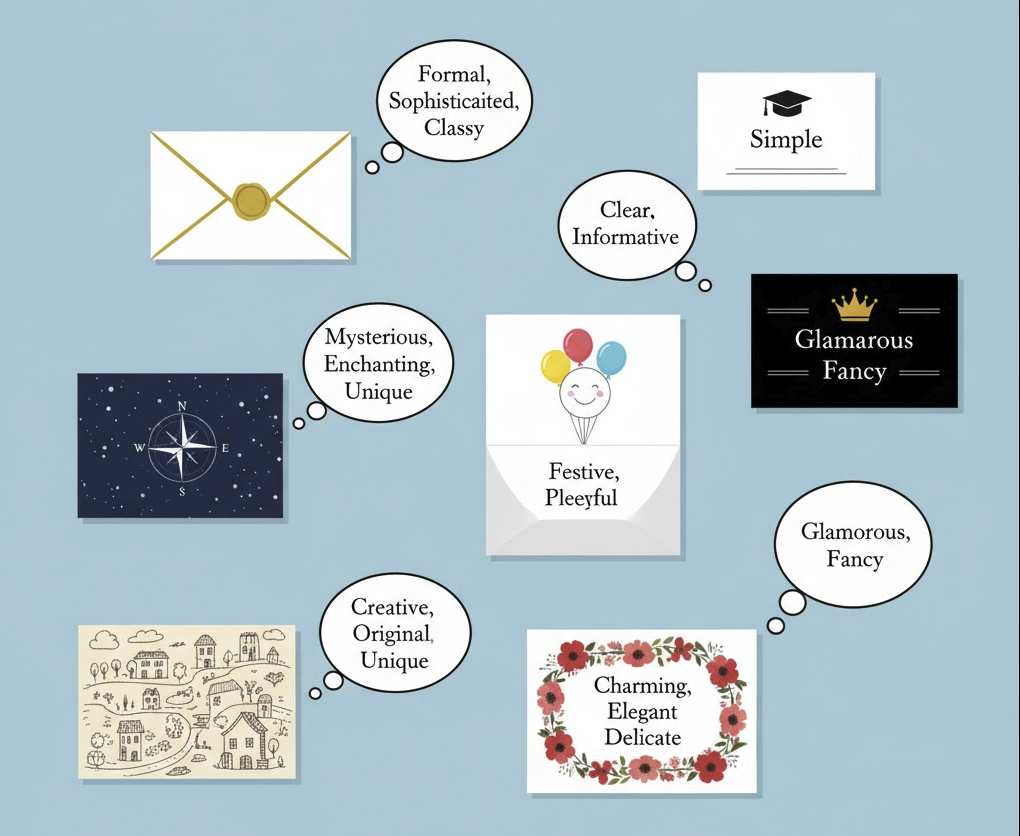
Structural Breakdown
The structure of using adjectives in invitations typically involves placing them before the nouns they modify or using them after linking verbs. Understanding these structures is essential for crafting grammatically correct and stylistically effective invitations.
Here’s a detailed look at the common structural patterns:
- Attributive Adjectives: These adjectives are placed directly before the noun they modify. This is the most common structure.
- Example: “Join us for a special occasion.” (Special modifies occasion.)
- Example: “Attend our exclusive networking event.” (Exclusive modifies event.)
- Predicative Adjectives: These adjectives follow a linking verb (such as is, are, was, were, seem, become) and describe the subject of the sentence.
- Example: “The event is elegant and grand.” (Elegant and grand describe event.)
- Example: “The celebration will be unforgettable.” (Unforgettable describes celebration.)
- Multiple Adjectives: You can use multiple adjectives to provide a more detailed description. When using multiple adjectives, follow the general order: opinion, size, age, shape, color, origin, material, and purpose.
- Example: “Attend our exciting, annual fundraising gala.” (Exciting is an opinion, and annual describes age.)
- Example: “Join us for a delightful, small garden party.” (Delightful is an opinion, and small describes size.)
When using multiple adjectives, remember to separate them with commas, except for the last adjective, which is usually connected to the noun with “and” if there are only two adjectives, or simply placed before the noun if there are more than two.
Consider these examples to illustrate the structural breakdown:
| Structure | Example | Explanation |
|---|---|---|
| Attributive Adjective | “You’re invited to a remarkable celebration!” | The adjective “remarkable” directly precedes and modifies the noun “celebration.” |
| Predicative Adjective | “The evening promises to be magical.” | The adjective “magical” follows the linking verb “to be” and describes the subject “evening.” |
| Multiple Adjectives | “Join us for a sophisticated, black-tie affair.” | The adjectives “sophisticated” and “black-tie” both modify “affair,” providing a more detailed description. |
Types and Categories of Adjectives for Invitations
Adjectives used in invitations can be categorized based on various aspects, such as formality, tone, purpose, and atmosphere. Understanding these categories helps in selecting the most appropriate adjectives for different types of events.
Adjectives Describing Formality
These adjectives indicate the level of formality of the event, ranging from highly formal to casual.
- Formal: Black-tie, elegant, grand, sophisticated, ceremonial, official, dignified, stately.
- Informal: Casual, relaxed, laid-back, friendly, informal, easygoing, comfortable, intimate.
Adjectives Describing Tone
These adjectives set the emotional or thematic tone of the event.
- Positive: Joyful, celebratory, festive, delightful, memorable, exciting, thrilling, wonderful.
- Professional: Informative, strategic, insightful, educational, productive, beneficial, valuable, professional.
- Intimate: Cozy, private, personal, warm, heartfelt, sincere, cherished, exclusive.
Adjectives Describing Purpose
These adjectives highlight the main reason or goal of the event.
- Charitable: Fundraising, benevolent, philanthropic, charitable, humanitarian, altruistic, generous, compassionate.
- Networking: Networking, connecting, collaborative, professional, strategic, business, career-oriented, mentoring.
- Milestone: Anniversary, commemorative, celebratory, significant, special, milestone, historic, landmark.
Adjectives Describing Atmosphere
These adjectives evoke the ambiance and environment of the event.
- Glamorous: Glamorous, luxurious, opulent, lavish, stylish, chic, elegant, sophisticated.
- Rustic: Rustic, charming, quaint, natural, organic, country, vintage, homely.
- Modern: Modern, contemporary, innovative, cutting-edge, sleek, minimalist, futuristic, state-of-the-art.
Examples of Adjectives in Invitations
This section provides numerous examples of adjectives used in different types of invitations to illustrate their practical application.
Formal Invitations
Formal invitations often use adjectives that convey elegance, sophistication, and tradition. These adjectives help create a sense of importance and respect.
| Invitation Text | Adjective(s) Used | Category |
|---|---|---|
| “You are cordially invited to a grand gala.” | Grand | Formality |
| “Join us for an elegant evening of fine dining.” | Elegant | Formality |
| “Attend our prestigious awards ceremony.” | Prestigious | Formality |
| “We request your presence at a sophisticated black-tie event.” | Sophisticated | Formality |
| “You are invited to a ceremonial dinner honoring distinguished guests.” | Ceremonial, Distinguished | Formality, Tone |
| “The President requests your presence at an official state dinner.” | Official | Formality |
| “Join us for a dignified evening celebrating years of service.” | Dignified | Formality |
| “Attend the stately ball at the historic Grandview Mansion.” | Stately, Historic | Formality, Atmosphere |
| “We invite you to a formal luncheon celebrating the company’s anniversary.” | Formal | Formality |
| “An exquisite dinner awaits you at the annual charity event.” | Exquisite | Tone |
| “Be part of a memorable night at the opera.” | Memorable | Tone |
| “Join us for a splendid evening of classical music.” | Splendid | Tone |
| “You’re invited to a lavish party at the Ambassador’s residence.” | Lavish | Atmosphere |
| “Attend a refined gathering of art enthusiasts.” | Refined | Atmosphere |
| “We are hosting a distinguished lecture on international relations.” | Distinguished | Tone |
| “Join us for a historical reenactment and celebration.” | Historical | Purpose |
| “The renowned professor will be giving a keynote speech.” | Renowned | Tone |
| “You are invited to a respectful memorial service.” | Respectful | Tone |
| “Attend this significant event marking a milestone in our company’s history.” | Significant | Purpose |
| “You are invited to celebrate a remarkable achievement.” | Remarkable | Tone |
| “A remarkable evening awaits as we celebrate a century of excellence.” | Remarkable | Tone |
| “Join us for an extraordinary celebration of art and culture.” | Extraordinary | Tone |
| “You are invited to a spectacular performance by the city’s symphony orchestra.” | Spectacular | Tone |
Informal Invitations
Informal invitations use adjectives that convey a sense of ease, friendliness, and relaxation. These adjectives make the invitation more approachable and welcoming.
| Invitation Text | Adjective(s) Used | Category |
|---|---|---|
| “Join us for a casual get-together at my place.” | Casual | Formality |
| “Come to a relaxed barbecue this weekend.” | Relaxed | Formality |
| “Let’s have a friendly game night!” | Friendly | Formality |
| “You’re invited to an informal potluck dinner.” | Informal | Formality |
| “Join us for an easygoing afternoon by the pool.” | Easygoing | Formality |
| “Come over for a comfortable movie night.” | Comfortable | Formality |
| “Let’s have an intimate gathering with close friends.” | Intimate | Formality |
| “Join us for a fun day at the park.” | Fun | Tone |
| “You’re invited to a joyful celebration of friendship.” | Joyful | Tone |
| “Come celebrate with us at a festive birthday bash!” | Festive | Tone |
| “Join us for a delightful picnic in the countryside.” | Delightful | Tone |
| “Let’s make some memorable moments together.” | Memorable | Tone |
| “Come and enjoy an exciting weekend getaway.” | Exciting | Tone |
| “Join us for a thrilling adventure in the mountains.” | Thrilling | Tone |
| “You’re invited to a wonderful evening of laughter and games.” | Wonderful | Tone |
| “Let’s have a cozy night in with movies and snacks.” | Cozy | Atmosphere |
| “Join us for a warm and welcoming housewarming party.” | Warm, Welcoming | Atmosphere |
| “Come and enjoy a charming afternoon tea in the garden.” | Charming | Atmosphere |
| “Let’s have a natural and organic cooking session.” | Natural, Organic | Atmosphere |
| “You’re invited to a vintage-themed costume party.” | Vintage | Atmosphere |
| “Join us for a homely dinner with family and friends.” | Homely | Atmosphere |
| “A heartfelt celebration awaits as we look back on our friendship through the years.” | Heartfelt | Tone |
| “Come and experience a sincere expression of gratitude.” | Sincere | Tone |
| “Join us for a cherished moment as we spend time together.” | Cherished | Tone |
| “You’re invited to an exclusive gathering of close friends.” | Exclusive | Formality |
Business Invitations
Business invitations require adjectives that convey professionalism, value, and purpose. These adjectives help attract attendees who are looking for specific benefits or information.
| Invitation Text | Adjective(s) Used | Category |
|---|---|---|
| “Attend our informative seminar on market trends.” | Informative | Tone |
| “Join us for a strategic planning workshop.” | Strategic | Tone |
| “Gain insightful perspectives at our industry conference.” | Insightful | Tone |
| “Participate in an educational training session.” | Educational | Tone |
| “Attend our productive team-building event.” | Productive | Tone |
| “Discover beneficial strategies for business growth.” | Beneficial | Tone |
| “Receive valuable insights from industry leaders.” | Valuable | Tone |
| “Join our professional networking event.” | Professional | Tone |
| “Attend a connecting event for entrepreneurs.” | Connecting | Purpose |
| “Join our collaborative workshop on innovation.” | Collaborative | Purpose |
| “Participate in a business-oriented leadership summit.” | Business-oriented | Purpose |
| “Attend our career-oriented development program.” | Career-oriented | Purpose |
| “Join us for a mentoring session with top executives.” | Mentoring | Purpose |
| “Attend a cutting-edge technology showcase.” | Cutting-edge | Atmosphere |
| “Join us for an innovative product launch.” | Innovative | Atmosphere |
| “Attend our state-of-the-art facility tour.” | State-of-the-art | Atmosphere |
| “Join us for a critical review of current market trends.” | Critical | Tone |
| “Attend our essential workshop on cybersecurity.” | Essential | Tone |
| “You’re invited to our annual shareholders meeting.” | Annual | Purpose |
| “Come to our exclusive product demonstration featuring our new line.” | Exclusive | Formality |
| “Join us for a special presentation on the future of renewable energy.” | Special | Purpose |
| “Attend our groundbreaking conference on artificial intelligence.” | Groundbreaking | Tone |
| “Join us for a transformative leadership retreat.” | Transformative | Tone |
Festive Invitations
Festive invitations use adjectives that evoke joy, excitement, and celebration. These adjectives help create a sense of anticipation and encourage attendance.
| Invitation Text | Adjective(s) Used | Category |
|---|---|---|
| “Join us for a joyful holiday celebration!” | Joyful | Tone |
| “Attend our celebratory new year’s eve party.” | Celebratory | Tone |
| “Come to our festive Christmas gathering.” | Festive | Tone |
| “Join us for a delightful spring festival.” | Delightful | Tone |
| “Let’s have a memorable birthday bash!” | Memorable | Tone |
| “Come and enjoy an exciting Halloween party.” | Exciting | Tone |
| “Join us for a thrilling costume party!” | Thrilling | Tone |
| “You’re invited to a wonderful summer carnival.” | Wonderful | Tone |
| “Attend our glamorous masquerade ball.” | Glamorous | Atmosphere |
| “Join us for a luxurious garden party.” | Luxurious | Atmosphere |
| “Attend our opulent gala event.” | Opulent | Atmosphere |
| “Join us for a stylish fashion show.” | Stylish | Atmosphere |
| “You’re invited to a chic cocktail party.” | Chic | Atmosphere |
| “Join us for a spectacular fireworks display on July 4th.” | Spectacular | Tone |
| “Attend our lively Cinco de Mayo fiesta.” | Lively | Tone |
| “Come to our magical winter wonderland celebration.” | Magical | Atmosphere |
| “You are invited to a special evening of caroling and merriment.” | Special | Purpose |
| “Join us for an unforgettable night of dancing and music.” | Unforgettable | Tone |
| “Attend our colorful Holi festival celebration.” | Colorful | Atmosphere |
| “Join us for a traditional Thanksgiving feast.” | Traditional | Atmosphere |
| “Attend our dynamic New Year’s Eve party.” | Dynamic | Tone |
Unique and Creative Invitations
Unique invitations use adjectives that are unconventional and imaginative, creating a sense of intrigue and novelty. These adjectives help the invitation stand out and capture attention.
| Invitation Text | Adjective(s) Used | Category |
|---|---|---|
| “Embark on a whimsical adventure with us!” | Whimsical | Tone |
| “Join us for an enchanting evening under the stars.” | Enchanting | Tone |
| “Attend our fantastical masquerade ball.” | Fantastical | Tone |
| “Come to a mystical garden party.” | Mystical | Atmosphere |
| “Experience an otherworldly celebration.” | Otherworldly | Atmosphere |
| “Join us for a surreal art exhibition.” | Surreal | Atmosphere |
| “Attend our avant-garde performance art show.” | Avant-garde | Atmosphere |
| “Come to a quirky tea party.” | Quirky | Formality |
| “Join us for an unconventional gathering.” | Unconventional | Formality |
| “Discover a secret garden party.” | Secret | Atmosphere |
| “Attend a hidden speakeasy night.” | Hidden | Atmosphere |
| “Join us for a daring adventure into the unknown.” | Daring | Tone |
| “Attend our unexpected celebration.” | Unexpected | Tone |
| “Come to a transformative retreat in the mountains.” | Transformative | Purpose |
| “Embark on a pioneering journey of self-discovery.” | Pioneering | Purpose |
| “Join us for an innovative approach to team building.” | Innovative | Purpose |
| “A captivating evening of storytelling awaits.” | Captivating | Tone |
| “Join us for a unique experience.” | Unique | Purpose |
| “Come and experience a breathtaking view from the rooftop.” | Breathtaking | Atmosphere |
| “Attend our unforgettable masquerade ball.” | Unforgettable | Tone |
| “Let’s have a splendid time at the festival.” | Splendid | Tone |
| “Join us for a thrilling adventure.” | Thrilling | Tone |
Usage Rules for Adjectives in Invitations
Using adjectives correctly in invitations requires adherence to certain grammatical rules and stylistic considerations. These rules ensure clarity, impact, and appropriateness.
- Adjective Order: When using multiple adjectives, follow the general order: opinion, size, age, shape, color, origin, material, and purpose.
- Correct: “a beautiful, small, old house”
- Incorrect: “an old, small, beautiful house” (unless emphasizing age)
- Coordination: Use commas to separate coordinate adjectives (adjectives that independently modify the noun). If the adjectives are not coordinate, do not use a comma.
- Correct: “a charming, rustic cottage” (You can say “charming and rustic cottage”)
- Incorrect: “a dark blue car” (Dark modifies blue, so no comma is needed)
- Hyphenation: Use hyphens for compound adjectives that come before a noun.
- Correct: “a well-planned event”
- Incorrect: “a well planned event”
- Appropriateness: Choose adjectives that align with the tone and formality of the event.
- Formal: Use adjectives like elegant, grand, sophisticated.
- Informal: Use adjectives like casual, relaxed, friendly.
- Clarity: Avoid using too many adjectives, as it can make the invitation sound cluttered and confusing.
- Concise: “Join us for an exciting party.”
- Overly Descriptive: “Join us for an exciting, wonderful, fantastic, amazing party.”
- Specificity: Use adjectives that provide specific and meaningful information about the event.
- Specific: “Attend our informative business seminar.”
- Vague: “Attend our good event.”
Remember that the goal is to enhance the invitation’s appeal and clarity, not to overwhelm the reader with excessive or inappropriate adjectives.
Common Mistakes When Using Adjectives in Invitations
Even experienced writers can make mistakes when using adjectives in invitations. Being aware of these common errors can help you avoid them and create more polished and effective invitations.
| Mistake | Incorrect Example | Correct Example | Explanation |
|---|---|---|---|
| Incorrect Adjective Order | “Join us for a old, beautiful housewarming.” | “Join us for a beautiful, old housewarming.” | Adjectives should follow the order: opinion, size, age, etc. |
| Misplaced Comma | “Attend our elegant, formal ball.” | “Attend our elegant formal ball.” | Commas are not needed between adjectives that are not coordinate. |
| Missing Hyphen | “Join us for a well planned event.” | “Join us for a well-planned event.” | Compound adjectives before a noun should be hyphenated. |
| Inappropriate Tone | “Join us for a chill black-tie affair.” | “Join us for an elegant black-tie affair.” | The tone should match the formality of the event. |
| Too Many Adjectives | “Attend our exciting, wonderful, fantastic, amazing party!” | “Attend our exciting party!” | Avoid overwhelming the reader with too many adjectives. |
| Vague Adjectives | “Join us for a good celebration.” | “Join us for a memorable celebration.” | Use specific and meaningful adjectives. |
| Incorrect Adjective Form | “Attend our more informative seminar.” | “Attend our informative seminar.” | Avoid using comparative or superlative forms unless comparing two or more events. |
| Redundant Adjectives | “Join us for a festive and celebratory event.” | “Join us for a festive event.” | Avoid using adjectives with similar meanings. |
| Misuse of “Unique” | “Attend our very unique event.” | “Attend our unique event.” | “Unique” means one-of-a-kind, so it cannot be modified by “very.” |
| Using Adjectives as Adverbs | “We are excited to invite you!” | “We are delighted to invite you | Use the correct form (adjective vs. adverb). |
Practice Exercises
Test your understanding of adjectives in invitations with these practice exercises. Identify the best adjectives to use in each scenario and correct any mistakes.
Exercise 1: Formal Invitation
Rewrite the following invitation using more appropriate and impactful adjectives:
“You are invited to a party.”
Answer:
“You are cordially invited to a grand gala.”
Exercise 2: Informal Invitation
Rewrite the following invitation using adjectives that create a more relaxed and friendly tone:
“Come to a gathering at my place.”
Answer:
“Join us for a casual get-together at my place.”
Exercise 3: Business Invitation
Improve the following invitation with adjectives that highlight the value and purpose of the event:
“Attend our event on business strategies.”
Answer:
“Attend our informative seminar on business strategies.”
Exercise 4: Festive Invitation
Enhance the following invitation with adjectives that evoke excitement and celebration:
“Join us for a holiday party.”
Answer:
“Join us for a joyful holiday celebration!”
Exercise 5: Correct the Mistakes
Identify and correct the mistakes in the following invitation:
“Attend our very unique, good celebration!”
Answer:
“Attend our unique celebration!”
Advanced Topics
For those looking to delve deeper into the art of using adjectives, here are some advanced topics to consider:
- Figurative Language: Using metaphors and similes to create vivid descriptions.
- Connotation and Denotation: Understanding the emotional associations of adjectives.
- Cultural Sensitivity: Choosing adjectives that are appropriate for diverse audiences.
- Rhetorical Devices: Employing techniques like alliteration and assonance to enhance the impact of adjectives.
- Adapting Adjectives for Different Mediums: Tailoring your adjective choices for print, email, and social media invitations.
Frequently Asked Questions (FAQ)
How many adjectives should I use in an invitation?
Use as many adjectives as necessary to convey the tone and purpose of the event, but avoid overwhelming the reader. Generally, one to three well-chosen adjectives are sufficient.
What if I can’t think of the right adjective?
Use a thesaurus to explore synonyms and related words. Consider the specific qualities you want to highlight and choose adjectives that best capture those qualities.
Are there any adjectives I should always avoid?
Avoid vague adjectives like “good,” “nice,” and “okay.” Also, be cautious of using adjectives that could be considered offensive or insensitive.
How important are adjectives compared to other elements of an invitation?
Adjectives are crucial for setting the tone and creating interest, but they are just one part of a successful invitation. Other important elements include clear and concise information, appealing design, and a compelling call to action.
Can I use adjectives in other parts of the invitation besides describing the event itself?
Yes, you can use adjectives to describe the venue, the food, the entertainment, or any other aspect of the event that you want to highlight. For example, “Enjoy our delicious catering” or “Experience our state-of-the-art venue.”
Conclusion
Mastering the use of adjectives in invitations is an invaluable skill for anyone looking to create compelling and effective communications. By understanding the different types and categories of adjectives, adhering to usage rules, and avoiding common mistakes, you can craft invitations that not only inform but also excite and entice potential attendees.
Whether you’re planning a formal gala, a casual get-together, a business seminar, or a festive celebration, the right adjectives can make all the difference in ensuring your event is a resounding success. So, take the time to choose your words wisely, and watch as your invitations transform from simple notices into irresistible calls to action.