
Understanding how to use adjectives effectively is crucial for painting vivid pictures with words, and when describing a country as multifaceted as Japan, a rich vocabulary of adjectives is essential. This article provides a comprehensive guide to adjectives for describing Japan, covering everything from basic descriptors to more nuanced and evocative terms.
Whether you’re a student, a writer, or simply someone fascinated by Japanese culture, this guide will equip you with the tools to express your thoughts and impressions with accuracy and flair.
This article is designed for English language learners of all levels, from beginners seeking basic vocabulary to advanced speakers aiming to refine their descriptive abilities. By mastering the adjectives presented here, you’ll be able to communicate more effectively about Japan’s culture, history, geography, and people.
Let’s embark on a linguistic journey to explore the enchanting world of Japanese adjectives!
Table of Contents
- Definition of Adjectives
- Structural Breakdown of Adjectives in English
- Types and Categories of Adjectives for Describing Japan
- Examples of Adjectives in Sentences
- Usage Rules for Adjectives
- Common Mistakes When Using Adjectives
- Practice Exercises
- Advanced Topics: Nuances and Collocations
- Frequently Asked Questions
- Conclusion
Definition of Adjectives
An adjective is a word that modifies a noun or pronoun, providing more information about its qualities, characteristics, or attributes. Adjectives answer questions like “What kind?”, “Which one?”, “How many?”, or “How much?” They add detail and specificity to our descriptions, making our language more vivid and engaging.
In essence, adjectives bring nouns to life, allowing us to paint a clearer picture in the minds of our listeners or readers.
Adjectives can be classified into several categories based on their function and meaning. Some common types include descriptive adjectives (e.g., beautiful, old, interesting), quantitative adjectives (e.g., few, many, some), demonstrative adjectives (e.g., this, that, these), and possessive adjectives (e.g., my, your, his).
Understanding these categories can help you choose the most appropriate adjective for a given context.
Structural Breakdown of Adjectives in English
In English, adjectives typically precede the noun they modify. For example, we say “a beautiful garden” rather than “a garden beautiful.” However, there are exceptions to this rule.
Adjectives can also follow linking verbs such as “be,” “seem,” “become,” and “appear.” In these cases, the adjective describes the subject of the sentence rather than a specific noun.
Adjectives can also be modified by adverbs, which add intensity or nuance to their meaning. For instance, we can say “very beautiful” or “extremely interesting.” Adverbs typically precede the adjective they modify.
The order of adjectives is also important. When using multiple adjectives to describe a noun, there’s a general order that native speakers follow, although it’s not a strict rule.
This order is typically: opinion, size, age, shape, color, origin, material, and purpose.
Types and Categories of Adjectives for Describing Japan
When describing Japan, a diverse range of adjectives can be used to capture its unique essence. These adjectives can be categorized based on different aspects of the country, such as its culture, geography, people, food, and modernity.
Let’s explore each of these categories in more detail.
Describing Culture and Tradition
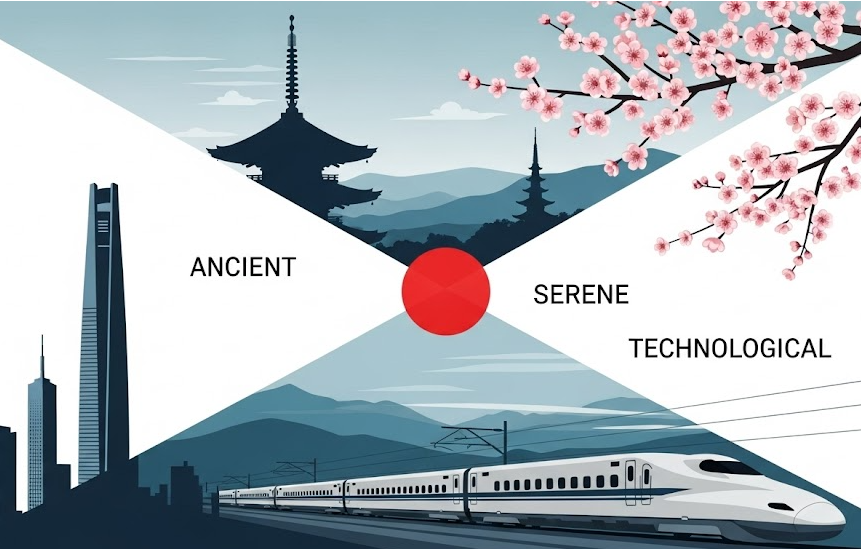
Japan’s culture and traditions are rich and deeply rooted in history. Adjectives that describe this aspect often evoke a sense of respect, elegance, and artistry.
These words help to illustrate the unique blend of ancient customs and refined aesthetics that characterize Japanese culture.
Consider adjectives like traditional, ancient, ceremonial, artistic, elegant, refined, spiritual, historical, sacred, and venerable. These words can be used to describe aspects of Japanese culture such as tea ceremonies, temples, shrines, traditional arts, and festivals. They help to convey the deep sense of history and cultural significance that permeates many aspects of Japanese life.
Describing Geography and Nature
Japan’s geography is incredibly diverse, ranging from towering mountains to serene coastlines. Adjectives used to describe its natural beauty often highlight its variety, tranquility, and sometimes, its dramatic power.
These words allow us to appreciate the stunning landscapes that define Japan.
Adjectives like mountainous, coastal, volcanic, lush, serene, picturesque, breathtaking, tranquil, verdant, and scenic are commonly used to describe Japan’s geography. These words can paint a vivid picture of the country’s natural wonders, from the snow-capped peaks of the Japanese Alps to the tranquil beauty of its bamboo forests and the dramatic coastlines sculpted by the Pacific Ocean.
Describing People and Society
Japanese society is often characterized by its politeness, diligence, and sense of community. Adjectives that describe the people and society often emphasize these qualities, reflecting the values and norms that are highly regarded in Japan.
Understanding these adjectives provides insight into the social fabric of the nation.
Useful adjectives include polite, respectful, diligent, hardworking, disciplined, harmonious, collectivist, courteous, reserved, and efficient. These words capture the essence of Japanese social interactions and the values that underpin the culture. They reflect the emphasis on politeness, respect for elders, and the importance of group harmony that are central to Japanese society.
Describing Food and Cuisine
Japanese cuisine is renowned for its delicate flavors, meticulous presentation, and emphasis on fresh ingredients. Adjectives used to describe Japanese food often highlight these qualities, appealing to the senses and conveying the artistry of Japanese cooking.
These words can make your descriptions of Japanese food more enticing and evocative.
Consider adjectives like delicious, flavorful, fresh, delicate, savory, umami, exquisite, artistic, traditional, and authentic. These words can be used to describe a wide range of Japanese dishes, from sushi and ramen to tempura and wagyu beef. They help to convey the unique flavors, textures, and presentation that make Japanese cuisine so highly regarded around the world.
Describing Modernity and Technology
Japan is also a global leader in technology and innovation, known for its cutting-edge advancements and modern infrastructure. Adjectives that describe this aspect often emphasize its efficiency, innovation, and futuristic qualities, reflecting Japan’s role as a technological powerhouse.
Adjectives such as modern, innovative, technological, efficient, futuristic, advanced, high-tech, sleek, urban, and automated are suitable for describing Japan’s modernity. These words can be used to describe its bullet trains, skyscrapers, robotics industry, and urban landscapes, showcasing the country’s commitment to progress and technological advancement.
Examples of Adjectives in Sentences
To further illustrate the use of adjectives for describing Japan, let’s look at some examples in sentences. These examples are organized by the categories discussed earlier, providing a clear context for each adjective.
The following tables illustrates the use of adjectives, with specific examples related to Japan.
| Category | Adjective | Example Sentence |
|---|---|---|
| Culture and Tradition | Traditional | The traditional tea ceremony is a deeply respected art form in Japan. |
| Culture and Tradition | Ancient | The ancient temples of Kyoto are a testament to Japan’s rich history. |
| Culture and Tradition | Ceremonial | The ceremonial kimonos worn during weddings are elaborately designed. |
| Culture and Tradition | Artistic | The artistic gardens of Japan are carefully designed to create a sense of harmony. |
| Culture and Tradition | Elegant | The elegant calligraphy demonstrates years of dedicated practice. |
| Culture and Tradition | Refined | The refined manners of the Japanese people are admired worldwide. |
| Culture and Tradition | Spiritual | Many visit Japan seeking a spiritual experience in its serene temples. |
| Culture and Tradition | Historical | The historical sites of Hiroshima serve as a reminder of the past. |
| Culture and Tradition | Sacred | Mount Fuji is considered a sacred mountain by many Japanese. |
| Culture and Tradition | Venerable | The venerable traditions are passed down through generations. |
| Geography and Nature | Mountainous | Japan is a mountainous country, with many peaks over 3,000 meters. |
| Geography and Nature | Coastal | The coastal regions of Japan are known for their beautiful beaches. |
| Geography and Nature | Volcanic | Japan’s volcanic landscape has created numerous hot springs. |
| Geography and Nature | Lush | The lush forests of Yakushima are home to ancient cedar trees. |
| Geography and Nature | Serene | The serene gardens of Kyoto provide a peaceful escape. |
| Geography and Nature | Picturesque | The picturesque villages along the coast are a delight to visit. |
| Geography and Nature | Breathtaking | The breathtaking views from Mount Fuji are unforgettable. |
| Geography and Nature | Tranquil | The tranquil bamboo forests offer a calming experience. |
| Geography and Nature | Verdant | The verdant rice paddies stretch across the countryside. |
| Geography and Nature | Scenic | The scenic train rides through the mountains are highly recommended. |
The following table provides examples of adjectives used to describe people and society in Japan.
| Category | Adjective | Example Sentence |
|---|---|---|
| People and Society | Polite | The Japanese are known for being exceptionally polite. |
| People and Society | Respectful | The respectful attitude towards elders is deeply ingrained in Japanese culture. |
| People and Society | Diligent | Japanese workers are known for their diligent approach to their jobs. |
| People and Society | Hardworking | The hardworking nature of the Japanese people has contributed to the country’s success. |
| People and Society | Disciplined | The disciplined lifestyle is evident in many aspects of Japanese society. |
| People and Society | Harmonious | Maintaining a harmonious environment is highly valued in Japan. |
| People and Society | Collectivist | Japanese society is often described as collectivist, emphasizing group goals. |
| People and Society | Courteous | The courteous service in Japanese stores and restaurants is remarkable. |
| People and Society | Reserved | Many find the Japanese to be reserved in their initial interactions. |
| People and Society | Efficient | The efficient public transportation system in Japan is admired worldwide. |
| Food and Cuisine | Delicious | The sushi was absolutely delicious. |
| Food and Cuisine | Flavorful | The ramen had a rich and flavorful broth. |
| Food and Cuisine | Fresh | The seafood in Japan is incredibly fresh. |
| Food and Cuisine | Delicate | The delicate flavors of the kaiseki cuisine are a true culinary experience. |
| Food and Cuisine | Savory | The takoyaki was a savory treat. |
| Food and Cuisine | Umami | The miso soup had a deep umami flavor. |
| Food and Cuisine | Exquisite | The exquisite presentation of the bento box made it a feast for the eyes. |
| Food and Cuisine | Artistic | The artistic plating of the sushi was a testament to the chef’s skill. |
| Food and Cuisine | Traditional | The traditional preparation methods have been passed down for generations. |
| Food and Cuisine | Authentic | The restaurant served authentic Japanese cuisine. |
The following table provides examples of adjectives used to describe modernity and technology in Japan.
| Category | Adjective | Example Sentence |
|---|---|---|
| Modernity and Technology | Modern | Tokyo is a modern metropolis with cutting-edge architecture. |
| Modernity and Technology | Innovative | Japan is known for its innovative approach to technology. |
| Modernity and Technology | Technological | The technological advancements in robotics are impressive. |
| Modernity and Technology | Efficient | The efficient bullet trains make traveling around Japan easy. |
| Modernity and Technology | Futuristic | The futuristic designs of some buildings in Tokyo are striking. |
| Modernity and Technology | Advanced | Japan has advanced medical technology. |
| Modernity and Technology | High-tech | The high-tech toilets in Japan are a unique experience for visitors. |
| Modernity and Technology | Sleek | The sleek design of the new smartphones is appealing. |
| Modernity and Technology | Urban | The urban landscape of Tokyo is constantly evolving. |
| Modernity and Technology | Automated | The automated systems in factories increase productivity. |
Usage Rules for Adjectives
Using adjectives correctly involves understanding their placement, order, and agreement with the nouns they modify. While English adjective usage is generally straightforward, there are some rules and guidelines to keep in mind to ensure clarity and accuracy.
Placement: As mentioned earlier, adjectives typically precede the noun they modify. However, they can also follow linking verbs. For example: “The cherry blossoms are beautiful.” Here, “beautiful” describes the subject “cherry blossoms” and follows the linking verb “are.”
Order: When using multiple adjectives, follow the general order: opinion, size, age, shape, color, origin, material, and purpose. For example: “a beautiful, small, old, round, blue, Japanese, wooden, coffee table.” While this order isn’t always strictly followed, it’s a helpful guideline for creating natural-sounding sentences.
Exceptions: Some adjectives are always placed after the noun they modify. These are typically adjectives borrowed from French, such as “heir apparent” or “court martial.”
Common Mistakes When Using Adjectives
Even experienced English speakers sometimes make mistakes when using adjectives. Being aware of these common errors can help you avoid them and improve your accuracy.
Incorrect: The garden beautiful.
Correct: The beautiful garden.
Incorrect: A delicious very sushi.
Correct: Very delicious sushi.
Incorrect: The polite very people.
Correct: The very polite people.
Incorrect: An old small house.
Correct: A small old house. (Size usually comes before age)
Incorrect: A wooden Japanese table.
Correct: A Japanese wooden table. (Origin usually comes before material)
Practice Exercises
Test your understanding of adjectives with the following practice exercises. Each exercise focuses on a different aspect of adjective usage, from choosing the right adjective to ordering multiple adjectives correctly.
Exercise 1: Choosing the Right Adjective
Fill in the blanks with the most appropriate adjective from the list provided.
List: ancient, modern, delicious, mountainous, polite
| Question | Answer |
|---|---|
| 1. Japan is a __________ country with many tall peaks. | mountainous |
| 2. The __________ temples of Kyoto attract many tourists. | ancient |
| 3. The sushi at that restaurant is incredibly __________. | delicious |
| 4. The __________ technology in Japan is world-renowned. | modern |
| 5. The Japanese people are known for being very __________. | polite |
| 6. She visited the __________ shrines during her trip. | ancient |
| 7. The __________ scenery of the Japanese Alps is breathtaking. | mountainous |
| 8. I had a __________ bowl of ramen for lunch. | delicious |
| 9. The __________ architecture of Tokyo is impressive. | modern |
| 10. It is __________ to show respect to elders in Japan. | polite |
Exercise 2: Ordering Adjectives
Rewrite the following sentences with the adjectives in the correct order.
| Question | Answer |
|---|---|
| 1. She bought a blue cotton new jacket. | She bought a new blue cotton jacket. |
| 2. He saw a big old brown dog. | He saw a big old brown dog. |
| 3. They live in a white modern small house. | They live in a small modern white house. |
| 4. It was a delicious Japanese hot soup. | It was a delicious hot Japanese soup. |
| 5. She wore an elegant silk long dress. | She wore a long elegant silk dress. |
| 6. He found an antique valuable coin. | He found a valuable antique coin. |
| 7. They have a wooden old table. | They have an old wooden table. |
| 8. She carried a black leather small purse. | She carried a small black leather purse. |
| 9. He drove a fast red new car. | He drove a fast new red car. |
| 10. They visited a beautiful stone ancient temple. | They visited a beautiful ancient stone temple. |
Exercise 3: Using Adjectives with Linking Verbs
Complete the following sentences using an appropriate adjective that follows a linking verb (is, are, seems, appears, etc.).
| Question | Answer |
|---|---|
| 1. The cherry blossoms in spring __________. | are beautiful |
| 2. The traditional Japanese gardens __________. | seem peaceful |
| 3. The food at the restaurant __________. | is delicious |
| 4. The people in Japan __________. | are polite |
| 5. The technology in the city __________. | is advanced |
| 6. The weather today __________. | is pleasant |
| 7. The view from the mountain __________. | is breathtaking |
| 8. The culture of Japan __________. | is fascinating |
| 9. The train system __________. | is efficient |
| 10. This experience __________. | is unforgettable |
Advanced Topics: Nuances and Collocations
For advanced learners, understanding the nuances and collocations of adjectives can significantly enhance their descriptive abilities. Collocations are words that frequently appear together, and using them correctly can make your language sound more natural and idiomatic.
For instance, instead of saying “very beautiful scenery,” you might say “stunning scenery.” Similarly, instead of “very polite people,” you could say “exceptionally courteous people.” Pay attention to the specific combinations of adjectives and nouns that native speakers use to refine your vocabulary and improve your fluency.
Another advanced topic is understanding the subtle differences between synonyms. For example, “tranquil” and “serene” both describe a sense of peace, but “tranquil” often implies a deeper, more profound sense of calm, while “serene” suggests a gentle, undisturbed peace.
Choosing the right synonym can add depth and precision to your descriptions.
Frequently Asked Questions
Here are some frequently asked questions about using adjectives to describe Japan, along with detailed answers to help clarify any confusion.
- Q: What’s the general rule for adjective order in English?A: The general order is: opinion, size, age, shape, color, origin, material, and purpose. However, this is more of a guideline than a strict rule. Use your judgment and listen to how native speakers construct their sentences.
- Q: Can I use multiple adjectives of the same type (e.g., two opinion adjectives)?A: Yes, you can, but be mindful of how they sound together. Using too many adjectives can make your sentence sound awkward. Use commas to separate the adjectives if they are of the same type and modify the noun equally (e.g., “The beautiful, elegant garden”).
- Q: How do I choose the right adjective to describe something?A: Consider the specific qualities you want to emphasize. Think about the overall impression you want to create and choose adjectives that align with that impression. Use a thesaurus to explore synonyms and find the perfect word.
- Q: Are there any adjectives that should always be avoided when describing Japan?A: Avoid using adjectives that are overly general or vague, such as “good” or “bad.” Instead, try to be more specific and descriptive. Also, be mindful of cultural sensitivities and avoid adjectives that could be considered offensive or disrespectful.
- Q: How can I improve my vocabulary of adjectives for describing Japan?A: Read widely about Japan, paying attention to the adjectives that writers use. Watch documentaries and travelogues, and listen to how narrators describe the country. Make a list of new adjectives and practice using them in your own writing and speaking.
- Q: Is it okay to use subjective adjectives (like “beautiful”) when describing Japan?A: Yes, it is perfectly acceptable to use subjective adjectives, as long as you are expressing your own personal opinion or impression. Just be aware that others may have different opinions.
- Q: How can I make my descriptions of Japan more vivid and engaging?A: Use a variety of adjectives, including sensory adjectives that appeal to sight, sound, smell, taste, and touch. Also, use adverbs to modify your adjectives and add intensity to your descriptions (e.g., “incredibly beautiful,” “exceptionally polite”).
- Q: What is the difference between ‘historic’ and ‘historical’? Which one should I use?A: ‘Historic’ refers to something important or noteworthy in history (e.g., “a historic event”). ‘Historical’ refers to anything related to the past (e.g., “historical documents”). When describing a specific landmark or event, ‘historic’ is often more appropriate, emphasizing its significance.
Conclusion
Mastering adjectives is essential for anyone seeking to describe Japan effectively. By understanding the different types of adjectives, their usage rules, and common mistakes to avoid, you can significantly enhance your descriptive abilities and communicate more clearly and vividly about this fascinating country.
Remember to practice using these adjectives in your own writing and speaking, and don’t be afraid to experiment with different combinations to find the perfect words to express your thoughts and impressions. With a little effort and attention to detail, you can paint a truly captivating picture of Japan with your words.
Continue to expand your vocabulary, explore the nuances of language, and immerse yourself in the rich culture of Japan. The more you learn, the more effectively you’ll be able to describe its beauty, history, and people, bringing this remarkable country to life for others.