The kitchen – often called the heart of the home – is a space filled with activity, aromas, and memories. Describing it effectively requires a rich vocabulary, especially a strong command of adjectives.
Understanding how to use adjectives correctly not only enhances your descriptive writing and speaking skills but also allows you to communicate more precisely about the features, ambiance, and functionality of this essential room. This article provides a comprehensive guide to adjectives used for describing kitchens, suitable for English language learners of all levels, from beginner to advanced.
By exploring various categories of adjectives and practicing their usage, you’ll be able to paint a vivid picture of any kitchen, whether it’s a cozy cottage kitchen or a sleek, modern culinary space.
This guide is designed to help you master the art of using adjectives to describe kitchens effectively. Whether you are writing a blog post about your home renovation or simply want to improve your conversational skills, this article will provide you with the tools and knowledge you need.
Table of Contents
- Introduction
- What are Adjectives?
- Adjective Placement and Structure
- Types of Adjectives for Describing Kitchens
- Examples of Adjectives in Use
- Usage Rules for Adjectives
- Common Mistakes with Adjectives
- Practice Exercises
- Advanced Topics: Intensifiers and Compound Adjectives
- Frequently Asked Questions
- Conclusion
What are Adjectives?
An adjective is a word that modifies a noun or pronoun, providing more information about it. Adjectives describe the qualities, characteristics, or state of being of the noun they modify.
They answer questions like “What kind?”, “Which one?”, “How many?”, or “How much?”. In the context of describing kitchens, adjectives help us to create a detailed and evocative picture of the space.
Adjectives serve several crucial functions in a sentence. They add detail and specificity, making your descriptions more vivid and engaging.
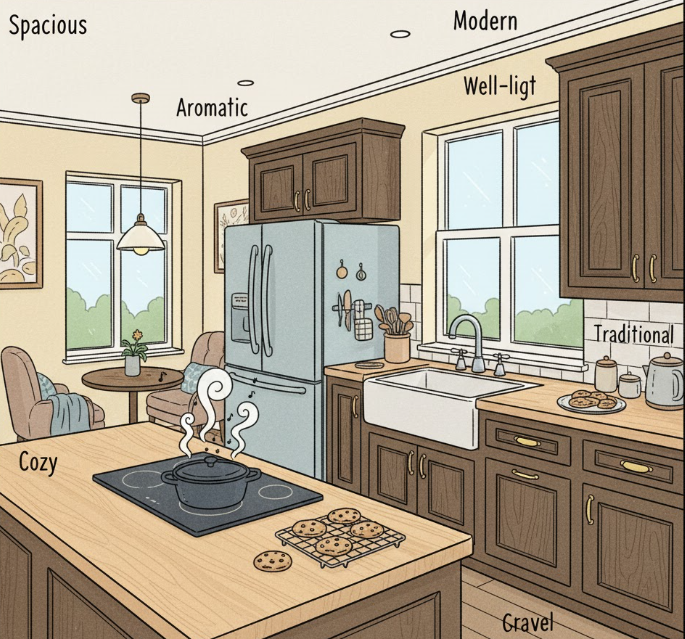
They also help to distinguish between different nouns, clarifying your meaning and preventing confusion. For instance, consider the difference between “a kitchen” and “a modern kitchen.” The adjective “modern” adds a crucial layer of information.
Adjectives can be classified based on their function and meaning. Some common classifications include:
- Descriptive Adjectives: These describe the qualities or characteristics of a noun (e.g., spacious, bright, rustic).
- Quantitative Adjectives: These indicate the quantity or amount of a noun (e.g., many, few, some).
- Demonstrative Adjectives: These point out specific nouns (e.g., this, that, these, those).
- Possessive Adjectives: These show ownership (e.g., my, your, his, her, its, our, their).
- Interrogative Adjectives: These are used to ask questions about nouns (e.g., which, what, whose).
Adjective Placement and Structure
In English, adjectives typically precede the noun they modify. This is known as the attributive position. For example, “a large kitchen” or “the stainless steel appliances.” However, adjectives can also follow a linking verb (such as be, seem, appear, become, look, feel, taste, smell, sound). This is known as the predicative position. For example, “The kitchen is clean” or “The countertops look shiny.”
When using multiple adjectives to describe a noun, there is a general order that native English speakers tend to follow, though it’s not a rigid rule. The typical order is:
- Opinion: (e.g., beautiful, ugly, delicious)
- Size: (e.g., large, small, tiny)
- Age: (e.g., old, new, ancient)
- Shape: (e.g., round, square, oval)
- Color: (e.g., red, blue, green)
- Origin: (e.g., Italian, French, American)
- Material: (e.g., wooden, metal, plastic)
- Purpose: (e.g., cooking, serving, baking)
For example, you might say “a beautiful large old square blue Italian wooden cooking table.” While this sentence sounds somewhat unnatural due to the excessive number of adjectives, it illustrates the typical order. In practice, it’s usually best to use only two or three well-chosen adjectives.
Compound adjectives are formed by combining two or more words, often with a hyphen. These can add precision and detail to your descriptions.
Examples include “state-of-the-art kitchen,” “well-equipped kitchen,” and “open-plan kitchen.”
Types of Adjectives for Describing Kitchens
There are many different types of adjectives that can be used to describe a kitchen. Here are some common categories:
Adjectives of Size
These adjectives describe the physical dimensions of the kitchen.
- Large: A kitchen with ample space.
- Small: A kitchen with limited space.
- Spacious: A kitchen that feels open and roomy.
- Compact: A kitchen that is efficiently designed to fit in a small area.
- Tiny: A very small kitchen.
- Huge: An extremely large kitchen.
- Extensive: A kitchen that covers a large area.
- Roomy: Similar to spacious, offering plenty of room.
- Narrow: A kitchen that is long and thin.
- Wide: A kitchen that is broad and expansive.
Adjectives of Color
These adjectives describe the dominant colors in the kitchen.
- White: A kitchen with primarily white surfaces.
- Black: A kitchen with primarily black surfaces.
- Gray: A kitchen with primarily gray surfaces.
- Blue: A kitchen with blue accents or features.
- Green: A kitchen with green accents or features.
- Red: A kitchen with red accents or features.
- Yellow: A kitchen with yellow accents or features.
- Beige: A kitchen with beige tones.
- Neutral: A kitchen with a palette of neutral colors.
- Colorful: A kitchen with a variety of colors.
Adjectives of Style
These adjectives describe the overall design and aesthetic of the kitchen.
- Modern: A kitchen with a contemporary design.
- Traditional: A kitchen with a classic, timeless design.
- Rustic: A kitchen with a country or farmhouse style.
- Contemporary: Similar to modern, emphasizing current trends.
- Minimalist: A kitchen with a clean, uncluttered design.
- Eclectic: A kitchen with a mix of different styles.
- Vintage: A kitchen with an old-fashioned or retro style.
- Industrial: A kitchen with a raw, utilitarian design.
- Scandinavian: A kitchen with a simple, functional, and light design.
- Mediterranean: A kitchen with warm colors and natural materials.
Adjectives of Material
These adjectives describe the materials used in the kitchen’s construction and decor.
- Wooden: A kitchen with wooden cabinets or countertops.
- Metal: A kitchen with metal appliances or fixtures.
- Stainless steel: A kitchen with stainless steel appliances.
- Granite: A kitchen with granite countertops.
- Marble: A kitchen with marble countertops or flooring.
- Tile: A kitchen with tile flooring or backsplash.
- Glass: A kitchen with glass cabinets or features.
- Concrete: A kitchen with concrete countertops or flooring.
- Laminate: A kitchen with laminate countertops or cabinets.
- Quartz: A kitchen with quartz countertops.
Adjectives of Condition
These adjectives describe the state of the kitchen.
- Clean: A kitchen that is free from dirt and clutter.
- Dirty: A kitchen that is not clean.
- New: A recently built or renovated kitchen.
- Old: A kitchen that is aged or outdated.
- Renovated: A kitchen that has been updated.
- Well-maintained: A kitchen that is kept in good condition.
- Outdated: A kitchen that is no longer modern or stylish.
- Spotless: A kitchen that is perfectly clean.
- Messy: A kitchen that is disorganized and cluttered.
- Immaculate: A kitchen that is extremely clean and tidy.
Adjectives of Functionality
These adjectives describe how well the kitchen works and its features.
- Functional: A kitchen that is practical and efficient.
- Well-equipped: A kitchen with all the necessary appliances and tools.
- Modernized: A kitchen with updated features and technology.
- Efficient: A kitchen designed for optimal workflow.
- Practical: Similar to functional, emphasizing usability.
- Organized: A kitchen that is well-arranged and easy to use.
- User-friendly: A kitchen that is easy to navigate and operate.
- State-of-the-art: A kitchen with the latest technology.
- Ergonomic: A kitchen designed for comfort and ease of use.
- Accessible: A kitchen designed to be easily used by people with disabilities.
Adjectives of Emotional Impact
These adjectives describe the feeling or atmosphere that the kitchen evokes.
- Cozy: A kitchen that feels warm and comfortable.
- Inviting: A kitchen that makes people feel welcome.
- Bright: A kitchen that is well-lit and cheerful.
- Warm: A kitchen that feels comforting and inviting.
- Cheerful: A kitchen that is bright and uplifting.
- Elegant: A kitchen that is stylish and refined.
- Sophisticated: A kitchen that is cultured and refined.
- Relaxing: A kitchen that promotes a sense of calm.
- Homely: A kitchen that feels like home.
- Serene: A kitchen that is peaceful and tranquil.
Examples of Adjectives in Use
Here are several examples of how you can use adjectives to describe kitchens, organized by category.
Adjectives of Size Examples
The following table provides examples of adjectives of size used in sentences describing kitchens.
| Sentence |
|---|
| The large kitchen was perfect for entertaining. |
| The small kitchen was efficiently designed. |
| The spacious kitchen felt open and airy. |
| The compact kitchen had everything within reach. |
| The tiny kitchen was charming despite its size. |
| Their huge kitchen included a full island and breakfast bar. |
| The extensive kitchen renovation took several months to complete. |
| The roomy kitchen allowed multiple cooks to work comfortably. |
| The narrow kitchen presented a design challenge, but it was beautifully resolved. |
| The wide kitchen was ideal for hosting large family gatherings. |
| It’s a vast kitchen, almost the size of a living room. |
| Despite being petite, the kitchen had everything I needed. |
| The restaurant’s industrial-sized kitchen was a hive of activity. |
| The oversized island dominated the kitchen. |
| The apartment had a minuscule kitchenette. |
| The generous kitchen space made cooking a pleasure. |
| The confined kitchen felt cramped and unwelcoming. |
| The mammoth kitchen was equipped with every imaginable appliance. |
| The voluminous kitchen was perfect for large-scale catering. |
| The substantial kitchen featured a walk-in pantry. |
| The palatial kitchen was fit for a king. |
| The cramped kitchen made it difficult to move around. |
| The immense kitchen was a chef’s dream. |
| The ample kitchen space allowed for a large dining table. |
| The limited kitchen space required clever storage solutions. |
Adjectives of Color Examples
The following table provides examples of adjectives of color used in sentences describing kitchens.
| Sentence |
|---|
| The white kitchen felt bright and airy. |
| The black kitchen was sleek and modern. |
| The gray kitchen had a sophisticated feel. |
| The blue kitchen cabinets added a pop of color. |
| The green kitchen was inspired by nature. |
| The red kitchen accents created a vibrant atmosphere. |
| The yellow kitchen was cheerful and sunny. |
| The beige kitchen was warm and inviting. |
| The neutral kitchen provided a calming backdrop. |
| The colorful kitchen was full of personality. |
| The cream-colored cabinets gave the kitchen a soft, elegant look. |
| The navy blue island stood out against the white countertops. |
| The charcoal grey walls provided a modern contrast. |
| The emerald green backsplash added a touch of luxury. |
| The burnt orange appliances gave the kitchen a retro vibe. |
| The pastel pink walls created a whimsical atmosphere. |
| The lavender accents softened the room’s industrial feel. |
| The terracotta tiles brought warmth to the kitchen floor. |
| The ochre cabinets complemented the rustic decor. |
| The ivory countertops reflected the light beautifully. |
| The silver hardware added a touch of glamour. |
| The bronze fixtures gave the kitchen a vintage feel. |
| The golden lighting created a warm ambiance. |
| The copper pots hung above the stove, adding character. |
| The jet black appliances looked sleek and modern. |
Adjectives of Style Examples
The following table provides examples of adjectives of style used in sentences describing kitchens.
| Sentence |
|---|
| The modern kitchen featured sleek lines and minimalist design. |
| The traditional kitchen had classic cabinets and a farmhouse sink. |
| The rustic kitchen was filled with natural wood and stone. |
| The contemporary kitchen incorporated the latest trends and technologies. |
| The minimalist kitchen was clean and uncluttered. |
| The eclectic kitchen blended different styles seamlessly. |
| The vintage kitchen was charming and nostalgic. |
| The industrial kitchen had exposed brick and metal accents. |
| The Scandinavian kitchen was simple, functional, and bright. |
| The Mediterranean kitchen featured warm colors and natural textures. |
| The country-style kitchen had a cozy, welcoming feel. |
| The farmhouse kitchen was the heart of the home. |
| The cottage kitchen had a charming, quaint appeal. |
| The transitional kitchen blended traditional and modern elements. |
| The Art Deco kitchen was glamorous and sophisticated. |
| The Bohemian kitchen was colorful and free-spirited. |
| The French country kitchen had a romantic, rustic charm. |
| The Tuscan kitchen featured warm earth tones and natural materials. |
| The coastal kitchen had a light, airy, beachy feel. |
| The Asian-inspired kitchen was serene and minimalist. |
| The mid-century modern kitchen was stylish and retro. |
| The Hollywood Regency kitchen was opulent and luxurious. |
| The Spanish kitchen featured terracotta tiles and wrought iron accents. |
| The Southwestern kitchen had a warm, earthy vibe. |
| The Victorian kitchen was ornate and detailed. |
Usage Rules for Adjectives
Using adjectives correctly involves understanding a few key rules:
- Placement: As mentioned earlier, adjectives generally come before the noun they modify (attributive) or after a linking verb (predicative).
- Agreement: Adjectives do not change form based on the number or gender of the noun they modify in English.
- Order: When using multiple adjectives, follow the general order of opinion, size, age, shape, color, origin, material, and purpose.
- Commas: Use commas to separate coordinate adjectives (adjectives that independently modify the noun) if they can be joined by “and.” For example, “a clean, modern kitchen.” Do not use a comma if the adjectives are not coordinate, such as “a small wooden table.”
- Hyphens: Use hyphens in compound adjectives that come before the noun. For example, “a well-equipped kitchen.”
Common Mistakes with Adjectives
Here are some common mistakes to avoid when using adjectives:
| Incorrect | Correct | Explanation |
|---|---|---|
| The kitchen is clean and spacious. | The kitchen is clean and spacious. | This sentence is already correct. Adjectives are used correctly after the linking verb “is”. |
| A wooden small table. | A small wooden table. | Incorrect order of adjectives. Size usually comes before material. |
| A well equiped kitchen. | A well-equipped kitchen. | Missing hyphen in the compound adjective “well-equipped.” |
| The clean, modern kitchen. | The clean modern kitchen. | Since clean and modern are not coordinate adjectives (they don’t independently modify kitchen in the same way), no comma is needed. |
| The kitchen new. | The new kitchen. | Incorrect placement of the adjective before the noun. |
Practice Exercises
Test your understanding of adjectives with these practice exercises.
Exercise 1: Identifying Adjectives
Identify the adjectives in the following sentences.
| Question | Answer |
|---|---|
| 1. The bright kitchen was a joy to cook in. | 1. bright |
| 2. The small, functional kitchen had everything I needed. | 2. small, functional |
| 3. The renovated kitchen featured granite countertops. | 3. renovated, granite |
| 4. The modern kitchen appliances were state-of-the-art. | 4. modern, state-of-the-art |
| 5. The cozy kitchen was perfect for family meals. | 5. cozy |
| 6. The wooden table was old and worn. | 6. wooden, old, worn |
| 7. The colorful kitchen was full of personality. | 7. colorful |
| 8. The spacious kitchen felt open and airy. | 8. spacious |
| 9. The new tile floor was easy to clean. | 9. new, tile |
| 10. The stainless steel appliances were sleek and modern. | 10. stainless steel, sleek, modern |
Exercise 2: Filling in the Blanks
Fill in the blanks with appropriate adjectives to describe the kitchen.
| Question | Answer |
|---|---|
| 1. The kitchen had _________ cabinets and _________ countertops. | 1. wooden, granite (Answers may vary) |
| 2. The _________ kitchen was perfect for a _________ family. | 2. cozy, small (Answers may vary) |
| 3. The _________ appliances added a _________ touch to the kitchen. | 3. stainless steel, modern (Answers may vary) |
| 4. The _________ kitchen felt _________ and inviting. | 4. bright, warm (Answers may vary) |
| 5. The _________ island was the centerpiece of the _________ kitchen. | 5. large, spacious (Answers may vary) |
| 6. The _________ style kitchen reminded me of my grandma’s _________ house. | 6. rustic, old (Answers may vary) |
| 7. The _________ kitchen was so _________ that it was hard to move around. | 7. small, cramped (Answers may vary) |
| 8. The chef loved his _________ kitchen with its _________ equipment. | 8. functional, modern (Answers may vary) |
| 9. The couple remodeled their _________ kitchen into a _________ dream. | 9. outdated, modern (Answers may vary) |
| 10. The _________ cabinets and _________ backsplash gave the kitchen a unique look. | 10. colorful, tile (Answers may vary) |
Exercise 3: Correcting Mistakes
Identify and correct the mistakes in the following sentences.
| Question | Answer |
|---|---|
| 1. A big, wooden old table. | 1. An old, big wooden table. |
| 2. The kitchen is clean and tidy. | 2. The kitchen is clean and tidy. (Correct) |
| 3. A well equiped kitchen. | 3. A well-equipped kitchen. |
| 4. She has a modern state of the art kitchen. | 4. She has a state-of-the-art modern kitchen. |
| 5. The kitchen new was beautiful. | 5. The new kitchen was beautiful. |
| 6. That island is big and rectangular. | 6. That island is big and rectangular. (Correct) |
| 7. The kitchen is small, but functional. | 7. The kitchen is small, but functional. (Correct) |
| 8. A stainless steel shiny appliance. | 8. A shiny stainless steel appliance. |
| 9. The kitchen is spotless, and clean. | 9. The kitchen is spotless and clean. |
| 10. They bought a nice new dinning table. | 10. They bought a nice new dining table. |
Advanced Topics: Intensifiers and Compound Adjectives
For advanced learners, mastering intensifiers and compound adjectives can significantly enhance descriptive abilities.
Intensifiers are words that strengthen the meaning of an adjective. Common intensifiers include very, extremely, incredibly, really, and absolutely. For example, “The kitchen was extremely spacious” or “The countertops were absolutely spotless.” Using intensifiers effectively can add emphasis and nuance to your descriptions.
Compound Adjectives, as mentioned earlier, are formed by combining two or more words, often with a hyphen. These can create more specific and descriptive phrases. Examples include:
- Open-plan: “The open-plan kitchen flowed seamlessly into the living room.”
- State-of-the-art: “The state-of-the-art kitchen was a chef’s dream.”
- Well-lit: “The well-lit kitchen made cooking a pleasure.”
- Hand-painted: “The hand-painted tiles added a unique touch to the kitchen.”
- Custom-built: “The custom-built cabinets provided ample storage space.”
Using intensifiers and compound adjectives correctly can elevate your descriptive writing and speaking, allowing you to communicate more precisely and effectively.
Frequently Asked Questions
- What is the difference between an adjective and an adverb?Adjectives modify nouns or pronouns, while adverbs modify verbs, adjectives, or other adverbs. For example, in the sentence “The kitchen is beautiful,” beautiful is an adjective describing the noun kitchen. In the sentence “She cooks quickly,” quickly is an adverb describing the verb cooks.
- Can a noun be used as an adjective?Yes, nouns can sometimes function as adjectives. These are called attributive nouns or noun adjuncts. For example, in the phrase “kitchen table,” the noun kitchen is used as an adjective to describe the type of table.
- How do I choose the best adjectives to describe a kitchen?Consider the key features, style, condition, and atmosphere of the kitchen. Think about what makes it unique and choose adjectives that accurately and vividly convey those qualities. Use a thesaurus to find synonyms and expand your vocabulary.
- Is there a limit to how many adjectives I can use in a sentence?While there is no strict limit, using too many adjectives can make your writing cumbersome and difficult to read. It’s generally best to use only two or three well-chosen adjectives to describe a noun effectively.
- How can I improve my adjective vocabulary?Read widely, pay attention to how adjectives are used in different contexts, and make a habit of looking up unfamiliar words. Practice using new adjectives in your own writing and speaking.
- What are some alternatives to using multiple adjectives?Instead of using multiple adjectives, consider using more descriptive verbs or adverbs. You can also use figurative language, such as metaphors and similes, to create a more vivid impression.
- How do I know if I’m using adjectives correctly?Pay attention to the placement and order of adjectives, and make sure they agree with the nouns they modify. Use a grammar checker or ask a native speaker to review your writing.
- What is the role of adjectives in creative writing?Adjectives play a crucial role in creative writing by adding detail, depth, and emotional resonance to your descriptions. They help to create a vivid and engaging experience for the reader.
Conclusion
Mastering the use of adjectives is crucial for effectively describing kitchens and enhancing your overall communication skills in English. By understanding the different types of adjectives, their placement, and the rules governing their usage, you can paint vivid and accurate pictures of any culinary space.
Remember to practice regularly, pay attention to common mistakes, and continually expand your vocabulary.
With a solid grasp of adjectives, you can confidently describe kitchens in detail, whether you’re writing a blog post, engaging in conversation, or simply admiring a beautiful kitchen design. Keep exploring, practicing, and refining your skills to unlock the full potential of adjectives in your English language journey.
Remember, the key to success is consistent effort and a willingness to learn from your mistakes. Happy describing!