
Laughter, a universal expression of joy and amusement, is described using a rich variety of adjectives that add depth and nuance to our communication. Understanding these adjectives enhances our ability to convey specific types of laughter, from a gentle chuckle to a boisterous guffaw.
This article provides a comprehensive guide to adjectives for laughter, exploring their definitions, usage, and structural elements. This guide is beneficial for English language learners, writers, and anyone looking to improve their descriptive vocabulary.
Table of Contents
- Introduction
- Definition of Adjectives for Laughter
- Structural Breakdown
- Types of Adjectives for Laughter
- Examples of Adjectives for Laughter
- Usage Rules
- Common Mistakes
- Practice Exercises
- Advanced Topics
- FAQ
- Conclusion
Introduction
Laughter is a fundamental human expression, and the English language provides a multitude of adjectives to describe its various forms. From quiet, suppressed giggles to loud, unrestrained roars, laughter can convey a wide range of emotions and intensities.
Mastering the use of adjectives to describe laughter allows for more precise and vivid communication, enriching both writing and speech. This article is designed to provide a thorough understanding of these adjectives, empowering learners to use them effectively and creatively.
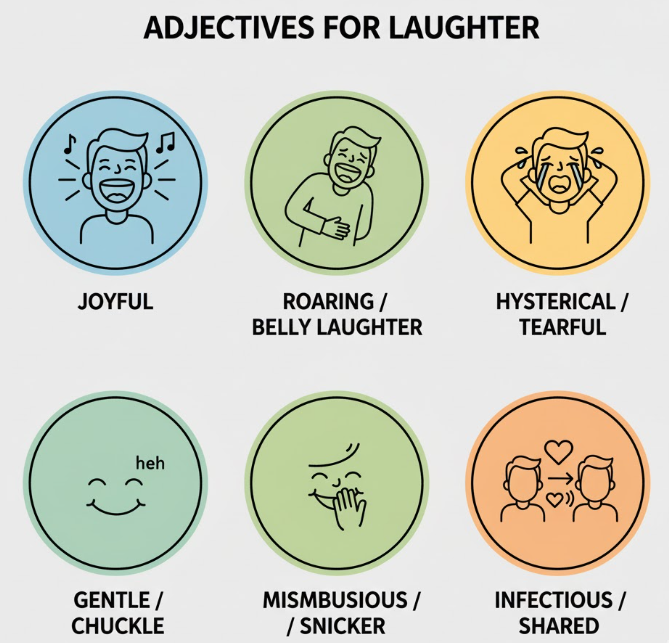
Definition of Adjectives for Laughter
Adjectives for laughter are words that modify nouns or pronouns to describe the characteristics, intensity, or emotional tone of laughter. They provide specific details about the sound, appearance, and feeling associated with laughter, enhancing the reader’s or listener’s understanding.
These adjectives can be classified based on various criteria, including their descriptive nature, the intensity they convey, the emotions they express, and the sounds they mimic.
Classification: Adjectives for laughter can be classified into several categories, including descriptive, intensity-related, emotional, and sound-related adjectives. Each category highlights a different aspect of laughter, allowing for a nuanced and detailed description.
Function: The primary function of these adjectives is to add detail and specificity to the description of laughter. They help to paint a clearer picture of the laughter in question, making it easier for the audience to visualize and understand the context and emotions involved.
Contexts: Adjectives for laughter are used in a variety of contexts, including literature, everyday conversation, and academic writing. They are particularly important in creative writing, where vivid descriptions are essential for engaging the reader.
Structural Breakdown
The structure of phrases using adjectives for laughter typically follows a simple pattern: adjective + noun (laughter). However, these adjectives can also be part of more complex sentences, providing additional context and detail.
Understanding the structural elements helps in constructing grammatically correct and meaningful sentences.
Basic Structure: The most basic structure is adjective + laughter. For example: hearty laughter, nervous laughter, infectious laughter.
Expanded Structure: The basic structure can be expanded with additional elements, such as adverbs modifying the adjective or prepositional phrases providing further context. For example: genuinely hearty laughter, a bout of nervous laughter, laughter infectious to everyone in the room.
Sentence Integration: Adjectives for laughter can be integrated into sentences in various ways, serving as either attributive or predicative adjectives. Attributive adjectives precede the noun, while predicative adjectives follow a linking verb.
- Attributive: His boisterous laughter filled the room.
- Predicative: The laughter was infectious.
Types of Adjectives for Laughter
Adjectives for laughter can be categorized based on the aspect of laughter they describe. These categories include descriptive, intensity, emotional, and sound adjectives.
Descriptive Adjectives
Descriptive adjectives provide general information about the characteristics of laughter. They paint a picture of what the laughter is like, without necessarily focusing on its intensity or the emotions behind it. Examples include: genuine, forced, awkward, polite.
Intensity Adjectives
Intensity adjectives describe the strength or volume of laughter. They indicate how loud or forceful the laughter is. Examples include: loud, quiet, hearty, raucous, unrestrained, explosive.
Emotional Adjectives
Emotional adjectives reveal the underlying emotions associated with laughter. They provide insight into why someone is laughing and what they are feeling. Examples include: nervous, joyful, bitter, hysterical, malicious, gleeful.
Sound Adjectives
Sound adjectives mimic the sounds of laughter, often using onomatopoeia or descriptive terms related to sound. They focus on the auditory aspect of laughter. Examples include: giggling, chuckling, roaring, guffawing, snorting, tittering.
Examples of Adjectives for Laughter
The following tables provide examples of adjectives for laughter, categorized by type. Each table includes a variety of adjectives with example sentences to illustrate their usage.
Descriptive Adjectives Examples
This table presents examples of descriptive adjectives used to describe laughter, providing a general sense of its characteristics.
| Adjective | Example Sentence |
|---|---|
| Genuine | Her genuine laughter made everyone feel at ease. |
| Forced | His forced laughter didn’t quite reach his eyes. |
| Awkward | There was an awkward laughter after the inappropriate joke. |
| Polite | She gave a polite laughter to acknowledge his comment. |
| Brief | A brief laughter escaped her lips before she regained composure. |
| Prolonged | The movie was so funny it induced prolonged laughter from the audience. |
| Warm | His warm laughter was comforting and inviting. |
| Dry | A dry laughter indicated his skepticism. |
| Sudden | A sudden laughter erupted from the corner of the room. |
| Controlled | She offered a controlled laughter, mindful of the quiet environment. |
| Heartfelt | His heartfelt laughter resonated with everyone present. |
| Playful | Their playful laughter filled the park as they chased each other. |
| Sincere | Her sincere laughter was a welcome sound after a long day. |
| Artificial | The celebrity’s artificial laughter seemed rehearsed and insincere. |
| Spontaneous | A wave of spontaneous laughter swept through the crowd. |
| Quiet | She offered a quiet laughter so as not to disturb the sleeping baby. |
| Loud | His loud laughter drew attention from across the room. |
| Infected | Her infected laughter encouraged everyone else to laugh. |
| Wholehearted | His wholehearted laughter reflected his pure joy. |
| Suppressed | She gave a suppressed laughter in an attempt to remain serious. |
| Unrestrained | Their unrestrained laughter echoed through the halls. |
| Gentle | She offered a gentle laughter as she listened to the story. |
| Deep | His deep laughter was a sign of true enjoyment. |
| Light | A light laughter punctuated their conversation. |
| Melodious | Her melodious laughter was pleasing to hear. |
| Musical | His musical laughter brought joy to everyone around. |
Intensity Adjectives Examples
This table provides examples of intensity adjectives used to describe the strength or volume of laughter.
| Adjective | Example Sentence |
|---|---|
| Loud | His loud laughter echoed through the hallway. |
| Quiet | She gave a quiet laughter so as not to disturb others. |
| Hearty | They shared a hearty laughter over old memories. |
| Raucous | The bar was filled with raucous laughter on Friday night. |
| Unrestrained | Their unrestrained laughter showed how much fun they were having. |
| Explosive | An explosive laughter burst from him when he heard the punchline. |
| Boisterous | The children’s boisterous laughter filled the playground. |
| Subdued | A subdued laughter came from the corner of the room. |
| Muffled | Her muffled laughter indicated she was trying to suppress it. |
| Resonant | His resonant laughter filled the room with warmth. |
| Thundering | A thundering laughter erupted from the audience during the comedy show. |
| Feeble | A feeble laughter was all she could muster in her weakened state. |
| Robust | His robust laughter was contagious and infectious. |
| Gentle | A gentle laughter accompanied her kind words. |
| Faint | A faint laughter reached her ears from the neighboring room. |
| Vigorous | His vigorous laughter showed genuine amusement and joy. |
| Powerful | His powerful laughter could be heard from across the room. |
| Soft | A soft laughter escaped her lips as she read the book. |
| Weak | A weak laughter was all that he could manage. |
| Deafening | The comedian was met with deafening laughter after the punchline. |
| Shrill | A shrill laughter pierced the silence of the room. |
| Restrained | She offered a restrained laughter, mindful of the formal setting. |
| Full-throated | His full-throated laughter was a sign of pure joy. |
| Tremulous | A tremulous laughter betrayed her nervousness. |
| Voluminous | His voluminous laughter filled the stadium. |
Emotional Adjectives Examples
This table showcases emotional adjectives that describe the feelings associated with laughter.
| Adjective | Example Sentence |
|---|---|
| Nervous | His nervous laughter betrayed his anxiety. |
| Joyful | Her joyful laughter was a delight to hear. |
| Bitter | A bitter laughter revealed his resentment. |
| Hysterical | She was overcome with hysterical laughter. |
| Malicious | His malicious laughter sent shivers down her spine. |
| Gleeful | Their gleeful laughter indicated they were up to something. |
| Amused | An amused laughter escaped his lips as he watched the scene. |
| Sardonic | A sardonic laughter revealed his cynical outlook. |
| Mocking | His mocking laughter was intended to humiliate her. |
| Contemptuous | A contemptuous laughter dripped with disdain. |
| Cynical | His cynical laughter reflected his distrust of others. |
| Relieved | A relieved laughter followed after the stressful situation. |
| Guilty | A guilty laughter suggested he knew more than he was letting on. |
| Happy | Her happy laughter was infectious and cheerful. |
| Teasing | Their teasing laughter was all in good fun. |
| Delighted | Her delighted laughter showed her genuine pleasure. |
| Comfortable | A comfortable laughter indicated they were at ease with each other. |
| Insecure | An insecure laughter hinted at her self-doubt. |
| Whimsical | Their whimsical laughter filled the air with joy. |
| Forlorn | A forlorn laughter betrayed her disappointment. |
| Cheerful | Her cheerful laughter brightened the room. |
| Anxious | His anxious laughter revealed his underlying worries. |
| Silly | Their silly laughter was carefree and lighthearted. |
| Merry | A merry laughter echoed through the holiday party. |
| Grinning | His grinning laughter signified his mischievous nature. |
Sound Adjectives Examples
This table presents examples of sound adjectives that mimic or describe the sounds of laughter.
| Adjective | Example Sentence |
|---|---|
| Giggling | The girls were giggling over a silly joke. |
| Chuckling | He was chuckling to himself as he read the book. |
| Roaring | The audience erupted in roaring laughter. |
| Guffawing | He was guffawing at the comedian’s jokes. |
| Snorting | He couldn’t help snorting with laughter at the absurdity of the situation. |
| Tittering | The children were tittering in the back of the classroom. |
| Cackling | The witch’s cackling laughter echoed through the forest. |
| Chortling | He was chortling with amusement at the prank. |
| Hooting | The students were hooting with laughter at the teacher’s blunder. |
| Belly | His belly laughter was loud and infectious. |
| Throaty | Her throaty laughter was deep and resonant. |
| High-pitched | A high-pitched laughter pierced the air with a sense of excitement. |
| Rumbling | His rumbling laughter shook his entire body. |
| Squeaky | Her squeaky laughter was almost like a bird chirping. |
| Silvery | A silvery laughter rang out, light and pleasing. |
| Hollow | A hollow laughter echoed in the empty hall. |
| Maniacal | His maniacal laughter suggested a descent into madness. |
| Snickering | They were snickering behind his back. |
| Gurgling | Her gurgling laughter was bubbly and infectious. |
| Ringing | Her ringing laughter echoed through the halls. |
| Whinnying | His whinnying laughter sounded like a horse. |
| Barking | His barking laughter was loud and abrupt. |
| Screeching | A screeching laughter cut through the room. |
| Whistling | His whistling laughter was peculiar and unique. |
Usage Rules
Using adjectives for laughter correctly involves understanding their specific meanings and contexts. While many adjectives can be used interchangeably, others have subtle differences that can significantly alter the meaning of a sentence.
Following these usage rules helps ensure clarity and precision in communication.
Agreement: Adjectives must agree in number and gender with the noun they modify. However, in English, adjectives do not change based on the noun’s number or gender.
Placement: Adjectives typically precede the noun they modify (attributive position). However, they can also follow a linking verb (predicative position). For example:
- Attributive: The joyful laughter filled the room.
- Predicative: The laughter was joyful.
Combining Adjectives: When using multiple adjectives to describe laughter, follow the general order of adjectives: opinion, size, age, shape, color, origin, material, and purpose. For example: the loud, hearty laughter.
Contextual Appropriateness: Choose adjectives that are appropriate for the context. For example, “hysterical laughter” might be appropriate in a dramatic scene but not in a formal business setting.
Common Mistakes
Learners often make mistakes when using adjectives for laughter due to a lack of understanding of their specific meanings or incorrect application of grammatical rules. Being aware of these common mistakes can help avoid errors and improve accuracy.
Incorrect Adjective Choice: Using an adjective that doesn’t accurately describe the laughter.
- Incorrect: His sad laughter echoed in the room.
- Correct: His bitter laughter echoed in the room.
Misplaced Adjectives: Placing the adjective in an awkward or grammatically incorrect position.
- Incorrect: Laughter loud filled the room.
- Correct: Loud laughter filled the room.
Redundant Adjectives: Using adjectives that convey the same meaning.
- Incorrect: The joyful, happy laughter resonated.
- Correct: The joyful laughter resonated.
Inappropriate Tone: Using an adjective that doesn’t match the tone of the sentence or context.
- Incorrect: The formal meeting was filled with hysterical laughter.
- Correct: The formal meeting was punctuated by polite laughter.
Practice Exercises
The following exercises will help you practice using adjectives for laughter correctly. Choose the best adjective to complete each sentence.
Exercise 1: Fill in the Blanks
| Question | Answer |
|---|---|
| 1. Her ______ laughter made everyone feel comfortable. (nervous, joyful) | joyful |
| 2. The comedian was met with ______ laughter after the punchline. (quiet, roaring) | roaring |
| 3. His ______ laughter suggested he was hiding something. (guilty, sincere) | guilty |
| 4. A ______ laughter escaped her lips as she read the book. (soft, loud) | soft |
| 5. The children’s ______ laughter filled the playground. (subdued, boisterous) | boisterous |
| 6. Their ______ laughter was all in good fun. (teasing, malicious) | teasing |
| 7. A ______ laughter revealed his resentment. (bitter, happy) | bitter |
| 8. The witch’s ______ laughter echoed through the forest. (giggling, cackling) | cackling |
| 9. His ______ laughter was a sign of true enjoyment. (deep, shallow) | deep |
| 10. She gave a ______ laughter to acknowledge his comment. (polite, awkward) | polite |
Exercise 2: Sentence Completion
Complete each sentence using an appropriate adjective for laughter.
| Question | Answer |
|---|---|
| 1. After hearing the ridiculous joke, he burst into ______ laughter. | unrestrained |
| 2. Her ______ laughter made the atmosphere in the room lighter. | cheerful |
| 3. The ______ laughter of children playing filled the park. | joyful |
| 4. Despite the tension, a ______ laughter escaped her. | nervous |
| 5. His ______ laughter suggested he was up to no good. | mischievous |
| 6. The ______ laughter of the audience showed they enjoyed the performance. | hearty |
| 7. She tried to hide her amusement, but a ______ laughter betrayed her. | suppressed |
| 8. His ______ laughter was like music to her ears. | melodious |
| 9. The ______ laughter of the villain sent chills down everyone’s spines. | malicious |
| 10. After the long day, their ______ laughter showed they were finally relaxing. | comfortable |
Advanced Topics
For advanced learners, exploring the nuances of adjectives for laughter can involve understanding their figurative use and their role in creating specific literary effects. This includes analyzing how authors use these adjectives to convey character emotions, set the tone of a scene, and create vivid imagery.
Figurative Language: Adjectives for laughter can be used metaphorically to describe non-literal laughter, such as the “laughter of the wind” or the “laughter of the waves.” These uses add depth and complexity to writing, creating evocative imagery.
Literary Devices: Authors often use adjectives for laughter to develop characters and themes. For example, a character whose laughter is consistently described as “bitter” or “forced” might be portrayed as unhappy or untrustworthy.
Cultural Context: The interpretation of laughter and its associated adjectives can vary across cultures. Understanding these cultural differences is important for avoiding miscommunications and appreciating the diversity of human expression.
FAQ
This section addresses frequently asked questions about adjectives for laughter.
Q1: What is the difference between “giggling” and “chuckling”?
A1: “Giggling” refers to a series of light, often suppressed, sounds expressing amusement or nervousness. “Chuckling” is a quiet, contained laughter, often expressing satisfaction or amusement. Giggling is usually high-pitched and associated with youthful or silly amusement, while chuckling is a more mature, subdued form of laughter.
Q2: Can an adjective for laughter also be a verb?
A2: Yes, many adjectives that describe sounds of laughter, such as “giggling,” “chuckling,” “roaring,” and “snorting,” can also be used as verbs. The verb form describes the act of producing that particular sound of laughter.
Q3: How do I choose the right adjective for laughter?
A3: Consider the context, the emotions involved, and the specific sound or characteristic of the laughter you want to describe. Think about the situation, the person laughing, and the overall tone you want to convey.
Q4: Is it possible to use too many adjectives to describe laughter?
A4: Yes, using too many adjectives can make your writing sound cluttered and awkward. Choose the most relevant and descriptive adjectives to avoid redundancy and maintain clarity.
Q5: Are there any adjectives for laughter that should be avoided?
A5: Avoid using adjectives that are offensive, insensitive, or that could be misinterpreted. Also, be cautious with adjectives that might perpetuate stereotypes or reinforce negative connotations.
Q6: Can I create new adjectives for laughter?
A6: While you can create new adjectives, ensure they are easily understood and appropriate for the context. Neologisms (newly coined words) can be effective if used sparingly and with clear intent.
Q7: What is the difference between “hearty” and “boisterous” laughter?
A7: “Hearty” laughter is genuine, full-bodied, and often expresses sincere enjoyment. “Boisterous” laughter is loud, energetic, and often unrestrained, sometimes bordering on rowdy or exuberant. Hearty laughter emphasizes the genuineness, while boisterous laughter emphasizes the energy and volume.
Q8: How can I improve my vocabulary of adjectives for laughter?
A8: Read widely, paying attention to how authors describe laughter. Use a thesaurus to explore synonyms and related terms. Practice using different adjectives in your own writing and speaking to become more comfortable with their meanings and usages.
Conclusion
Mastering the use of adjectives for laughter is essential for effective communication and descriptive writing. By understanding the different types of adjectives, their structural elements, and usage rules, learners can enhance their ability to convey specific emotions, intensities, and characteristics of laughter.
Remember to practice using these adjectives in various contexts to improve fluency and accuracy. Continue to expand your vocabulary and pay attention to how skilled writers use these adjectives to create vivid and engaging narratives.