Understanding how to accurately describe a lie involves more than just calling it “wrong.” The English language offers a rich variety of adjectives that capture the nuances of deceit, from harmless fibs to malicious fabrications. Mastering these adjectives allows for more precise communication, enabling you to express the severity, intent, and impact of a lie with greater clarity.
This comprehensive guide explores the diverse vocabulary available to describe lies, providing definitions, examples, and practice exercises to enhance your understanding and usage.
This article is designed for English language learners, writers, and anyone seeking to improve their descriptive abilities. Whether you’re crafting compelling narratives, analyzing complex situations, or simply aiming for more precise communication, this guide will equip you with the tools to effectively describe the multifaceted nature of lies and deception.
Table of Contents
- Introduction
- Defining Lies: The Role of Adjectives
- Structural Breakdown: Adjectives and Their Usage
- Types and Categories of Lies
- Examples of Adjectives for Lies
- Usage Rules for Adjectives Describing Lies
- Common Mistakes to Avoid
- Practice Exercises
- Advanced Topics: Nuances and Subtleties
- Frequently Asked Questions
- Conclusion
Defining Lies: The Role of Adjectives
A lie is a statement made with the intention to deceive. It’s a deliberate act of dishonesty, where the speaker knows the information presented is false or misleading.
Adjectives play a crucial role in elaborating on the nature of a lie, providing details about its intent, severity, and impact. They transform a simple declaration of “it was a lie” into a nuanced description that conveys deeper meaning.
Adjectives modify the noun “lie,” adding layers of information. They can describe the lie’s purpose (e.g., a benevolent lie), its impact (e.g., a devastating lie), or its inherent quality (e.g., a blatant lie). Understanding the different types of adjectives and their connotations is essential for effective communication.
Consider the difference between saying “He told a lie” versus “He told a malicious lie.” The addition of the adjective “malicious” immediately communicates the harmful intent behind the lie, adding a significant layer of understanding.
Structural Breakdown: Adjectives and Their Usage
Adjectives typically precede the noun they modify. In the case of describing lies, the adjective will usually come before the word “lie” or a synonym like “fabrication,” “deception,” or “falsehood.” However, adjectives can also follow a linking verb (such as *is*, *was*, *seems*, *appears*) to describe the lie indirectly.
Attributive Position: The adjective directly precedes the noun.
Example: “He told a white lie.” (White directly modifies lie)
Predicative Position: The adjective follows a linking verb and describes the noun.
Example: “The lie was outrageous.” (Outrageous describes lie and follows the linking verb *was*)
Understanding this structural difference allows for flexibility in sentence construction and stylistic variation. While the attributive position is more common, the predicative position can be useful for emphasis or to create a more descriptive sentence.
Types and Categories of Lies
Lies can be categorized in various ways depending on the criteria used for classification. Here, we will explore three common categorization methods: based on intent, based on awareness, and based on severity.
Intentional Lies
Intentional lies are those that are consciously and deliberately told with the intent to deceive. The speaker is fully aware that what they are saying is untrue and aims to mislead the listener.
Common adjectives to describe intentional lies include:
- Deliberate: A lie told intentionally and with careful consideration.
- Calculated: A lie that is planned and designed to achieve a specific outcome.
- Premeditated: Similar to calculated, implying a lie that was thought out in advance.
- Purposeful: A lie told with a specific goal or intention in mind.
- Willful: A lie told stubbornly and intentionally, despite knowing it’s wrong.
Unintentional Lies
Unintentional lies, also known as falsehoods or inaccuracies, occur when someone unknowingly provides false information. These are not driven by a deceptive intent but rather stem from mistakes, misunderstandings, or lack of awareness.
Adjectives to describe unintentional lies include:
- Inadvertent: A lie told unintentionally or without realizing it.
- Unknowing: A lie that is told without awareness of its falsity.
- Accidental: A lie that happens by chance or without intention.
- Unintentional: A general term for a lie that was not meant to deceive.
- Mistaken: A lie based on a misunderstanding or error.
Severity-Based Lies
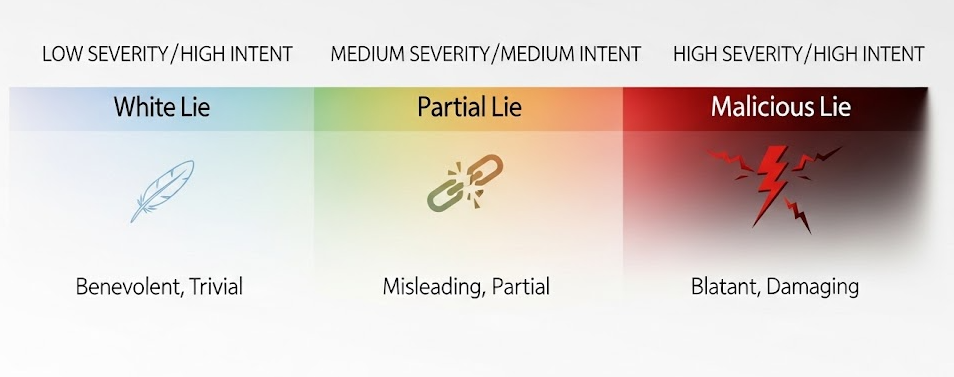
Lies can also be categorized based on their impact and the degree of harm they cause. This categorization ranges from relatively harmless lies to those that have severe and devastating consequences.
Adjectives to describe lies based on their severity include:
- White: A harmless or trivial lie, often told to avoid hurting someone’s feelings.
- Small: A relatively insignificant lie.
- Trivial: Similar to white, emphasizing the lack of importance.
- Significant: A lie that carries some weight or consequence.
- Serious: A lie that has potentially harmful or damaging effects.
- Grave: A very serious or critical lie.
- Devastating: A lie that causes immense harm or destruction.
- Catastrophic: A lie that leads to a disaster or major calamity.
Examples of Adjectives for Lies
This section provides extensive examples of adjectives used to describe lies, categorized for clarity. Each table offers a range of options with contextual sentences to illustrate their usage.
The following table focuses on adjectives describing the nature and quality of lies.
| Adjective | Example Sentence |
|---|---|
| Blatant | His excuse was a blatant lie, easily disproven by the evidence. |
| Barefaced | She told a barefaced lie without even flinching. |
| Complete | The story he presented was a complete lie from beginning to end. |
| Outright | It was an outright lie, a complete fabrication of the truth. |
| Deliberate | The deliberate lie was intended to mislead the investigators. |
| Bold | It was a bold lie, considering how easily it could be checked. |
| Audacious | The audacious lie was so unbelievable, it almost worked. |
| Fabricated | The evidence presented was completely fabricated, designed to deceive. |
| False | The claim he made was demonstrably false. |
| Untrue | The statement was simply untrue. |
| Erroneous | Due to a misunderstanding, he provided erroneous information. |
| Misleading | The advertisement contained misleading claims about the product’s capabilities. |
| Deceptive | Her smile hid a deceptive nature. |
| Perfidious | The perfidious lie betrayed the trust of his closest allies. |
| Treacherous | The treacherous lie led to the downfall of the entire organization. |
| Artful | The con artist told an artful lie, carefully constructed to exploit the victim’s weaknesses. |
| Cunning | With a cunning lie, he managed to evade suspicion. |
| Crafty | The spy used a crafty lie to gain access to the secret documents. |
| Ingenious | His ingenious lie was so complex, it took years to unravel. |
| Inventive | The child told an inventive lie about why he was late for school. |
This table focuses on adjectives that describe the impact and consequences of lies.
| Adjective | Example Sentence |
|---|---|
| Damaging | The damaging lie ruined his reputation. |
| Harmful | The harmful lie caused irreparable damage to their relationship. |
| Devastating | The devastating lie shattered her world. |
| Catastrophic | The catastrophic lie led to the company’s bankruptcy. |
| Innocuous | It seemed like an innocuous lie at the time, but it had unforeseen consequences. |
| Consequential | The consequential lie had a significant impact on the election results. |
| Significant | The significant lie altered the course of history. |
| Minor | It was only a minor lie, but it still eroded trust. |
| Petty | The petty lie was hardly worth the trouble it caused. |
| Trivial | The trivial lie was quickly forgotten. |
| Far-reaching | The far-reaching lie affected communities across the nation. |
| Wide-spread | The wide-spread lie caused panic amongst the public. |
| Impactful | The impactful lie changed the way the company operated. |
| Momentous | The momentous lie altered the political landscape. |
| Substantial | The substantial lie cost the company millions of dollars. |
| Serious | The serious lie put many people’s lives at risk. |
| Grave | The grave lie had international repercussions. |
| Critical | The critical lie jeopardized the entire mission. |
| Dire | The dire lie led to a state of emergency. |
| Direful | The direful lie brought about the downfall of the kingdom. |
This table focuses on adjectives that describe the intent and motivation behind lies.
| Adjective | Example Sentence |
|---|---|
| Benevolent | It was a benevolent lie, told to spare her feelings. |
| Malicious | The malicious lie was intended to destroy his career. |
| Self-serving | The self-serving lie was designed to benefit him alone. |
| Protective | It was a protective lie, meant to shield her from harm. |
| Defensive | The defensive lie was an attempt to avoid punishment. |
| Evasive | His response was an evasive lie, designed to avoid the question. |
| Calculated | The calculated lie was part of a larger scheme. |
| Premeditated | The premeditated lie was carefully planned in advance. |
| Opportunistic | The opportunistic lie was used to take advantage of the situation. |
| Strategic | The strategic lie was a key component of their plan. |
| Expedient | The expedient lie was the easiest way to resolve the immediate problem. |
| Tactical | The tactical lie was used to gain a short-term advantage. |
| Insidious | The insidious lie slowly poisoned their relationship. |
| Evil | The evil lie was motivated by pure malice. |
| Vicious | The vicious lie was deliberately cruel and hurtful. |
| Spiteful | The spiteful lie was told out of pure resentment. |
| Vindictive | The vindictive lie was an act of revenge. |
| Retaliatory | The retaliatory lie was a response to a previous offense. |
| Deceitful | His deceitful lie was intended to manipulate her emotions. |
| Duplicitous | The duplicitous lie masked his true intentions. |
This table focuses on adjectives that describe the degree of truth in lies.
| Adjective | Example Sentence |
|---|---|
| Partial | It was a partial lie; some parts of the story were true. |
| Half-truth | The statement was a half-truth, carefully omitting key details. |
| Exaggerated | The story was an exaggerated lie, blown out of proportion. |
| Understated | The impact was an understated lie, minimizing the true consequences. |
| Embellished | The account was an embellished lie, adding fictional details to make it more interesting. |
| Overblown | The incident was an overblown lie, hyped up for sensationalism. |
| Extravagant | The claim was an extravagant lie, far removed from reality. |
| Subtle | It was a subtle lie, difficult to detect. |
| Overt | The overt lie was obvious and easily recognized. |
| Covert | The covert lie was hidden beneath layers of deception. |
| Veiled | The veiled lie was only partially concealed. |
| Disguised | The disguised lie was concealed under a false appearance. |
| Camouflaged | The camouflaged lie was carefully masked to avoid detection. |
| Garbled | The garbled lie was confused and difficult to understand. |
| Distorted | The distorted lie twisted the truth to suit his purposes. |
| Twisted | The twisted lie perverted the facts to create a false narrative. |
| Altered | The altered lie changed the details to mislead the audience. |
| Modified | The modified lie adjusted the circumstances to deceive the listener. |
| Adapted | The adapted lie changed its form to fit the situation. |
| Transformed | The transformed lie completely altered the original story. |
Usage Rules for Adjectives Describing Lies
When using adjectives to describe lies, consider the following rules:
- Context is Key: Choose adjectives that accurately reflect the situation. A “white” lie is appropriate in some social situations, while a “malicious” lie implies harmful intent.
- Avoid Redundancy: Don’t use adjectives that repeat the meaning already inherent in the word “lie.” For example, “false lie” is redundant because a lie is, by definition, false.
- Consider Connotation: Pay attention to the emotional associations of the adjective. “Deceptive” and “misleading” have slightly different connotations, even though they both describe untruths.
- Maintain Consistency: Ensure that the adjectives you use are consistent with the overall tone and message of your writing or speech.
- Placement matters: Remember the attributive and predicative positions. “A cruel lie” vs. “The lie was cruel.”
It’s also crucial to be aware of the specific connotations of certain adjectives. For example, “perfidious” and “treacherous” suggest a betrayal of trust, while “artful” and “cunning” imply cleverness and skill in deception.
Common Mistakes to Avoid
Here are some common mistakes to avoid when using adjectives to describe lies:
| Incorrect | Correct | Explanation |
|---|---|---|
| False lie | Lie | “False” is redundant because a lie is inherently false. |
| Very lie | Big lie, Significant lie | “Very” is vague. Use a more specific adjective to describe the lie’s impact. |
| Honest lie | White lie, Benevolent lie | “Honest” and “lie” are contradictory. Use an adjective that suggests a well-intentioned untruth. |
| Good lie | Benevolent lie, Protective lie | “Good” is too general. Specify the positive intention behind the lie. |
| Bad lie | Malicious lie, Damaging lie | “Bad” is vague. Use an adjective that describes the negative consequences of the lie. |
| Lie truth | Half-truth, Partial lie | The phrasing is incorrect. Use a compound noun or adjective to indicate a mixture of truth and falsehood. |
| A big of lie | A big lie | The phrasing is incorrect. |
| More lie | Bigger lie, More significant lie | The phrasing is incorrect. |
| Most lie | Biggest lie, Most significant lie | The phrasing is incorrect. |
| Lieful | Deceitful, Untruthful | “Lieful” is not a standard English word. Use a more common synonym. |
Practice Exercises
Test your understanding with these practice exercises. Choose the best adjective to describe the lie in each sentence.
Exercise 1: Fill in the Blanks
| Question | Answer |
|---|---|
| 1. The politician told a ______ lie about his past, hoping to win votes. (strategic, trivial) | strategic |
| 2. It was a ______ lie, told to avoid hurting her feelings. (benevolent, malicious) | benevolent |
| 3. The ______ lie caused widespread panic and confusion. (catastrophic, innocuous) | catastrophic |
| 4. He presented a ______ lie, claiming he was out of town when he was actually at the scene of the crime. (blatant, subtle) | blatant |
| 5. It was an ______ lie, as she didn’t know the information she provided was wrong. (unknowing, deliberate) | unknowing |
| 6. The ______ lie was carefully planned to deceive the investors. (calculated, accidental) | calculated |
| 7. The ______ lie ruined his reputation and cost him his job. (damaging, trivial) | damaging |
| 8. It was a ______ lie, almost too unbelievable to be true. (audacious, minor) | audacious |
| 9. The ______ lie was told out of spite and resentment. (spiteful, protective) | spiteful |
| 10. It was a ______ lie, exaggerating the truth to impress his friends. (exaggerated, understated) | exaggerated |
Exercise 2: Sentence Completion
Complete the following sentences using an appropriate adjective from the list below. (Each adjective should only be used one time.)
(partial, misleading, treacherous, defensive, substantial, garbled, dire, consequential, inventive, self-serving)
| Question | Answer |
|---|---|
| 1. His statement was a ______ lie, omitting key facts to create a false impression. | misleading |
| 2. The ______ lie was motivated by a desire to protect his own interests. | self-serving |
| 3. The ______ lie led to a state of emergency and widespread chaos. | dire |
| 4. The ______ lie had a significant impact on the outcome of the negotiations. | consequential |
| 5. Her ______ lie was an attempt to justify her actions and avoid blame. | defensive |
| 6. It was a ______ lie, only revealing a portion of the truth. | partial |
| 7. The ______ lie was so complex and imaginative it was hard to believe. | inventive |
| 8. The ______ lie cost the company millions of dollars in damages. | substantial |
| 9. The ______ lie betrayed the trust of his closest allies. | treacherous |
| 10. The ______ lie was confused and hard to understand. | garbled |
Exercise 3: Adjective Identification
Identify the adjective that best describes the lie in each sentence.
| Question | Answer |
|---|---|
| 1. The fabricate lie was easily disproven by the evidence. | fabricate |
| 2. The embellished lie was much more exciting than the truth. | embellished |
| 3. The willful lie was told in spite of warnings. | willful |
| 4. The petty lie was hardly worth the trouble. | petty |
| 5. The strategic lie was crucial for gaining an advantage. | strategic |
| 6. The evil lie was motivated by malice. | evil |
| 7. The deceptive lie was intended to manipulate their feelings. | deceptive |
| 8. The camouflaged lie was hidden under the surface. | camouflaged |
| 9. The adapted lie was changed to fit the situation. | adapted |
| 10. The far-reaching lie affected the entire community. | far-reaching |
Advanced Topics: Nuances and Subtleties
For advanced learners, consider exploring the following nuances related to adjectives describing lies:
- Figurative Language: Adjectives can be used metaphorically to describe lies. For example, a “poisonous” lie suggests a lie that is harmful and destructive, even if it doesn’t literally contain poison.
- Irony and Sarcasm: Adjectives can be used ironically to describe lies, creating a humorous or satirical effect. For example, calling a blatant lie “honest” can be a form of sarcasm.
- Cultural Context: The interpretation of lies and the appropriateness of certain adjectives can vary across cultures. What is considered a “white” lie in one culture might be viewed as a serious offense in another.
- Legal and Ethical Implications: The severity of a lie can have legal and ethical consequences. Adjectives like “perjurious” (related to perjury) and “libelous” (related to libel) have specific legal meanings.
Furthermore, explore the use of compound adjectives (e.g., “well-intentioned lie”) and adjective phrases (e.g., “a lie designed to deceive”) for more complex descriptions.
Frequently Asked Questions
- What is the difference between a “white lie” and a “lie”?
A “white lie” is a minor or harmless lie, often told to avoid hurting someone’s feelings or to maintain social harmony. A “lie,” in general, is any statement made with the intention to deceive, regardless of the severity or motivation.
- Can an adjective change the meaning of the word “lie”?
Yes, adjectives significantly alter the meaning and connotation of “lie.” They add layers of information, specifying the type, intent, impact, or quality of the lie. For example, “malicious lie” conveys a very different meaning than “white lie.”
- Are there any adjectives that should never be used to describe a lie?
Avoid using adjectives that are redundant (e.g., “false lie”) or contradictory (e.g., “honest lie”). Also, be mindful of using adjectives that are too vague or general (e.g., “good lie,” “bad lie”) without providing more specific details.
- How do I choose the right adjective to describe a lie?
Consider the context of the situation, the intent behind the lie, the impact it has, and the overall tone you want to convey. Choose an adjective that accurately reflects these aspects and avoids ambiguity or misinterpretation.
- What is the difference between “deceptive” and “misleading”?
“Deceptive” implies an intent to trick or deceive, while “misleading” suggests that something causes someone to have a wrong impression, whether intentionally or unintentionally. A deceptive lie is always intentional, while something misleading might not be.
- Is it ever okay to tell a lie?
The ethical implications of lying are complex and depend on individual values, cultural norms, and the specific circumstances. Some people believe that “white lies” are acceptable in certain situations, while others maintain that all lies are morally wrong. This is a matter of personal judgment and ethical consideration.
- How can I improve my vocabulary for describing lies?
Read widely, paying attention to how different authors use adjectives to describe deception. Use a thesaurus to explore synonyms and related terms. Practice using new adjectives in your own writing and speech. Pay attention to the news and how different sources describe potentially deceitful situations.
- What is the difference between a “half-truth” and a “lie”?
A half-truth is a statement that contains some elements of truth but deliberately omits or distorts other relevant information to create a false impression. While technically not a complete fabrication, a half-truth is still a form of deception because it aims to mislead the listener.
Conclusion
Mastering the art of describing lies with precision involves understanding the nuances of language and the diverse range of adjectives available. By carefully considering the intent, impact, and nature of a lie, you can choose the most appropriate adjective to convey your message effectively.
This skill is invaluable for clear communication, compelling storytelling, and critical analysis.
Remember to practice using these adjectives in various contexts, paying attention to their connotations and the overall effect they create. By expanding your vocabulary and refining your understanding of language, you can become a more articulate and persuasive communicator.
Continue to explore the subtleties of language and strive for accuracy and clarity in your expression.
Ultimately, the ability to describe lies effectively empowers you to navigate complex situations, analyze information critically, and communicate your thoughts and ideas with greater precision and impact. Keep learning, keep practicing, and keep exploring the fascinating world of language!