
Understanding how to use adjectives to express regret is crucial for conveying emotions accurately and effectively in English. This knowledge allows you to communicate not just the fact that you regret something, but also the intensity and nature of that regret.
Mastering these adjectives enhances your ability to express nuanced feelings, making your communication more empathetic and precise. This article is designed for English language learners of all levels, from beginners to advanced speakers, as well as teachers seeking comprehensive resources for their students.
By the end of this guide, you will be able to confidently use a variety of adjectives to express regret in diverse contexts.
This guide will cover definitions, structural usage, categories of regret-related adjectives, real-world examples, common mistakes to avoid, practice exercises, and advanced topics. Whether you’re preparing for an English exam, aiming to improve your conversational skills, or simply seeking a deeper understanding of English grammar, this article will provide you with the tools and knowledge you need.
Table of Contents
- Definition: Adjectives of Regret
- Structural Breakdown
- Types and Categories of Adjectives of Regret
- Examples of Adjectives of Regret
- Usage Rules for Adjectives of Regret
- Common Mistakes When Using Adjectives of Regret
- Practice Exercises
- Advanced Topics
- Frequently Asked Questions (FAQ)
- Conclusion
Definition: Adjectives of Regret
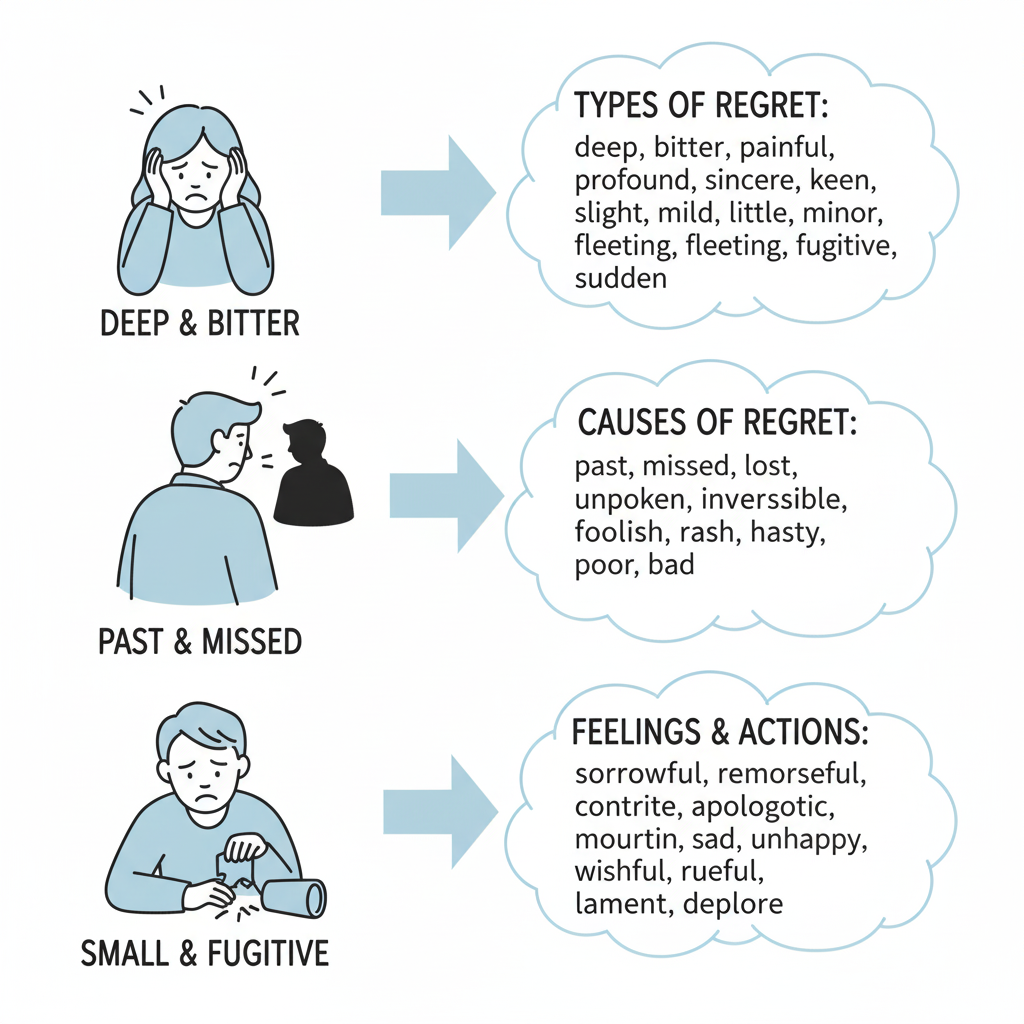
Adjectives of regret are words that describe the feeling of sadness, disappointment, or remorse over something that has happened or been done, especially when it is felt too late. These adjectives help to express the intensity and specific nature of one’s regret.
They modify nouns or pronouns, providing more information about the feeling or the person experiencing it.
These adjectives are crucial for conveying emotions effectively, allowing speakers and writers to express the depth and nuance of their feelings. For example, saying “I feel remorseful about my decision” communicates a stronger sense of regret than simply saying “I regret my decision.” The adjective adds emotional weight and clarity.
Key Characteristics:
- Express Emotion: They directly relate to feelings of regret, sorrow, or disappointment.
- Modify Nouns/Pronouns: They describe the feeling itself or the person experiencing the feeling.
- Vary in Intensity: They range from mild regret to deep remorse.
- Context-Dependent: Their meaning can be subtly influenced by the context in which they are used.

Structural Breakdown
Adjectives of regret, like other adjectives, typically precede the noun they modify or follow a linking verb (such as be, seem, feel, appear). Understanding this structural placement is essential for using these adjectives correctly in sentences.
Placement Before Nouns (Attributive Position):
When an adjective of regret is placed before the noun it modifies, it is in the attributive position. This is a common structure in English.
Example: “He had a regretful look on his face.” (Regretful modifies look)
Placement After Linking Verbs (Predicative Position):
When an adjective of regret follows a linking verb, it is in the predicative position. The adjective describes the subject of the sentence.
Example: “She felt ashamed of her actions.” (Ashamed describes she)
Typical Sentence Structures:
- Subject + Linking Verb + Adjective of Regret: “I am sorry.”
- Subject + Verb + Object + Adjective of Regret: “He made a regrettable mistake.”
- Subject + Verb + Adverb + Adjective of Regret: “She was deeply remorseful.”
Understanding these structural patterns allows you to construct grammatically correct and meaningful sentences that effectively convey your feelings of regret.
Types and Categories of Adjectives of Regret
Adjectives of regret can be categorized based on the intensity and specific nature of the regret they express. Here are some key categories:
Intensity of Regret
This category focuses on the degree of regret, ranging from mild to severe.
- Mild Regret: Sorry, Disappointed, Unhappy
- Moderate Regret: Regretful, Contrite, Rueful
- Severe Regret: Ashamed, Remorseful, Guilt-ridden, Heartbroken
Nature of Regret
This category focuses on the specific reason or cause for the regret.
- Regret for Actions: Remorseful, Ashamed, Guilty
- Regret for Inaction: Disappointed, Frustrated, Unfulfilled
- Regret for Consequences: Sorrowful, Heartbroken, Distressed
Emotional Tone
This category focuses on the emotional coloring or the feeling that the adjective evokes.
- Sadness: Sorrowful, Melancholy, Downcast
- Guilt: Guilty, Ashamed, Repentant
- Disappointment: Disappointed, Crestfallen, Dejected
By understanding these categories, you can choose the most appropriate adjective to express your specific feelings of regret. The nuance allows for more precise and meaningful communication.
Examples of Adjectives of Regret
The following tables provide extensive examples of adjectives of regret used in different contexts. Each table focuses on a specific category, illustrating how these adjectives can be used in sentences.
Table 1: Adjectives Expressing Mild Regret
This table focuses on adjectives expressing a low degree of regret or disappointment. These are used when the feeling of regret is not particularly strong.
| Adjective | Example Sentence |
|---|---|
| Sorry | I am sorry that I missed your call. |
| Disappointed | She was disappointed that the event was canceled. |
| Unhappy | He was unhappy with the outcome of the meeting. |
| Sad | I felt sad when I heard the news. |
| Regretful | She gave a regretful sigh. |
| Mildly regretful | He seemed mildly regretful about his decision. |
| Slightly disappointed | I was slightly disappointed not to see you there. |
| Underwhelmed | I felt underwhelmed by the performance. |
| A bit sad | She was a bit sad about leaving. |
| Not thrilled | He was not thrilled with the results. |
| Somewhat regretful | They were somewhat regretful of their hasty actions. |
| A little sorry | She seemed a little sorry for what she said. |
| Partly disappointed | He was only partly disappointed by the rejection. |
| Marginally unhappy | They were marginally unhappy with the changes. |
| Slightly rueful | He gave a slightly rueful smile. |
| Tinged with regret | Her voice was tinged with regret. |
| A touch disappointed | I felt a touch disappointed when I realized the truth. |
| Somewhat sad | The movie left me feeling somewhat sad. |
| A little regretful | He was a little regretful that he couldn’t attend. |
| Mildly sorry | She was mildly sorry for her mistake. |
| Not completely happy | He was not completely happy with the compromise. |
| A shade disappointed | I was a shade disappointed by the quality. |
| Somewhat unhappy | They were somewhat unhappy with the delay. |
| A bit regretful | She was a bit regretful about not saying goodbye. |
Table 2: Adjectives Expressing Moderate Regret
This table focuses on adjectives expressing a noticeable level of regret or remorse. These are used when the feeling is more pronounced.
| Adjective | Example Sentence |
|---|---|
| Regretful | He felt regretful about not spending more time with his family. |
| Contrite | She was contrite after realizing her mistake. |
| Rueful | He gave a rueful smile as he remembered the incident. |
| Disappointed in oneself | I was disappointed in myself for not trying harder. |
| Chagrined | He felt chagrined by his public blunder. |
| Penitent | The criminal was penitent for his crimes. |
| Sorrowful | She was sorrowful about the loss. |
| Apologetic | He was apologetic for his behavior. |
| Remorseful | She was deeply remorseful for her actions. |
| Downhearted | He felt downhearted after the rejection. |
| Heavy-hearted | She was heavy-hearted after the argument. |
| Grieved | He was grieved by the news of the accident. |
| Saddened | She was saddened by the story. |
| Distressed | He was distressed by the situation. |
| Dejected | She felt dejected after the failure. |
| Mournful | He had a mournful expression. |
| Gloomful | She was feeling gloomful after the rain started. |
| Woeful | He told a woeful tale of misfortune. |
| Lamenting | She was lamenting the loss of her friend. |
| Bewailing | He was bewailing his fate. |
| Wistful | She had a wistful look in her eyes. |
| Pensive | He was pensive about the past. |
| Somber | The mood was somber after the announcement. |
| Solemn | He gave a solemn promise. |
Table 3: Adjectives Expressing Severe Regret
This table focuses on adjectives expressing a strong and intense degree of regret, remorse, or guilt. These are used when the feeling is overwhelming.
| Adjective | Example Sentence |
|---|---|
| Ashamed | I felt ashamed of my behavior at the party. |
| Remorseful | He was deeply remorseful for causing the accident. |
| Guilt-ridden | She was guilt-ridden after lying to her friend. |
| Heartbroken | He was heartbroken when he lost the competition. |
| Devastated | She was devastated by the news of the earthquake. |
| Crushed | He felt crushed after failing the exam. |
| Wretched | I felt wretched after betraying my friend’s trust. |
| Desolate | She was desolate after her breakup. |
| Distraught | He was distraught when he couldn’t find his keys. |
| Repentant | The thief was repentant for his crimes. |
| Contrite | She was contrite after realizing her mistake. |
| Full of regret | He was full of regret for the things he didn’t do. |
| Deeply sorry | She was deeply sorry for her actions. |
| Inconsolable | He was inconsolable after the loss of his pet. |
| Tormented | She was tormented by her past mistakes. |
| Anguished | He was anguished by the decision he had to make. |
| Harrowed | She looked harrowed after the traumatic event. |
| Worn down | He was worn down by his constant regret. |
| Brokenhearted | She was brokenhearted after the end of her relationship. |
| Overwhelmed with remorse | He was overwhelmed with remorse for his role in the tragedy. |
| Stricken with guilt | She was stricken with guilt after the accident. |
| Filled with shame | He was filled with shame after his public humiliation. |
| Deeply ashamed | She was deeply ashamed of her past actions. |
| Bitterly regretful | He was bitterly regretful of the choices he made in his youth. |
Usage Rules for Adjectives of Regret
Using adjectives of regret correctly involves understanding their placement in sentences, the verbs they can follow, and their connotations. Here are some important rules to keep in mind:
- Placement: As mentioned earlier, adjectives can be placed before the noun they modify (attributive) or after a linking verb (predicative).
- Linking Verbs: Adjectives of regret often follow linking verbs such as be, feel, seem, appear, look, sound, and become.
- Connotation: Be aware of the specific connotation of each adjective. For example, “sorry” is milder than “remorseful.”
- Adverbs: Adverbs can be used to intensify the meaning of adjectives of regret (e.g., deeply remorseful, very sorry).
- Context: The context in which the adjective is used can influence its meaning. Consider the situation and the audience when choosing an adjective.
Examples of Correct Usage:
- “She felt deeply ashamed of her mistake.” (Adverb + Adjective after a linking verb)
- “He had a regretful expression on his face.” (Adjective before the noun)
- “I am sorry that I hurt your feelings.” (Adjective after a linking verb)
Common Mistakes When Using Adjectives of Regret
Even advanced learners can make mistakes when using adjectives of regret. Being aware of these common errors can help you avoid them.
Mistake 1: Incorrect Adjective Choice
Choosing an adjective that doesn’t accurately reflect the intensity of the regret.
Incorrect: “I am happy about my mistake.”
Correct: “I am sorry about my mistake.”
Mistake 2: Misplaced Adjective
Putting the adjective in the wrong position in the sentence.
Incorrect: “The look regretful was on his face.”
Correct: “The regretful look was on his face.”
Mistake 3: Incorrect Verb Usage
Using a verb that doesn’t correctly link the subject to the adjective.
Incorrect: “She did ashamed.”
Correct: “She felt ashamed.”
Mistake 4: Using the Wrong Form
Using a noun or verb form instead of an adjective.
Incorrect: “He felt regret.”
Correct: “He felt regretful.”
Mistake 5: Confusing Similar Adjectives
Mixing up adjectives with similar meanings but different connotations.
Incorrect: “I am remorseful that I missed your call.” (Remorseful implies a deeper level of regret than is appropriate here)
Correct: “I am sorry that I missed your call.”
Table 4: Correct vs. Incorrect Examples
This table lists common mistakes and their corrections to help avoid confusion.
| Mistake | Incorrect Example | Correct Example |
|---|---|---|
| Incorrect Adjective Choice | I am happy for what happened. | I am sorry for what happened. |
| Misplaced Adjective | The face was sad. | The face was sad. |
| Incorrect Verb Usage | He does regretful. | He feels regretful. |
| Wrong Form | She had guilt. | She felt guilty. |
| Confusing Similar Adjectives | I am remorseful I forgot to buy milk. | I am sorry I forgot to buy milk. |
Practice Exercises
Test your understanding of adjectives of regret with the following exercises. Each exercise focuses on a different aspect of using these adjectives correctly.
Exercise 1: Fill in the Blanks
Fill in the blanks with the most appropriate adjective of regret from the list provided:
(sorry, regretful, ashamed, remorseful, disappointed)
- I am _______ that I couldn’t make it to your party.
- She felt _______ of her actions after the argument.
- He was _______ for the pain he had caused.
- They were _______ that the event was canceled.
- He gave a _______ sigh as he thought about the past.
Exercise 2: Sentence Transformation
Rewrite the following sentences using an adjective of regret:
- I feel bad about what I did.
- She is not happy with the result.
- He feels guilt for his mistake.
- They are sad about the news.
- I have regrets about not trying harder.
Exercise 3: Error Correction
Identify and correct the errors in the following sentences:
- She did ashamed of her behavior.
- He felt regret for his actions.
- I am happy that I hurt your feelings.
- The look regret was on his face.
- They are remorseful for missing the meeting.
Table 5: Answers to Practice Exercises
This table provides the answers to the exercises above, allowing you to check your work.
| Exercise | Question | Answer |
|---|---|---|
| Exercise 1 | 1 | sorry |
| Exercise 1 | 2 | ashamed |
| Exercise 1 | 3 | remorseful |
| Exercise 1 | 4 | disappointed |
| Exercise 1 | 5 | regretful |
| Exercise 2 | 1 | I feel sorry about what I did. |
| Exercise 2 | 2 | She is disappointed with the result. |
| Exercise 2 | 3 | He feels guilty for his mistake. |
| Exercise 2 | 4 | They are sorrowful about the news. |
| Exercise 2 | 5 | I am regretful about not trying harder. |
| Exercise 3 | 1 | She felt ashamed of her behavior. |
| Exercise 3 | 2 | He felt regretful for his actions. |
| Exercise 3 | 3 | I am sorry that I hurt your feelings. |
| Exercise 3 | 4 | The regretful look was on his face. |
| Exercise 3 | 5 | They are regretful for missing the meeting. |
Exercise 4: Contextual Usage
Choose the best adjective of regret for each sentence, considering the context:
(sorry, ashamed, regretful, heartbroken, disappointed)
- After failing the important exam, he felt _____.
- She was _____ to hear about the accident that occurred.
- Having lied to her best friend, she felt incredibly _____.
- Looking back on his youth, he was _____ for not pursuing his dreams.
- When her pet passed away, she was truly _____.
Exercise 5: Identifying Intensity
Rank the following adjectives of regret from least intense to most intense:
(remorseful, sorry, regretful, disappointed, ashamed)
Table 6: Answers for Exercises 4 and 5
| Exercise | Question | Answer |
|---|---|---|
| Exercise 4 | 1 | Disappointed |
| Exercise 4 | 2 | Sorry |
| Exercise 4 | 3 | Ashamed |
| Exercise 4 | 4 | Regretful |
| Exercise 4 | 5 | Heartbroken |
| Exercise 5 | Ranking | Sorry, Disappointed, Regretful, Ashamed, Remorseful |
Advanced Topics
For advanced learners, understanding more nuanced aspects of adjectives of regret can further enhance your proficiency. This includes exploring idiomatic expressions, subtle connotations, and literary uses.
Idiomatic Expressions
Certain phrases use adjectives of regret in idiomatic ways, adding depth and color to language.
- “Sorry sight”: Something unpleasant or pitiable to look at.
- “Regretful day”: A day marked by sorrow or disappointment.
Subtle Connotations
Adjectives of regret can have subtle differences in meaning that are important to recognize.
- “Ashamed” vs. “Guilty”: Ashamed often relates to feelings of embarrassment or humiliation, while guilty relates to feelings of culpability or responsibility for wrongdoing.
- “Regretful” vs. “Remorseful”: Regretful is a general feeling of sadness about something, while remorseful implies a deep and sincere sense of guilt and sorrow.
Literary Uses
In literature, adjectives of regret are often used to create vivid imagery and convey complex emotions.
Example: “The sorrowful protagonist wandered through the desolate landscape, haunted by his past.”
Exploring these advanced topics will help you use adjectives of regret with greater precision and artistry, enhancing your ability to communicate effectively in both spoken and written English.
Frequently Asked Questions (FAQ)
Here are some frequently asked questions about adjectives of regret:
- What is the difference between “sorry” and “regretful”?While both express a feeling of sadness or disappointment, “sorry” is generally milder and more commonly used in everyday situations. “Regretful” implies a deeper sense of longing or remorse about something that has happened or not happened.
- How do I choose the right adjective of regret?Consider the intensity of your feeling and the specific reason for your regret. If the feeling is mild, use adjectives like “sorry” or “disappointed.” If it’s more intense, use adjectives like “ashamed” or “remorseful.” Also, consider the context and your audience.
- Can I use adverbs with adjectives of regret?Yes, adverbs can be used to intensify the meaning of these adjectives. For example, you can say “deeply sorry,” “very regretful,” or “extremely ashamed.”
- What are some common mistakes to avoid?Common mistakes include choosing the wrong adjective, misplacing the adjective in the sentence, using incorrect verb usage, using the wrong form of the word (e.g., noun instead of adjective), and confusing similar adjectives.
- How can I improve my use of adjectives of regret?Practice using these adjectives in different contexts, pay attention to their connotations, and be aware of common mistakes. Reading widely and listening to native speakers can also help you improve your understanding and usage.
- Are there any regional differences in the use of these adjectives?While the core meanings of these adjectives are generally consistent across English-speaking regions, there may be subtle differences in usage and connotation. Pay attention to how native speakers in your region use these adjectives.
- What is the difference between “guilty” and “remorseful”?While both indicate feeling bad about something, “guilty” specifically implies admitting responsibility for a wrongdoing. “Remorseful” goes further, suggesting a deep and genuine sorrow for the harm caused and a desire to make amends. You can feel guilty without being truly remorseful, but genuine remorse always includes guilt.
- Can adjectives of regret be used in a positive sense?Generally, adjectives of regret are used to express negative emotions. However, they can sometimes be used in a more reflective or philosophical sense to acknowledge past experiences without necessarily implying deep sorrow. For example, someone might say they have a “wistful” feeling about their childhood, suggesting a gentle longing rather than intense regret.
Conclusion
Mastering adjectives of regret is essential for expressing complex emotions accurately and effectively in English. By understanding their definitions, structural usage, categories, and connotations, you can communicate your feelings with greater precision.
Remember to avoid common mistakes, practice regularly, and pay attention to the context in which you are using these adjectives.
Continue to expand your vocabulary and practice using these adjectives in both spoken and written English. The more you use them, the more natural and confident you will become in expressing your feelings of regret.
By mastering these nuances, you enhance your overall communication skills and emotional intelligence in English.