Shopping is a ubiquitous activity, and the ability to describe what we’re looking for, comparing items, and expressing our opinions about products is crucial for effective communication in English. Mastering adjectives related to shopping not only enhances vocabulary but also improves comprehension in various shopping scenarios.
This article provides a comprehensive guide to adjectives used in shopping, covering definitions, examples, usage rules, common mistakes, and practice exercises. Whether you are a beginner or an advanced learner, this guide will equip you with the necessary tools to confidently navigate the world of shopping in English.
Table of Contents
- Introduction
- Definition of Adjectives for Shopping
- Structural Breakdown
- Types and Categories of Shopping Adjectives
- Examples of Shopping Adjectives
- Usage Rules
- Common Mistakes
- Practice Exercises
- Advanced Topics
- FAQ
- Conclusion
Definition of Adjectives for Shopping
Adjectives are words that describe or modify nouns. In the context of shopping, adjectives are used to provide details about products, express opinions, compare items, and describe the shopping experience. They help to paint a vivid picture and convey specific information about the items being considered for purchase. Adjectives are essential for clear and effective communication when discussing shopping experiences or products.
Adjectives in shopping can be classified based on their function. Some describe physical attributes like size, color, or material.
Others express subjective opinions, such as whether something is beautiful, stylish, or comfortable. Comparative and superlative adjectives are used to compare different items, highlighting their relative qualities.
Understanding these different types of adjectives will enable more precise and effective communication about shopping related topics.
Structural Breakdown
Adjectives typically precede the noun they modify. For example, in the phrase “a beautiful dress,” the adjective “beautiful” comes before the noun “dress.” However, adjectives can also follow linking verbs such as be, seem, appear, look, feel, taste, smell, and sound. In the sentence “The dress is beautiful,” the adjective “beautiful” follows the linking verb “is.”
When multiple adjectives are used to describe a single noun, they usually follow a specific order. The general order of adjectives in English is: opinion, size, age, shape, color, origin, material, and purpose. For instance, “a lovely small old round blue Italian leather riding bag.” This order is not always strictly followed, and it’s important to consider what sounds natural in the given context. Commas are typically used to separate coordinate adjectives (adjectives that independently modify the noun), but not between the last adjective and the noun.
Types and Categories of Shopping Adjectives
Shopping adjectives can be categorized in several ways, based on what aspect of the product or experience they describe. Here are some of the most common types:
Descriptive Adjectives
Descriptive adjectives provide details about the qualities or characteristics of an item. These adjectives help to create a clear picture of the product in the mind of the listener or reader.
Examples of descriptive adjectives include: soft, comfortable, durable, elegant, modern, classic, stylish, practical, functional, versatile, lightweight, waterproof, breathable, spacious, compact, adjustable, user-friendly, high-quality, well-made, and unique.
Comparative Adjectives
Comparative adjectives are used to compare two items. They are formed by adding “-er” to the end of the adjective (if it is a short adjective) or by using “more” before the adjective (for longer adjectives).
Examples of comparative adjectives include: cheaper (than), more expensive (than), larger (than), smaller (than), better (than), worse (than), more comfortable (than), more stylish (than), more durable (than), more practical (than), more versatile (than), lighter (than), heavier (than), more spacious (than), more compact (than), more adjustable (than), more user-friendly (than), higher-quality (than), more well-made (than), and more unique (than).
Superlative Adjectives
Superlative adjectives are used to compare three or more items and indicate which one has the highest degree of the quality being described. They are formed by adding “-est” to the end of the adjective (if it is a short adjective) or by using “most” before the adjective (for longer adjectives).
Examples of superlative adjectives include: cheapest, most expensive, largest, smallest, best, worst, most comfortable, most stylish, most durable, most practical, most versatile, lightest, heaviest, most spacious, most compact, most adjustable, most user-friendly, highest-quality, most well-made, and most unique.
Opinion Adjectives
Opinion adjectives express subjective judgments or feelings about a product. These adjectives reflect personal preferences and can vary from person to person.
Examples of opinion adjectives include: beautiful, ugly, attractive, unattractive, lovely, horrible, amazing, terrible, fantastic, awful, wonderful, disgusting, charming, dreadful, elegant, vulgar, sophisticated, tacky, stylish, and outdated.
Size Adjectives
Size adjectives describe the dimensions or scale of a product. They are useful for specifying the physical size of an item.
Examples of size adjectives include: large, small, big, tiny, huge, miniature, tall, short, long, wide, narrow, thick, thin, deep, shallow, oversized, undersized, compact, bulky, and portable.
Color Adjectives
Color adjectives specify the hue or shade of a product. They are essential for describing the visual appearance of an item.
Examples of color adjectives include: red, blue, green, yellow, orange, purple, pink, brown, black, white, gray, silver, gold, beige, ivory, navy, teal, maroon, lavender, and turquoise.
Material Adjectives
Material adjectives indicate the substance or composition of a product. They provide information about what the item is made of.
Examples of material adjectives include: cotton, silk, wool, leather, denim, linen, velvet, plastic, metal, wood, glass, ceramic, stainless steel, aluminum, polyester, nylon, acrylic, rubber, suede, and canvas.
Condition Adjectives
Condition adjectives describe the state or quality of a product, especially regarding its newness or wear.
Examples of condition adjectives include: new, used, old, vintage, antique, refurbished, damaged, flawed, mint, pre-owned, secondhand, worn, unworn, pristine, scratched, broken, faulty, imperfect, repaired, and restored.
Price Adjectives
Price adjectives describe the cost or value of a product. They are crucial for discussing affordability and value for money.
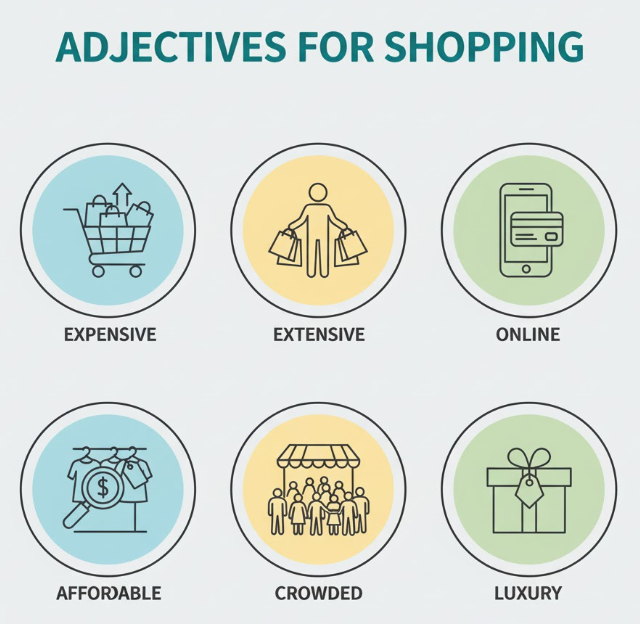
Examples of price adjectives include: expensive, cheap, affordable, costly, inexpensive, reasonable, overpriced, underpriced, discounted, sale, budget-friendly, high-end, luxury, economical, premium, bargain, reduced, wholesale, retail, and clearance.
Pattern Adjectives
Pattern adjectives describe the design or motif of a product, particularly in textiles and decorative items.
Examples of pattern adjectives include: striped, polka-dotted, floral, plaid, paisley, geometric, abstract, checkered, argyle, camo, leopard-print, zebra-print, tie-dye, chevron, houndstooth, damask, brocade, ikat, toile, and gingham.
Examples of Shopping Adjectives
Here are several tables with example sentences that use various shopping adjectives in context. These examples are categorized to show how different types of adjectives are used in real-life shopping scenarios.
The following table provides examples of descriptive adjectives used in shopping scenarios. These adjectives help to provide more detail and paint a clearer picture of the items being described.
| Category | Example Sentence |
|---|---|
| Clothing | This soft sweater is perfect for chilly evenings. |
| Shoes | These comfortable sneakers are ideal for walking. |
| Electronics | This durable phone case will protect your phone from damage. |
| Furniture | This elegant sofa will add a touch of class to your living room. |
| Accessories | A stylish handbag can complete any outfit. |
| Kitchenware | This practical kitchen gadget makes cooking easier. |
| Appliances | A functional refrigerator is essential for any household. |
| Tools | This versatile tool can handle a variety of tasks. |
| Luggage | A lightweight suitcase is easier to carry when traveling. |
| Outdoor Gear | This waterproof jacket will keep you dry in the rain. |
| Clothing | The breathable fabric makes this shirt perfect for summer. |
| Bags | This spacious tote bag can hold all your essentials. |
| Gadgets | This compact charger is easy to carry around. |
| Furniture | The adjustable chair allows you to customize your comfort. |
| Electronics | This user-friendly device is easy to operate. |
| Jewelry | This high-quality necklace is a timeless piece. |
| Crafts | These well-made brushes are perfect for painting. |
| Collectibles | This unique figurine is a rare find. |
| Home Decor | This decorative vase adds charm to the room. |
| Stationery | These smooth pens are a joy to write with. |
The following table provides examples of comparative adjectives used in shopping scenarios. These adjectives help compare two items and highlight relative qualities.
| Category | Example Sentence |
|---|---|
| Cars | This car is more expensive than that one, but it’s also faster. |
| Clothing | This jacket is warmer than the one I saw yesterday. |
| Electronics | This phone is more user-friendly than the previous model. |
| Furniture | This chair is more comfortable than the other one in the store. |
| Books | This book is more interesting than the one I read last week. |
| Shoes | These shoes are lighter than my old pair. |
| Bags | This bag is more spacious than my current one. |
| Appliances | This washing machine is more energy-efficient than our old one. |
| Tools | This drill is more powerful than the one I borrowed. |
| Jewelry | This necklace is more elegant than the one I saw online. |
| Cosmetics | This lipstick is longer-lasting than the other brand I tried. |
| Food | This coffee is stronger than the one I usually buy. |
| Toys | This toy is more durable than the plastic one. |
| Sports Equipment | This bike is faster than my old one. |
| Watches | This watch is more stylish than my current one. |
| Home Decor | This vase is taller than the one I saw at the other store. |
| Kitchenware | This pan is heavier than the non-stick one. |
| Office Supplies | This printer is more efficient than my old one. |
| Garden Supplies | This shovel is sharper than the one I have. |
| Musical Instruments | This guitar is louder than my current one. |
The following table provides examples of superlative adjectives used in shopping scenarios. These adjectives are used to compare three or more items and indicate which one has the highest degree of the quality being described.
| Category | Example Sentence |
|---|---|
| Cars | This is the most expensive car on the lot. |
| Clothing | This is the warmest coat in the store. |
| Electronics | This is the most advanced phone on the market. |
| Furniture | This is the most comfortable chair I’ve ever sat in. |
| Books | This is the most interesting book I’ve read this year. |
| Shoes | These are the lightest running shoes available. |
| Bags | This is the most spacious backpack I could find. |
| Appliances | This is the most energy-efficient refrigerator we sell. |
| Tools | This is the most powerful drill in our collection. |
| Jewelry | This is the most elegant necklace in the store. |
| Cosmetics | This is the longest-lasting lipstick I’ve ever worn. |
| Food | This is the strongest coffee I’ve ever tasted. |
| Toys | This is the most durable toy for toddlers. |
| Sports Equipment | This is the fastest bike on the market. |
| Watches | This is the most stylish watch I’ve seen. |
| Home Decor | This is the tallest vase in the shop. |
| Kitchenware | This is the heaviest pan, ensuring even cooking. |
| Office Supplies | This is the most efficient printer available. |
| Garden Supplies | This is the sharpest shovel for digging. |
| Musical Instruments | This is the loudest guitar I’ve ever played. |
The following table provides examples of opinion adjectives used in shopping scenarios. These adjectives express subjective judgments or feelings about a product.
| Category | Example Sentence |
|---|---|
| Clothing | That dress is beautiful! |
| Shoes | These shoes are ugly. |
| Electronics | This phone is attractive. |
| Furniture | That sofa is unattractive. |
| Jewelry | This necklace is lovely. |
| Food | This cake is delicious. |
| Cars | That car is fantastic! |
| Home Decor | This painting is charming. |
| Accessories | This bag is stylish. |
| Toys | This toy is dreadful. |
| Appliances | This fridge is amazing! |
| Kitchenware | These pots are elegant. |
| Books | This novel is wonderful. |
| Cosmetics | This lipstick is vulgar. |
| Tools | This drill is terrible. |
| Watches | This watch is sophisticated. |
| Sports Equipment | This bike is horrible. |
| Garden Supplies | These flowers are disgusting. |
| Office Supplies | These pens are outdated. |
| Musical Instruments | This guitar is tacky. |
Usage Rules
The placement of adjectives in a sentence is crucial. As mentioned earlier, adjectives usually come before the nouns they modify.
However, they can also follow linking verbs. Here are some specific usage rules to keep in mind:
- Order of Adjectives: When using multiple adjectives, follow the general order: opinion, size, age, shape, color, origin, material, purpose.
- Coordinate Adjectives: Use commas to separate coordinate adjectives (adjectives that independently modify the noun). For example, “a beautiful, elegant dress.”
- Non-Coordinate Adjectives: Do not use commas between non-coordinate adjectives. For example, “a small blue bag.”
- Adjectives after Linking Verbs: Use adjectives after linking verbs like be, seem, appear, look, feel, taste, smell, and sound. For example, “The food tastes delicious.”
- Articles with Adjectives: Use articles (a, an, the) appropriately. For example, “a stylish hat,” “the most expensive watch.”
Common Mistakes
Learners often make mistakes when using adjectives, particularly with word order and comparative/superlative forms. Here are some common mistakes to avoid:
- Incorrect Word Order: Placing adjectives in the wrong order.
- Incorrect: a blue small bag
- Correct: a small blue bag
- Missing or Incorrect Commas: Forgetting commas between coordinate adjectives.
- Incorrect: a beautiful elegant dress
- Correct: a beautiful, elegant dress
- Incorrect Comparative/Superlative Forms: Using the wrong form of the adjective for comparison.
- Incorrect: This is the most durable than that one.
- Correct: This is more durable than that one.
- Incorrect: This is the durableest toy.
- Correct: This is the most durable toy.
- Using Adjectives as Adverbs: Confusing adjectives with adverbs.
- Incorrect: She sings beautiful.
- Correct: She sings beautifully.
Practice Exercises
Test your understanding with these practice exercises. Fill in the blanks with the appropriate adjective form.
Exercise 1: Fill in the blanks with a descriptive adjective.
| Question | Answer |
|---|---|
| 1. I bought a ______ dress for the party. | elegant |
| 2. These shoes are very ______. | comfortable |
| 3. This phone has a ______ camera. | high-quality |
| 4. I need a ______ bag for my trip. | spacious |
| 5. This jacket is ______ for the winter. | warm |
| 6. He bought a ______ car. | fast |
| 7. She has a ______ voice. | beautiful |
| 8. This chair is very ______. | sturdy |
| 9. The coffee has a ______ aroma. | rich |
| 10. This pen writes very ______. | smoothly |
Exercise 2: Fill in the blanks with the comparative form of the adjective.
| Question | Answer |
|---|---|
| 1. This car is ______ (expensive) than that one. | more expensive |
| 2. This shirt is ______ (soft) than the other one. | softer |
| 3. This phone is ______ (user-friendly) than the old model. | more user-friendly |
| 4. This bag is ______ (large) than my current one. | larger |
| 5. This coat is ______ (warm) than the one I saw yesterday. | warmer |
| 6. My new job is ______ (interesting) than my old one. | more interesting |
| 7. This coffee is ______ (strong) than the one I usually drink. | stronger |
| 8. This exercise is ______ (easy) than I thought. | easier |
| 9. Living in the city is ______ (convenient) than living in the country. | more convenient |
| 10. This book is ______ (long) than the one I read last week. | longer |
Exercise 3: Fill in the blanks with the superlative form of the adjective.
| Question | Answer |
|---|---|
| 1. This is the ______ (expensive) car in the showroom. | most expensive |
| 2. This is the ______ (soft) blanket I’ve ever felt. | softest |
| 3. This is the ______ (user-friendly) phone on the market. | most user-friendly |
| 4. This is the ______ (large) bag I could find. | largest |
| 5. This is the ______ (warm) coat in the store. | warmest |
| 6. This is the ______ (interesting) movie I’ve seen this year. | most interesting |
| 7. This is the ______ (strong) coffee I’ve ever tasted. | strongest |
| 8. This is the ______ (easy) exam I’ve ever taken. | easiest |
| 9. This is the ______ (convenient) way to travel. | most convenient |
| 10. This is the ______ (long) book I’ve ever read. | longest |
Advanced Topics
For advanced learners, understanding nuances in adjective usage can further enhance their proficiency. This includes:
- Attributive vs. Predicative Adjectives: Attributive adjectives precede the noun (e.g., “a red car”), while predicative adjectives follow a linking verb (e.g., “The car is red“).
- Absolute Adjectives: Some adjectives, like “unique” or “perfect,” are considered absolute and should not be used in comparative or superlative forms.
- Compound Adjectives: Two or more words can combine to form a single adjective (e.g., “a well-made product”).
FAQ
Here are some frequently asked questions about using adjectives for shopping:
- What is the correct order of adjectives in a sentence?The general order is: opinion, size, age, shape, color, origin, material, and purpose. For example: a beautiful, small, old, round, blue, Italian, leather, riding bag.
- How do I form comparative and superlative adjectives?For short adjectives, add “-er” for comparative and “-est” for superlative forms (e.g., faster, fastest). For longer adjectives, use “more” and “most” (e.g., more beautiful, most beautiful).
- What are coordinate adjectives?Coordinate adjectives independently modify the noun and are separated by commas. For example, “a beautiful, elegant dress.”
- What are linking verbs, and how do they relate to adjectives?Linking verbs connect the subject to an adjective that describes it. Common linking verbs include be, seem, appear, look, feel, taste, smell, and sound. For example, “The food tastes delicious.”
- Can I use multiple adjectives to describe one noun?Yes, you can use multiple adjectives, but they should follow the correct order and be separated by commas if they are coordinate adjectives.
- What is the difference between an adjective and an adverb?Adjectives modify nouns, while adverbs modify verbs, adjectives, or other adverbs. For example, “a beautiful flower” (adjective) vs. “She sings beautifully” (adverb).
- How do I know when to use “more” vs. “-er” for comparative adjectives?Generally, use “-er” for one-syllable and some two-syllable adjectives. Use “more” for adjectives with two or more syllables that don’t end in -y, -er, -ow, or -le.
- Are there any exceptions to the adjective order rule?Yes, the order is not always strict, and sometimes it’s best to rearrange adjectives to what sounds most natural. However, the general guideline is a helpful starting point.
Conclusion
Mastering adjectives for shopping is essential for effective communication in English, allowing you to describe products, express opinions, and compare items accurately. Understanding the different types of adjectives, their structural rules, and common mistakes will significantly enhance your vocabulary and comprehension in various shopping scenarios.
By practicing the examples and exercises provided in this guide, you can confidently navigate the world of shopping in English.
Remember to pay attention to the order of adjectives, use comparative and superlative forms correctly, and avoid common errors such as confusing adjectives with adverbs. With consistent practice and attention to detail, you can improve your fluency and precision when discussing shopping-related topics.
Happy shopping and happy learning!