Soccer, or football as it’s known in many parts of the world, is a sport rich with action, strategy, and emotion. To accurately describe the nuances of the game, a wide range of adjectives is essential.
This article provides a comprehensive exploration of adjectives used in the context of soccer, covering their definitions, structures, usage rules, and common mistakes. Whether you’re a sports journalist, a soccer enthusiast, or an English language learner, mastering these adjectives will significantly enhance your ability to communicate effectively about the beautiful game.
Table of Contents
- Introduction
- Definition of Adjectives for Soccer
- Structural Breakdown
- Categories of Adjectives for Soccer
- Examples of Adjectives for Soccer
- Usage Rules
- Common Mistakes
- Practice Exercises
- Advanced Topics
- FAQ
- Conclusion
Definition of Adjectives for Soccer
An adjective is a word that modifies a noun or pronoun, providing more information about it. In the context of soccer, adjectives are used to describe various aspects of the game, including players, teams, actions, strategies, and the overall atmosphere.
These adjectives can convey a wide range of meanings, from simple descriptions of physical attributes to complex evaluations of performance and tactical approaches. Understanding adjectives is crucial for anyone who wants to discuss soccer with precision and clarity.
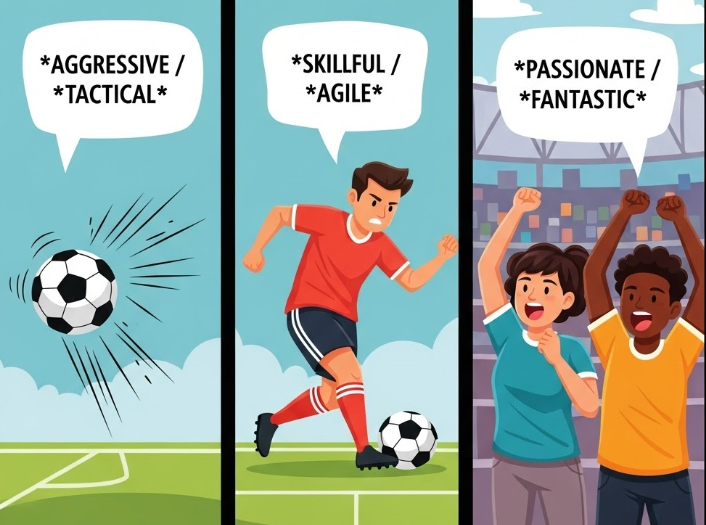
Adjectives in soccer can be classified based on their function and the type of information they provide. They can describe the physical characteristics of players (e.g., tall, agile), evaluate their performance (e.g., skillful, inconsistent), or describe the nature of actions and strategies (e.g., aggressive, defensive). The correct use of adjectives adds depth and color to our descriptions of the game.
Structural Breakdown
Adjectives in English typically precede the noun they modify (e.g., “the fast player”). However, they can also follow a linking verb such as “is,” “are,” “was,” or “were” (e.g., “The player is fast“). Understanding these basic structural patterns is essential for constructing grammatically correct sentences about soccer.
Adjectives can also be modified by adverbs, which further refine their meaning. For example, “a very skillful player” uses the adverb “very” to intensify the adjective “skillful.” Additionally, adjectives can be used in comparative and superlative forms to compare different entities. For instance, “He is a faster player than his teammate,” or “She is the fastest player on the team.”
The position of multiple adjectives can also affect meaning. Generally, opinion adjectives come before fact adjectives (e.g., “a fantastic young player”).
Categories of Adjectives for Soccer
Descriptive Adjectives
Descriptive adjectives provide information about the physical attributes, appearance, or condition of players, equipment, or the environment. These adjectives help to paint a vivid picture of the scene.
Evaluative Adjectives
Evaluative adjectives express opinions, judgments, or assessments about the quality or performance of players, teams, or strategies. These adjectives are subjective and reflect the speaker’s perspective.
Action-Oriented Adjectives
Action-oriented adjectives describe the nature or quality of actions performed during the game, such as passes, shots, tackles, and runs. These adjectives often convey the intensity, effectiveness, or style of the action.
Positional Adjectives
Positional adjectives indicate the location or placement of players, objects, or events on the field. These adjectives are essential for describing formations, movements, and tactical arrangements.
Time-Related Adjectives
Time-related adjectives specify when something occurred or its duration. These are vital for describing the timing of passes, plays, and strategies.
Examples of Adjectives for Soccer
Here are comprehensive tables with examples of adjectives used in soccer, categorized for clarity.
Table 1: Descriptive Adjectives
This table provides examples of descriptive adjectives used to describe soccer players and their skills.
| Adjective | Example Sentence |
|---|---|
| Tall | The tall defender easily wins aerial duels. |
| Short | Despite being short, he’s incredibly agile. |
| Agile | The agile midfielder danced through the defense. |
| Strong | He’s a strong player who can hold off defenders. |
| Fast | The fast winger outpaced his marker. |
| Skinny | The skinny player surprised everyone with his strength. |
| Muscular | The muscular striker posed a threat to the defense. |
| Young | The young player showed great potential. |
| Experienced | The experienced goalkeeper made several crucial saves. |
| Bald | The bald coach was known for his tactical brilliance. |
| Bearded | The bearded player looked intimidating on the field. |
| Blonde | The blonde forward scored the winning goal. |
| Brunette | The brunette midfielder controlled the tempo of the game. |
| Tattooed | The tattooed defender was a fan favorite. |
| Fit | The fit players could maintain a high intensity throughout the match. |
| Energetic | The energetic midfielder covered every blade of grass. |
| Tired | The tired players struggled to keep up in the final minutes. |
| Injured | The injured striker watched the game from the sidelines. |
| Healthy | The healthy players were ready for the challenge. |
| Focused | The focused players were determined to win. |
| Calm | The calm goalkeeper inspired confidence in his team. |
| Aggressive | The aggressive defender made life difficult for the forwards. |
| Skilled | The skilled attacker could dribble past multiple defenders. |
| Creative | The creative midfielder always found a way to unlock the defense. |
| Disciplined | The disciplined team followed the coach’s instructions perfectly. |
| Passionate | The passionate fans cheered their team on until the final whistle. |
| Dedicated | The dedicated athlete spends hours practicing every day. |
Table 2: Evaluative Adjectives
The following table showcases evaluative adjectives used to assess performance and strategies in soccer.
| Adjective | Example Sentence |
|---|---|
| Excellent | His excellent performance earned him the Man of the Match award. |
| Poor | The team put in a poor performance, losing 3-0. |
| Impressive | Their impressive teamwork led to a stunning victory. |
| Disappointing | It was a disappointing result for the home fans. |
| Outstanding | She made an outstanding save to keep her team in the game. |
| Terrible | The referee made a terrible decision to award a penalty. |
| Brilliant | That was a brilliant goal from the young striker. |
| Awful | The weather was awful, making it difficult to play. |
| Fantastic | The supporters created a fantastic atmosphere. |
| Mediocre | The team’s performance was mediocre, failing to impress. |
| Superb | He delivered a superb cross for the winning goal. |
| Weak | Their weak defense was easily exploited by the opposing team. |
| Strong | They showed a strong mental attitude. |
| Effective | Their effective pressing game stifled the opposition. |
| Ineffective | The striker was ineffective, failing to create any chances. |
| Strategic | The coach made a strategic substitution to change the game. |
| Tactical | Their tactical approach proved to be highly successful. |
| Unsuccessful | Their unsuccessful attempts to break the deadlock frustrated the fans. |
| Successful | Their successful penalty gave them the lead. |
| Decisive | That was a decisive moment in the match. |
| Crucial | That crucial save kept the team in the competition. |
| Important | It was an important win for their chances of qualifying. |
| Vital | His contribution was vital to the team’s success. |
| Beneficial | The new training regime proved to be beneficial. |
| Detrimental | The injury proved detrimental to the player’s career. |
| Positive | The manager gave a positive assessment of the team’s progress. |
| Negative | The team received a negative review after their defeat. |
Table 3: Action-Oriented Adjectives
This table lists action-oriented adjectives that describe actions during a soccer game.
| Adjective | Example Sentence |
|---|---|
| Accurate | He delivered an accurate pass to the striker. |
| Inaccurate | His inaccurate shot sailed over the bar. |
| Powerful | She unleashed a powerful shot from outside the box. |
| Weak | He took a weak shot that barely reached the goalkeeper. |
| Skillful | He made a skillful dribble past two defenders. |
| Clumsy | He made a clumsy tackle that resulted in a penalty. |
| Aggressive | He launched an aggressive attack on the ball. |
| Defensive | The team adopted a defensive approach to protect their lead. |
| Swift | He made a swift counter-attack. |
| Slow | The slow build-up play allowed the defense to regroup. |
| Precise | The player executed a precise free kick. |
| Careless | He committed a careless foul inside the penalty area. |
| Determined | The player made a determined run towards the goal. |
| Hesitant | His hesitant pass was intercepted by the opposition. |
| Creative | He played a creative through ball to the striker. |
| Direct | The team played a direct style of football. |
| Indirect | The free kick was indirect. |
| Desperate | He made a desperate tackle to prevent a goal. |
| Controlled | He made a controlled pass to his teammate. |
| Wild | He took a wild shot that went wide. |
| Calculated | The player made a calculated move to outsmart the defender. |
| Risky | He took a risky pass that could have been intercepted. |
| Bold | The team made a bold substitution to try and win the game. |
| Cautious | The team adopted a cautious approach to defend their lead. |
| Sudden | A sudden change in tactics surprised the opposing team. |
| Unexpected | An unexpected goal turned the game around. |
Table 4: Positional Adjectives
This table illustrates positional adjectives used in soccer to describe locations and placements.
| Adjective | Example Sentence |
|---|---|
| Left | The left winger made a run down the flank. |
| Right | The right back made a crucial interception. |
| Central | The central midfielder controlled the game. |
| Forward | The forward players pressed high up the pitch. |
| Defensive | The defensive line held firm against the attack. |
| Attacking | The attacking players pushed forward. |
| Upper | The ball sailed into the upper corner of the net. |
| Lower | The goalkeeper dived to his lower right to make the save. |
| Near | The player passed to a teammate in a near position. |
| Far | The ball was crossed to the far post. |
| Opposite | The player was on the opposite side of the field. |
| Adjacent | The two players were in adjacent positions. |
| Front | The striker positioned himself in front of the goal. |
| Back | The defender stayed back to protect the goal. |
| Middle | The midfielder played in the middle of the field. |
| Inside | The player dribbled the ball inside the box. |
| Outside | The player shot from outside the box. |
| Deep | The defender made a deep clearance. |
| Shallow | The cross was shallow and easily cleared. |
| Advanced | The advanced players were eager to score. |
| Rear | The rear guard protected the goal. |
| Wing | The wing players created space on the flanks. |
| Center | The center forward positioned himself in front of the goal. |
| Flank | The flank players tried to create opportunities. |
Table 5: Time-Related Adjectives
The table below presents time-related adjectives used to describe events in soccer.
| Adjective | Example Sentence |
|---|---|
| Early | They scored an early goal in the first minute. |
| Late | They conceded a late goal, losing the match. |
| Quick | He made a quick pass to his teammate. |
| Slow | The game had a slow start. |
| Sudden | There was a sudden change in the game’s tempo. |
| Immediate | The substitution had an immediate impact. |
| Prolonged | The team had a prolonged period of possession. |
| Brief | There was a brief stoppage in play due to an injury. |
| Current | The current score is 1-0. |
| Previous | Their previous match ended in a draw. |
| Future | The club has future plans for expansion. |
| Final | The final whistle blew, signaling the end of the game. |
| Opening | The opening goal set the tone for the match. |
| Closing | The closing minutes were tense and exciting. |
| Instant | The player had an instant impact on the game. |
| Gradual | There was a gradual improvement in the team’s performance. |
| Regular | The player is a regular starter for the team. |
| Occasional | He made occasional appearances off the bench. |
| Annual | The club held its annual awards ceremony. |
| Seasonal | The club had a seasonal membership discount. |
Usage Rules
When using adjectives in soccer-related contexts, it’s important to follow standard English grammar rules. Adjectives generally precede the nouns they modify. For example, “a skillful player” is correct, while “a player skillful” is typically incorrect unless it follows a linking verb (e.g., “The player is skillful”).
When using multiple adjectives, the order often follows a general pattern: opinion, size, age, shape, color, origin, material, and purpose. For example, “a fantastic young player” sounds more natural than “a young fantastic player.” However, this order is not rigid and can be adjusted for emphasis or stylistic effect.
Coordinate adjectives, which modify the same noun equally, are separated by commas (e.g., “a strong, agile player”). However, if the adjectives are not coordinate, no comma is needed (e.g., “a young talented player”). You can test if adjectives are coordinate by inserting “and” between them. If the sentence still makes sense, they are coordinate and require a comma.
Also, remember to use the correct form of comparative and superlative adjectives. For short adjectives (one or two syllables), use “-er” and “-est” (e.g., “faster,” “fastest”).
For longer adjectives, use “more” and “most” (e.g., “more skillful,” “most skillful”).
Common Mistakes
One common mistake is misplacing adjectives, leading to awkward or unclear sentences. For instance, saying “He scored a goal fantastic” instead of “He scored a fantastic goal.” The adjective should almost always precede the noun.
Another error involves using the wrong form of comparative or superlative adjectives. For example, using “more fast” instead of “faster,” or “most skillfull” instead of “most skillful.” Always double-check the correct forms.
Confusing adjectives with adverbs is also a frequent mistake. Adjectives modify nouns, while adverbs modify verbs, adjectives, or other adverbs. For example, “He played good” is incorrect; it should be “He played well.” “Good” is an adjective, while “well” is an adverb.
Here are some examples of common mistakes and their corrections:
| Incorrect | Correct | Explanation |
|---|---|---|
| The player is skillfull. | The player is skillful. | Misspelling of “skillful.” |
| He made a pass accurate. | He made an accurate pass. | Adjective should precede the noun. |
| She is more fast than him. | She is faster than him. | Incorrect comparative form. |
| He played good in the game. | He played well in the game. | Using an adjective instead of an adverb. |
| A young fantastic player. | A fantastic young player. | Incorrect adjective order. |
| The strong, agile, player. | The strong, agile player. | Unnecessary comma before the noun. |
| The most skillfulest player. | The most skillful player. | Double superlative is incorrect. |
Practice Exercises
Test your knowledge of adjectives for soccer with these exercises.
Exercise 1: Fill in the Blanks
Fill in the blanks with an appropriate adjective from the word bank:
(fast, crucial, impressive, defensive, talented, accurate, poor, tactical, strong, young)
| Question | Answer |
|---|---|
| 1. The ______ midfielder made a ______ pass to the striker. | talented, accurate |
| 2. The team adopted a ______ formation to protect their lead. | defensive |
| 3. That was a ______ save by the goalkeeper. | crucial |
| 4. The ______ striker is known for his ______ pace. | young, fast |
| 5. Their ______ performance resulted in a 4-0 defeat. | poor |
| 6. The coach made a ______ substitution to change the game. | tactical |
| 7. He is a ______ player who can hold off defenders. | strong |
| 8. The team showed an ______ display of teamwork. | impressive |
| 9. The ______ player is eager to prove himself. | young |
| 10. The coach gave ______ instructions before the game. | tactical |
Exercise 2: Identify the Adjective
Identify the adjective in each sentence:
| Question | Answer |
|---|---|
| 1. The skillful player dribbled past the defenders. | skillful |
| 2. It was a disappointing result for the home team. | disappointing |
| 3. The powerful shot hit the back of the net. | powerful |
| 4. The central midfielder controlled the tempo of the game. | central |
| 5. They scored a late goal to win the match. | late |
| 6. The agile defender made a crucial tackle. | agile, crucial |
| 7. The strategic move changed the game. | strategic |
| 8. The accurate pass led to a goal. | accurate |
| 9. The injured player watched from the bench. | injured |
| 10. The passionate fans cheered loudly. | passionate |
Exercise 3: Correct the Mistakes
Correct the mistakes in the following sentences:
| Question | Answer |
|---|---|
| 1. He made a shot powerful. | He made a powerful shot. |
| 2. The player is more good than him. | The player is better than him. |
| 3. It was a game exciting. | It was an exciting game. |
| 4. The team played bad. | The team played badly. |
| 5. She is the most skillfullest player. | She is the most skillful player. |
| 6. A young fantastic player scored. | A fantastic young player scored. |
| 7. It was a result disappointing. | It was a disappointing result. |
| 8. He made a run quick. | He made a quick run. |
| 9. The team adopted a defense strong. | The team adopted a strong defense. |
| 10. That was a save crucial, | That was a crucial save. |
Advanced Topics
For advanced learners, exploring the nuances of adjective order and the use of participial adjectives can further refine their understanding. Participial adjectives are formed from verbs (e.g., exciting, motivated) and can add a dynamic quality to descriptions. Understanding the subtle differences in meaning between adjectives that are similar (e.g., strategic vs. tactical) is also crucial for precise communication.
Another advanced topic is the use of compound adjectives, which are formed by combining two or more words (e.g., world-class, high-scoring). These adjectives can convey complex meanings in a concise way. Also, explore how cultural context influences the interpretation and usage of certain adjectives.
FAQ
Here are some frequently asked questions about adjectives for soccer:
- What is the difference between descriptive and evaluative adjectives?
Descriptive adjectives provide factual information about the qualities of a noun (e.g., “tall player”), while evaluative adjectives express opinions or judgments (e.g., “skillful player”). Descriptive adjectives are more objective, while evaluative adjectives are subjective.
- How do I know the correct order of adjectives when using multiple adjectives?
A general guideline is: opinion, size, age, shape, color, origin, material, purpose. However, this is not a strict rule, and you can adjust the order for emphasis or stylistic effect. When in doubt, consider which order sounds most natural to a native speaker.
- What are participial adjectives, and how are they used?
Participial adjectives are formed from verbs and can be either present participles (ending in “-ing,” e.g., “exciting”) or past participles (ending in “-ed” or “-en,” e.g., “motivated”). They describe the noun as being in a state or having an effect related to the verb. For example, “an exciting game” is a game that causes excitement, while “a motivated player” is a player who has motivation.
- How can I avoid making mistakes with adjectives and adverbs?
Remember that adjectives modify nouns, while adverbs modify verbs, adjectives, or other adverbs. Pay attention to the function of the word in the sentence. If it’s describing a noun, use an adjective; if it’s describing an action, use an adverb. For example, “He is a good player” (adjective) vs. “He plays well” (adverb).
- What are compound adjectives, and how are they formed?
Compound adjectives are formed by combining two or more words, often with a hyphen (e.g., “world-class player,” “high-scoring game”). They function as a single adjective and usually precede the noun they modify.
- How can I improve my vocabulary of adjectives for soccer?
Read widely about soccer, including news articles, match reports, and books. Pay attention to the adjectives used by commentators and writers. Keep a vocabulary notebook and record new adjectives you encounter, along with their definitions and example sentences. Practice using these adjectives in your own writing and conversations.
- Why is it important to use a variety of adjectives when describing soccer?
Using a variety of adjectives adds depth, detail, and nuance to your descriptions. It allows you to convey a more vivid and accurate picture of the game, capturing the emotions, strategies, and individual performances that make soccer so compelling.
- Are there any regional differences in the adjectives used to describe soccer?
Yes, there can be some regional differences in the adjectives used to describe soccer, particularly in slang or informal expressions. However, the core set of adjectives is generally consistent across different English-speaking regions. Understanding these regional variations can enhance your appreciation of the diverse ways in which soccer is discussed and celebrated around the world.
Conclusion
Mastering adjectives for soccer is an essential skill for anyone who wants to communicate effectively about the sport. By understanding the different types of adjectives, their structures, and usage rules, you can significantly enhance your ability to describe the nuances of the game.
Remember to practice using these adjectives in your writing and conversations, and pay attention to the language used by commentators and writers.
From descriptive adjectives that paint a vivid picture to evaluative adjectives that express opinions and judgments, the right choice of words can bring the beautiful game to life. By avoiding common mistakes and continuously expanding your vocabulary, you can become a more articulate and engaging communicator about soccer, enriching the experience for yourself and others.