Adjectives are essential for adding detail, color, and precision to our spoken language. Mastering the use of adjectives can significantly enhance clarity, engagement, and overall communication effectiveness.
This article provides a comprehensive guide to understanding and using adjectives in spoken English, covering definitions, structures, types, usage rules, common mistakes, and practice exercises. Whether you’re a beginner or an advanced learner, this guide will help you improve your fluency and confidence in spoken English.
This article is designed for English language learners of all levels, from beginners seeking to build a solid foundation to advanced speakers aiming to refine their expressive abilities. By understanding the nuances of adjective usage, learners can articulate their thoughts more effectively and engage in richer, more meaningful conversations.
Table of Contents
- Definition of Adjectives
- Structural Breakdown
- Types of Adjectives
- Examples of Adjectives in Sentences
- Usage Rules for Adjectives
- Common Mistakes with Adjectives
- Practice Exercises
- Advanced Topics
- Frequently Asked Questions
- Conclusion
Definition of Adjectives
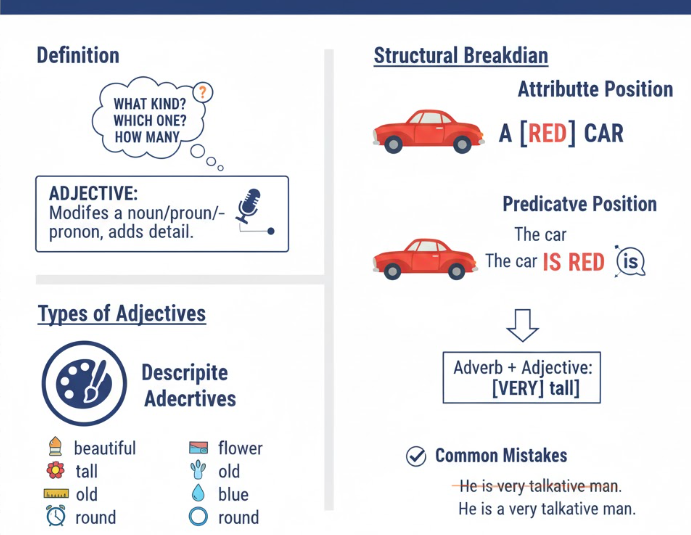
An adjective is a word that modifies a noun or pronoun, providing more information about it. Adjectives describe qualities, characteristics, or states of being related to the noun or pronoun they modify.
They answer questions like “What kind?”, “Which one?”, “How many?”, or “How much?” about the noun they describe. Adjectives are crucial for adding detail and specificity to our spoken and written language.
Adjectives can be classified based on their function and the type of information they provide. Understanding these classifications helps in using adjectives more effectively and accurately. For example, a descriptive adjective describes a quality of the noun, while a quantitative adjective indicates the quantity or amount. The context in which an adjective is used significantly affects its meaning and impact.
Structural Breakdown
Adjectives typically precede the noun they modify (attributive position), but they can also follow a linking verb, such as is, are, was, were, become, or seem (predicative position). Understanding these two positions is essential for correct sentence construction.
In the attributive position, the adjective directly precedes the noun. For example, in the phrase “a red car,” the adjective “red” comes before the noun “car.” In the predicative position, the adjective follows a linking verb and describes the subject of the sentence. For example, in the sentence “The car is red,” the adjective “red” follows the linking verb “is” and describes the subject “car.”
Adjectives can also be modified by adverbs to further refine their meaning. For instance, in the phrase “very tall,” the adverb “very” modifies the adjective “tall,” indicating a higher degree of tallness. This combination of adverbs and adjectives allows for more precise and nuanced descriptions.
Types of Adjectives
Adjectives can be categorized into several types based on their function and meaning. Here are some of the most common types:
Descriptive Adjectives
Descriptive adjectives, also known as qualitative adjectives, describe the qualities or characteristics of a noun. They provide information about the appearance, color, size, shape, or other attributes of the noun.
For instance, adjectives like beautiful, tall, old, blue, and round are all descriptive adjectives. They add vivid details and help create a clearer picture in the listener’s mind.
Quantitative Adjectives
Quantitative adjectives indicate the quantity or amount of a noun. They answer the question “How many?” or “How much?”.
Examples include one, few, many, several, some, and all. These adjectives are essential for providing specific information about the number or amount of something.
Demonstrative Adjectives
Demonstrative adjectives specify which noun is being referred to. They include the words this, that, these, and those.
This and these refer to nouns that are near in proximity or time, while that and those refer to nouns that are farther away. For example, “This book is interesting” and “Those cars are expensive.”
Possessive Adjectives
Possessive adjectives show ownership or possession. They include words like my, your, his, her, its, our, and their.
These adjectives always precede a noun and indicate who or what owns the noun. For example, “My car is new” and “Their house is large.”
Interrogative Adjectives
Interrogative adjectives are used to ask questions about nouns. The main interrogative adjectives are which and whose.
For example, “Which book do you want?” and “Whose car is this?” These adjectives help to specify the noun being questioned.
Proper Adjectives
Proper adjectives are formed from proper nouns and are always capitalized. They describe something as being related to a specific person, place, or thing.
Examples include American (from America), Shakespearean (from Shakespeare), and Victorian (from Victoria). For example, “an American car” and “a Shakespearean play.”
Compound Adjectives
Compound adjectives are formed by combining two or more words, often connected by a hyphen. They act as a single adjective modifying a noun.
Examples include well-known, high-quality, long-term, and easy-going. For example, “a well-known author” and “a long-term project.”
Examples of Adjectives in Sentences
The following tables provide numerous examples of adjectives used in sentences, categorized by adjective type. These examples illustrate how adjectives function in spoken English and enhance clarity and descriptiveness.
Descriptive Adjectives Examples
This table demonstrates the use of descriptive adjectives to add detail and color to sentences.
| Sentence | Descriptive Adjective |
|---|---|
| The beautiful sunset painted the sky with vibrant colors. | beautiful |
| She wore a red dress to the party. | red |
| The tall building dominated the city skyline. | tall |
| He has a friendly dog that loves to play. | friendly |
| The old house had a lot of character. | old |
| The coffee had a strong aroma. | strong |
| The delicious cake was quickly devoured. | delicious |
| The quiet library was a perfect place to study. | quiet |
| The heavy box was difficult to lift. | heavy |
| The bright sun made me squint. | bright |
| She has curly hair. | curly |
| The soft blanket was very comforting. | soft |
| The loud music made it hard to hear. | loud |
| The small town had a charming atmosphere. | small |
| He is a brave soldier. | brave |
| The angry customer complained to the manager. | angry |
| The happy children played in the park. | happy |
| The sad movie made her cry. | sad |
| The wise old man gave good advice. | wise |
| The clean room was very inviting. | clean |
| The dirty car needed a wash. | dirty |
| The expensive watch was a luxury item. | expensive |
| The cheap restaurant offered good value. | cheap |
| The dark night was filled with stars. | dark |
| The light rain was refreshing. | light |
Quantitative Adjectives Examples
This table illustrates the use of quantitative adjectives to specify the amount or quantity of nouns.
| Sentence | Quantitative Adjective |
|---|---|
| I have five apples in my basket. | five |
| Few people attended the meeting. | few |
| Many students study in the library. | many |
| I have several books on my shelf. | several |
| I need some sugar for my coffee. | some |
| All the tickets were sold out. | all |
| There are no chairs available. | no |
| He has one car. | one |
| She has two cats. | two |
| We need more time to finish the project. | more |
| I have less money than I thought. | less |
| There is enough food for everyone. | enough |
| He has little patience. | little |
| She has much experience in this field. | much |
| I have half a pizza left. | half |
| We need double the amount of ingredients. | double |
| He has a couple of friends visiting. | couple |
| She has hundreds of books. | hundreds |
| There are thousands of stars in the sky. | thousands |
| He has millions of dollars. | millions |
| I have zero complaints. | zero |
| She has several options to choose from. | several |
| He has a few close friends. | a few |
| There are a lot of opportunities here. | a lot of |
| I need a bit of help. | a bit of |
Demonstrative Adjectives Examples
This table provides examples of demonstrative adjectives, showing how they specify which noun is being referred to.
| Sentence | Demonstrative Adjective |
|---|---|
| This book is very interesting. | This |
| That car is very expensive. | That |
| These flowers smell wonderful. | These |
| Those birds are flying south for the winter. | Those |
| I like this song. | This |
| That idea sounds great. | That |
| These shoes are comfortable. | These |
| Those cookies look delicious. | Those |
| Can you pass me that pen? | That |
| This is my favorite restaurant. | This |
| I don’t like those kinds of movies. | Those |
| These problems are very difficult to solve. | These |
| That store is always crowded. | That |
| This coffee is too hot. | This |
| Those days were the best of my life. | Those |
| These are my friends. | These |
| That house is for sale. | That |
| This is my hometown. | This |
| Those are my parents. | Those |
| I want this one. | This |
| Give me that one. | That |
| Let’s try these flavors. | These |
| I remember those times fondly. | Those |
| This project is due tomorrow. | This |
| That building is historic. | That |
Possessive Adjectives Examples
This table shows the use of possessive adjectives to indicate ownership or possession.
| Sentence | Possessive Adjective |
|---|---|
| My car is parked outside. | My |
| Your house is very beautiful. | Your |
| His book is on the table. | His |
| Her dress is very elegant. | Her |
| The dog wagged its tail. | Its |
| Our team won the game. | Our |
| Their children are very polite. | Their |
| This is my pen. | My |
| What is your name? | Your |
| His job is very demanding. | His |
| Her smile is contagious. | Her |
| The company improved its profits. | Its |
| Our vacation was amazing. | Our |
| Their wedding was beautiful. | Their |
| Is that your bag? | Your |
| My favorite color is blue. | My |
| His favorite sport is soccer. | His |
| Her hobby is painting. | Her |
| The bird built its nest. | Its |
| Our goal is to succeed. | Our |
| Their plan is very ambitious. | Their |
| I like your style. | Your |
| My opinion matters too. | My |
| His advice was helpful. | His |
| Her voice is beautiful. | Her |
Usage Rules for Adjectives
There are several important rules to follow when using adjectives in spoken English. These rules ensure clarity, correctness, and effective communication.
- Adjective Order: When using multiple adjectives to describe a noun, follow a general order: opinion, size, age, shape, color, origin, material, and purpose. For example, “a beautiful large old round blue Italian leather dining table.”
- Coordinate Adjectives: Coordinate adjectives are adjectives that modify the same noun equally. They are separated by commas. For example, “a smart, talented student.” If the adjectives are not coordinate, do not use a comma. For example, “a tall young man.”
- Comparative and Superlative Forms: Use the comparative form (e.g., taller, more beautiful) to compare two things and the superlative form (e.g., tallest, most beautiful) to compare three or more things.
- Articles with Adjectives: When an adjective is used to describe a singular, countable noun, use the articles “a” or “an” appropriately. For example, “a tall building” or “an interesting book.”
- Proper Adjectives: Always capitalize proper adjectives, as they are derived from proper nouns. For example, “American” or “Shakespearean.”
Common Mistakes with Adjectives
Several common mistakes can occur when using adjectives, particularly for English language learners. Understanding these mistakes and how to correct them can significantly improve your spoken English.
| Incorrect | Correct | Explanation |
|---|---|---|
| The car red. | The car is red. | Adjectives must follow a linking verb when used in the predicative position. |
| A interesting book. | An interesting book. | Use “an” before adjectives that begin with a vowel sound. |
| He is more taller than me. | He is taller than me. | Do not use “more” with adjectives that already have “-er” in the comparative form. |
| She is the most tallest girl. | She is the tallest girl. | Do not use “most” with adjectives that already have “-est” in the superlative form. |
| A blue, old car. | A blue old car. | Adjectives of color and age are not coordinate and do not require a comma. |
| I have five apple. | I have five apples. | When using a quantitative adjective greater than one, the noun must be plural. |
| My brother car. | My brother’s car. Or My brother has a car. | This requires either the possessive form ‘s or the use of a possessive adjective. |
| This is my’s book. | This is my book. | “My” is already a possessive adjective and does not need an additional ‘s. |
| She is very interest. | She is very interested. | Use the correct form of the adjective (-ed for feeling, -ing for causing the feeling). |
| The weather is bore. | The weather is boring. | Use the correct form of the adjective (-ed for feeling, -ing for causing the feeling). |
Practice Exercises
Complete the following exercises to test your understanding of adjectives. Choose the correct adjective or form of the adjective to complete each sentence.
Exercise 1: Identifying Adjectives
Identify the adjectives in the following sentences.
| Question | Answer |
|---|---|
| The old house stood on a quiet street. | old, quiet |
| She wore a beautiful, red dress. | beautiful, red |
| He is a talented and smart musician. | talented, smart |
| The delicious cake was made with fresh ingredients. | delicious, fresh |
| The tall tree provided cool shade. | tall, cool |
| I have five cats and two dogs. | five, two |
| This book is more interesting than that one. | This, that |
| My favorite color is blue. | My, blue |
| Which car is yours? | Which |
| He is an American citizen. | American |
Exercise 2: Choosing the Correct Adjective Form
Choose the correct form of the adjective in the following sentences.
| Question | Answer |
|---|---|
| She is the (tall/taller/tallest) girl in the class. | tallest |
| This book is (interesting/more interesting/most interesting) than that one. | more interesting |
| He is a (good/better/best) student. | good |
| The weather is (cold/colder/coldest) today than yesterday. | colder |
| This is the (expensive/more expensive/most expensive) car in the showroom. | most expensive |
| She is (happy/happier/happiest) now that she has a new job. | happier |
| He is (brave/braver/bravest) than his brother. | braver |
| This is the (easy/easier/easiest) question on the test. | easiest |
| The coffee is (strong/stronger/strongest) than usual. | stronger |
| This summer is the (hot/hotter/hottest) on record. | hottest |
Exercise 3: Correcting Adjective Errors
Correct the adjective errors in the following sentences.
| Question | Corrected Answer |
|---|---|
| The car red is fast. | The red car is fast. |
| A interesting story. | An interesting story. |
| He is more taller than her. | He is taller than her. |
| She is the most tallest girl. | She is the tallest girl. |
| I have five apple. | I have five apples. |
| My brother car is new. | My brother’s car is new. |
| This is my’s pen. | This is my pen. |
| She is very interest in art. | She is very interested in art. |
| The movie was bore. | The movie was boring. |
| A old, green car. | An old green car. |
Advanced Topics
For advanced learners, understanding more complex aspects of adjective usage can further enhance their fluency and precision in spoken English.
- Participial Adjectives: These are adjectives formed from verbs (e.g., interesting, excited, broken). Understanding when to use the present participle (-ing) and past participle (-ed) forms is crucial.
- Adjective Clauses: Also known as relative clauses, these clauses function as adjectives, providing additional information about a noun. For example, “The book that I borrowed from the library is very interesting.”
- Intensifiers: Words like very, extremely, incredibly, and quite can be used to intensify the meaning of adjectives.
- Subject Complements: An adjective that follows a linking verb and describes the subject (e.g., “She is happy.”).
- Object Complements: An adjective that follows the direct object and modifies or describes it (e.g., “They painted the house blue.”).
Frequently Asked Questions
- What is the difference between attributive and predicative adjectives?Attributive adjectives come before the noun they modify (e.g., “a red car”), while predicative adjectives follow a linking verb and describe the subject (e.g., “The car is red“).
- How do I know the correct order of adjectives when using multiple adjectives?Follow the general order: opinion, size, age, shape, color, origin, material, and purpose. This order helps ensure clarity and natural-sounding sentences.
- When should I use a comma between adjectives?Use a comma between coordinate adjectives, which are adjectives that modify the same noun equally. If the adjectives are not coordinate, do not use a comma.
- What are participial adjectives, and how do I use them correctly?Participial adjectives are formed from verbs and can be either present participles (-ing) or past participles (-ed). Use the -ing form for adjectives that describe something that causes a feeling or quality (e.g., “The movie was boring“), and use the -ed form for adjectives that describe a feeling or state (e.g., “I was bored“).
- How can I improve my use of adjectives in spoken English?Practice using a variety of adjectives in your conversations, pay attention to the adjective order, and listen to native speakers to observe how they use adjectives in different contexts. Reading widely and noting adjective usage is also very beneficial.
- What is the difference between demonstrative and possessive adjectives?Demonstrative adjectives (this, that, these, those) specify which noun is being referred to, while possessive adjectives (my, your, his, her, its, our, their) show ownership or possession.
- Can a noun act as an adjective?Yes, a noun can sometimes function as an adjective. This is called a noun adjunct or attributive noun. For example, in the phrase “science class,” the noun “science” modifies the noun “class.”
- How do I choose the right adjective to describe something?Consider the specific qualities or characteristics you want to highlight. Think about the context and the impression you want to create. Use a thesaurus to find synonyms and expand your vocabulary.
Conclusion
Mastering the use of adjectives is crucial for effective communication in spoken English. By understanding the different types of adjectives, their structural roles, and the rules governing their usage, you can significantly enhance your clarity, expressiveness, and overall fluency.
Pay attention to common mistakes and practice regularly to solidify your understanding.
Remember to focus on incorporating a variety of adjectives into your everyday conversations. Listen to native speakers and observe how they use adjectives to add detail and nuance to their speech.
With consistent effort and practice, you can confidently and accurately use adjectives to enrich your spoken English and communicate more effectively.