Adjectives are essential for painting vivid pictures with words, and when describing sportsmen, they can bring their achievements, personalities, and physical attributes to life. Mastering adjectives allows us to convey not only what a sportsman *is*, but also *how* they perform and *why* they inspire.
This article provides a comprehensive guide to using adjectives effectively to describe sportsmen, covering definitions, structures, types, usage rules, common mistakes, and practice exercises. Whether you’re a student, writer, or sports enthusiast, this guide will enhance your ability to communicate with precision and flair.
This guide will benefit anyone who wants to improve their descriptive writing skills, particularly when focusing on sports and athletes. By understanding the nuances of adjective usage, you can add depth and color to your descriptions, making them more engaging and informative.
Table of Contents
- Definition of Adjectives for Sportsmen
- Structural Breakdown
- Types and Categories of Adjectives
- Examples of Adjectives for Sportsmen
- Usage Rules for Adjectives
- Common Mistakes with Adjectives
- Practice Exercises
- Advanced Topics
- Frequently Asked Questions
- Conclusion
Definition of Adjectives for Sportsmen
An adjective is a word that modifies a noun or pronoun, providing more information about it. When describing sportsmen, adjectives help us specify qualities, characteristics, achievements, and physical attributes.
Adjectives add detail and specificity, making our descriptions more engaging and informative.
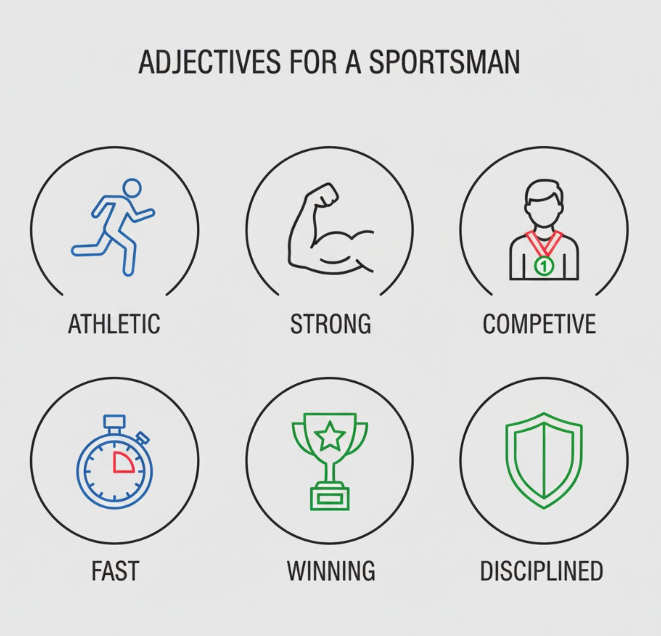
Adjectives can be classified based on their function and meaning. Some adjectives describe physical attributes (e.g., *tall*, *strong*, *agile*), while others describe personality traits (e.g., *determined*, *courageous*, *humble*).
Still others describe performance (e.g., *skilled*, *precise*, *consistent*). Understanding these classifications helps in choosing the right adjective for the context.
In the context of sports, adjectives are crucial for conveying the essence of an athlete. They can highlight their strengths, weaknesses, and overall impact on the game.
For example, describing a basketball player as *dominant* conveys a different meaning than describing them as *reliable*. The choice of adjective significantly impacts the reader’s perception of the sportsman.
Structural Breakdown
Adjectives typically appear before the noun they modify (attributive position) or after a linking verb (predicative position). The structure of a sentence can change depending on where the adjective is placed.
Attributive Adjectives: These adjectives come directly before the noun they describe. This is the most common placement. For example, in the phrase “a fast runner,” the adjective *fast* precedes the noun *runner*.
Predicative Adjectives: These adjectives follow a linking verb (such as *is*, *are*, *was*, *were*, *seems*, *becomes*). For example, in the sentence “The athlete is determined,” the adjective *determined* follows the linking verb *is*.
Adjectives can also be modified by adverbs to add further detail. For example, “an extremely talented player” uses the adverb *extremely* to intensify the adjective *talented*.
Types and Categories of Adjectives
Adjectives can be categorized in various ways, including by their function and the type of information they provide. Here are some key categories:
Descriptive Adjectives
Descriptive adjectives describe the qualities or characteristics of a noun. They answer the question, “What kind?” Examples include *strong*, *agile*, *intelligent*, and *dedicated*.
Quantitative Adjectives
Quantitative adjectives indicate the quantity or amount of a noun. Examples include *many*, *few*, *several*, and *numerous*.
Demonstrative Adjectives
Demonstrative adjectives specify which noun is being referred to. The main demonstrative adjectives are *this*, *that*, *these*, and *those*. For example, “This game is crucial.”
Possessive Adjectives
Possessive adjectives indicate ownership or belonging. Examples include *his*, *her*, *my*, *your*, *its*, *our*, and *their*. For example, “His performance was outstanding.”
Interrogative Adjectives
Interrogative adjectives are used in questions to ask about a noun. The main interrogative adjectives are *which*, *what*, and *whose*. For example, “Which team will win?”
Proper Adjectives
Proper adjectives are formed from proper nouns and are usually capitalized. For example, *American* athlete, *Olympic* games.
Examples of Adjectives for Sportsmen
The following tables provide extensive examples of adjectives used to describe sportsmen, categorized by different attributes.
Physical Attributes
This table focuses on adjectives that describe a sportsman’s physical characteristics.
| Adjective | Example Sentence |
|---|---|
| Athletic | The athletic swimmer won three gold medals. |
| Muscular | The muscular weightlifter broke the world record. |
| Tall | The tall basketball player dominated the court. |
| Agile | The agile gymnast performed flawlessly. |
| Strong | The strong rugby player tackled his opponent. |
| Fast | The fast sprinter crossed the finish line first. |
| Lean | The lean marathon runner maintained a steady pace. |
| Nimble | The nimble soccer player dribbled past the defenders. |
| Sturdy | The sturdy wrestler overpowered his opponent. |
| Tough | The tough boxer endured many hard hits. |
| Resilient | The resilient athlete recovered quickly from the injury. |
| Energetic | The energetic player motivated the team. |
| Graceful | The graceful dancer captivated the audience. |
| Brawny | The brawny strongman lifted an incredible weight. |
| Well-built | The well-built swimmer had a powerful physique. |
| Lithe | The lithe gymnast moved with ease and precision. |
| Robust | The robust cyclist completed the challenging race. |
| Wiry | The wiry jockey skillfully controlled the horse. |
| Compact | The compact figure skater executed a perfect spin. |
| Powerful | The powerful tennis player served an ace. |
| Healthy | The healthy athlete maintained a strict diet. |
| Conditioned | The conditioned boxer was ready for the fight. |
| Sculpted | The sculpted physique of the bodybuilder was impressive. |
| Proportionate | The proportionate build of the athlete was ideal for the sport. |
| Enduring | The enduring mountain climber reached the summit. |
| Quick | The quick reflexes of the goalie saved the game. |
| Fleet-footed | The fleet-footed runner easily outpaced the competition. |
| Stamina-filled | The stamina-filled cyclist completed the tour. |
Personality Traits
This table focuses on adjectives that describe a sportsman’s character and personality.
| Adjective | Example Sentence |
|---|---|
| Determined | The determined athlete never gave up. |
| Courageous | The courageous climber faced the dangerous peak. |
| Humble | The humble champion always acknowledged his team. |
| Resilient | The resilient player bounced back from the injury. |
| Disciplined | The disciplined sportsman followed a strict regimen. |
| Focused | The focused archer aimed with precision. |
| Competitive | The competitive racer pushed himself to the limit. |
| Passionate | The passionate coach inspired his players. |
| Dedicated | The dedicated athlete trained tirelessly. |
| Persistent | The persistent swimmer kept practicing despite setbacks. |
| Ambitious | The ambitious golfer aimed for the top spot. |
| Tenacious | The tenacious defender never let the opponent score. |
| Gracious | The gracious loser congratulated the winner. |
| Modest | The modest champion downplayed his achievements. |
| Patient | The patient angler waited for the perfect catch. |
| Confident | The confident quarterback led his team to victory. |
| Optimistic | The optimistic player believed in his team’s chances. |
| Respectful | The respectful athlete honored his opponents. |
| Supportive | The supportive teammate encouraged his colleagues. |
| Inspirational | The inspirational leader motivated his team. |
| Hardworking | The hardworking athlete achieved great success. |
| Principled | The principled player always played fair. |
| Selfless | The selfless captain put the team first. |
| Courteous | The courteous player showed respect to all. |
| Focused | The focused athlete blocked out all distractions. |
| Determined | The determined fighter refused to give up. |
| Brave | The brave skydiver leaped from the plane. |
| Fearless | The fearless mountaineer scaled the highest peak. |
Performance-Related Adjectives
This table focuses on adjectives that describe a sportsman’s performance and skill.
| Adjective | Example Sentence |
|---|---|
| Skilled | The skilled tennis player won the tournament. |
| Precise | The precise archer hit the bullseye. |
| Consistent | The consistent golfer maintained a steady score. |
| Efficient | The efficient swimmer used minimal energy. |
| Effective | The effective strategy led to victory. |
| Talented | The talented musician excelled in sports too. |
| Gifted | The gifted athlete broke several records. |
| Accomplished | The accomplished skier navigated the slopes. |
| Proficient | The proficient cyclist handled the bike expertly. |
| Expert | The expert marksman never missed a shot. |
| Masterful | The masterful chess player won the game. |
| Strategic | The strategic planner designed the winning play. |
| Innovative | The innovative coach introduced new techniques. |
| Brilliant | The brilliant tactician outmaneuvered the opponent. |
| Remarkable | The remarkable performance amazed the audience. |
| Outstanding | The outstanding athlete received numerous awards. |
| Exceptional | The exceptional talent was evident from a young age. |
| Superb | The superb technique led to a flawless victory. |
| Impressive | The impressive display of skill was unforgettable. |
| Spectacular | The spectacular save prevented a goal. |
| Dominant | The dominant player controlled the game. |
| Versatile | The versatile athlete excelled in multiple sports. |
| Adaptable | The adaptable player adjusted to the changing conditions. |
| Calculated | The calculated moves led to success. |
| Elite | The elite team won the championship. |
| Top-tier | The top-tier player was highly respected. |
| World-class | The world-class athlete represented the country. |
Usage Rules for Adjectives
Using adjectives correctly involves understanding their placement, order, and agreement with the nouns they modify.
Adjective Order: When using multiple adjectives, there is a general order to follow, though it’s not a rigid rule. The typical order is: opinion, size, age, shape, color, origin, material, and purpose. For example: “a beautiful small old round blue Italian leather soccer ball.” However, it’s best to use only two or three adjectives at most for clarity.
Compound Adjectives: These are adjectives made up of two or more words, often hyphenated. For example, “a well-trained athlete” or “a world-renowned sportsman.”
Coordinate Adjectives: These are adjectives of equal rank that modify the same noun. They are separated by a comma. For example, “a strong, agile player.”
Proper Adjectives: Always capitalize proper adjectives as they are derived from proper nouns. For example, *Olympic* games, *American* athlete.
Common Mistakes with Adjectives
Here are some common mistakes to avoid when using adjectives to describe sportsmen.
Incorrect: The athlete is more better than the others.
Correct: The athlete is better than the others.
Incorrect: He is a very strong muscular athlete.
Correct: He is a very strong athlete or He is a muscular athlete. (Avoid using too many similar adjectives.)
Incorrect: The player is goodly.
Correct: The player is good.
Incorrect: This athlete is most talented.
Correct: This athlete is very talented or This athlete is the most talented.
Incorrect: The team played bad.
Correct: The team played badly. (Use an adverb to modify a verb.)
Incorrect: A old fast car.
Correct: A fast old car. (Adjective order matters.)
Practice Exercises
Test your understanding of adjectives with these practice exercises.
Exercise 1: Identifying Adjectives
Identify the adjectives in the following sentences.
| Question | Answer |
|---|---|
| 1. The dedicated athlete trained hard. | dedicated |
| 2. The tall basketball player scored the winning point. | tall |
| 3. The courageous climber scaled the dangerous peak. | courageous, dangerous |
| 4. The skilled swimmer won the gold medal. | skilled, gold |
| 5. The competitive racer pushed himself to the limit. | competitive |
| 6. The agile gymnast performed a flawless routine. | agile, flawless |
| 7. The impressive display of skill amazed the crowd. | impressive |
| 8. The humble champion thanked his team. | humble |
| 9. The strategic planner designed the winning play. | strategic, winning |
| 10. The persistent runner never gave up. | persistent |
Exercise 2: Filling in the Blanks
Fill in the blanks with appropriate adjectives.
| Question | Answer |
|---|---|
| 1. The ______ athlete broke the world record. | strong/muscular/talented |
| 2. The ______ coach inspired his players. | passionate/dedicated/inspirational |
| 3. The ______ tennis player won the match. | skilled/talented/competitive |
| 4. The ______ gymnast performed gracefully. | agile/lithe/graceful |
| 5. The ______ soccer player dribbled past the defenders. | nimble/quick/fast |
| 6. The ______ climber reached the summit. | enduring/brave/fearless |
| 7. The ______ boxer was ready for the fight. | conditioned/tough/resilient |
| 8. The ______ racer pushed himself to the limit. | competitive/ambitious/tenacious |
| 9. The ______ leader motivated the team. | inspirational/supportive/hardworking |
| 10. The ______ player always played fair. | principled/courteous/respectful |
Exercise 3: Correcting Mistakes
Correct the mistakes in the following sentences.
| Question | Answer |
|---|---|
| 1. The athlete is more stronger than the others. | The athlete is stronger than the others. |
| 2. He is a very strong muscular athlete. | He is a very strong athlete. / He is a muscular athlete. |
| 3. The player is goodly. | The player is good. |
| 4. This athlete is most talented. | This athlete is very talented. / This athlete is the most talented. |
| 5. The team played bad. | The team played badly. |
| 6. A old fast car. | A fast old car. |
| 7. The boxer is very bravely. | The boxer is very brave. |
| 8. She is the most best player on the team. | She is the best player on the team. |
| 9. He is more taller than his brother. | He is taller than his brother. |
| 10. The team was badly prepared for the game. | The team was poorly prepared for the game. |
Advanced Topics
For advanced learners, exploring nuanced uses and literary applications of adjectives can further enhance descriptive skills.
Figurative Language: Adjectives can be used in metaphors and similes to create vivid comparisons. For example, “His determination was as unyielding as steel.”
Abstract Adjectives: These adjectives describe intangible qualities, such as *honorable*, *ethical*, and *inspirational*. Using abstract adjectives effectively requires a deep understanding of the subject.
Intensifiers and Qualifiers: Mastering the use of adverbs to modify adjectives (intensifiers like *very*, *extremely*, and qualifiers like *somewhat*, *relatively*) allows for more precise descriptions. For example, “a remarkably consistent performance” versus “a somewhat consistent performance.”
Frequently Asked Questions
Here are some frequently asked questions about using adjectives to describe sportsmen.
Q1: What is the difference between an attributive and a predicative adjective?
A: An attributive adjective comes before the noun it modifies (e.g., “a fast runner”), while a predicative adjective follows a linking verb (e.g., “The runner is fast“).
Q2: How do I choose the right adjective to describe a sportsman?
A: Consider the specific qualities, characteristics, and achievements you want to highlight. Use a thesaurus to explore synonyms and find the most precise and impactful word.
Q3: Can I use multiple adjectives to describe a sportsman?
A: Yes, but it’s best to use only two or three adjectives at most for clarity. Follow the general order of adjectives (opinion, size, age, shape, color, origin, material, purpose) when using multiple adjectives.
Q4: What are compound adjectives, and how should they be used?
A: Compound adjectives are made up of two or more words, often hyphenated (e.g., “a well-trained athlete”). Use them to provide more specific and nuanced descriptions.
Q5: How do I avoid common mistakes when using adjectives?
A: Pay attention to adjective order, avoid using double comparatives (e.g., “more better”), and ensure that adjectives agree with the nouns they modify.
Q6: Are there any adjectives that should be avoided when describing sportsmen?
A: Avoid using adjectives that are vague, overused, or could be interpreted as biased or offensive. Strive for specificity and accuracy in your descriptions.
Q7: How can I improve my vocabulary of adjectives for describing sportsmen?
A: Read widely, pay attention to the language used in sports journalism and literature, and use a thesaurus to explore synonyms and expand your vocabulary.
Q8: What role do adverbs play in relation to adjectives when describing sportsmen?
A: Adverbs modify adjectives, adding intensity or qualification. For example, “an extremely talented player” or “a somewhat consistent performance.” Using adverbs effectively can enhance the precision of your descriptions.
Conclusion
Mastering the use of adjectives is crucial for effectively describing sportsmen and conveying their unique qualities, characteristics, and achievements. By understanding the different types of adjectives, their placement, and usage rules, you can add depth, color, and precision to your writing.
Remember to avoid common mistakes and continuously expand your vocabulary to become a more skilled and articulate communicator.
Continue practicing with the exercises provided and exploring new adjectives to refine your descriptive skills. With dedication and attention to detail, you can enhance your ability to bring the world of sports to life through vivid and engaging language.
The key takeaway is that intentional adjective use makes your descriptions not just accurate, but also captivating.