The wind, an invisible yet powerful force, has captivated humanity for centuries. From the gentle caress of a summer breeze to the destructive fury of a hurricane, its nuances are vast and varied.
To accurately depict the wind in writing or conversation, a rich vocabulary of adjectives is essential. This article provides a comprehensive exploration of adjectives used to describe wind, helping you paint vivid and precise pictures with your words.
Whether you’re a student, writer, or simply an enthusiast of the English language, this guide will enhance your understanding and appreciation of the descriptive power of adjectives for wind.
Table of Contents
- Introduction
- Definition of Adjectives for Wind
- Structural Breakdown
- Types and Categories of Adjectives for Wind
- Examples of Adjectives for Wind
- Usage Rules for Adjectives for Wind
- Common Mistakes
- Practice Exercises
- Advanced Topics
- FAQ
- Conclusion
Definition of Adjectives for Wind
Adjectives for wind are words that modify nouns related to wind, providing more specific and descriptive information about its characteristics. These adjectives help to convey the intensity, direction, effect, and overall quality of the wind.
They play a crucial role in creating vivid imagery and conveying precise meaning in both spoken and written language. Understanding these adjectives enhances your ability to describe weather conditions, environmental scenes, and even metaphorical situations involving forces similar to wind.
In grammatical terms, adjectives for wind function like any other adjective. They typically precede the noun they modify (e.g., “a strong wind”) or follow a linking verb (e.g., “The wind is bitter“). They can be classified based on their specific descriptive function, such as intensity (e.g., gentle, fierce), direction (e.g., easterly, northerly), effect (e.g., chilling, soothing), or quality (e.g., stale, fresh).
Structural Breakdown
The structure of phrases using adjectives for wind is generally straightforward. The adjective typically appears before the noun it modifies.
However, the placement can vary depending on the sentence structure and the presence of other modifiers.
Here are some common structural patterns:
- Adjective + Noun: This is the most common structure. For example, “a gusty wind,” “the icy wind.”
- Article + Adjective + Noun: This structure includes an article (a, an, the) before the adjective. For example, “a cold wind,” “the prevailing wind.”
- Linking Verb + Adjective: In this structure, the adjective follows a linking verb (e.g., is, are, was, were, seems). For example, “The wind is strong,” “The breeze was gentle.”
Adjectives can also be modified by adverbs to further refine their meaning. For example, “an incredibly strong wind,” “a barely perceptible breeze.”
Types and Categories of Adjectives for Wind
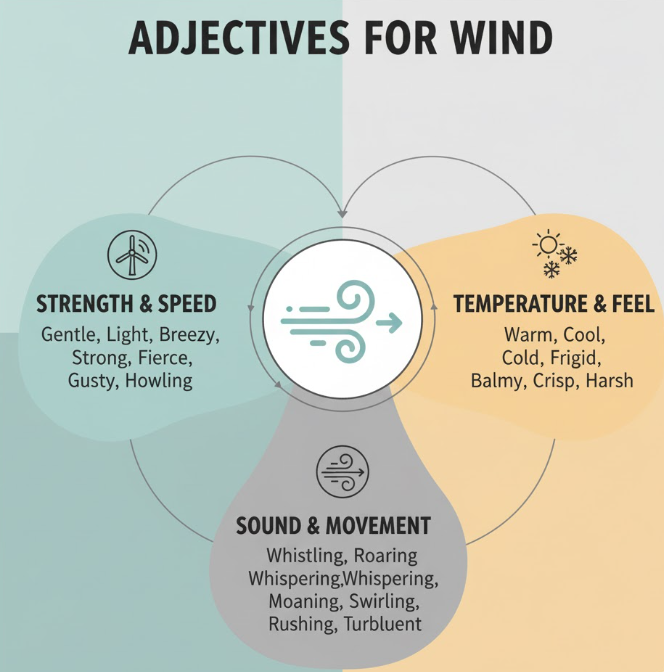
Adjectives for wind can be categorized based on the specific aspect of the wind they describe. Here are four main categories:
Adjectives Describing Intensity
These adjectives indicate the strength or force of the wind. They range from very mild to extremely powerful.
Adjectives Describing Direction
These adjectives specify the direction from which the wind is blowing. They are often based on compass points.
Adjectives Describing Effect
These adjectives describe the impact or sensation caused by the wind, such as its temperature or how it feels.
Adjectives Describing Quality
These adjectives describe the general characteristics or attributes of the wind, such as its freshness or steadiness.
Examples of Adjectives for Wind
Here are some examples of adjectives for wind, organized by category. Each table provides a variety of adjectives with example sentences to illustrate their use.
Intensity Examples
The following table provides examples of adjectives used to describe the intensity of the wind, ranging from gentle to fierce.
| Adjective | Example Sentence |
|---|---|
| Gentle | A gentle breeze rustled the leaves in the trees. |
| Light | The light wind barely disturbed the surface of the lake. |
| Mild | A mild wind made the summer evening pleasant. |
| Weak | The weak wind was not enough to fill the sails of the boat. |
| Faint | A faint whisper of wind carried the scent of wildflowers. |
| Moderate | A moderate wind picked up, causing the waves to grow larger. |
| Fresh | A fresh wind blew in from the sea, bringing a salty smell. |
| Brisk | A brisk wind invigorated the hikers on the trail. |
| Strong | A strong wind whipped through the city streets, scattering debris. |
| Gale-force | The gale-force wind made it difficult to stand upright. |
| Powerful | The powerful wind threatened to uproot the old oak tree. |
| Fierce | A fierce wind howled through the mountains, creating a deafening roar. |
| Violent | The violent wind tore down power lines and damaged buildings. |
| Raging | A raging wind battered the coastline, causing severe flooding. |
| Tempestuous | The tempestuous wind made sailing impossible. |
| Howling | The howling wind kept us awake all night. |
| Gusty | A gusty wind made it difficult to control the kite. |
| Blustery | The blustery wind swirled leaves and snow into the air. |
| Whirlwind | A sudden whirlwind kicked up dust and debris in the desert. |
| Hurricane-force | The hurricane-force winds caused widespread devastation. |
| Forceful | The forceful wind slammed the door shut. |
| Heady | A heady wind whipped through the city streets. |
| Intense | The intense wind made it difficult to see. |
| Keen | A keen wind cut through our jackets. |
| Lusty | A lusty wind blew the laundry off the line. |
| Mighty | The mighty wind shaped the landscape over centuries. |
| Piercing | A piercing wind made our bones ache. |
| Potent | A potent wind carried the scent of rain. |
Direction Examples
The following table provides examples of adjectives used to describe the direction from which the wind is blowing.
| Adjective | Example Sentence |
|---|---|
| Northerly | A northerly wind brought cold air from the Arctic. |
| Southerly | A southerly wind carried the warm scent of the tropics. |
| Easterly | An easterly wind often brings dry weather. |
| Westerly | A westerly wind is common in this region. |
| Northeasterly | A northeasterly wind can bring snow in the winter. |
| Northwesterly | A northwesterly wind is often associated with clear skies. |
| Southeasterly | A southeasterly wind is bringing humid air. |
| Southwesterly | A southwesterly wind is expected to bring rain. |
| Onshore | The onshore wind made the waves perfect for surfing. |
| Offshore | The offshore wind created calm conditions near the beach. |
| Upstream | The upstream wind made it difficult for the birds to fly. |
| Downstream | The downstream wind carried the leaves away. |
| Leeward | The leeward wind side of the island was sheltered from the storm. |
| Windward | The windward side of the mountain received the most rain. |
| Trade | The trade winds are a constant feature of the tropical climate. |
| Polar | The polar winds brought freezing temperatures. |
| Equatorial | The equatorial winds are warm and moist. |
| Returning | The returning wind brought the storm back. |
| Head | The head wind slowed the cyclist down. |
| Following | The following wind helped the sailor reach his destination. |
| Cross | The cross wind made landing the plane difficult. |
| Prevailing | The prevailing wind direction is from the west. |
| Regional | The regional wind patterns affect agriculture in the area. |
| Local | The local wind conditions are influenced by the mountains. |
| Venturi | The Venturi wind effect increased the wind speed through the valley. |
Effect Examples
The following table provides examples of adjectives used to describe the effect or sensation of the wind.
| Adjective | Example Sentence |
|---|---|
| Chilling | A chilling wind swept across the plains. |
| Freezing | The freezing wind made my fingers numb. |
| Icy | An icy wind cut through my coat. |
| Bitter | The bitter wind stung my cheeks. |
| Cold | A cold wind blew down from the mountains. |
| Warm | A warm wind carried the scent of flowers. |
| Balmy | A balmy wind made the evening pleasant. |
| Soothing | A soothing wind calmed my nerves. |
| Refreshing | A refreshing wind invigorated me after the long hike. |
| Invigorating | The invigorating wind made me feel alive. |
| Dusty | A dusty wind swirled sand around our feet. |
| Sandy | A sandy wind stung our faces at the beach. |
| Cutting | The cutting wind made our eyes water. |
| Piercing | The piercing wind went right through our layers of clothing. |
| Howling | The howling wind kept us awake at night. |
| Whispering | A whispering wind rustled the leaves. |
| Moaning | The moaning wind sounded eerie in the dark. |
| Singing | The singing wind made the trees sound like they were alive. |
| Lashing | The lashing wind drove the rain against the windows. |
| Driving | The driving wind made it difficult to see. |
| Raw | The raw wind chilled us to the bone. |
| Gusting | The gusting wind made it difficult to steer the boat. |
| Blasting | The blasting wind nearly knocked us over. |
| Scorching | The scorching wind dried out the land. |
| Benumbing | The benumbing wind froze our exposed skin. |
| Caressing | A caressing wind barely moved the curtains. |
Quality Examples
The following table provides examples of adjectives used to describe the overall quality or characteristics of the wind.
| Adjective | Example Sentence |
|---|---|
| Steady | A steady wind is ideal for sailing. |
| Constant | The constant wind made the windmill turn continuously. |
| Erratic | The erratic wind made it difficult to predict where the kite would go. |
| Variable | The variable wind kept changing direction. |
| Stable | The stable wind conditions allowed for a safe flight. |
| Fresh | The fresh wind carried the scent of pine trees. |
| Stale | The stale wind in the city felt polluted. |
| Clean | The clean wind from the mountains was invigorating. |
| Salty | The salty wind reminded me of the ocean. |
| Dry | A dry wind can cause wildfires. |
| Humid | A humid wind makes the air feel sticky. |
| Oppressive | The oppressive wind felt heavy and stifling. |
| Balmy | The balmy wind signaled the arrival of spring. |
| Keen | A keen wind whipped through the trees. |
| Autumnal | The autumnal wind carried the scent of fallen leaves. |
| Ethereal | An ethereal wind seemed to whisper secrets. |
| Whimsical | A whimsical wind played with the dandelion seeds. |
| Capricious | The capricious wind shifted without warning. |
| Fickle | The fickle wind changed its mind every second. |
| Gusting | The gusting wind made the boat difficult to control. |
| Whirling | The whirling wind created small dust devils. |
| Pungent | A pungent wind carried the smell of burning wood. |
| Acrid | An acrid wind carried the smell of smoke from the factory. |
| Fragrant | A fragrant wind carried the scent of jasmine. |
| Aromatic | An aromatic wind carried the smell of spices from the market. |
| Misty | A misty wind shrouded the hills. |
Usage Rules for Adjectives for Wind
Using adjectives for wind correctly involves understanding their specific meanings and connotations. Here are some general rules to follow:
- Choose the right adjective for the context: Consider the specific characteristics you want to convey. For example, use “strong” to describe the intensity of the wind, “northerly” to indicate its direction, and “chilling” to describe its effect.
- Use adjectives sparingly: While adjectives can enhance your writing, overusing them can make it sound cluttered and unnatural. Choose adjectives that add significant detail and avoid redundancy.
- Pay attention to connotations: Some adjectives have positive or negative connotations. For example, “balmy” has a positive connotation, while “bitter” has a negative one. Choose adjectives that align with the overall tone and mood of your writing.
- Consider the combination of adjectives: You can use multiple adjectives to describe the wind, but make sure they work well together. For example, “a cold, strong wind” is a common and effective combination.
Common Mistakes
Here are some common mistakes to avoid when using adjectives for wind:
| Incorrect | Correct | Explanation |
|---|---|---|
| The wind was hardly strong. | The wind was barely strong. | “Hardly” means almost not at all, which doesn’t make sense. “Barely” is more appropriate. |
| A heavily wind blew. | A strong wind blew. | “Heavily” is an adverb and cannot modify the noun “wind.” Use the adjective “strong” instead. |
| The wind is southerly from the north. | The wind is northerly. | The wind cannot be southerly from the north. Choose the correct direction. |
| A refresh wind. | A refreshing wind. | The correct adjective form is “refreshing,” not “refresh.” |
| The wind was very gale. | The wind was gale-force. | “Gale” is a noun. Use “gale-force” as an adjective. |
Practice Exercises
Test your understanding of adjectives for wind with these practice exercises.
Exercise 1: Fill in the Blanks
Choose the most appropriate adjective from the list to fill in the blank in each sentence. (Options: gentle, strong, northerly, chilling, fresh)
| Question | Answer |
|---|---|
| 1. A ______ breeze rustled the curtains. | gentle |
| 2. The ______ wind made it difficult to walk against. | strong |
| 3. A ______ wind brought cold air from Canada. | northerly |
| 4. The ______ wind made us shiver despite our warm coats. | chilling |
| 5. A ______ wind blew in from the sea, carrying the scent of salt. | fresh |
| 6. The ______ wind carried sounds from far away. | gentle |
| 7. The ______ wind made it difficult to open the door. | strong |
| 8. A ______ wind is often associated with snow. | northerly |
| 9. The ______ wind made exposed skin sting. | chilling |
| 10. A ______ wind cleared the stuffy air in the room. | fresh |
Exercise 2: Sentence Rewriting
Rewrite each sentence using a more descriptive adjective for wind.
| Original Sentence | Rewritten Sentence |
|---|---|
| 1. The wind was cold. | The wind was icy. |
| 2. The wind was strong. | The wind was gale-force. |
| 3. The wind was from the east. | The wind was easterly. |
| 4. The wind felt good. | The wind felt refreshing. |
| 5. The wind was changing. | The wind was variable. |
| 6. The wind was somewhat strong. | The wind was brisk. |
| 7. The wind was from the south. | The wind was southerly. |
| 8. The wind was warm and pleasant. | The wind was balmy. |
| 9. The wind was not consistent. | The wind was erratic. |
| 10. The wind was quite cold. | The wind was bitter. |
Exercise 3: Adjective Identification
Identify the adjective describing the wind in each sentence and indicate its category (Intensity, Direction, Effect, or Quality).
| Sentence | Adjective | Category |
|---|---|---|
| 1. A gentle breeze stirred the leaves. | gentle | Intensity |
| 2. The northerly wind brought snow. | northerly | Direction |
| 3. A chilling wind swept across the plains. | chilling | Effect |
| 4. The steady wind filled the sails. | steady | Quality |
| 5. A strong gust of wind nearly blew my hat off. | strong | Intensity |
| 6. An easterly wind brought dry weather. | easterly | Direction |
| 7. The freezing wind made my fingers numb. | freezing | Effect |
| 8. The fresh wind carried the scent of pine. | fresh | Quality |
| 9. A blustery wind swirled the snow around. | blustery | Intensity |
| 10. The prevailing wind comes from the west. | prevailing | Direction |
Advanced Topics
For advanced learners, here are some more complex aspects of adjectives for wind:
- Figurative Language: Adjectives for wind can be used metaphorically to describe other forces or influences. For example, “a whirlwind of emotions,” “the chilling effect of criticism.”
- Compound Adjectives: These are adjectives formed from two or more words, such as “gale-force,” “hurricane-proof,” or “wind-swept.”
- Regional Variations: The specific adjectives used to describe wind can vary depending on the region or dialect. For example, some regions might use “zephyr” to describe a gentle breeze, while others might use “flurry.”
- Literary Usage: In literature, adjectives for wind are often used to create atmosphere and mood. Authors may use vivid and evocative adjectives to convey the power and unpredictability of the wind.
FAQ
Here are some frequently asked questions about adjectives for wind:
- What is the difference between “breeze” and “wind”?Generally, “breeze” refers to a light and gentle wind, while “wind” is a more general term that can refer to any moving air. The Beaufort scale provides a more precise classification based on wind speed.
- How can I improve my vocabulary of adjectives for wind?Read widely, paying attention to how authors describe weather conditions. Use a thesaurus to find synonyms for common adjectives. Practice using new adjectives in your own writing and conversation.
- Are there any adjectives that can describe both the intensity and the effect of the wind?Yes, some adjectives, such as “bitter,” can describe both the intensity (strong) and the effect (cold and unpleasant) of the wind.
- What are some good resources for learning more about weather terminology?Meteorological websites, weather dictionaries, and books on meteorology are excellent resources for expanding your knowledge of weather terminology, including adjectives for wind.
- How do I choose the right adjective for describing wind in a poem?Consider the mood and imagery you want to create. Choose adjectives that evoke the desired emotions and sensory experiences. Experiment with different combinations of adjectives to find the most effective ones.
- Is it correct to say “a windy wind”?While grammatically correct, it’s redundant. “Windy” already implies the presence of wind. A better alternative would be “a strong wind” or “a blustery wind.”
- Can I use adjectives for wind to describe something other than the weather?Yes, adjectives for wind can be used metaphorically to describe other forces or influences that resemble wind in their intensity, direction, or effect. For example, you might describe a political movement as “gaining momentum like a strong wind.”
- What is the best way to practice using these adjectives in conversation?Try describing the weather each day using a variety of adjectives. Engage in conversations about outdoor activities and use adjectives for wind to describe the conditions. The more you practice, the more natural it will become.
Conclusion
Mastering adjectives for wind is a valuable skill for anyone seeking to improve their descriptive abilities in English. By understanding the different categories of adjectives and their specific meanings, you can paint vivid and precise pictures with your words.
Remember to choose adjectives carefully, paying attention to context, connotation, and the overall tone of your writing. Regular practice and exposure to diverse texts will further enhance your command of this essential aspect of English grammar.
From the gentle caress of a “soft” breeze to the destructive power of a “violent” gale, the wind offers a wide range of descriptive possibilities. Embrace the challenge of finding the perfect adjective to capture its essence, and your writing will soar to new heights.
Keep exploring, keep practicing, and keep refining your understanding of this fascinating topic. The world of adjectives for wind is vast and rewarding, offering endless opportunities for linguistic creativity and precision.