Learning how to express beauty in German is crucial for enriching your vocabulary and enhancing your communication skills. The German language offers a variety of words and phrases to describe different types of beauty, from physical attractiveness to the beauty of nature or art.
Understanding these nuances allows you to express yourself more precisely and appreciate the richness of the German language. This article provides a comprehensive guide to the various ways of saying “beautiful” in German, along with examples, usage rules, and practice exercises.
This guide is beneficial for students of all levels, from beginners to advanced learners. Whether you’re just starting to learn German or looking to refine your language skills, this article will provide you with the knowledge and tools you need to confidently express beauty in German.
By the end of this guide, you will be able to use a range of vocabulary to describe beauty in various contexts, enhancing your overall fluency and understanding of the German language.
Table of Contents
- Definition of “Beautiful” in German
- Structural Breakdown of “Schön”
- Types and Categories of “Beautiful”
- Examples of “Beautiful” in German
- Usage Rules for “Beautiful” in German
- Common Mistakes When Saying “Beautiful”
- Practice Exercises
- Advanced Topics
- Frequently Asked Questions
- Conclusion
Definition of “Beautiful” in German
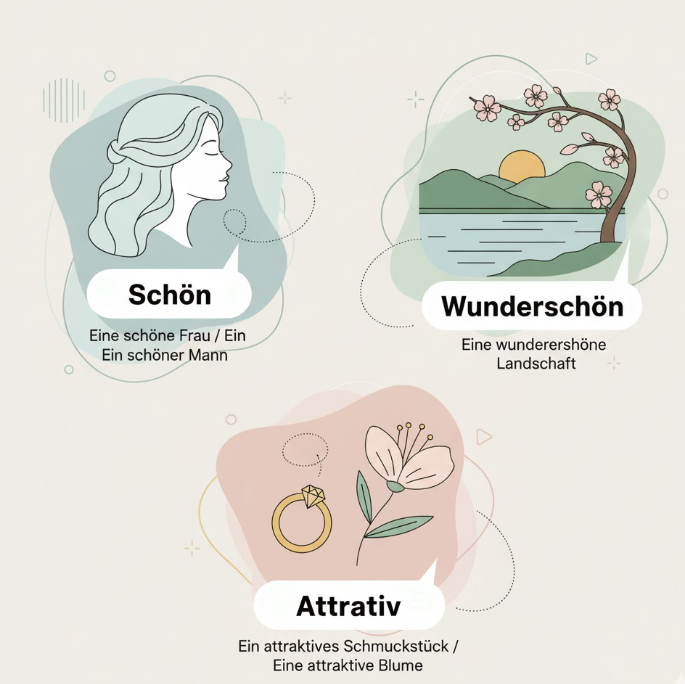
The most common translation of “beautiful” in German is schön. However, German offers a rich vocabulary to describe various aspects of beauty, each with its own nuances. Schön is a versatile adjective that can be used to describe people, places, objects, and experiences. It generally conveys aesthetic pleasure or admiration.
Other words that can be used to express “beautiful” in German include:
- Hübsch: Often used for “pretty” or “cute,” typically referring to a pleasing appearance.
- Wunderschön: “Wonderfully beautiful,” an intensified form of schön.
- Atemberaubend: “Breathtaking,” often used for spectacular or stunning beauty.
- Reizend: “Charming” or “lovely,” suggesting an appealing and delightful quality.
- Anmutig: “Graceful,” describing beauty in movement or form.
- Lieblich: “Lovely” or “sweet,” often used for delicate or gentle beauty.
The choice of word depends on the specific context and the type of beauty you want to express. It’s important to understand the subtle differences between these words to use them correctly and effectively.
Structural Breakdown of “Schön”
The word schön is an adjective in German. As such, it must agree in gender, number, and case with the noun it modifies. This means that the ending of schön will change depending on the grammatical context.
Here’s a breakdown of how schön changes in different cases and genders:
Masculine
- Nominative: schöner
- Accusative: schönen
- Dative: schönem
- Genitive: schönen
Feminine
- Nominative: schöne
- Accusative: schöne
- Dative: schöner
- Genitive: schöner
Neuter
- Nominative: schönes
- Accusative: schönes
- Dative: schönem
- Genitive: schönen
Plural
- Nominative: schöne
- Accusative: schöne
- Dative: schönen
- Genitive: schöner
For example:
- Der schöne Mann (The beautiful man – Nominative masculine)
- Ich sehe den schönen Mann (I see the beautiful man – Accusative masculine)
- Die schöne Frau (The beautiful woman – Nominative feminine)
- Ich sehe die schöne Frau (I see the beautiful woman – Accusative feminine)
- Das schöne Kind (The beautiful child – Nominative neuter)
- Ich sehe das schöne Kind (I see the beautiful child – Accusative neuter)
- Die schönen Blumen (The beautiful flowers – Nominative plural)
- Ich sehe die schönen Blumen (I see the beautiful flowers – Accusative plural)
Understanding these declension rules is vital for using schön correctly in German sentences. Paying attention to the gender, number, and case of the noun you’re describing will ensure grammatical accuracy.
Types and Categories of “Beautiful”
The concept of beauty is broad and can be expressed in various contexts. In German, different words and phrases are used to describe different types of beauty.
Here are some key categories:
Physical Beauty
Physical beauty refers to the attractiveness of a person’s appearance. Words like schön, hübsch, and attraktiv are commonly used in this context. The specific word choice can depend on the degree of beauty and the speaker’s personal preference.
Beauty of Nature
The beauty of nature encompasses landscapes, natural phenomena, and the environment. Words like wunderschön, herrlich, and atemberaubend are often used to describe natural beauty. These words convey a sense of awe and wonder.
Beauty of Art
The beauty of art includes paintings, sculptures, music, literature, and other forms of creative expression. Words like schön, wundervoll, and meisterhaft can be used to describe artistic beauty. These words highlight the skill and aesthetic appeal of the artwork.
Inner Beauty
Inner beauty refers to the positive qualities of a person’s character, such as kindness, compassion, and intelligence. While schön can be used in this context, words like liebenswert, gutherzig, and charmant are more commonly used to describe inner beauty. These words emphasize the positive impact of a person’s character on others.
Examples of “Beautiful” in German
To illustrate how to use different words for “beautiful” in German, here are several examples categorized by the type of beauty they describe.
Physical Beauty Examples
Here are some examples of how to describe physical beauty using different German words and phrases. The table below includes both the German sentence and its English translation.
| German | English |
|---|---|
| Sie ist eine schöne Frau. | She is a beautiful woman. |
| Er ist ein hübscher Mann. | He is a handsome man. |
| Das Baby hat schöne Augen. | The baby has beautiful eyes. |
| Sie hat ein schönes Lächeln. | She has a beautiful smile. |
| Er sieht sehr attraktiv aus. | He looks very attractive. |
| Sie ist eine wunderschöne Braut. | She is a wonderfully beautiful bride. |
| Er hat ein reizendes Gesicht. | He has a charming face. |
| Sie bewegt sich sehr anmutig. | She moves very gracefully. |
| Das Mädchen ist lieblich. | The girl is lovely. |
| Er hat eine schöne Figur. | He has a beautiful figure. |
| Sie trägt ein schönes Kleid. | She is wearing a beautiful dress. |
| Er hat schöne Haare. | He has beautiful hair. |
| Sie hat eine schöne Stimme. | She has a beautiful voice. |
| Er hat ein schönes Lachen. | He has a beautiful laugh. |
| Sie ist eine schöne Tänzerin. | She is a beautiful dancer. |
| Er ist ein schöner Schauspieler. | He is a handsome actor. |
| Sie hat eine schöne Ausstrahlung. | She has a beautiful aura. |
| Er hat schöne Hände. | He has beautiful hands. |
| Sie hat schöne Beine. | She has beautiful legs. |
| Er hat ein schönes Profil. | He has a beautiful profile. |
| Sie ist schön geschminkt. | She is beautifully made up. |
| Er ist schön gebräunt. | He is beautifully tanned. |
| Sie hat eine schöne Haut. | She has beautiful skin. |
| Er hat ein schönes Lächeln. | He has a beautiful smile. |
| Sie ist eine schöne Erscheinung. | She is a beautiful sight. |
| Er hat eine schöne Statur. | He has a beautiful stature. |
Beauty of Nature Examples
The following examples demonstrate how to describe the beauty of nature in German. Notice the use of words like wunderschön and atemberaubend to convey a sense of awe and grandeur.
| German | English |
|---|---|
| Die Landschaft ist wunderschön. | The landscape is wonderfully beautiful. |
| Der Sonnenuntergang war atemberaubend. | The sunset was breathtaking. |
| Die Berge sind herrlich. | The mountains are magnificent. |
| Der See ist schön und ruhig. | The lake is beautiful and calm. |
| Der Wald ist zauberhaft. | The forest is enchanting. |
| Die Blumen sind prächtig. | The flowers are splendid. |
| Der Garten ist lieblich. | The garden is lovely. |
| Die Aussicht ist fantastisch. | The view is fantastic. |
| Der Wasserfall ist spektakulär. | The waterfall is spectacular. |
| Der Himmel ist strahlend blau. | The sky is radiantly blue. |
| Die Natur ist einfach wundervoll. | Nature is simply wonderful. |
| Die Sterne sind funkelnd. | The stars are sparkling. |
| Der Strand ist malerisch. | The beach is picturesque. |
| Die Bäume sind majestätisch. | The trees are majestic. |
| Die Wiese ist saftig grün. | The meadow is lush green. |
| Der Fluss ist glitzernd. | The river is glittering. |
| Die Insel ist paradiesisch. | The island is paradisiacal. |
| Der Vulkan ist imposant. | The volcano is imposing. |
| Die Höhle ist geheimnisvoll. | The cave is mysterious. |
| Das Tal ist friedlich. | The valley is peaceful. |
| Die Küste ist wildromantisch. | The coast is wildly romantic. |
| Der Regenbogen ist farbenprächtig. | The rainbow is colorful. |
| Das Gebirge ist ehrfurchtgebietend. | The mountain range is awe-inspiring. |
| Die Quelle ist rein und klar. | The spring is pure and clear. |
| Die Dämmerung ist stimmungsvoll. | The twilight is atmospheric. |
| Der Frost ist kristallin. | The frost is crystalline. |
Beauty of Art Examples
Here are some examples of how to describe the beauty of art using different German words and phrases. The table below provides examples of how to praise various forms of art.
| German | English |
|---|---|
| Das Gemälde ist wunderschön. | The painting is wonderfully beautiful. |
| Die Musik ist bezaubernd. | The music is enchanting. |
| Das Buch ist fesselnd. | The book is captivating. |
| Der Film ist brillant. | The film is brilliant. |
| Die Skulptur ist meisterhaft. | The sculpture is masterful. |
| Das Gedicht ist erhaben. | The poem is sublime. |
| Die Aufführung war grandios. | The performance was magnificent. |
| Das Design ist elegant. | The design is elegant. |
| Die Architektur ist imposant. | The architecture is imposing. |
| Die Kunst ist inspirierend. | The art is inspiring. |
| Das Ballett ist anmutig. | The ballet is graceful. |
| Das Theaterstück ist bewegend. | The play is moving. |
| Die Oper ist dramatisch. | The opera is dramatic. |
| Das Lied ist melodisch. | The song is melodic. |
| Die Fotografie ist ausdrucksstark. | The photography is expressive. |
| Die Installation ist innovativ. | The installation is innovative. |
| Die Keramik ist filigran. | The ceramics are delicate. |
| Das Mosaik ist farbenfroh. | The mosaic is colorful. |
| Die Kalligraphie ist kunstvoll. | The calligraphy is artistic. |
| Die Statue ist majestätisch. | The statue is majestic. |
| Die Zeichnung ist detailreich. | The drawing is detailed. |
| Das Denkmal ist ehrfurchtgebietend. | The monument is awe-inspiring. |
| Die Inszenierung ist effektvoll. | The staging is effective. |
| Die Komposition ist harmonisch. | The composition is harmonious. |
| Die Lyrik ist poetisch. | The lyrics are poetic. |
| Der Tanz ist rhythmisch. | The dance is rhythmic. |
Inner Beauty Examples
The following examples illustrate how to describe inner beauty in German. Notice the use of words that emphasize character traits and positive qualities.
| German | English |
|---|---|
| Sie ist eine liebenswerte Person. | She is a lovable person. |
| Er ist sehr gutherzig. | He is very kind-hearted. |
| Sie hat einen charmanten Charakter. | She has a charming character. |
| Er ist ein freundlicher Mensch. | He is a friendly person. |
| Sie ist sehr hilfsbereit. | She is very helpful. |
| Er ist ehrlich und aufrichtig. | He is honest and sincere. |
| Sie ist eine weise Frau. | She is a wise woman. |
| Er ist ein intelligenter Mann. | He is an intelligent man. |
| Sie ist sehr mitfühlend. | She is very compassionate. |
| Er ist geduldig und verständnisvoll. | He is patient and understanding. |
| Sie hat ein reines Herz. | She has a pure heart. |
| Er ist bescheiden und zurückhaltend. | He is modest and reserved. |
| Sie ist sehr tolerant. | She is very tolerant. |
| Er ist mutig und entschlossen. | He is courageous and determined. |
| Sie ist optimistisch und fröhlich. | She is optimistic and cheerful. |
| Er ist zuverlässig und verantwortungsbewusst. | He is reliable and responsible. |
| Sie ist kreativ und phantasievoll. | She is creative and imaginative. |
| Er ist loyal und treu. | He is loyal and faithful. |
| Sie ist einfühlsam und sensibel. | She is empathetic and sensitive. |
| Er ist respektvoll und höflich. | He is respectful and polite. |
| Sie ist großzügig und hilfsbereit. | She is generous and helpful. |
| Er ist besonnen und ausgeglichen. | He is thoughtful and balanced. |
| Sie ist stark und unabhängig. | She is strong and independent. |
| Er ist ehrgeizig und zielstrebig. | He is ambitious and goal-oriented. |
| Sie ist verständnisvoll und geduldig. | She is understanding and patient. |
| Er ist tapfer und furchtlos. | He is brave and fearless. |
Usage Rules for “Beautiful” in German
Using “beautiful” in German requires understanding a few key rules:
- Adjective Agreement: As mentioned earlier, adjectives in German must agree in gender, number, and case with the noun they modify. This is crucial for using schön and other related words correctly.
- Word Order: In German, adjectives usually come before the noun they modify. For example: Die schöne Blume (The beautiful flower).
- Intensifiers: You can use intensifiers like sehr (very), unglaublich (unbelievably), or wirklich (really) to emphasize the beauty. For example: Sie ist sehr schön (She is very beautiful).
- Context: The choice of words depends on the context. Use hübsch for “pretty,” wunderschön for “wonderfully beautiful,” and atemberaubend for “breathtaking.”
- Formal vs. Informal: In formal settings, it’s generally appropriate to use more sophisticated vocabulary. In informal settings, you can use more casual words.
Understanding these rules will help you use “beautiful” in German accurately and effectively. Pay attention to the grammatical context and choose the word that best conveys the intended meaning.
Common Mistakes When Saying “Beautiful”
Here are some common mistakes that learners make when using “beautiful” in German, along with corrections:
| Incorrect | Correct | Explanation |
|---|---|---|
| Der Frau ist schön. | Die Frau ist schön. | Using the correct article (die for feminine nouns). |
| Das Mann ist schön. | Der Mann ist schön. | Using the correct article (der for masculine nouns). |
| Die Blume ist schönes. | Die Blume ist schön. | Adjectives must agree with the noun. The adjective should be in its base form because it follows the verb “ist”. |
| Ich sehe ein schön Mann. | Ich sehe einen schönen Mann. | Accusative case requires a different adjective ending for masculine nouns. |
| Sie ist sehr gut. | Sie ist sehr schön. | Using the correct adjective. Gut means “good,” not “beautiful.” |
| Der Haus ist schön. | Das Haus ist schön. | Using the correct article for neuter nouns (das). |
| Die Kinder sind schön. | Die Kinder sind schöne. | Adjective must agree with the plural noun. |
Avoiding these common mistakes will improve your accuracy and confidence when expressing beauty in German. Always double-check your grammar and word choice.
Practice Exercises
Test your knowledge with these practice exercises. Fill in the blanks with the correct form of “schön” or another appropriate word for “beautiful.”
| Question | Answer |
|---|---|
| 1. Das ist ein _______ Tag. | schöner |
| 2. Sie hat _______ Augen. | schöne |
| 3. Der Garten ist _______ und friedlich. | schön |
| 4. Er ist ein _______ Mann. | hübscher |
| 5. Die Aussicht ist _______. | atemberaubend |
| 6. Sie ist eine _______ Frau. | schöne |
| 7. Das Kleid ist _______. | schön |
| 8. Die Musik ist _______. | wunderschön |
| 9. Er hat ein _______ Lächeln. | schönes |
| 10. Sie ist eine _______ Tänzerin. | anmutige |
More Practice Exercises
| Question | Answer |
|---|---|
| 1. Die _______ Blumen blühen im Frühling. | schönen |
| 2. Der _______ See lädt zum Verweilen ein. | schöne |
| 3. Das _______ Mädchen spielt im Garten. | hübsche |
| 4. Sie trägt ein _______ Kleid zur Party. | schönes |
| 5. Er hat _______ Augen, die mich verzaubern. | schöne |
| 6. Die Landschaft ist _______ im Sonnenlicht. | wunderschön |
| 7. Die _______ Musik beruhigt meine Seele. | schöne |
| 8. Das _______ Haus steht am Hügel. | schöne |
| 9. Er schenkte ihr einen _______ Ring. | schönen |
| 10. Sie hat eine _______ Stimme, die mich begeistert. | schöne |
Even More Practice Exercises
| Question | Answer |
|---|---|
| 1. Die _______ Erinnerungen bleiben für immer. | schönen |
| 2. Der _______ Sonnenuntergang malte den Himmel. | schöne |
| 3. Das _______ Kunstwerk beeindruckte die Besucher. | schöne |
| 4. Sie erzählte eine _______ Geschichte am Lagerfeuer. | schöne |
| 5. Er tanzte mit einer _______ Partnerin. | schönen |
| 6. Die _______ Melodie berührte die Herzen der Zuhörer. | schöne |
| 7. Das _______ Lächeln erhellte ihren Tag. | schöne |
| 8. Sie wohnt in einem _______ Viertel der Stadt. | schönen |
| 9. Er hat eine _______ Seele. | schöne |
| 10. Die _______ Aussicht vom Berg war unvergesslich. | schöne |
Advanced Topics
For advanced learners, consider exploring these more complex aspects:
- Figurative Language: How is “beautiful” used in metaphors, similes, and other figures of speech in German?
- Regional Variations: Are there regional differences in how “beautiful” is expressed in German-speaking countries?
- Historical Context: How has the concept of beauty and its expression in German evolved over time?
- Literary Usage: How do German authors and poets use “beautiful” and related words to create vivid imagery and convey deeper meanings?
Delving into these advanced topics will further enrich your understanding of the German language and culture.
Frequently Asked Questions
- What is the most common way to say “beautiful” in German?
The most common way to say “beautiful” in German is schön. It’s versatile and can be used in various contexts. - Is there a difference between schön and hübsch?
Yes, schön generally means “beautiful,” while hübsch means “pretty” or “cute.” Hübsch is often used for a more delicate or charming beauty, while schön can describe a broader range of beauty. - How do I use schön in a sentence?
Schön is an adjective and must agree in gender, number, and case with the noun it modifies. For example, Die schöne Frau (The beautiful woman). - What are some other ways to say “beautiful” in German?
Other ways to say “beautiful” in German include wunderschön (wonderfully beautiful), atemberaubend (breathtaking), reizend (charming), anmutig (graceful), and lieblich (lovely). - How do I emphasize the beauty of something in German?
You can use intensifiers like sehr (very), unglaublich (unbelievably), or wirklich (really) before the adjective. For example, Sie ist sehr schön (She is very beautiful). You can also use wunderschön which already has the intensification built in. - Can I use schön to describe inner beauty?
While schön can be used to describe inner beauty, it’s more common to use words like liebenswert (lovable), gutherzig (kind-hearted), or charmant (charming) to emphasize positive character traits. - What is the difference between “wunderschön” and “sehr schön”?
Both translate to “very beautiful” or “wonderfully beautiful,” but “wunderschön” is a single word that inherently carries a stronger emphasis and sense of awe compared to “sehr schön,” which is a combination of “very” and “beautiful.” - How does the context affect which word for “beautiful” I should use?
The context is crucial. For physical attractiveness, “schön” or “hübsch” might suffice. For nature or art, “wunderschön” or “atemberaubend” could be more appropriate to convey grandeur and awe. For inner qualities, using words like “liebenswert” or “charmant” is better to highlight character traits.
Conclusion
Mastering the various ways to say “beautiful” in German is essential for expressing yourself fluently and accurately. Understanding the nuances between words like schön, hübsch, wunderschön, and others allows you to convey different aspects of beauty in various contexts. Remember to pay attention to adjective agreement, word order, and the specific context to use these words correctly. By practicing regularly and avoiding common mistakes, you can confidently express your appreciation for beauty in the German language.
Continue to explore the advanced topics and delve deeper into the cultural and literary uses of these words to further enrich your understanding. With consistent effort and attention to detail, you will be able to express beauty in German with confidence and precision.
Keep practicing, and enjoy the journey of learning this beautiful language!