Learning how to greet someone appropriately in a different language is crucial for effective communication and creating positive first impressions. In French, saying “good afternoon” involves understanding not just the words, but also the cultural context and nuances of their usage.
This article provides a comprehensive guide to mastering “good afternoon” in French, covering everything from the basic translation to advanced usage, common mistakes, and practical exercises. Whether you are a beginner or an advanced learner, this guide will help you confidently navigate French greetings and enhance your overall language skills.
This guide is designed for anyone who wants to improve their French language skills, particularly those who are interested in learning formal and informal greetings. It will benefit students, travelers, business professionals, and anyone who interacts with French speakers.
By the end of this guide, you will have a solid understanding of how to say “good afternoon” in French and how to use it appropriately in various situations.
Table of Contents
- Introduction
- Definition of “Good Afternoon” in French
- Structural Breakdown of “Bonjour” and “Bon après-midi”
- Types of Greetings
- Examples of Usage
- Usage Rules
- Common Mistakes
- Practice Exercises
- Advanced Topics
- FAQ
- Conclusion
Definition of “Good Afternoon” in French
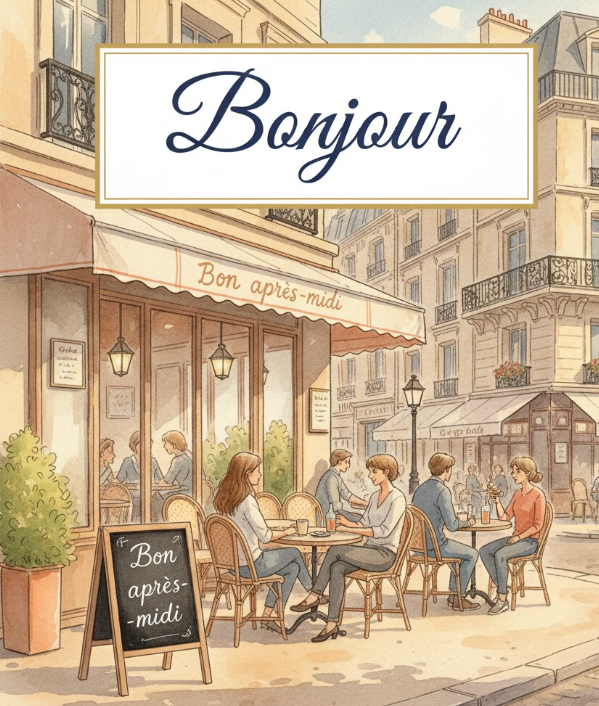
The most common way to say “good afternoon” in French is “Bonjour.” While “bonjour” literally translates to “good day,” it is used from morning until late afternoon, typically around 6 PM or sunset. Another, less frequently used phrase is “Bon après-midi,” which more directly translates to “good afternoon.”
Bonjour is a versatile greeting that can be used in both formal and informal settings. It is appropriate for greeting strangers, acquaintances, colleagues, and even friends and family, depending on the context. It conveys respect and politeness, making it a fundamental part of French etiquette.
Bon après-midi, while grammatically correct, is less commonly used in everyday conversation. It is often used when you want to specifically wish someone a good afternoon, especially when departing or concluding a conversation in the afternoon. It can also add a touch of formality or emphasis.
Structural Breakdown of “Bonjour” and “Bon après-midi”
Understanding the structural components of these phrases can help you appreciate their meanings and use them correctly.
Bonjour is composed of two parts:
- Bon: This is the masculine singular form of the adjective “bon,” meaning “good.”
- Jour: This is the noun “jour,” meaning “day.”
Therefore, “bonjour” literally means “good day.”
Bon après-midi is composed of three parts:
- Bon: Again, the masculine singular form of the adjective “bon,” meaning “good.”
- Après: This is a preposition meaning “after.”
- Midi: This is the noun “midi,” meaning “noon” or “midday.”
Therefore, “bon après-midi” literally means “good after noon,” or “good afternoon.” The adjective ‘bon’ agrees in gender and number with the noun it modifies. In this case, ‘après-midi’ is masculine singular, so ‘bon’ remains in its masculine singular form.
Types of Greetings
French greetings can be categorized based on their level of formality and context. Understanding these categories helps you choose the most appropriate greeting for any situation.
Formal Greetings
Formal greetings are used in professional settings, when addressing strangers, or when showing respect to someone of higher status. Bonjour is the standard formal greeting for “good morning” or “good afternoon.”
Example situations include:
- Meeting a client for the first time
- Addressing a superior at work
- Greeting a store clerk
- Talking to someone you don’t know on the street
Informal Greetings
Informal greetings are used with friends, family, and close acquaintances. While bonjour can still be used in informal settings, other greetings like salut (hi) or coucou (hey) are more common.
Example situations include:
- Greeting a friend
- Talking to a family member
- Chatting with a close colleague
Regional Variations
While bonjour is universally understood in France, some regional variations exist. In some areas, particularly in the south of France, you might hear bonsoir (good evening) used earlier in the day than in other regions. However, bonjour remains the safest and most widely accepted option for “good afternoon.”
Examples of Usage
To fully understand how to use “good afternoon” in French, let’s look at some practical examples in various situations.
Everyday Situations
In everyday situations, bonjour is your go-to greeting in the afternoon. Here are some examples:
The following table presents examples of using “Bonjour” in various everyday situations:
| Situation | French Greeting | English Translation |
|---|---|---|
| Entering a bakery | Bonjour Madame, je voudrais un croissant, s’il vous plaît. | Good afternoon Madam, I would like a croissant, please. |
| Greeting a neighbor | Bonjour Jean, comment allez-vous? | Good afternoon Jean, how are you? |
| Entering a store | Bonjour Monsieur. | Good afternoon Sir. |
| Answering the phone in the afternoon | Bonjour, à qui ai-je l’honneur? | Good afternoon, to whom do I have the pleasure of speaking? |
| Meeting a friend for lunch | Bonjour Marie, content de te voir! | Good afternoon Marie, glad to see you! |
| Starting a conversation with a stranger | Bonjour, excusez-moi de vous déranger. | Good afternoon, excuse me for bothering you. |
| Greeting a delivery person | Bonjour, merci pour la livraison. | Good afternoon, thank you for the delivery. |
| Entering a doctor’s office | Bonjour, j’ai un rendez-vous à 14h. | Good afternoon, I have an appointment at 2 PM. |
| Greeting someone at the post office | Bonjour, je voudrais envoyer ce colis. | Good afternoon, I would like to send this package. |
| Meeting someone at a café | Bonjour Pierre, ça va? | Good afternoon Pierre, how’s it going? |
| Entering a pharmacy | Bonjour, je cherche un médicament pour la toux. | Good afternoon, I’m looking for a cough medicine. |
| Greeting a librarian | Bonjour, où se trouve la section des romans? | Good afternoon, where is the fiction section located? |
| Meeting a teacher in the hallway | Bonjour Madame Dupont. | Good afternoon Mrs. Dupont. |
| Greeting a bus driver | Bonjour Monsieur. | Good afternoon Sir. |
| Entering a government office | Bonjour, j’ai besoin d’un formulaire. | Good afternoon, I need a form. |
| Greeting a museum employee | Bonjour, combien coûte l’entrée? | Good afternoon, how much is the entrance fee? |
| Meeting a tour guide | Bonjour, nous sommes prêts pour la visite. | Good afternoon, we are ready for the tour. |
| Greeting a hotel receptionist | Bonjour, j’ai une réservation au nom de Smith. | Good afternoon, I have a reservation under the name Smith. |
| Greeting someone at a train station | Bonjour, où est le quai pour Paris? | Good afternoon, where is the platform for Paris? |
| Greeting someone at the airport | Bonjour, je cherche le comptoir d’enregistrement. | Good afternoon, I’m looking for the check-in counter. |
| Greeting a waiter at a restaurant | Bonjour, une table pour deux, s’il vous plaît. | Good afternoon, a table for two, please. |
| Greeting someone at a concert | Bonjour, avez-vous des billets supplémentaires? | Good afternoon, do you have any extra tickets? |
| Greeting someone at a sporting event | Bonjour, quel est le score? | Good afternoon, what’s the score? |
Business Settings
In business settings, maintaining a formal tone is important. Here’s how you can use “good afternoon” in French:
The following table presents examples of using “Bonjour” in various business settings:
| Situation | French Greeting | English Translation |
|---|---|---|
| Answering the phone at work | Bonjour, [Company Name], à l’appareil. | Good afternoon, [Company Name], speaking. |
| Greeting a client in a meeting | Bonjour Monsieur/Madame, bienvenue. | Good afternoon Sir/Madam, welcome. |
| Starting an email in the afternoon | Bonjour Monsieur/Madame [Last Name], | Good afternoon Mr./Ms. [Last Name], |
| Greeting a colleague | Bonjour Sophie, comment s’est passé votre matinée? | Good afternoon Sophie, how was your morning? |
| Addressing your boss | Bonjour Monsieur le Directeur. | Good afternoon Mr. Director. |
| Starting a presentation | Bonjour à tous, je suis ravi de vous voir. | Good afternoon everyone, I am delighted to see you. |
| Greeting someone at a conference | Bonjour, je ne crois pas que nous nous soyons déjà rencontrés. | Good afternoon, I don’t think we’ve met before. |
| Answering a business call | Bonjour, comment puis-je vous aider? | Good afternoon, how can I help you? |
| Greeting a visitor at the office | Bonjour, puis-je vous aider? | Good afternoon, can I help you? |
| Starting a meeting with a team | Bonjour l’équipe, commençons. | Good afternoon team, let’s begin. |
| Greeting a customer in a store | Bonjour, puis-je vous renseigner? | Good afternoon, can I help you? |
| Greeting a service provider | Bonjour, vous êtes bien à l’adresse indiquée? | Good afternoon, are you at the correct address? |
| Greeting a job applicant | Bonjour, merci d’être venu. | Good afternoon, thank you for coming. |
| Greeting a business partner | Bonjour, ravi de faire affaire avec vous. | Good afternoon, pleased to do business with you. |
| Greeting someone at a networking event | Bonjour, quel est votre secteur d’activité? | Good afternoon, what is your industry? |
| Greeting a guest speaker | Bonjour, nous sommes honorés de vous recevoir. | Good afternoon, we are honored to have you. |
| Greeting a new employee | Bonjour, bienvenue dans l’équipe. | Good afternoon, welcome to the team. |
| Greeting a client during a video call | Bonjour Monsieur/Madame, merci de vous joindre à nous. | Good afternoon Mr./Ms., thank you for joining us. |
| Greeting a conference speaker after their talk | Bonjour, votre présentation était très intéressante. | Good afternoon, your presentation was very interesting. |
| Greeting someone at a trade show | Bonjour, puis-je vous présenter notre produit? | Good afternoon, may I introduce you to our product? |
| Greeting a consultant | Bonjour, nous sommes impatients de travailler avec vous. | Good afternoon, we look forward to working with you. |
| Greeting a supplier | Bonjour, avez-vous les dernières mises à jour de prix? | Good afternoon, do you have the latest price updates? |
| Greeting an interviewer | Bonjour, merci de me recevoir. | Good afternoon, thank you for having me. |
Travel Scenarios
When traveling in France, knowing how to greet people is essential. Here are some examples:
The following table presents examples of using “Bonjour” in various travel scenarios:
| Situation | French Greeting | English Translation |
|---|---|---|
| Entering a hotel | Bonjour, j’ai une réservation. | Good afternoon, I have a reservation. |
| Asking for directions | Bonjour, où est la gare, s’il vous plaît? | Good afternoon, where is the train station, please? |
| Ordering food at a restaurant | Bonjour, je voudrais le plat du jour. | Good afternoon, I would like the special of the day. |
| Buying a ticket at a museum | Bonjour, un billet pour le musée, s’il vous plaît. | Good afternoon, one ticket for the museum, please. |
| Greeting a taxi driver | Bonjour, à l’aéroport, s’il vous plaît. | Good afternoon, to the airport, please. |
| Checking into a hostel | Bonjour, j’ai réservé un lit. | Good afternoon, I have booked a bed. |
| Asking for help at a tourist information center | Bonjour, pouvez-vous m’aider à planifier ma visite? | Good afternoon, can you help me plan my visit? |
| Greeting a bus driver | Bonjour, un ticket pour le centre-ville, s’il vous plaît. | Good afternoon, a ticket to the city center, please. |
| Asking for information at the airport | Bonjour, où est le terminal des vols internationaux? | Good afternoon, where is the international flights terminal? |
| Greeting a customs officer | Bonjour Monsieur/Madame. | Good afternoon Sir/Madam. |
| Greeting someone at a campsite | Bonjour, nous cherchons un emplacement. | Good afternoon, we are looking for a campsite. |
| Asking for recommendations at a local shop | Bonjour, quels sont les produits locaux à essayer? | Good afternoon, what are the local products to try? |
| Greeting someone at a train station | Bonjour, ce train va-t-il à Lyon? | Good afternoon, does this train go to Lyon? |
| Greeting someone at a car rental agency | Bonjour, je viens chercher ma voiture. | Good afternoon, I am here to pick up my car. |
| Asking for directions on the street | Bonjour, comment aller à la Tour Eiffel, s’il vous plaît? | Good afternoon, how do I get to the Eiffel Tower, please? |
| Greeting someone at a bike rental shop | Bonjour, je voudrais louer un vélo. | Good afternoon, I would like to rent a bicycle. |
| Asking for help at a laundromat | Bonjour, comment utiliser cette machine? | Good afternoon, how do I use this machine? |
| Greeting someone at a currency exchange | Bonjour, je voudrais changer des dollars en euros. | Good afternoon, I would like to exchange dollars for euros. |
| Asking for a recommendation at a local market | Bonjour, quel est le meilleur fromage ici? | Good afternoon, what is the best cheese here? |
| Greeting someone at a winery | Bonjour, nous aimerions faire une dégustation. | Good afternoon, we would like to do a tasting. |
| Greeting someone at a ski resort | Bonjour, où puis-je louer des skis? | Good afternoon, where can I rent skis? |
| Greeting someone at a beach resort | Bonjour, où sont les transats? | Good afternoon, where are the sun loungers? |
| Greeting someone at a historical site | Bonjour, quelle est l’histoire de ce lieu? | Good afternoon, what is the history of this place? |
Usage Rules
To use “good afternoon” correctly in French, consider the following rules:
Time of Day Considerations
Bonjour is generally used from morning until around 6 PM. After 6 PM, it is more appropriate to use bonsoir (good evening). However, the exact time can vary depending on the region and the specific situation.
Bon après-midi is specifically used during the afternoon hours but is less common than bonjour.
Level of Formality
Bonjour is suitable for both formal and informal situations. In very formal settings, you may add Monsieur (Sir) or Madame (Madam) after bonjour. In informal settings, you can use bonjour with friends and family, but other greetings like salut are also appropriate.
Cultural Sensitivity
In French culture, it is considered polite to greet people when entering a store, office, or any public space. Failing to do so can be seen as rude. Always make eye contact and offer a friendly bonjour.
Common Mistakes
Here are some common mistakes to avoid when saying “good afternoon” in French:
The following table highlights common mistakes and their corrections:
| Incorrect | Correct | Explanation |
|---|---|---|
| Bon soir in the afternoon | Bonjour in the afternoon | Bonsoir is for the evening, bonjour is for the afternoon. |
| Salut Madame (to a stranger) | Bonjour Madame (to a stranger) | Salut is informal, bonjour is more appropriate for strangers. |
| Bon après-midi (too frequently) | Bonjour (more commonly used) | Bon après-midi is less common than bonjour. |
| Forgetting to say anything | Bonjour | It’s rude not to greet people when entering a space. |
| Bonjour followed by tutoyer immediately | Bonjour followed by vouvoyer initially | Start with vous (formal you) unless you know the person well. |
Practice Exercises
Test your knowledge with these practice exercises:
Exercise 1: Choose the correct greeting
Select the most appropriate greeting for each situation.
| Situation | Options | Answer |
|---|---|---|
| Entering a store at 3 PM | a) Bonsoir b) Bonjour c) Salut | b) Bonjour |
| Greeting a friend at 4 PM | a) Bon après-midi b) Bonjour c) Salut | c) Salut |
| Addressing your boss at 5 PM | a) Salut b) Bonjour Monsieur c) Bonsoir | b) Bonjour Monsieur |
| Answering the phone at work at 2 PM | a) Bonsoir b) Bonjour c) Coucou | b) Bonjour |
| Greeting a stranger on the street at 1 PM | a) Salut b) Bonjour c) Bon après-midi | b) Bonjour |
| Meeting a client for the first time at 4:30 PM | a) Salut b) Bonjour Monsieur/Madame c) Bonsoir | b) Bonjour Monsieur/Madame |
| Entering a café at 2:15 PM | a) Bonsoir b) Bonjour c) Coucou | b) Bonjour |
| Greeting a hotel receptionist at 3:45 PM | a) Bonsoir b) Bonjour c) Salut | b) Bonjour |
| Meeting a new colleague at 1:50 PM | a) Salut b) Bonjour c) Bon après-midi | b) Bonjour |
| Greeting a delivery person at 4:55 PM | a) Bonsoir b) Bonjour c) Coucou | b) Bonjour |
Exercise 2: Translate the following sentences into French
Translate the following English sentences into French, using the appropriate greeting.
| English Sentence | French Translation |
|---|---|
| Good afternoon, how are you? (formal) | Bonjour, comment allez-vous? |
| Good afternoon, I would like a coffee, please. | Bonjour, je voudrais un café, s’il vous plaît. |
| Good afternoon, can you help me? | Bonjour, pouvez-vous m’aider? |
| Good afternoon, welcome to our office. | Bonjour, bienvenue dans notre bureau. |
| Good afternoon, I have a reservation. | Bonjour, j’ai une réservation. |
| Good afternoon, what time is it? | Bonjour, quelle heure est-il? |
| Good afternoon, nice to meet you. | Bonjour, enchanté(e). |
| Good afternoon, where is the train station? | Bonjour, où est la gare? |
| Good afternoon, thank you for your help. | Bonjour, merci pour votre aide. |
| Good afternoon, do you speak English? | Bonjour, parlez-vous anglais? |
Exercise 3: Fill in the blanks
Complete the following sentences with the appropriate greeting.
| Sentence | Answer |
|---|---|
| ______ Madame, je cherche un livre. | Bonjour |
| ______ Pierre, ça va? | Bonjour |
| ______ Monsieur le Directeur. | Bonjour |
| ______ à tous, commençons la réunion. | Bonjour |
| ______ , comment puis-je vous aider? | Bonjour |
| ______ , je suis perdu. | Bonjour |
| ______ , je veux un croissant. | Bonjour |
| ______ , merci de votre visite. | Bonjour |
| ______ , quel est le prix? | Bonjour |
| ______ , je suis en retard. | Bonjour |
Advanced Topics
For advanced learners, let’s explore some nuanced aspects of using “good afternoon” in French.
Idiomatic Expressions
While there aren’t specific idiomatic expressions directly related to bonjour or bon après-midi, understanding related expressions can enrich your communication. For example, saying “passer une bonne journée” (have a good day) or “bonne continuation” (have a good continuation) can follow a greeting and add a friendly touch.
Nuances of Politeness
In French culture, politeness is highly valued. When greeting someone, always use the appropriate level of formality. If you are unsure whether to use tu (informal you) or vous (formal you), it is always safer to start with vous. Additionally, using phrases like “s’il vous plaît” (please) and “merci” (thank you) can further enhance your politeness.
FAQ
Here are some frequently asked questions about saying “good afternoon” in French:
- Is “bon après-midi” commonly used?
While grammatically correct, “bon après-midi” is less commonly used than “bonjour” in everyday conversation. “Bonjour” is the standard greeting for both “good morning” and “good afternoon.”
- When should I switch from “bonjour” to “bonsoir”?
Generally, you should switch from “bonjour” to “bonsoir” around 6 PM or when it starts to get dark. However, this can vary depending on the region and the specific situation.
- Is it rude not to say “bonjour” when entering a store?
Yes, it is considered impolite not to greet people when entering a store, office, or any public space in France. Always make eye contact and offer a friendly “bonjour.”
- Can I use “salut” in formal situations?
“Salut” is an informal greeting and should only be used with friends, family, and close acquaintances. In formal situations, always use “bonjour.”
- What is the difference between “tu” and “vous”?
“Tu” is the informal form of “you,” used with friends and family. “Vous” is the formal form of “you,” used with strangers, colleagues, and people of higher status. When in doubt, it’s best to start with “vous.”
- How do I respond when someone says “bonjour” to me?
You can simply respond with “bonjour” as well. You can also add “comment allez-vous?” (how are you?) if you want to be more conversational.
- What if I forget to say “bonjour”?
If you realize you’ve forgotten to say “bonjour,” simply apologize and say “pardon, bonjour” (sorry, good afternoon). People will appreciate your acknowledgment and correction.
- Are there regional variations in how people greet each other?
Yes, while “bonjour” is universally understood, some regions may have their own variations or customs. For example, in some parts of southern France, “bonsoir” might be used earlier in the day than in other regions.
Conclusion
Mastering the art of saying “good afternoon” in French is essential for effective communication and cultural sensitivity. While bonjour is the most common and versatile greeting, understanding the nuances of formality, time of day, and cultural context will help you navigate various situations with confidence. By practicing the examples and exercises provided in this guide, you can enhance your French language skills and make a positive impression on French speakers.
Remember, language learning is a continuous process. Keep practicing, exploring new expressions, and immersing yourself in the French language and culture.
With dedication and effort, you will become fluent in French greetings and beyond. Bonne chance!