Learning how to greet someone properly in a new language is essential for making a good first impression and showing respect. In Italian, saying “good afternoon” involves understanding the nuances of the language and the appropriate context.
This article provides a detailed exploration of how to say “good afternoon” in Italian, including its variations, usage rules, common mistakes, and practical exercises. Whether you’re a beginner or an advanced learner, this guide will help you master this fundamental greeting and enhance your Italian communication skills.
This comprehensive guide is designed for anyone learning Italian, whether you’re a student, traveler, or simply someone interested in the language. Mastering greetings like “good afternoon” is a crucial step in becoming proficient in Italian.
This article will break down the grammar, usage, and cultural context, ensuring you can use this greeting confidently in various situations.
Table of Contents
- Introduction
- Definition of “Good Afternoon” in Italian
- Structural Breakdown of “Buon Pomeriggio”
- Variations of “Good Afternoon”
- Examples of “Buon Pomeriggio” in Use
- Usage Rules for “Buon Pomeriggio”
- Common Mistakes to Avoid
- Practice Exercises
- Advanced Topics
- Frequently Asked Questions (FAQ)
- Conclusion
Definition of “Good Afternoon” in Italian
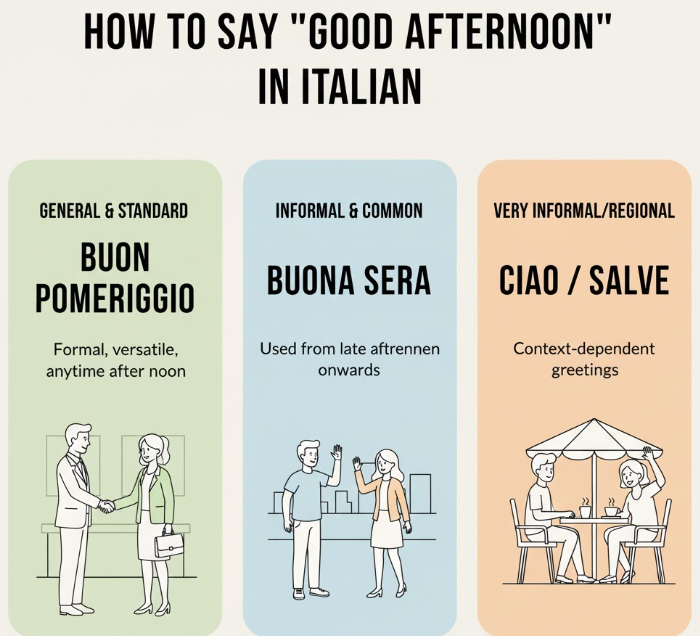
The most common way to say “good afternoon” in Italian is “Buon pomeriggio.” This phrase is a standard greeting used during the afternoon hours. It’s polite and generally appropriate for most situations. “Buon” means “good” and “pomeriggio” means “afternoon.” Together, they form a simple and effective way to greet someone in Italian during the afternoon.
The phrase “Buon pomeriggio” functions as a greeting, similar to “good afternoon” in English. It is used to acknowledge someone’s presence and initiate a conversation.
The context in which it’s used is crucial, as it’s typically used from noon until the early evening, when “Buonasera” (good evening) becomes more appropriate.
Structural Breakdown of “Buon Pomeriggio”
To understand “Buon pomeriggio,” it’s helpful to break down its components:
- Buon: This is a shortened form of “buono,” which means “good.” The shortening occurs because it precedes a masculine singular noun (pomeriggio).
- Pomeriggio: This is a masculine singular noun that means “afternoon.”
The phrase follows a simple structure: adjective + noun. The adjective “buon” modifies the noun “pomeriggio,” indicating a positive sentiment towards the afternoon.
This structure is common in Italian greetings and other descriptive phrases.
Variations of “Good Afternoon”
While “Buon pomeriggio” is the standard way to say “good afternoon,” there are variations depending on the context and level of formality.
Formal vs. Informal Greetings
In most situations, “Buon pomeriggio” is suitable for both formal and informal settings. However, in very formal situations, you might add a title or honorific.
In extremely informal situations, greetings like “Ciao” (hello/goodbye) might be used if you already know the person well and it’s still afternoon, though “Ciao” is less specific to the time of day.
The table below illustrates the differences between formal and informal greetings related to “good afternoon”:
| Formality | Greeting | Explanation | Example Scenario |
|---|---|---|---|
| Formal | Buon pomeriggio, Signor/Signora [Last Name] | Adding a title and last name shows respect. | Greeting a client or a senior colleague. |
| Formal | Buon pomeriggio, Dottore/Dottoressa [Last Name] | Using “Dottore/Dottoressa” (Doctor) for someone with a doctorate. | Greeting a doctor or professor. |
| Neutral | Buon pomeriggio | Standard greeting, appropriate for most situations. | Greeting a shopkeeper or a neighbor. |
| Informal | Ciao (if appropriate for the relationship and time of day) | Less formal, used with friends and family. | Greeting a close friend or family member (around lunchtime, but less common in mid-afternoon). |
| Informal (less common) | Buon pomeriggio (followed by a question about their day) | Shows interest and engagement. | “Buon pomeriggio, come stai?” (Good afternoon, how are you?) |
Regional Variations
While “Buon pomeriggio” is widely understood throughout Italy, regional variations in greetings are less common for “good afternoon” compared to other greetings like “hello” or “goodbye.” The phrase is fairly standard across different regions.
Even though the phrase itself doesn’t change much, the way it’s delivered or the context in which it’s used can vary slightly depending on the region. For example, in some regions, people might be more inclined to use formal greetings even in relatively informal situations.
Examples of “Buon Pomeriggio” in Use
Understanding how to use “Buon pomeriggio” in various contexts is crucial. Here are several examples demonstrating its usage in different situations.
General Examples
These examples show how “Buon pomeriggio” can be used in everyday situations:
| Scenario | Italian | English Translation |
|---|---|---|
| Entering a shop in the afternoon | Buon pomeriggio! | Good afternoon! |
| Greeting a neighbor in the hallway | Buon pomeriggio, signora! | Good afternoon, madam! |
| Answering the phone in the afternoon (less common than Buongiorno) | Pronto, buon pomeriggio! | Hello, good afternoon! |
| Starting a meeting in the afternoon | Buon pomeriggio a tutti! | Good afternoon everyone! |
| Greeting a friend you run into | Buon pomeriggio, Marco! Come stai? | Good afternoon, Marco! How are you? |
| Greeting a group of people | Buon pomeriggio a tutti voi! | Good afternoon to all of you! |
| Greeting someone at a cafe | Buon pomeriggio, posso aiutarla? | Good afternoon, can I help you? |
| Greeting a teacher after lunch. | Buon pomeriggio, professore. | Good afternoon, professor. |
| Greeting someone while walking your dog. | Buon pomeriggio! Che bel cane! | Good afternoon! What a beautiful dog! |
| Greeting the mailman. | Buon pomeriggio, signor postino. | Good afternoon, Mr. Mailman. |
| Entering a restaurant in the afternoon | Buon pomeriggio, avete un tavolo per due? | Good afternoon, do you have a table for two? |
| Greeting your boss in the afternoon | Buon pomeriggio, signor Rossi. | Good afternoon, Mr. Rossi. |
| Greeting a doctor in the waiting room | Buon pomeriggio, dottore. | Good afternoon, doctor. |
| Greeting a shop assistant | Buon pomeriggio, sto solo guardando. | Good afternoon, I’m just looking. |
| Greeting someone before asking a question | Buon pomeriggio, scusi, sa dirmi dov’è la stazione? | Good afternoon, excuse me, can you tell me where the station is? |
| Greeting a librarian | Buon pomeriggio, cerco un libro. | Good afternoon, I’m looking for a book. |
| Greeting someone you haven’t seen in a while | Buon pomeriggio! Quanto tempo! | Good afternoon! Long time no see! |
| Greeting a receptionist | Buon pomeriggio, ho un appuntamento. | Good afternoon, I have an appointment. |
| Greeting someone while volunteering | Buon pomeriggio, sono qui per aiutare. | Good afternoon, I’m here to help. |
| Greeting a tour guide. | Buon pomeriggio, quando inizia il tour? | Good afternoon, when does the tour start? |
| Greeting a parking attendant. | Buon pomeriggio, quanto costa parcheggiare qui? | Good afternoon, how much does it cost to park here? |
| Greeting someone while delivering a package. | Buon pomeriggio, ho un pacco per lei. | Good afternoon, I have a package for you. |
| Greeting a cashier at the grocery store. | Buon pomeriggio, pago con la carta. | Good afternoon, I’ll pay with card. |
Formal Settings
In formal settings, it’s important to show respect. Here are examples of using “Buon pomeriggio” in formal situations:
| Scenario | Italian | English Translation |
|---|---|---|
| Greeting a client | Buon pomeriggio, Signor Bianchi. | Good afternoon, Mr. Bianchi. |
| Addressing a professor | Buon pomeriggio, Professore Rossi. | Good afternoon, Professor Rossi. |
| Speaking to a government official | Buon pomeriggio, Dottore. | Good afternoon, Doctor. |
| Meeting a business partner | Buon pomeriggio, è un piacere conoscerla. | Good afternoon, it’s a pleasure to meet you. |
| Addressing a judge in court (less common, but possible) | Buon pomeriggio, giudice. | Good afternoon, judge. |
| Greeting the mayor at an event | Buon pomeriggio, signor Sindaco. | Good afternoon, Mr. Mayor. |
| Greeting a high-ranking member of the clergy | Buon pomeriggio, reverendo. | Good afternoon, Reverend. |
| Greeting an ambassador | Buon pomeriggio, ambasciatore. | Good afternoon, Ambassador. |
| Greeting a head of department at a university | Buon pomeriggio, Preside. | Good afternoon, Dean. |
Informal Settings
In informal settings, you can be more relaxed. Here are examples of using “Buon pomeriggio” with friends and family:
| Scenario | Italian | English Translation |
|---|---|---|
| Greeting a friend | Buon pomeriggio, come stai? | Good afternoon, how are you? |
| Greeting a family member | Buon pomeriggio, mamma! | Good afternoon, mom! |
| Greeting a close colleague | Buon pomeriggio, tutto bene? | Good afternoon, everything okay? |
| Greeting someone you know well | Buon pomeriggio! Che fai di bello? | Good afternoon! What are you up to? |
| Greeting a friend at the park | Buon pomeriggio! Bella giornata, vero? | Good afternoon! Nice day, right? |
| Greeting someone you’re working with on a project | Buon pomeriggio! A che punto siamo? | Good afternoon! Where are we with the project? |
Business Settings
Using “Buon pomeriggio” in business settings is important for maintaining professionalism:
| Scenario | Italian | English Translation |
|---|---|---|
| Answering the phone at work | [Company Name], buon pomeriggio! | [Company Name], good afternoon! |
| Greeting a colleague in the office | Buon pomeriggio, hai novità? | Good afternoon, any news? |
| Starting an afternoon meeting | Buon pomeriggio a tutti, iniziamo? | Good afternoon everyone, shall we start? |
| Greeting a client visiting the office | Buon pomeriggio, benvenuto nel nostro ufficio. | Good afternoon, welcome to our office. |
| Responding to an email received in the afternoon (less common) | Buon pomeriggio, grazie per la sua email. | Good afternoon, thank you for your email. |
Travel Scenarios
When traveling in Italy, using “Buon pomeriggio” can enhance your interactions with locals:
| Scenario | Italian | English Translation |
|---|---|---|
| Entering a restaurant | Buon pomeriggio, un tavolo per uno, per favore. | Good afternoon, a table for one, please. |
| Asking for directions | Buon pomeriggio, scusi, dov’è il Colosseo? | Good afternoon, excuse me, where is the Colosseum? |
| Checking into a hotel | Buon pomeriggio, ho una prenotazione a nome di [Your Name]. | Good afternoon, I have a reservation under the name of [Your Name]. |
| Entering a museum | Buon pomeriggio, quanto costa il biglietto? | Good afternoon, how much is the ticket? |
| Greeting the staff at a train station. | Buon pomeriggio, a che ora parte il treno per Firenze? | Good afternoon, what time does the train to Florence leave? |
| Greeting someone at a tourist information center. | Buon pomeriggio, potete consigliarmi un buon ristorante? | Good afternoon, can you recommend a good restaurant? |
Usage Rules for “Buon Pomeriggio”
To use “Buon pomeriggio” correctly, it’s important to understand the specific rules that govern its usage.
Timing Considerations
“Buon pomeriggio” is typically used from noon (12:00 PM) until the early evening, generally around 5:00 PM or 6:00 PM, depending on the season and local customs. After that, “Buonasera” (good evening) is more appropriate.
It’s crucial to be mindful of the time of day to use the correct greeting.
While there isn’t a strict cutoff time, using “Buon pomeriggio” too late in the day might sound odd. When in doubt, “Buonasera” is a safer option as it can be used from late afternoon through the night.
Contextual Appropriateness
“Buon pomeriggio” is generally appropriate in most contexts, from formal business settings to casual encounters. However, it’s essential to consider the relationship you have with the person you’re greeting.
In extremely informal situations, especially with close friends, a simple “Ciao” might suffice, but “Buon pomeriggio” is still a polite and acceptable option.
In very formal settings, adding a title (e.g., Signor, Signora, Dottore) before the last name can add a layer of respect. This is particularly important when addressing someone of higher status or someone you don’t know well.
Grammatical Accuracy
The grammar of “Buon pomeriggio” is relatively straightforward. “Buon” is an adjective that agrees in gender and number with the noun it modifies.
In this case, “pomeriggio” is masculine singular, so “buono” becomes “buon.”
It’s important to note that if you were to use a feminine noun, the adjective would change accordingly. However, since “pomeriggio” is masculine, “Buon pomeriggio” remains consistent.
Common Mistakes to Avoid
Even with a simple phrase like “Buon pomeriggio,” learners can make mistakes. Here are some common errors to avoid:
Pronunciation Errors
Mispronouncing “Buon pomeriggio” can lead to misunderstandings. Here are some common pronunciation errors and how to correct them:
- Incorrect: “Boon pomeridjo”
- Correct: “Bwɔn pomeˈriddʒo” (IPA)
- Explanation: Ensure you pronounce the “uo” in “buon” as a diphthong and the double “g” in “pomeriggio” with a soft “j” sound.
Practicing with native speakers or using online pronunciation tools can help you refine your pronunciation and avoid these common errors.
Grammatical Errors
While the grammar is simple, mistakes can still occur. Here are some examples:
- Incorrect: “Buona pomeriggio”
- Correct: “Buon pomeriggio”
- Explanation: “Buona” is the feminine form of “buono,” but “pomeriggio” is masculine.
- Incorrect: “Buono pomeriggio”
- Correct: “Buon pomeriggio”
- Explanation: “Buono” is shortened to “buon” before a masculine singular noun starting with a consonant.
Contextual Errors
Using “Buon pomeriggio” at the wrong time of day is a common contextual error:
- Incorrect: Using “Buon pomeriggio” at 8:00 AM
- Correct: Using “Buongiorno” at 8:00 AM
- Explanation: “Buongiorno” (good morning) is appropriate in the morning.
- Incorrect: Using “Buon pomeriggio” at 9:00 PM
- Correct: Using “Buonasera” at 9:00 PM
- Explanation: “Buonasera” (good evening) is appropriate in the evening.
Practice Exercises
To solidify your understanding of “Buon pomeriggio,” try these practice exercises:
Exercise 1: Translation Practice
Translate the following sentences into Italian using “Buon pomeriggio” where appropriate:
| Question | Answer |
|---|---|
| Good afternoon, how are you? (formal) | Buon pomeriggio, come sta? |
| Good afternoon, everyone! | Buon pomeriggio a tutti! |
| Good afternoon, Mr. Rossi. | Buon pomeriggio, Signor Rossi. |
| Good afternoon, can I help you? | Buon pomeriggio, posso aiutarla? |
| Good afternoon, what are you doing? (informal) | Buon pomeriggio, che fai? |
| Good afternoon, professor. | Buon pomeriggio, professore. |
| Good afternoon, welcome to Italy! | Buon pomeriggio, benvenuto in Italia! |
| Good afternoon, do you have a table for two? | Buon pomeriggio, avete un tavolo per due? |
| Good afternoon, I’m looking for a book. | Buon pomeriggio, cerco un libro. |
| Good afternoon, how much does it cost? | Buon pomeriggio, quanto costa? |
Exercise 2: Dialogue Completion
Complete the following dialogues using appropriate greetings:
| Dialogue | Completion |
|---|---|
| A: ______, Signorina Bianchi. B: Buon pomeriggio, Signor Verdi. | Buon pomeriggio |
| A: ______, come stai? B: Tutto bene, grazie! | Buon pomeriggio |
| A: Pronto? B: Si, ______, sono io, Marco. | Buon pomeriggio |
| A: ______, posso chiederle un’informazione? B: Certo, mi dica. | Buon pomeriggio |
| A: ______, a tutti i presenti. B: Buon pomeriggio! | Buon pomeriggio |
| A: ______, Dottore. B: Buon pomeriggio, si accomodi. | Buon pomeriggio |
| A: ______, cerco la stazione. B: Prosegua dritto. | Buon pomeriggio |
| A: ______, sono qui per l’appuntamento. B: Perfetto, aspetti un attimo. | Buon pomeriggio |
| A: ______, che bella giornata! B: Sì, è vero! | Buon pomeriggio |
| A: ______, hai fatto i compiti? B: Non ancora! | Buon pomeriggio |
Exercise 3: Scenario-Based Greetings
Choose the appropriate greeting for each scenario:
| Scenario | Possible Greetings | Correct Greeting |
|---|---|---|
| Entering a café at 3:00 PM | Buongiorno, Buon pomeriggio, Buonasera | Buon pomeriggio |
| Meeting your professor after lunch | Ciao, Buon pomeriggio, Buonasera | Buon pomeriggio |
| Answering the phone for your company at 4:00 PM | Buongiorno, Buon pomeriggio, Ciao | Buon pomeriggio |
| Greeting your neighbor at 6:30 PM in winter | Buon pomeriggio, Buonasera, Ciao | Buonasera |
| Entering a shop at 1:00 PM | Buongiorno, Buon pomeriggio, Ciao | Buon pomeriggio |
| Seeing a friend at 2:00 pm. | Ciao, Buon pomeriggio, Buonasera | Buon pomeriggio |
| Meeting a client at 5:30 pm. | Ciao, Buon pomeriggio, Buonasera | Buonasera |
| Greeting a doctor at 4:00 pm. | Ciao, Buon pomeriggio, Buonasera | Buon pomeriggio |
| Greeting a librarian at 3:00 pm. | Ciao, Buon pomeriggio, Buonasera | Buon pomeriggio |
| Meeting a tour guide at 4:30 pm. | Ciao, Buon pomeriggio, Buonasera | Buon pomeriggio |
Advanced Topics
For advanced learners, exploring idiomatic expressions and cultural nuances can further enhance your understanding of Italian greetings.
Idiomatic Expressions
While “Buon pomeriggio” itself isn’t usually part of idiomatic expressions, understanding related phrases can enrich your vocabulary. For example, you might hear phrases like “passare un buon pomeriggio” (to have a good afternoon), which isn’t a greeting but a wish.
Knowing these expressions can make your Italian sound more natural and fluent.
Cultural Nuances
In Italy, greetings are often accompanied by gestures, such as a light kiss on both cheeks (fare la bacia), especially in informal settings among friends and family. However, this custom varies by region and social context. In more formal situations, a handshake is common.
Understanding these cultural nuances can help you navigate social interactions more effectively and show respect for Italian customs.
Frequently Asked Questions (FAQ)
Here are some frequently asked questions about saying “good afternoon” in Italian:
- When should I use “Buon pomeriggio” instead of “Buongiorno”?Use “Buongiorno” from morning until noon (approximately 12:00 PM). After noon and until early evening (around 5:00 PM or 6:00 PM), use “Buon pomeriggio.” After that, switch to “Buonasera.”
- Is “Buon pomeriggio” appropriate in all situations?Yes, “Buon pomeriggio” is generally appropriate in most situations, from formal to informal. However, in very formal settings, adding a title (e.g., Signor, Signora, Dottore) can be more respectful. In extremely informal situations, “Ciao” might be used, but “Buon pomeriggio” is still polite.
- How do I pronounce “Buon pomeriggio” correctly?Pronounce it as “Bwɔn pomeˈriddʒo.” Pay attention to the diphthong “uo” in “buon” and the soft “j” sound of the double “g” in “pomeriggio.”
- Can I use “Buon pomeriggio” in an email?While possible, it’s less common than “Buongiorno” or “Buonasera” in emails. It’s more common to simply start with “Ciao” or “Gentile [Name]” depending on the formality.
- What if I’m unsure whether to use “Buon pomeriggio” or “Buonasera”?If you’re unsure, “Buonasera” is often a safer option as it can be used from late afternoon through the night.
- Are there any regional variations of “Buon pomeriggio”?While the phrase itself is fairly standard across Italy, the way it’s delivered or the context in which it’s used can vary slightly depending on the region.
- Is it rude to not say “Buon pomeriggio” when entering a shop?It’s not considered rude, but it’s polite to acknowledge the shopkeeper with a greeting, especially in smaller shops. Saying “Buon pomeriggio” is a nice gesture.
- Can I use “Buon pomeriggio” when answering the phone?While possible, “Buongiorno” is more common when answering the phone. You can use “Pronto, buongiorno!” or “Pronto, [Company Name]!”
Conclusion
Mastering the art of saying “good afternoon” in Italian involves understanding not only the phrase itself but also its context, usage rules, and cultural nuances. “Buon pomeriggio” is a versatile greeting that can be used in a variety of situations, from formal business meetings to casual encounters with friends and family.
By avoiding common mistakes and practicing regularly, you can confidently use this greeting and enhance your Italian communication skills.
This article has provided a comprehensive guide to “Buon pomeriggio,” covering everything from its definition and structural breakdown to practical examples and advanced topics. Remember to consider the timing, context, and your relationship with the person you’re greeting to use the phrase appropriately.
With practice and attention to detail, you’ll be well on your way to mastering this essential Italian greeting and making a positive impression in your interactions with Italian speakers.