Learning how to express dislikes is just as important as expressing likes when learning a new language. In Spanish, there are several ways to say “I don’t like it,” each with its own nuance and context.
This article will provide a comprehensive guide to understanding and using these expressions correctly. Whether you are a beginner or an advanced learner, mastering the nuances of expressing dislike will significantly improve your communication skills and allow you to express your opinions more accurately and naturally.
This guide is beneficial for anyone studying Spanish, planning to travel to Spanish-speaking countries, or interacting with Spanish speakers.
Table of Contents
- Introduction
- Definition of “I Don’t Like It” in Spanish
- Structural Breakdown
- Types and Categories of Dislike Expressions
- Examples of “I Don’t Like It” in Spanish
- Usage Rules
- Common Mistakes
- Practice Exercises
- Advanced Topics
- Frequently Asked Questions
- Conclusion
Definition of “I Don’t Like It” in Spanish
The most common and direct translation of “I don’t like it” in Spanish is “No me gusta.” This phrase is versatile and can be used in a wide range of contexts. However, Spanish offers a variety of other expressions to convey different degrees of dislike, aversion, or even disgust. Understanding these nuances is crucial for effective communication.
The phrase “No me gusta” literally translates to “It is not pleasing to me.” The core component, “gusta,” comes from the verb “gustar,” which functions differently from the English verb “to like.” Instead of the subject liking something, the object “pleases” the subject. This indirect structure is fundamental to understanding how to express likes and dislikes in Spanish.
Structural Breakdown
The basic structure for expressing “I don’t like it” in Spanish using “gustar” involves several key elements:
- “No”: This is the negation word, meaning “no” or “not.” It always precedes the verb.
- “Me”: This is an indirect object pronoun, meaning “to me.” It indicates who is experiencing the liking or disliking. Other indirect object pronouns can be used to express that someone else doesn’t like something (e.g., “le” for “to him/her/you [formal]”).
- “Gusta”: This is the third-person singular form of the verb “gustar,” meaning “to be pleasing.” It agrees in number and gender with the thing that is liked or disliked. If you are talking about multiple things, you would use “gustan.”
Therefore, the complete structure is generally: No + Indirect Object Pronoun + Gusta/Gustan + [Thing being liked/disliked].
For example, “No me gusta el café” (I don’t like coffee). Here, “el café” (the coffee) is the thing being disliked, and “gusta” is in the singular form because “el café” is singular.
Types and Categories of Dislike Expressions
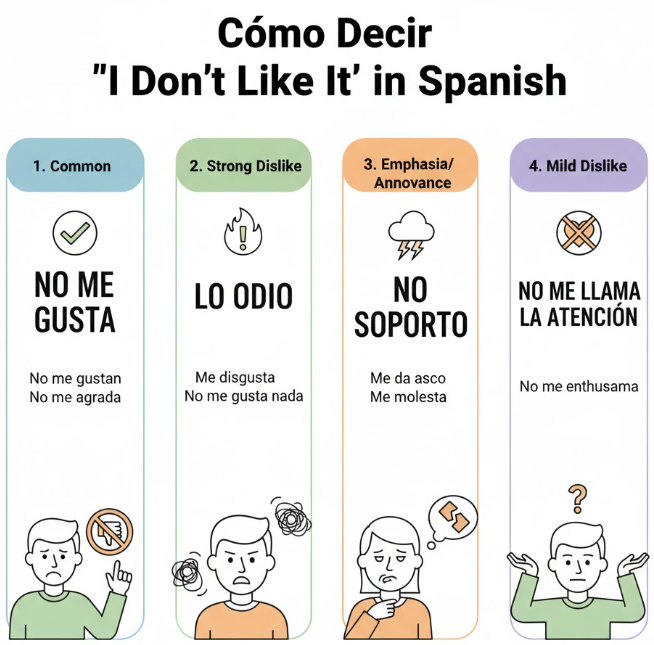
While “No me gusta” is the most common way to say “I don’t like it,” Spanish offers a variety of other expressions that convey different shades of meaning. These can be categorized based on intensity and context.
Mild Dislike
These expressions indicate a slight aversion or lack of preference.
- No me agrada: This translates to “It doesn’t please me” or “I don’t find it pleasant.” It’s slightly more formal than “No me gusta.”
- No me entusiasma: Meaning “It doesn’t excite me,” indicating a lack of enthusiasm.
- No me llama la atención: Meaning “It doesn’t catch my attention,” suggesting indifference rather than strong dislike.
Strong Dislike
These expressions convey a stronger sense of aversion or distaste.
- No me gusta nada: Meaning “I don’t like it at all.” The addition of “nada” intensifies the dislike.
- Lo odio: Meaning “I hate it.” This is a very strong expression and should be used carefully.
- Me disgusta: Meaning “It displeases me.” This is a more formal way of expressing strong dislike.
Dislike with Emphasis
These expressions add emphasis to the dislike, often conveying a sense of annoyance or frustration.
- No soporto: Meaning “I can’t stand it.” This indicates a strong aversion and inability to tolerate something.
- Me da asco: Meaning “It disgusts me.” This is used to express a strong feeling of revulsion.
- Me molesta: Meaning “It bothers me.” This indicates that something is annoying or irritating.
Examples of “I Don’t Like It” in Spanish
To illustrate the different ways to express “I don’t like it” in Spanish, here are several examples categorized by the type of dislike they convey.
Examples Using “No me gusta”
This section provides examples using the most common expression, “No me gusta”, in different contexts.
| Spanish | English |
|---|---|
| No me gusta la lluvia. | I don’t like the rain. |
| No me gusta el brócoli. | I don’t like broccoli. |
| No me gusta esta película. | I don’t like this movie. |
| No me gusta su actitud. | I don’t like his/her attitude. |
| No me gusta madrugar. | I don’t like waking up early. |
| No me gusta la comida picante. | I don’t like spicy food. |
| No me gusta esperar. | I don’t like waiting. |
| No me gusta el ruido. | I don’t like the noise. |
| No me gusta la gente maleducada. | I don’t like rude people. |
| No me gusta el invierno. | I don’t like winter. |
| No me gusta nada este libro. | I don’t like this book at all. |
| No me gusta cómo cocinas. | I don’t like how you cook. |
| No me gusta que llegues tarde. | I don’t like that you arrive late. |
| No me gusta tu nuevo corte de pelo. | I don’t like your new haircut. |
| No me gusta cuando gritas. | I don’t like when you shout. |
| No me gusta este tipo de música. | I don’t like this type of music. |
| No me gusta la idea. | I don’t like the idea. |
| No me gusta la injusticia. | I don’t like injustice. |
| No me gusta el fútbol. | I don’t like football (soccer). |
| No me gusta ir de compras. | I don’t like going shopping. |
| No me gusta planchar la ropa. | I don’t like ironing clothes. |
| No me gusta limpiar la casa. | I don’t like cleaning the house. |
| No me gusta conducir de noche. | I don’t like driving at night. |
| No me gusta hablar por teléfono. | I don’t like talking on the phone. |
Examples of Mild Dislike
This table showcases examples of expressing mild dislike, using phrases like “No me agrada” and “No me entusiasma.”
| Spanish | English |
|---|---|
| No me agrada este tipo de humor. | I don’t find this type of humor pleasant. |
| No me agrada la idea de mudarme. | I don’t find the idea of moving pleasant. |
| No me entusiasma ir a esa fiesta. | I’m not excited about going to that party. |
| No me entusiasma la propuesta. | I’m not excited about the proposal. |
| No me llama la atención ese programa. | That program doesn’t catch my attention. |
| No me llama la atención la política. | Politics doesn’t catch my attention. |
| No me agrada cuando me interrumpen. | I don’t like it when I’m interrupted. |
| No me agrada la forma en que habla. | I don’t like the way he/she speaks. |
| No me entusiasma la idea de trabajar los fines de semana. | I’m not excited about the idea of working on weekends. |
| No me entusiasma tener que hacer este trabajo. | I’m not excited about having to do this job. |
| No me llama la atención ir al museo. | Going to the museum doesn’t catch my attention. |
| No me llama la atención leer novelas de ciencia ficción. | Reading science fiction novels doesn’t catch my attention. |
| No me agrada tener que discutir por esto. | I don’t like having to argue about this. |
| No me agrada cuando la gente es impuntual. | I don’t like it when people are late. |
| No me entusiasma la idea de viajar en avión. | I’m not excited about the idea of traveling by plane. |
| No me entusiasma tener que levantarme temprano. | I’m not excited about having to get up early. |
| No me llama la atención ir a ese concierto. | I’m not interested in going to that concert. |
| No me llama la atención ver películas de terror. | I’m not interested in watching horror movies. |
| No me agrada el sabor de este té. | I don’t like the taste of this tea. |
| No me agrada la textura de este postre. | I don’t like the texture of this dessert. |
| No me entusiasma la idea de ir al gimnasio. | I’m not excited about the idea of going to the gym. |
| No me entusiasma tener que cocinar todas las noches. | I’m not excited about having to cook every night. |
| No me llama la atención la moda. | I’m not interested in fashion. |
| No me llama la atención los chismes. | I’m not interested in gossip. |
Examples of Strong Dislike
This table provides examples using stronger expressions like “No me gusta nada,” “Lo odio,” and “Me disgusta.”
| Spanish | English |
|---|---|
| No me gusta nada este clima. | I don’t like this weather at all. |
| Lo odio cuando me mientes. | I hate it when you lie to me. |
| Me disgusta la violencia. | Violence displeases me. |
| No me gusta nada su comportamiento. | I don’t like his/her behavior at all. |
| Lo odio este trabajo. | I hate this job. |
| Me disgusta tener que hacer esto. | Having to do this displeases me. |
| No me gusta nada la burocracia. | I don’t like bureaucracy at all. |
| Lo odio el tráfico. | I hate traffic. |
| Me disgusta la injusticia social. | Social injustice displeases me. |
| No me gusta nada esta situación. | I don’t like this situation at all. |
| Lo odio cuando llegas tarde. | I hate it when you are late. |
| Me disgusta la falta de respeto. | Lack of respect displeases me. |
| No me gusta nada la comida rápida. | I don’t like fast food at all. |
| Lo odio tener que limpiar. | I hate having to clean. |
| Me disgusta la contaminación. | Pollution displeases me. |
| No me gusta nada este sabor. | I don’t like this taste at all. |
| Lo odio cuando me critican. | I hate it when they criticize me. |
| Me disgusta la arrogancia. | Arrogance displeases me. |
| No me gusta nada tener que esperar. | I don’t like having to wait at all. |
| Lo odio tener que levantarme temprano. | I hate having to get up early. |
| Me disgusta la mentira. | Lying displeases me. |
| No me gusta nada la guerra. | I don’t like war at all. |
| Lo odio tener que ir al médico. | I hate having to go to the doctor. |
| Me disgusta la hipocresía. | Hypocrisy displeases me. |
Examples of Dislike with Emphasis
This table illustrates expressions that emphasize dislike, such as “No soporto,” “Me da asco,” and “Me molesta.”
| Spanish | English |
|---|---|
| No soporto el ruido de la ciudad. | I can’t stand the noise of the city. |
| Me da asco la comida en mal estado. | Rotten food disgusts me. |
| Me molesta que llegues tarde. | It bothers me that you arrive late. |
| No soporto la gente que habla mucho. | I can’t stand people who talk a lot. |
| Me da asco la suciedad. | Dirtiness disgusts me. |
| Me molesta que me interrumpan. | It bothers me when I’m interrupted. |
| No soporto la injusticia. | I can’t stand injustice. |
| Me da asco los insectos. | Insects disgust me. |
| Me molesta el calor. | The heat bothers me. |
| No soporto a mi vecino. | I can’t stand my neighbor. |
| Me da asco el olor a cigarrillo. | The smell of cigarettes disgusts me. |
| Me molesta la música alta. | Loud music bothers me. |
| No soporto tener que limpiar. | I can’t stand having to clean. |
| Me da asco la idea. | The idea disgusts me. |
| Me molesta que no me escuchen. | It bothers me that they don’t listen to me. |
| No soporto la arrogancia. | I can’t stand arrogance. |
| Me da asco la falsedad. | Falsehood disgusts me. |
| Me molesta el humo. | The smoke bothers me. |
| No soporto la espera. | I can’t stand the wait. |
| Me da asco la crueldad. | Cruelty disgusts me. |
| Me molesta tener que trabajar hasta tarde. | It bothers me having to work late. |
| No soporto que me griten. | I can’t stand being yelled at. |
| Me da asco la comida grasienta. | Greasy food disgusts me. |
| Me molesta que me hagan esperar. | It bothers me that they make me wait. |
Usage Rules
When using “gustar” and its variations, it’s essential to remember that the verb conjugates based on what is being liked or disliked, not who is doing the liking or disliking. Here are some key usage rules:
- Singular vs. Plural: If you are talking about a singular item, use “gusta.” If you are talking about multiple items, use “gustan.” For instance, “No me gusta el libro” (I don’t like the book) vs. “No me gustan los libros” (I don’t like the books).
- Indirect Object Pronouns: Always use the correct indirect object pronoun to indicate who is experiencing the liking or disliking. The most common ones are:
- Me (to me)
- Te (to you, informal)
- Le (to him/her/you, formal)
- Nos (to us)
- Os (to you, plural informal)
- Les (to them/you, plural formal)
- Placement of “No”: The negation “no” always comes before the indirect object pronoun and the verb.
- With Verbs: When you dislike doing something (expressed with a verb), use the infinitive form. For example, “No me gusta cocinar” (I don’t like to cook).
Common Mistakes
Many learners make common mistakes when using “gustar.” Understanding these errors can help you avoid them.
| Incorrect | Correct | Explanation |
|---|---|---|
| Yo no gusto el café. | No me gusta el café. | “Gustar” is not conjugated like a regular verb. The thing being liked/disliked is the subject, not the person. |
| No gusto el libro. | No me gusta el libro. | The indirect object pronoun “me” is necessary to indicate who is experiencing the liking/disliking. |
| No me gustan el libro. | No me gusta el libro. | “Gusta” must agree in number with the thing being liked/disliked. Since “el libro” is singular, use “gusta.” |
| No me gusta los libros. | No me gustan los libros. | “Gustan” is used because “los libros” is plural. |
| No le gusto la película (talking about myself). | No me gusta la película. | “Le” means “to him/her/you (formal).” Use “me” to refer to yourself. |
| Odio a el perro. | Odio al perro. | When “a” (to) is followed by “el” (the), they combine to form “al.” This is necessary with verbs like “odiar” when the object is a person or a pet. |
Practice Exercises
Test your knowledge with these practice exercises. Provide the correct Spanish translation for each sentence.
Exercise 1: Translate the Following Sentences
| English | Spanish |
|---|---|
| I don’t like the music. | No me gusta la música. |
| I don’t like the movies. | No me gustan las películas. |
| I don’t like to study. | No me gusta estudiar. |
| I don’t like the soup. | No me gusta la sopa. |
| I don’t like the vegetables. | No me gustan las verduras. |
| I don’t like to work. | No me gusta trabajar. |
| I don’t like the cold. | No me gusta el frío. |
| I don’t like the parties. | No me gustan las fiestas. |
| I don’t like to dance. | No me gusta bailar. |
| I don’t like the homework. | No me gusta la tarea. |
Exercise 2: Fill in the Blanks
Fill in the blanks with the correct form of “gustar” (gusta or gustan) and the appropriate indirect object pronoun.
| Sentence | Answer |
|---|---|
| A mí no ______ las manzanas. | A mí no me gustan las manzanas. |
| A ti no ______ el chocolate. | A ti no te gusta el chocolate. |
| A él no ______ los deportes. | A él no le gustan los deportes. |
| A nosotros no ______ la clase de matemáticas. | A nosotros no nos gusta la clase de matemáticas. |
| A vosotros no ______ las películas de terror. | A vosotros no os gustan las películas de terror. |
| A ellas no ______ ir de compras. | A ellas no les gusta ir de compras. |
| A mí no ______ madrugar. | A mí no me gusta madrugar. |
| A ti no ______ las mentiras. | A ti no te gustan las mentiras. |
| A él no ______ el café frío. | A él no le gusta el café frío. |
| A nosotros no ______ la lluvia. | A nosotros no nos gusta la lluvia. |
Exercise 3: Rewrite Using Stronger Dislike Expressions
Rewrite the following sentences using a stronger expression of dislike (e.g., “No me gusta nada,” “Lo odio,” “Me disgusta”).
| Original Sentence | Rewritten Sentence |
|---|---|
| No me gusta este programa. | No me gusta nada este programa. / Lo odio este programa. |
| No me gusta tener que esperar. | Me disgusta tener que esperar. / No me gusta nada tener que esperar. |
| No me gusta la contaminación. | Me disgusta la contaminación. / No me gusta nada la contaminación. |
| No me gusta la burocracia. | No me gusta nada la burocracia. / Me disgusta la burocracia. |
| No me gusta este sabor. | No me gusta nada este sabor. |
| No me gusta la guerra. | Lo odio la guerra. / Me disgusta la guerra. |
| No me gusta la injusticia. | Me disgusta la injusticia. / No me gusta nada la injusticia. |
| No me gusta la mentira. | Me disgusta la mentira. / No me gusta nada la mentira. |
| No me gusta levantarme temprano. | Lo odio tener que levantarme temprano. / Me disgusta tener que levantarme temprano. |
| No me gusta esta situación. | No me gusta nada esta situación. |
Advanced Topics
For advanced learners, there are more nuanced ways to express dislike in Spanish.
- Using Subjunctive: When expressing dislike for someone else’s actions or characteristics, the subjunctive mood is often used. For example, “No me gusta que seas tan impuntual” (I don’t like that you are so late).
- Expressing Conditional Dislike: Use conditional tenses to express dislike under certain conditions. For example, “No me gustaría ir si llueve” (I wouldn’t like to go if it rains).
- Idiomatic Expressions: Spanish has various idiomatic expressions to convey dislike, such as “No trago a alguien” (I can’t stand someone), which literally means “I don’t swallow someone.”
Frequently Asked Questions
- What is the difference between “No me gusta” and “No me agrada”?
“No me gusta” is the most common and general way to say “I don’t like it.” “No me agrada” is slightly more formal and means “It doesn’t please me” or “I don’t find it pleasant.” The difference is subtle, but “No me agrada” implies a slightly more refined or polite expression of dislike.
- When should I use “gustar” vs. “gustan”?
Use “gusta” when the thing you don’t like is singular. For example, “No me gusta el libro” (I don’t like the book). Use “gustan” when the things you don’t like are plural. For example, “No me gustan los libros” (I don’t like the books).
- How do I express that someone else doesn’t like something?
Use the appropriate indirect object pronoun. For example, “A él no le gusta” (He doesn’t like it), “A ella no le gusta” (She doesn’t like it), “A ellos no les gusta” (They don’t like it).
- Can I use “odiar” instead of “no me gusta”?
Yes, “odiar” means “to hate” and is a much stronger expression of dislike. Use it when you want to convey a strong aversion. For example, “Odio el tráfico” (I hate traffic).
- What does “No soporto” mean?
“No soporto” means “I can’t stand it.” It indicates a strong aversion and an inability to tolerate something. For example, “No soporto el ruido” (I can’t stand the noise).
- Is it rude to say “No me gusta”?
It depends on the context and how you say it. Saying “No me gusta” directly can sometimes be perceived as blunt. To be more polite, you can soften the expression by adding “mucho” (not much) or using a milder expression like “No me agrada.”
- How do I say “I don’t like doing something”?
Use the infinitive form of the verb after “gusta.” For example, “No me gusta cocinar” (I don’t like to cook), “No me gusta estudiar” (I don’t like to study).
- What are some other ways to express dislike in Spanish?
Besides the expressions mentioned, you can also use phrases like “No soy fan de…” (I’m not a fan of…), “No es de mi agrado…” (It’s not to my liking…), or “No me hace mucha gracia…” (It doesn’t appeal to me much…).
Conclusion
Mastering the art of expressing dislike in Spanish involves understanding the nuances of “gustar” and its variations. From the basic “No me gusta” to more emphatic expressions like “Lo odio” and “No soporto,” each phrase conveys a different level of aversion.
By understanding the structural rules, common mistakes, and contextual usage, you can effectively communicate your dislikes in Spanish with accuracy and confidence.
Remember to practice using these expressions in various contexts to solidify your understanding. Pay attention to how native speakers express their dislikes and try to incorporate those nuances into your own speech.
With consistent practice, you’ll be able to express your preferences and aversions naturally and fluently in Spanish. Keep in mind that language learning is an ongoing process, and continuous practice and exposure are key to achieving fluency.