
Expressing emotions is a vital part of any language, and Italian is no exception. Knowing how to say “I miss you” in Italian is crucial for connecting with loved ones and expressing your feelings authentically.
This article provides a comprehensive guide to mastering various ways to convey this sentiment in Italian, from the most common phrases to more nuanced expressions. Whether you’re a beginner or an advanced learner, this guide will equip you with the knowledge and tools to express your longing in Italian.
This guide will benefit anyone learning Italian, especially those interested in expressing emotions and connecting with Italian speakers on a deeper level. Understanding the nuances of expressing “I miss you” will enhance your communication skills and cultural understanding.
Table of Contents
- Introduction
- Definition of “I Miss You” in Italian
- Structural Breakdown of Key Phrases
- Types of Expressions to Say “I Miss You”
- Examples of “I Miss You” in Italian
- Usage Rules and Grammar
- Common Mistakes to Avoid
- Practice Exercises
- Advanced Topics
- Frequently Asked Questions
- Conclusion
Definition of “I Miss You” in Italian
The English phrase “I miss you” conveys a feeling of longing or sadness due to the absence of someone or something. In Italian, this sentiment can be expressed in several ways, each with slightly different nuances and grammatical structures. The most common translations involve the verb mancare, which means “to be missing” or “to lack.” However, instead of saying “I miss you” directly, Italian speakers use constructions that emphasize what is missing from them.
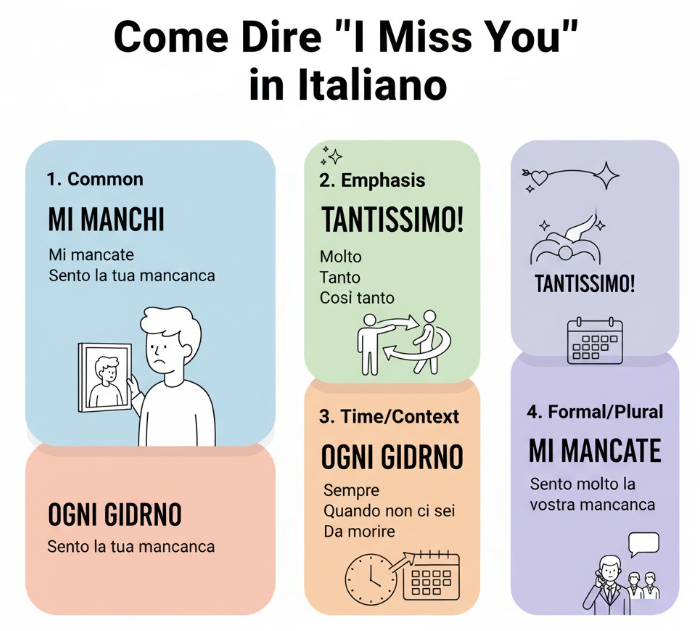
The primary ways to say “I miss you” in Italian are:
- Mi manchi: This is the most common and versatile way to say “I miss you.” Literally, it translates to “You are missing to me.”
- Mi sei mancato/a: This translates to “I have missed you.” The ending of mancato/a changes depending on the gender of the person being missed (-o for masculine, -a for feminine).
- Sento la tua mancanza: This phrase means “I feel your absence” or “I feel the lack of you.”
These phrases capture the essence of missing someone, but understanding their structural differences and usage is crucial for effective communication.
Structural Breakdown of Key Phrases
Understanding the structure of these phrases is essential for using them correctly. Let’s break down the two most common expressions:
Mi manchi
This phrase follows an indirect object construction. Here’s a breakdown:
- Mi: This is an indirect object pronoun meaning “to me.”
- Manchi: This is the second-person singular form of the verb mancare (to be missing/lacking) in the present tense. It agrees with the person who is missed (tu – you).
Therefore, Mi manchi literally means “You are missing to me.” The subject of the verb mancare is “you” (the person being missed), and “me” is the indirect object.
Mi sei mancato/a
This phrase uses the passato prossimo (present perfect) tense. Here’s a breakdown:
- Mi: This is an indirect object pronoun meaning “to me.”
- Sei: This is the second-person singular form of the verb essere (to be) in the present tense, used as an auxiliary verb.
- Mancato/a: This is the past participle of the verb mancare. It agrees in gender with the person being missed. Mancato is used if the person being missed is male, and mancata if the person is female.
Therefore, Mi sei mancato/a literally means “You have been missing to me.” The auxiliary verb essere is used because mancare is an intransitive verb (it doesn’t take a direct object). The past participle must agree in gender with the subject.
Types of Expressions to Say “I Miss You”
The Italian language offers a variety of ways to express “I miss you,” each suitable for different contexts and relationships. Here are some categories:
Formal Expressions
In formal situations, such as addressing someone you don’t know well or someone in a position of authority, it’s best to use more polite and less direct expressions. These phrases convey respect and distance.
- Mi è mancato/a: This is a more formal way of saying “I missed you,” suitable for addressing someone you don’t know well or someone older than you.
- Ho sentito la sua mancanza: This translates to “I felt your absence,” and it’s a polite way to express missing someone.
Informal Expressions
These are the most common and direct ways to say “I miss you,” suitable for friends, family, and romantic partners.
- Mi manchi: The most common and versatile expression.
- Mi sei mancato/a: Another very common expression, emphasizing that you have already missed them.
Romantic Expressions
When expressing your feelings to a romantic partner, you might want to use more affectionate and passionate phrases.
- Mi manchi da morire: This translates to “I miss you to death,” conveying a strong sense of longing.
- Non vedo l’ora di rivederti: This means “I can’t wait to see you again,” expressing anticipation and desire.
- Ho bisogno di te: This translates to “I need you,” emphasizing your dependence on the other person.
Platonic Expressions
When expressing your feelings to a friend or family member, you might want to use phrases that are warm but not overly romantic.
- Mi manchi tanto: This means “I miss you so much,” a heartfelt expression for close friends and family.
- È stato bello con te: This translates to “It was nice with you,” implying that you miss their company.
Strong Expressions
These phrases convey a deep and intense feeling of missing someone.
- Sono disperato/a senza di te: This translates to “I am desperate without you.”
- Non posso vivere senza di te: This means “I cannot live without you.”
Examples of “I Miss You” in Italian
Here are several examples of how to use these phrases in context:
Examples with Mi manchi
The following table demonstrates the usage of Mi manchi in different contexts. Note how Mi manchi is often followed by additional phrases to add emphasis or context.
| Italian | English Translation |
|---|---|
| Mi manchi tanto. | I miss you so much. |
| Mi manchi davvero. | I really miss you. |
| Mi manchi un sacco. | I miss you a lot. |
| Mi manchi ogni giorno. | I miss you every day. |
| Mi manchi quando non ci sei. | I miss you when you’re not here. |
| Mi manchi da impazzire. | I miss you like crazy. |
| Mi manchi come l’aria. | I miss you like air. |
| Mi manchi più del solito. | I miss you more than usual. |
| Mi manchi quando rido e quando piango. | I miss you when I laugh and when I cry. |
| Mi manchi, lo sai? | I miss you, you know? |
| Mi manchi come il sole d’estate. | I miss you like the summer sun. |
| Mi manchi quando sono solo/a. | I miss you when I’m alone. |
| Mi manchi sempre. | I always miss you. |
| Mi manchi durante la notte. | I miss you during the night. |
| Mi manchi più di quanto immagini. | I miss you more than you imagine. |
| Mi manchi, spero di vederti presto. | I miss you, I hope to see you soon. |
| Mi manchi perché sei speciale. | I miss you because you are special. |
| Mi manchi, amico/a mio/a. | I miss you, my friend. |
| Mi manchi, amore mio. | I miss you, my love. |
| Mi manchi, mamma. | I miss you, mom. |
| Mi manchi, papà. | I miss you, dad. |
| Mi manchi, sorella. | I miss you, sister. |
| Mi manchi, fratello. | I miss you, brother. |
| Mi manchi, nonna. | I miss you, grandma. |
| Mi manchi, nonno. | I miss you, grandpa. |
| Mi manchi terribilmente. | I miss you terribly. |
Examples with Mi sei mancato/a
The following table illustrates how to use Mi sei mancato/a. Remember that the ending of mancato changes based on the gender of the person you are missing.
| Italian | English Translation | Notes |
|---|---|---|
| Mi sei mancato, Marco. | I missed you, Marco. | Addressing a male named Marco. |
| Mi sei mancata, Giulia. | I missed you, Giulia. | Addressing a female named Giulia. |
| Mi sei mancato tanto. | I missed you so much (male). | Referring to a male. |
| Mi sei mancata tanto. | I missed you so much (female). | Referring to a female. |
| Mi sei mancato davvero! | I really missed you! (male) | Referring to a male. |
| Mi sei mancata davvero! | I really missed you! (female) | Referring to a female. |
| Mi sei mancato un sacco. | I missed you a lot (male). | Referring to a male. |
| Mi sei mancata un sacco. | I missed you a lot (female). | Referring to a female. |
| Mi sei mancato, amico mio. | I missed you, my friend (male). | Referring to a male friend. |
| Mi sei mancata, amica mia. | I missed you, my friend (female). | Referring to a female friend. |
| Mi sei mancato, amore mio. | I missed you, my love (male). | Referring to a male lover. |
| Mi sei mancata, amore mio. | I missed you, my love (female). | Referring to a female lover. |
| Mi sei mancato durante il viaggio. | I missed you during the trip (male). | Referring to a male. |
| Mi sei mancata durante il viaggio. | I missed you during the trip (female). | Referring to a female. |
| Mi sei mancato, papà. | I missed you, dad. | Referring to a male. |
| Mi sei mancata, mamma. | I missed you, mom. | Referring to a female. |
| Mi sei mancato, fratello. | I missed you, brother. | Referring to a male. |
| Mi sei mancata, sorella. | I missed you, sister. | Referring to a female. |
| Mi sei mancato più di quanto pensi. | I missed you more than you think (male). | Referring to a male. |
| Mi sei mancata più di quanto pensi. | I missed you more than you think (female). | Referring to a female. |
| Mi sei mancato come l’aria. | I missed you like air (male). | Referring to a male. |
| Mi sei mancata come l’aria. | I missed you like air (female). | Referring to a female. |
| Mi sei mancato da morire. | I missed you to death (male). | Referring to a male. |
| Mi sei mancata da morire. | I missed you to death (female). | Referring to a female. |
| Mi sei mancato/a quando ero solo/a. | I missed you when I was alone. | Gender of “mancato/a” depends on the person you missed. |
Examples with Other Expressions
This table includes various alternative expressions to convey “I miss you” in Italian.
| Italian | English Translation |
|---|---|
| Sento la tua mancanza. | I feel your absence. |
| Sento tanto la tua mancanza. | I feel your absence so much. |
| Non vedo l’ora di rivederti. | I can’t wait to see you again. |
| Ho nostalgia di te. | I’m nostalgic for you. |
| Ho bisogno di te. | I need you. |
| Non posso stare senza di te. | I can’t be without you. |
| Mi manca la tua voce. | I miss your voice. |
| Mi manca il tuo sorriso. | I miss your smile. |
| Mi manca il tuo profumo. | I miss your scent. |
| Mi manca la tua presenza. | I miss your presence. |
| Mi manca parlare con te. | I miss talking to you. |
| Mi manca ridere con te. | I miss laughing with you. |
| Mi manca tutto di te. | I miss everything about you. |
| Il tempo senza di te è infinito. | Time without you is endless. |
| Vorrei che fossi qui. | I wish you were here. |
| Penso sempre a te. | I always think of you. |
| Ti penso sempre. | I always think of you. |
| Ogni cosa mi ricorda te. | Everything reminds me of you. |
| La casa è vuota senza di te. | The house is empty without you. |
| La vita è incompleta senza di te. | Life is incomplete without you. |
| Sono triste senza di te. | I am sad without you. |
| Il mio cuore è vuoto senza di te. | My heart is empty without you. |
| Non sono lo stesso senza di te. | I am not the same without you. |
| Spero di rivederti presto. | I hope to see you soon. |
Usage Rules and Grammar
Understanding the grammatical rules that govern these expressions is crucial for accurate usage.
Agreement of Participles
As mentioned earlier, when using Mi sei mancato/a, the past participle mancato/a must agree in gender with the person being missed. If you are missing a male, use mancato; if you are missing a female, use mancata. This is a fundamental rule of Italian grammar when using auxiliary verbs like essere (to be) with intransitive verbs.
Pronoun Placement
In Italian, pronoun placement can vary depending on the context. In the case of Mi manchi and Mi sei mancato/a, the indirect object pronoun mi always precedes the verb. This is a standard rule for pronoun placement with verbs.
Formal vs. Informal Usage
As discussed earlier, certain expressions are more suitable for formal situations than others. Mi manchi and Mi sei mancato/a are generally informal and appropriate for friends, family, and romantic partners. In formal situations, consider using Mi è mancato/a or Ho sentito la sua mancanza.
Common Mistakes to Avoid
Here are some common mistakes that learners make when expressing “I miss you” in Italian:
| Incorrect | Correct | Explanation |
|---|---|---|
| Io manchi a te. | Mi manchi. | The correct structure is “You are missing to me,” not “I miss to you.” |
| Mi sono mancato. | Mi sei mancato. | The auxiliary verb should be essere (sei), and the past participle should agree with the person you missed. |
| Mi sei mancato, Maria (said to a male). | Mi sei mancata, Maria. | The past participle must agree in gender with the person being missed. |
| Ti manco. | Mi manchi. | Ti manco means “I miss you” (said by you to someone else). |
Practice Exercises
Test your understanding with these practice exercises:
Exercise 1: Translate to Italian
Translate the following sentences into Italian using the appropriate expressions.
| English | Italian (Answer) |
|---|---|
| I miss you so much. | Mi manchi tanto. |
| I missed you, John. | Mi sei mancato, Giovanni. |
| I feel your absence. | Sento la tua mancanza. |
| I really miss you. | Mi manchi davvero. |
| I missed you, Maria. | Mi sei mancata, Maria. |
| I miss your smile. | Mi manca il tuo sorriso. |
| I can’t wait to see you again. | Non vedo l’ora di rivederti. |
| I miss you, my friend. (to a male) | Mi manchi, amico mio. |
| I miss you, my friend. (to a female) | Mi manchi, amica mia. |
| I miss you, mom. | Mi manchi, mamma. |
Exercise 2: Choose the Correct Form
Choose the correct form of the verb in the following sentences.
| Question | Answer |
|---|---|
| Mi (manchi / manco) tanto. | Mi manchi tanto. |
| Mi sei (mancato / mancata), Luca. | Mi sei mancato, Luca. |
| Mi sei (mancato / mancata), Sofia. | Mi sei mancata, Sofia. |
| (Sento / sento a) la tua mancanza. | Sento la tua mancanza. |
| (Manchi / manco) come l’aria. | Mi manchi come l’aria. |
| (Ho / Sono) nostalgia di te. | Ho nostalgia di te. |
| Mi (manca / mancano) i tuoi abbracci. | Mi mancano i tuoi abbracci. |
| Mi (manchi / manco) da morire. | Mi manchi da morire. |
| (Mi sei mancato/ Ti sei mancato), amico mio. | Mi sei mancato, amico mio. |
| (Mi sei mancata/ Ti sei mancata), amica mia. | Mi sei mancata, amica mia. |
Exercise 3: Fill in the Blanks
Fill in the blanks with the appropriate Italian words.
| Question | Answer |
|---|---|
| _____ manchi tanto. | Mi |
| Mi sei _____ , Marco. | mancato |
| Sento la _____ mancanza. | tua |
| Non _____ l’ora di rivederti. | vedo |
| Ho _____ di te. | bisogno |
| Mi _____ la tua voce. | manca |
| _____ manchi da impazzire. | Mi |
| Mi sei _____ , cara. | mancata |
| Mi _____ parlare con te. | manca |
| Ti penso _____. | sempre |
Advanced Topics
For advanced learners, exploring more nuanced and complex aspects of expressing “I miss you” can further enhance your understanding and fluency.
Literary and Poetic Expressions
Italian literature and poetry offer a wealth of beautiful and evocative ways to express longing and missing someone. These expressions often use figurative language and imagery to convey deep emotions.
For example, you might find phrases like:
- “L’anima mia ti cerca” (My soul seeks you)
- “Il cuore mio sospira per te” (My heart sighs for you)
These expressions are more artistic and less commonly used in everyday conversation, but they can add a touch of elegance and depth to your communication.
Regional Variations
Like many aspects of the Italian language, expressions for “I miss you” can vary by region. While Mi manchi and Mi sei mancato/a are widely understood throughout Italy, some regions may have their own unique phrases or idioms.
For example, in some regions, you might hear:
- “Mi fai pena” (You make me feel sorry), used in a playful way to express missing someone.
Exploring these regional variations can provide a deeper understanding of the cultural nuances of the Italian language.
Frequently Asked Questions
Here are some frequently asked questions about expressing “I miss you” in Italian:
- What’s the difference between Mi manchi and Mi sei mancato/a?Mi manchi expresses a current feeling of missing someone, while Mi sei mancato/a expresses that you have already missed them. Mi manchi is more general, while Mi sei mancato/a implies a period of absence has already occurred.
- How do I know whether to use mancato or mancata?The ending of mancato/a depends on the gender of the person you are missing. Use mancato for a male and mancata for a female.
- Is Mi manchi appropriate for all situations?Mi manchi is generally appropriate for informal situations, such as with friends, family, and romantic partners. In formal situations, consider using Mi è mancato/a or Ho sentito la sua mancanza.
- Can I use Ti manco to say “Do you miss me?”Yes, Ti manco? means “Do you miss me?”.
- Are there any other ways to express “I miss you” besides Mi manchi and Mi sei mancato/a?Yes, there are many other ways to express “I miss you,” such as Sento la tua mancanza, Non vedo l’ora di rivederti, and Ho bisogno di te. Explore these options to add variety to your expressions.
- How do I express that I miss a group of people?You would use the plural form: Mi mancate (you all are missing to me) in the present tense, or Mi siete mancati/e (I have missed you all) in the past tense. The ending of mancati/e depends on whether the group is all male (mancati), all female (mancate), or mixed (mancati).
- Is it correct to say “Mi mancano i tuoi occhi”?Yes, it is correct. It means “I miss your eyes.” In this case, because the subject is plural (i tuoi occhi), the verb mancare is conjugated in the third-person plural form (mancano).
- Can I use “Mi manchi” to refer to a place?While less common, you can use “Mi manchi” to refer to a place, implying that you miss being there. For example, “Mi manchi, Roma” (I miss you, Rome). However, it’s more common to use other expressions like “Ho nostalgia di Roma” (I’m nostalgic for Rome).
Conclusion
Mastering the art of expressing “I miss you” in Italian involves understanding the nuances of the language and the cultural context. By learning the various phrases, their structural breakdowns, and usage rules, you can effectively convey your feelings to loved ones and connect with Italian speakers on a deeper level.
Remember to practice these expressions and pay attention to the gender agreement and formality required in different situations.
Continue to explore the Italian language and culture to enhance your communication skills and build meaningful relationships. With dedication and practice, you can confidently express your emotions and connect with others in a heartfelt and authentic way.