Knowing how to say “I’m back” in Italian is crucial for anyone learning the language, whether you’re a tourist returning to your hotel, a student coming back from class, or simply letting your family know you’ve arrived home. This seemingly simple phrase involves understanding Italian pronouns, verb conjugations, and idiomatic expressions.
Mastering it not only enhances your communication skills but also provides insight into Italian culture and conversational nuances. This guide breaks down the various ways to express “I’m back” in Italian, covering grammatical rules, contextual usage, and common mistakes.
This article is beneficial for beginner to intermediate Italian learners who want to improve their fluency and accuracy.
Learning to say “I’m back” effectively will empower you to engage in everyday conversations with confidence and clarity. This guide provides a structured approach to understanding and using this essential phrase in various contexts.
Table of Contents
- Introduction
- Definition: “I’m Back” in Italian
- Structural Breakdown
- Types and Categories of “I’m Back”
- Examples
- Usage Rules
- Common Mistakes
- Practice Exercises
- Advanced Topics
- FAQ
- Conclusion
Definition: “I’m Back” in Italian
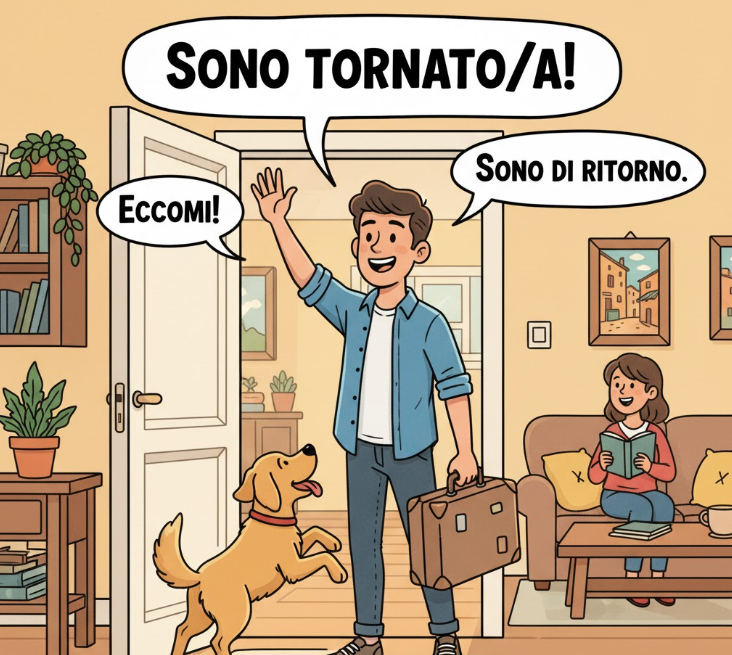
The most common and direct translation of “I’m back” in Italian is Sono tornato/a. This phrase uses the verb essere (to be) in the first-person singular present tense (sono) and the past participle of the verb tornare (to return, to come back). The past participle changes depending on the gender of the speaker: tornato for males and tornata for females.
Beyond the literal translation, there are other ways to convey the idea of “I’m back” in Italian, each with its own nuance and context. These include using phrases like Ritorno (a more formal announcement of return), Eccomi (here I am), and Di nuovo qui (again here). Understanding these variations allows for more flexible and natural communication.
Structural Breakdown
Let’s break down the structure of the most common phrase, Sono tornato/a:
- Sono: This is the first-person singular present tense of the verb essere, meaning “I am.” It’s an auxiliary verb used to form compound tenses.
- Tornato/a: This is the past participle of the verb tornare, meaning “returned” or “come back.” As mentioned before, the ending changes based on the speaker’s gender:
- Tornato: Used by males.
- Tornata: Used by females.
The combination of sono and tornato/a creates the past participle construction, indicating that the action of returning has been completed. The structure is similar to the English “I have returned,” but in Italian, essere is used instead of avere (to have) with intransitive verbs like tornare.
Types and Categories of “I’m Back”
While Sono tornato/a is the most common way to say “I’m back,” Italian offers several other options, each suitable for different contexts and conveying slightly different nuances.
Sono tornato/a: The Standard Form
This is the most straightforward and commonly used way to say “I’m back.” It’s suitable for almost any situation, from returning home to rejoining a group of friends.
Ritorno: A More Formal Approach
Ritorno is the first-person singular present tense of the verb ritornare, which is a more formal synonym of tornare. Using just Ritorno can sound a bit theatrical or formal, like announcing your return in a play. It’s not commonly used in everyday conversation but might appear in literature or formal speeches. It can also be used sarcastically.
Eccomi: Here I Am
Eccomi literally translates to “Here I am.” While not a direct translation of “I’m back,” it conveys a similar sentiment, especially when arriving after being expected or missed. It implies presence and readiness.
Di nuovo qui: Again Here
Di nuovo qui means “Again here.” This phrase emphasizes the repetition of being in a certain place. It’s suitable when returning to a place you’ve been before, possibly after a long absence.
Examples
Let’s look at some examples of how these phrases are used in context.
Examples with Sono tornato/a
This table provides a variety of sentences using Sono tornato/a in different scenarios, showcasing its versatility.
| Italian | English Translation | Context |
|---|---|---|
| Sono tornato a casa. (Male) | I’m back home. | Arriving at home after work. |
| Sono tornata a casa. (Female) | I’m back home. | Arriving at home after work. |
| Sono tornato dalle vacanze. (Male) | I’m back from vacation. | Returning from a trip. |
| Sono tornata dalle vacanze. (Female) | I’m back from vacation. | Returning from a trip. |
| Sono tornato al lavoro. (Male) | I’m back at work. | Returning to the office after a break. |
| Sono tornata al lavoro. (Female) | I’m back at work. | Returning to the office after a break. |
| Sono tornato in Italia. (Male) | I’m back in Italy. | Returning to Italy after being abroad. |
| Sono tornata in Italia. (Female) | I’m back in Italy. | Returning to Italy after being abroad. |
| Sono tornato dopo tanto tempo. (Male) | I’m back after a long time. | Returning after a long absence. |
| Sono tornata dopo tanto tempo. (Female) | I’m back after a long time. | Returning after a long absence. |
| Sono tornato, mi sei mancato/a! (Male speaking to male) | I’m back, I missed you! | Returning to a friend. |
| Sono tornata, mi sei mancato/a! (Female speaking to male) | I’m back, I missed you! | Returning to a friend. |
| Sono tornato, mi sei mancata! (Male speaking to female) | I’m back, I missed you! | Returning to a friend. |
| Sono tornata, mi sei mancata! (Female speaking to female) | I’m back, I missed you! | Returning to a friend. |
| Sono tornato a trovarti. (Male) | I’m back to see you. | Returning to visit someone. |
| Sono tornata a trovarti. (Female) | I’m back to see you. | Returning to visit someone. |
| Sono tornato per restare. (Male) | I’m back to stay. | Returning with the intention of staying permanently. |
| Sono tornata per restare. (Female) | I’m back to stay. | Returning with the intention of staying permanently. |
| Sono tornato prima del previsto. (Male) | I’m back earlier than expected. | Returning sooner than anticipated. |
| Sono tornata prima del previsto. (Female) | I’m back earlier than expected. | Returning sooner than anticipated. |
| Sono tornato a finire il lavoro. (Male) | I’m back to finish the work. | Returning to complete a task. |
| Sono tornata a finire il lavoro. (Female) | I’m back to finish the work. | Returning to complete a task. |
| Sono tornato in forma! (Male) | I’m back in shape! | Returning to a good physical condition. |
| Sono tornata in forma! (Female) | I’m back in shape! | Returning to a good physical condition. |
| Sono tornato ad aiutarti. (Male) | I’m back to help you. | Returning to provide assistance. |
| Sono tornata ad aiutarti. (Female) | I’m back to help you. | Returning to provide assistance. |
| Sono tornato a studiare qui. (Male) | I’m back to study here. | Returning to a place to study. |
| Sono tornata a studiare qui. (Female) | I’m back to study here. | Returning to a place to study. |
| Sono tornato a vivere qui. (Male) | I’m back to live here. | Returning to a place to reside. |
| Sono tornata a vivere qui. (Female) | I’m back to live here. | Returning to a place to reside. |
Examples with Ritorno
This table provides examples of Ritorno, noting its formal or sarcastic tone.
| Italian | English Translation | Context |
|---|---|---|
| Ritorno alla ribalta! | I’m back in the spotlight! | Used sarcastically or dramatically. |
| Ritorno a voi con nuove idee. | I return to you with new ideas. | A formal announcement, perhaps in a presentation. |
| Ritorno dopo una lunga assenza. | I return after a long absence. | Sounds somewhat pompous in everyday conversation. |
| Ritorno per vendicarmi! | I’m back for revenge! | Dramatic and theatrical. |
| Ritorno tra le vostre braccia. | I return to your arms. | Extremely dramatic or sarcastic. |
| Ritorno al mio paese natale. | I return to my homeland. | Formal and literary. |
| Ritorno con gioia. | I return with joy. | Sounds overly formal. |
| Ritorno per riprendere ciò che è mio. | I return to reclaim what is mine. | Very theatrical. |
| Ritorno, ma non per molto. | I return, but not for long. | Can be used to add emphasis. |
| Ritorno per affrontare la sfida. | I return to face the challenge. | Formal and dramatic. |
| Ritorno alla normalità. | I return to normality. | Can sound a little dramatic. |
| Ritorno con nuove energie. | I return with new energy. | Formal and can be used sarcastically. |
| Ritorno per sistemare le cose. | I return to fix things. | Somewhat dramatic. |
| Ritorno al mio posto. | I return to my place. | Formal and slightly theatrical. |
| Ritorno con il favore del pubblico. | I return with public favor. | Very dramatic and sarcastic. |
| Ritorno alla vita. | I return to life. | Sounds overly dramatic. |
| Ritorno alla vecchia maniera. | I return in the old way. | Formal and somewhat antiquated. |
| Ritorno per cambiare il mondo. | I return to change the world. | Very dramatic and likely sarcastic. |
| Ritorno al punto di partenza. | I return to the starting point. | Can be formal. |
| Ritorno per fare la differenza. | I return to make a difference. | Slightly dramatic. |
| Ritorno tra di voi. | I return among you. | Very formal and theatrical. |
| Ritorno con nuove speranze. | I return with new hopes. | Formal and a bit dramatic. |
| Ritorno per riavere ciò che mi spetta. | I return to get what is due to me. | Dramatic and assertive. |
| Ritorno alla realtà. | I return to reality. | Can be used in a slightly formal context. |
| Ritorno con un sorriso. | I return with a smile. | Sounds overly formal. |
| Ritorno per scrivere la storia. | I return to write history. | Very dramatic and probably sarcastic. |
| Ritorno alla mia passione. | I return to my passion. | Formal and a bit theatrical. |
| Ritorno per lasciare il segno. | I return to leave a mark. | Dramatic and ambitious. |
| Ritorno tra le stelle. | I return among the stars. | Highly dramatic and sarcastic. |
| Ritorno alla luce. | I return to the light. | Overly dramatic. |
Examples with Eccomi
This table shows how Eccomi is used to indicate presence and readiness.
| Italian | English Translation | Context |
|---|---|---|
| Eccomi, sono qui! | Here I am, I’m here! | Responding when someone calls your name. |
| Eccomi, pronto per partire. | Here I am, ready to leave. | Announcing your readiness. |
| Eccomi, cosa posso fare per te? | Here I am, what can I do for you? | Offering help. |
| Eccomi, finalmente! | Here I am, finally! | Arriving after being awaited. |
| Eccomi, sono arrivato. | Here I am, I’ve arrived. | Announcing your arrival. |
| Eccomi, non mi sono dimenticato. | Here I am, I haven’t forgotten. | Reassuring someone. |
| Eccomi, sono a tua disposizione. | Here I am, at your disposal. | Offering assistance formally. |
| Eccomi, sono tornato. | Here I am, I’m back. | Combining with “I’m back” for emphasis. |
| Eccomi, sono qui per te. | Here I am, I’m here for you. | Offering support. |
| Eccomi, sono presente. | Here I am, I’m present. | Confirming your presence. |
| Eccomi, pronto all’azione. | Here I am, ready for action. | Expressing readiness. |
| Eccomi, sono disponibile. | Here I am, I’m available. | Offering availability. |
| Eccomi, non sono sparito. | Here I am, I haven’t disappeared. | Reassuring someone of your presence. |
| Eccomi, sono con te. | Here I am, I’m with you. | Offering solidarity. |
| Eccomi, sono qui ad ascoltare. | Here I am, here to listen. | Offering a listening ear. |
| Eccomi, sono il tuo aiuto. | Here I am, I am your help. | Offering assistance. |
| Eccomi, sono il tuo supporto. | Here I am, I am your support. | Offering support. |
| Eccomi, sono la tua guida. | Here I am, I am your guide. | Offering guidance. |
| Eccomi, sono la tua ombra. | Here I am, I am your shadow. | Expressing unwavering support. |
| Eccomi, sono il tuo angelo custode. | Here I am, I am your guardian angel. | Offering protection. |
| Eccomi, rispondo alla chiamata. | Here I am, I answer the call. | Responding to a request for help. |
| Eccomi, sono pronto a servire. | Here I am, ready to serve. | Offering service. |
| Eccomi, sono qui per restare. | Here I am, I am here to stay. | Expressing long-term commitment. |
| Eccomi, sono il tuo alleato. | Here I am, I am your ally. | Offering alliance. |
| Eccomi, sono il tuo complice. | Here I am, I am your accomplice. | Offering partnership. |
| Eccomi, sono il tuo confidente. | Here I am, I am your confidant. | Offering trust. |
| Eccomi, sono il tuo amico. | Here I am, I am your friend. | Offering friendship. |
Examples with Di nuovo qui
This table illustrates how Di nuovo qui is used when returning to a place.
| Italian | English Translation | Context |
|---|---|---|
| Di nuovo qui, nello stesso posto. | Again here, in the same place. | Returning to a familiar location. |
| Di nuovo qui, dopo tanti anni. | Again here, after so many years. | Returning after a long absence. |
| Di nuovo qui, a casa. | Again here, at home. | Returning to one’s home. |
| Di nuovo qui, in ufficio. | Again here, in the office. | Returning to the workplace. |
| Di nuovo qui, in questa città. | Again here, in this city. | Returning to a specific city. |
| Di nuovo qui, con voi. | Again here, with you. | Returning to a group of people. |
| Di nuovo qui, per ricominciare. | Again here, to start again. | Returning with the intention to restart. |
| Di nuovo qui, dove tutto è iniziato. | Again here, where everything started. | Returning to the origin. |
| Di nuovo qui, a fare lo stesso errore. | Again here, to make the same mistake. | Returning to a place where mistakes were made. |
| Di nuovo qui, a rivivere i ricordi. | Again here, to relive memories. | Returning to a place full of memories. |
| Di nuovo qui, ma per poco. | Again here, but for a short time. | Returning temporarily. |
| Di nuovo qui, a respirare la stessa aria. | Again here, to breathe the same air. | Returning to a place to experience its atmosphere. |
| Di nuovo qui, a vedere le stesse facce. | Again here, to see the same faces. | Returning to see familiar people. |
| Di nuovo qui, a camminare per le stesse strade. | Again here, to walk the same streets. | Returning to walk familiar paths. |
| Di nuovo qui, a sentire gli stessi suoni. | Again here, to hear the same sounds. | Returning to hear familiar sounds. |
| Di nuovo qui, a provare le stesse emozioni. | Again here, to feel the same emotions. | Returning to experience familiar emotions. |
| Di nuovo qui, a fare ciò che so fare meglio. | Again here, to do what I do best. | Returning to a place to perform one’s best skills. |
| Di nuovo qui, a dare il massimo. | Again here, to give my best. | Returning to a place to exert maximum effort. |
| Di nuovo qui, a dimostrare chi sono. | Again here, to show who I am. | Returning to prove oneself. |
| Di nuovo qui, a prendermi la mia rivincita. | Again here, to get my revenge. | Returning to seek revenge. |
| Di nuovo qui, a riscrivere la storia. | Again here, to rewrite history. | Returning to a place to change its narrative. |
| Di nuovo qui, a lasciare un segno. | Again here, to leave a mark. | Returning to a place to make an impact. |
| Di nuovo qui, a fare la differenza. | Again here, to make a difference. | Returning to a place to create positive change. |
| Di nuovo qui, a proteggere questo posto. | Again here, to protect this place. | Returning to guard a location. |
| Di nuovo qui, a difendere i miei ideali. | Again here, to defend my ideals. | Returning to uphold one’s principles. |
| Di nuovo qui, a lottare per ciò che credo. | Again here, to fight for what I believe. | Returning to a place to fight for one’s beliefs. |
| Di nuovo qui, a non arrendermi mai. | Again here, to never give up. | Returning to a place with unwavering determination. |
| Di nuovo qui, a realizzare i miei sogni. | Again here, to realize my dreams. | Returning to a place to fulfill one’s dreams. |
| Di nuovo qui, a costruire il mio futuro. | Again here, to build my future. | Returning to a place to build one’s future. |
| Di nuovo qui, a trovare la felicità. | Again here, to find happiness. | Returning to a place to seek happiness. |
Usage Rules
Here are some important rules to keep in mind when using these phrases:
- Gender Agreement: Remember that the past participle tornato/a must agree in gender with the speaker. Males use tornato, and females use tornata.
- Context Matters: Choose the appropriate phrase based on the context and the level of formality required. Sono tornato/a is suitable for most situations, while Ritorno is more formal or can be sarcastic.
- Verb Choice: Understand the nuances between tornare and ritornare. While both mean “to return,” ritornare is more formal and less common in everyday speech.
- Idiomatic Expressions: Be aware of idiomatic expressions like Eccomi, which convey a similar meaning but are not direct translations.
Common Mistakes
Here are some common mistakes to avoid:
| Incorrect | Correct | Explanation |
|---|---|---|
| Sono tornata (said by a male) | Sono tornato | The past participle must agree with the speaker’s gender. |
| Ho tornato | Sono tornato | The verb tornare takes essere (to be) as an auxiliary verb, not avere (to have). |
| Eccomi a casa | Sono tornato/a a casa or Eccomi a casa! | While Eccomi can imply presence, it doesn’t directly translate to “I’m back home.” You can use either of the correct options. |
| Di nuovo qui a casa! | Sono tornato/a a casa! or Di nuovo qui, a casa. | Same as above. While Di nuovo qui can imply presence, it doesn’t directly translate to “I’m back home.” You can use either of the correct options. |
Practice Exercises
Test your understanding with these exercises.
Exercise 1: Translation
Translate the following sentences into Italian.
| Question | Answer |
|---|---|
| I’m back from school (male). | Sono tornato da scuola. |
| I’m back from school (female). | Sono tornata da scuola. |
| Here I am, ready to help. | Eccomi, pronto/a ad aiutare. |
| I’m back in Rome (male). | Sono tornato a Roma. |
| I’m back in Rome (female). | Sono tornata a Roma. |
| Again here, after all this time. | Di nuovo qui, dopo tutto questo tempo. |
| I’m back to stay (male). | Sono tornato per restare. |
| I’m back to stay (female). | Sono tornata per restare. |
| Here I am, finally. | Eccomi, finalmente! |
| I’m back at the office (male). | Sono tornato in ufficio. |
| I’m back at the office (female). | Sono tornata in ufficio. |
Exercise 2: Fill in the Blanks
Fill in the blanks with the correct form of tornare or the appropriate phrase.
| Question | Answer |
|---|---|
| Io _____ a casa. (male) | Sono tornato |
| Io _____ a casa. (female) | Sono tornata |
| _____, sono qui per te! | Eccomi |
| _____ qui dopo tanto tempo. | Di nuovo |
| Io _____ prima del previsto. (male) | Sono tornato |
| Io _____ prima del previsto. (female) | Sono tornata |
| _____, cosa posso fare? | Eccomi |
| _____ a studiare. (male) | Sono tornato |
| _____ a studiare. (female) | Sono tornata |
| _____ a trovarti. (male) | Sono tornato |
| _____ a trovarti. (female) | Sono tornata |
Exercise 3
: Contextual Usage
Provide the most appropriate way to say “I’m back” in the following contexts.
| Context | Appropriate Phrase |
|---|---|
| You’re returning home after a long day at work. | Sono tornato/a a casa. |
| You’re a performer announcing your return to the stage after a hiatus (said sarcastically). | Ritorno alla ribalta! |
| You’re responding to someone who called your name. | Eccomi! |
| You’re back in your hometown after many years. | Di nuovo qui, nella mia città natale. or Sono tornato/a nella mia città natale. |
| You’re reassuring a friend that you’ve come back to help. | Sono tornato/a per aiutarti. or Eccomi, sono qui per aiutarti. |
Advanced Topics
For more advanced learners, consider exploring these topics:
- Regional Variations: Investigate if there are regional variations in how “I’m back” is expressed in different parts of Italy.
- Figurative Language: Explore how the concept of returning is used in Italian literature and poetry.
- Historical Context: Research the historical evolution of the verbs tornare and ritornare.
FAQ
Is there a difference between “tornare” and “ritornare”?
Yes, “ritornare” is a more formal version of “tornare.” In most everyday situations, “tornare” is perfectly acceptable. “Ritorno” by itself is rarely used in conversation and can sound theatrical.
Can I use “Eccomi” instead of “Sono tornato/a”?
“Eccomi” means “Here I am,” so it’s not a direct replacement. However, it can convey a similar sentiment, especially when you’re expected or have been missed.
You can even combine them: “Eccomi, sono tornato/a!”
How do I remember the gender agreement for “tornato/a”?
Think of it like other adjectives in Italian. If you’re male, use the -o ending; if you’re female, use the -a ending.
Is it ever appropriate to just say “Tornato/a”?
No, you always need the auxiliary verb “sono” (I am) to form the complete phrase “Sono tornato/a”. Saying just “Tornato/a” is grammatically incorrect.
Can “Di nuovo qui” be used in any context?
Not really. “Di nuovo qui” is best used when you are physically returning to a place.
It emphasizes the act of being back in a location you’ve been to before.
Are there any other ways to say “I’m back” in Italian slang?
While “Sono tornato/a” is standard, you might hear slang variations depending on the region and context. For example, among very close friends, you might hear a shortened or more casual version, but it’s best to stick to the standard forms until you’re very comfortable with the language.
Conclusion
Mastering the various ways to say “I’m back” in Italian enriches your ability to communicate effectively and naturally. From the standard Sono tornato/a to the more nuanced Ritorno, Eccomi, and Di nuovo qui, each phrase offers a unique way to express your return. By understanding the grammatical rules, usage contexts, and common mistakes, you can confidently use these phrases in your everyday conversations. Keep practicing, and you’ll soon find yourself expressing your returns with the same flair as a native Italian speaker!