Understanding how to express “I’m coming” in Spanish is essential for effective communication, whether you’re planning a visit, responding to an invitation, or simply indicating your imminent arrival. This phrase, seemingly simple, has several nuances and variations depending on the context and desired level of formality.
This guide provides a detailed exploration of the different ways to say “I’m coming” in Spanish, covering grammatical structures, regional variations, and practical examples. This comprehensive resource is suitable for learners of all levels, from beginners to advanced speakers seeking to refine their communication skills.
This article will equip you with the knowledge and confidence to express your impending arrival in Spanish accurately and appropriately, enhancing your overall fluency and comprehension of the language.
Table of Contents
- Introduction
- Definition: Expressing “I’m Coming” in Spanish
- Structural Breakdown of Key Phrases
- Types and Categories of Expressions
- Examples of “I’m Coming” in Spanish
- Usage Rules and Considerations
- Common Mistakes to Avoid
- Practice Exercises
- Advanced Topics
- Frequently Asked Questions
- Conclusion
Definition: Expressing “I’m Coming” in Spanish
The phrase “I’m coming” in Spanish isn’t a direct one-to-one translation. Instead, it’s expressed through a variety of verbs and constructions that convey the idea of movement towards a specific location or person. The most common verbs used are ir (to go) and venir (to come). The choice between these verbs, as well as the inclusion of other verbs such as reflexive verbs, depends heavily on the context of the conversation.
The core concept revolves around indicating movement from the speaker’s current location to another location or towards another person. The specific nuance of the movement (whether it’s a general direction or a specific arrival) is what determines the most appropriate expression.
Structural Breakdown of Key Phrases
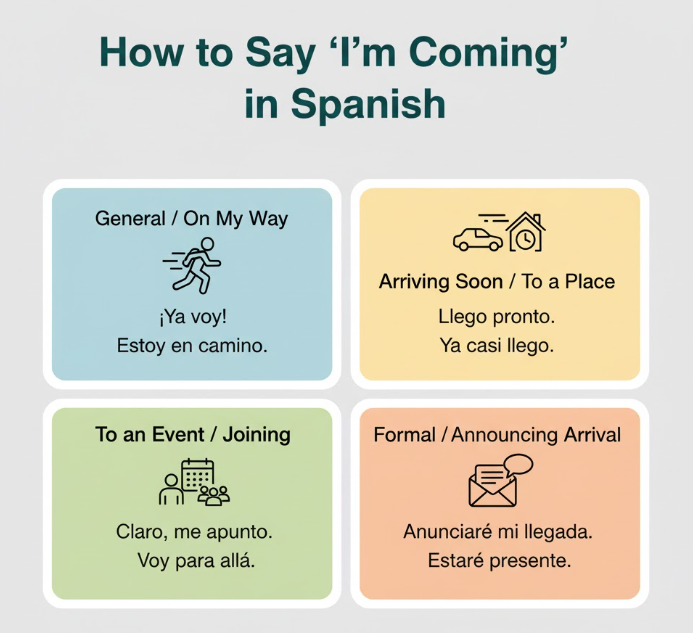
Several structures are used to express “I’m coming” in Spanish. Understanding these structures is crucial for accurate usage.
Here’s a breakdown:
- Voy + a + infinitive: This structure indicates an intention or plan to go somewhere. For example, “Voy a ir a tu casa” (I’m going to go to your house).
- Vengo: The present tense conjugation of venir, meaning “I come.” It implies that you are already on your way.
- Estoy yendo: This is the present progressive form, using estar (to be) + the gerund of ir (yendo). It emphasizes that the action of going is currently in progress.
- Reflexive verbs: Verbs like acercarse (to approach) can be used reflexively to indicate movement towards someone or something. For example, “Me acerco” (I’m approaching).
Types and Categories of Expressions
There are several ways to express “I’m coming” in Spanish, each with slightly different nuances. Understanding these categories will help you choose the most appropriate expression for the situation.
Conjugations of Ir (to go)
The verb ir (to go) is fundamental to expressing movement. Here’s the present tense conjugation:
- Yo: Voy (I go)
- Tú: Vas (You go)
- Él/Ella/Usted: Va (He/She/You go)
- Nosotros/Nosotras: Vamos (We go)
- Vosotros/Vosotras: Vais (You all go)
- Ellos/Ellas/Ustedes: Van (They/You all go)
The form “Voy” is used to express “I’m going” or “I’m coming” when indicating a future action or plan.
Conjugations of Venir (to come)
The verb venir (to come) indicates movement towards the speaker or a specific location. Here’s the present tense conjugation:
- Yo: Vengo (I come)
- Tú: Vienes (You come)
- Él/Ella/Usted: Viene (He/She/You come)
- Nosotros/Nosotras: Venimos (We come)
- Vosotros/Vosotras: Venís (You all come)
- Ellos/Ellas/Ustedes: Vienen (They/You all come)
The form “Vengo” is often used to express “I’m coming” when you are already on your way.
Estar + Gerund (going)
The present progressive form, using estar (to be) + the gerund of ir (yendo), emphasizes that the action of going is currently in progress. The conjugation of estar in the present tense is:
- Yo: Estoy (I am)
- Tú: Estás (You are)
- Él/Ella/Usted: Está (He/She/You are)
- Nosotros/Nosotras: Estamos (We are)
- Vosotros/Vosotras: Estáis (You all are)
- Ellos/Ellas/Ustedes: Están (They/You all are)
Therefore, “Estoy yendo” literally translates to “I am going,” but in context, it often means “I’m coming” and emphasizes the ongoing action.
Reflexive Verbs
Reflexive verbs, such as acercarse (to approach), can also be used to express the idea of coming closer. When used reflexively, they indicate that the subject is performing the action on themselves. The reflexive pronoun me is used with the first-person singular form.
For example, “Me acerco” means “I am approaching” or “I’m coming closer.”
Examples of “I’m Coming” in Spanish
Here are several examples illustrating the different ways to express “I’m coming” in Spanish, categorized by the grammatical structures discussed above.
General Examples Using Ir
These examples use the verb ir to indicate movement towards a destination.
The table bellow shows examples of using “Ir” to describe “I’m coming”.
| Spanish | English Translation | Context |
|---|---|---|
| Voy a tu casa. | I’m going to your house. | Indicating a plan to go to someone’s house. |
| Voy para allá. | I’m going that way. | Indicating direction of travel. |
| Voy en camino. | I’m on my way. | Indicating that you are already traveling. |
| Voy enseguida. | I’m coming right away. | Indicating that you will arrive soon. |
| Voy a llegar tarde. | I’m going to be late. | Expressing concern about being late. |
| Voy al supermercado. | I’m going to the supermarket. | Stating your destination. |
| Voy al trabajo. | I’m going to work. | Stating your destination. |
| Voy a la fiesta. | I’m going to the party. | Stating your destination. |
| Voy a verte. | I’m going to see you. | Stating your intention to see someone. |
| Voy a visitarte. | I’m going to visit you. | Stating your intention to visit. |
| Voy a estar allí pronto. | I’m going to be there soon. | Indicating arrival time. |
| Voy a ayudarte. | I’m going to help you. | Offering assistance. |
| Voy a buscarte. | I’m going to pick you up. | Offering to pick someone up. |
| Voy a recogerte. | I’m going to pick you up. | Offering to pick someone up. |
| Voy a salir ahora. | I’m going to leave now. | Indicating departure time. |
| Voy a comer. | I’m going to eat. | Stating your intention to eat. |
| Voy a dormir. | I’m going to sleep. | Stating your intention to sleep. |
| Voy a estudiar. | I’m going to study. | Stating your intention to study. |
| Voy a leer un libro. | I’m going to read a book. | Stating your intention to read. |
| Voy a ver una película. | I’m going to watch a movie. | Stating your intention to watch a movie. |
| Voy a hacer ejercicio. | I’m going to exercise. | Stating your intention to exercise. |
| Voy a llamar. | I’m going to call. | Stating your intention to call. |
| Voy a textarte. | I’m going to text you. | Stating your intention to text. |
Examples Using Venir
These examples use the verb venir to indicate movement towards the speaker or a specific location in relation to the speaker.
The table bellow shows examples of using “Venir” to describe “I’m coming”.
| Spanish | English Translation | Context |
|---|---|---|
| Vengo enseguida. | I’m coming right away. | Indicating immediate arrival. |
| Ya vengo. | I’m coming back. / I’ll be right back. | Indicating a quick return. |
| Vengo en cinco minutos. | I’m coming in five minutes. | Specifying arrival time. |
| Vengo para ayudarte. | I’m coming to help you. | Stating the purpose of your arrival. |
| Vengo a verte. | I’m coming to see you. | Stating the purpose of your arrival. |
| Vengo a recogerte. | I’m coming to pick you up. | Offering to pick someone up. |
| Vengo a visitarte. | I’m coming to visit you. | Stating the purpose of your visit. |
| ¿Vienes a la fiesta? | Are you coming to the party? | Asking if someone is attending. |
| Vengo del trabajo. | I’m coming from work. | Stating your origin. |
| Vengo de la escuela. | I’m coming from school. | Stating your origin. |
| Vengo del supermercado. | I’m coming from the supermarket. | Stating your origin. |
| Vengo cansado. | I’m coming tired. | Describing your condition upon arrival. |
| Vengo contento. | I’m coming happy. | Describing your condition upon arrival. |
| Vengo con mi familia. | I’m coming with my family. | Indicating who you are coming with. |
| Vengo con mis amigos. | I’m coming with my friends. | Indicating who you are coming with. |
| Vengo con un regalo. | I’m coming with a gift. | Indicating what you are bringing. |
| Vengo con la cena. | I’m coming with dinner. | Indicating what you are bringing. |
| Vengo a quedarme. | I’m coming to stay. | Indicating your intention to stay. |
| Vengo a vivir aquí. | I’m coming to live here. | Indicating your intention to live there. |
| Vengo a trabajar. | I’m coming to work. | Indicating your intention to work there. |
| Vengo a estudiar. | I’m coming to study. | Indicating your intention to study there. |
| Vengo a aprender. | I’m coming to learn. | Indicating your intention to learn there. |
Examples Using Estar Yendo
These examples use the estar + gerund construction to emphasize the ongoing action of coming.
The table bellow shows examples of using “Estar Yendo” to describe “I’m coming”.
| Spanish | English Translation | Context |
|---|---|---|
| Estoy yendo para allá. | I’m going that way. / I’m heading there. | Emphasizing the ongoing movement towards a location. |
| Estoy yendo a tu casa ahora mismo. | I’m going to your house right now. | Emphasizing the immediacy of the action. |
| Estoy yendo lo más rápido que puedo. | I’m going as fast as I can. | Emphasizing the effort being made to arrive. |
| Estoy yendo en el coche. | I’m going in the car. | Indicating the mode of transportation. |
| Estoy yendo en autobús. | I’m going on the bus. | Indicating the mode of transportation. |
| Estoy yendo en tren. | I’m going on the train. | Indicating the mode of transportation. |
| Estoy yendo a pie. | I’m going on foot. | Indicating the mode of transportation. |
| Estoy yendo con cuidado. | I’m going carefully. | Describing the manner of travel. |
| Estoy yendo despacio. | I’m going slowly. | Describing the manner of travel. |
| Estoy yendo rápido. | I’m going quickly. | Describing the manner of travel. |
| Estoy yendo a la reunión. | I’m going to the meeting. | Stating your destination. |
| Estoy yendo al centro comercial. | I’m going to the shopping mall. | Stating your destination. |
| Estoy yendo al cine. | I’m going to the cinema. | Stating your destination. |
| Estoy yendo al restaurante. | I’m going to the restaurant. | Stating your destination. |
| Estoy yendo a la playa. | I’m going to the beach. | Stating your destination. |
| Estoy yendo al parque. | I’m going to the park. | Stating your destination. |
| Estoy yendo al concierto. | I’m going to the concert. | Stating your destination. |
| Estoy yendo al evento. | I’m going to the event. | Stating your destination. |
| Estoy yendo a celebrar. | I’m going to celebrate. | Stating your purpose. |
| Estoy yendo a relajarme. | I’m going to relax. | Stating your purpose. |
| Estoy yendo a disfrutar. | I’m going to enjoy myself. | Stating your purpose. |
Examples Using Reflexive Verbs
These examples use reflexive verbs to express the idea of approaching or getting closer.
The table bellow shows examples of using Reflexive Verbs to describe “I’m coming”.
| Spanish | English Translation | Context |
|---|---|---|
| Me acerco. | I’m approaching. / I’m coming closer. | Indicating that you are getting closer to someone or something. |
| Me estoy acercando. | I am getting closer. | Emphasizing the ongoing process of approaching. |
| Me acerco a la puerta. | I’m approaching the door. | Specifying the destination. |
| Me acerco al coche. | I’m approaching the car. | Specifying the destination. |
| Me acerco a la mesa. | I’m approaching the table. | Specifying the destination. |
| Me acerco a la ventana. | I’m approaching the window. | Specifying the destination. |
Usage Rules and Considerations
To use these expressions correctly, it’s important to consider several factors, including formality, regional variations, and the inclusion of time expressions.
Formal vs. Informal Usage
The choice of expression can depend on the level of formality required. In general, “Voy” and “Vengo” are suitable for most situations. However, using more elaborate constructions can add a touch of politeness in formal settings. For instance, instead of simply saying “Vengo”, you could say “Voy para allá en breve” (I’m heading there shortly).
Regional Variations
Spanish has many regional variations, and the preferred way to express “I’m coming” can differ depending on the region. For example, in some Latin American countries, you might hear “Ya voy” more frequently than “Vengo enseguida”. Being aware of these variations can help you better understand and communicate with native speakers from different regions.
Adding Time Expressions
Adding time expressions can provide more clarity about your arrival. Common time expressions include:
- Enseguida (right away)
- Pronto (soon)
- En un momento (in a moment)
- En cinco minutos (in five minutes)
- Ahora mismo (right now)
For example, “Voy para allá en un momento” (I’m heading there in a moment) provides a more specific timeframe.
Common Mistakes to Avoid
Here are some common mistakes learners make when expressing “I’m coming” in Spanish:
- Incorrect verb choice: Using ir when venir is more appropriate, or vice versa. For example, saying “Voy a verte” when you are already on your way and should say “Vengo a verte.”
- Misusing the present progressive: Overusing “Estoy yendo” when a simpler form like “Voy” or “Vengo” would suffice.
- Forgetting reflexive pronouns: Omitting the reflexive pronoun when using reflexive verbs. For example, saying “Acerco” instead of “Me acerco.”
Here’s a table illustrating some common mistakes:
| Incorrect | Correct | Explanation |
|---|---|---|
| Voy aquí. | Vengo aquí. | Venir is used when referring to movement towards the speaker. |
| Estoy ir a tu casa. | Estoy yendo a tu casa. | The gerund form yendo is required after estar. |
| Acerco. | Me acerco. | The reflexive pronoun me is needed with acercarse. |
| Vengo a ir a la fiesta. | Voy a ir a la fiesta / Vengo a la fiesta. | Avoid redundancy. |
Practice Exercises
Test your understanding with these practice exercises.
Exercise 1: Translation
Translate the following sentences into Spanish, using the appropriate form of “I’m coming.”
| No. | English | Spanish (Answer) |
|---|---|---|
| 1 | I’m coming right away. | Vengo enseguida. |
| 2 | I’m going to your house. | Voy a tu casa. |
| 3 | I’m on my way. | Voy en camino. |
| 4 | I’m approaching the door. | Me acerco a la puerta. |
| 5 | I’m going there now. | Estoy yendo para allá ahora. |
| 6 | I’m coming in five minutes. | Vengo en cinco minutos. |
| 7 | I’m going to pick you up. | Voy a recogerte. |
| 8 | I’m coming to help you. | Vengo a ayudarte. |
| 9 | I’m going to celebrate. | Voy a celebrar. |
| 10 | I’m going to relax. | Voy a relajarme. |
Exercise 2: Fill in the Blanks
Fill in the blanks with the correct form of ir or venir.
| No. | Sentence | Answer |
|---|---|---|
| 1 | Yo _____ a la fiesta. | voy |
| 2 | _____ enseguida. | Vengo |
| 3 | Estoy _____ para allá. | yendo |
| 4 | _____ a recogerte. | Vengo |
| 5 | Yo _____ en camino. | voy |
| 6 | _____ a verte mañana. | Voy |
| 7 | _____ en cinco minutos. | Vengo |
| 8 | Estoy _____ lo más rápido que puedo. | yendo |
| 9 | Yo _____ a ayudarte. | vengo |
| 10 | _____ a visitarte. | Vengo |
Exercise 3: Sentence Building
Create sentences using the following prompts to express “I’m coming.”
| No. | Prompt | Example Answer |
|---|---|---|
| 1 | (Yo / casa / ahora) | Voy a casa ahora. |
| 2 | (Yo / fiesta / pronto) | Voy a la fiesta pronto. |
| 3 | (Yo / ayudarte / ahora mismo) | Vengo a ayudarte ahora mismo. |
| 4 | (Yo / acercarse / puerta) | Me acerco a la puerta. |
| 5 | (Yo / ir / allá / coche) | Estoy yendo para allá en coche. |
| 6 | (Yo / verte / tarde) | Voy a verte tarde. |
| 7 | (Yo / recoger / ti / escuela) | Vengo a recogerte de la escuela. |
| 8 | (Yo / ir / supermercado / ahora) | Voy al supermercado ahora. |
| 9 | (Yo / venir / cena / contigo) | Vengo a cenar contigo. |
| 10 | (Yo / estar / ir / cine) | Estoy yendo al cine. |
Advanced Topics
For advanced learners, here are some more complex aspects related to expressing arrival in Spanish.
Idiomatic Expressions Related to Arrival
Spanish has several idiomatic expressions related to arrival that go beyond the literal meaning of “I’m coming.” These expressions often add color and nuance to your speech.
- Estar al caer: To be about to arrive or happen. Example: “Está al caer.” (He/She is about to arrive.)
- Llegar y besar el santo: To arrive and immediately succeed. Example: “Llegó y besó el santo.” (He arrived and immediately succeeded.)
- A la vuelta de la esquina: Just around the corner (referring to an event or time). Example: “La Navidad está a la vuelta de la esquina.” (Christmas is just around the corner.)
Using the Subjunctive Mood
In certain contexts, particularly when expressing doubt or uncertainty about someone’s arrival, the subjunctive mood might be used. This is more common in complex sentences.
Example: “No creo que venga hoy.” (I don’t think he/she is coming today.) The subjunctive form venga is used because the speaker is expressing doubt.
Frequently Asked Questions
Here are some frequently asked questions about expressing “I’m coming” in Spanish:
- What’s the difference between “Voy” and “Vengo”?
“Voy” indicates movement away from the speaker’s current location, while “Vengo” indicates movement towards the speaker or a location relative to the speaker. Think of “Voy” as “I’m going” and “Vengo” as “I’m coming” in the sense of approaching you.
- When should I use “Estoy yendo”?
Use “Estoy yendo” to emphasize that the action of going is currently in progress. It’s more descriptive and emphasizes the ongoing nature of the movement.
- Is it always necessary to use a reflexive pronoun with acercarse?
Yes, acercarse is a reflexive verb, so you must use a reflexive pronoun (me, te, se, nos, os, se) depending on the subject. For “I’m coming closer,” you always need to say “Me acerco.”
- How can I specify my arrival time?
Add a time expression such as “en cinco minutos” (in five minutes), “enseguida” (right away), or “pronto” (soon). For example, “Vengo en cinco minutos.”
- Are there regional differences in how people say “I’m coming”?
Yes, there are regional variations. In some Latin American countries, you might hear “Ya voy” more frequently. Pay attention to how native speakers from different regions express themselves.
- Can I use “Llegaré” to mean “I’m coming”?
Yes, “Llegaré” (I will arrive) can be used, but it’s more formal and emphasizes the arrival itself rather than the act of coming. It’s suitable when you want to assure someone that you will reach the destination.
- How do I say “I’m coming to pick you up?”
You can say “Vengo a recogerte” or “Voy a recogerte.” Both are correct, but “Vengo a recogerte” implies you are already on your way, while “Voy a recogerte” suggests it’s a plan for the near future.
- Is it rude to be late?
In some cultures, punctuality is highly valued, while in others, being a bit late is more acceptable. It’s always a good idea to be mindful of cultural norms and communicate any delays promptly.
Conclusion
Expressing “I’m coming” in Spanish involves understanding the nuances of verbs like ir and venir, as well as the appropriate use of reflexive verbs and the present progressive. By mastering these concepts and considering factors like formality and regional variations, you can communicate your impending arrival accurately and effectively. Practice the examples and exercises provided in this guide to solidify your understanding and enhance your fluency in Spanish.