Expressing tiredness is a fundamental part of everyday conversation, and knowing how to do so in French is essential for effective communication. This guide provides a comprehensive overview of various ways to say “I’m tired” in French, ranging from simple phrases to more nuanced expressions.
Whether you’re a beginner or an advanced learner, this article will equip you with the vocabulary and grammatical knowledge to accurately convey your state of fatigue in French. Mastering these expressions will not only enhance your conversational skills but also deepen your understanding of French culture and idioms.
This article is designed for anyone learning French, from beginners to advanced students. It will be particularly helpful for those preparing for exams, planning a trip to a French-speaking country, or simply wanting to improve their everyday communication skills.
By the end of this guide, you will be able to confidently express your tiredness in a variety of contexts, using the appropriate vocabulary and grammar.
Table of Contents
- Introduction
- Definition: Expressing Tiredness in French
- Structural Breakdown: Key Phrases and Verbs
- Types and Categories of Expressions
- Examples of Expressing Tiredness
- Usage Rules and Grammar
- Common Mistakes to Avoid
- Practice Exercises
- Advanced Topics
- Frequently Asked Questions
- Conclusion
Definition: Expressing Tiredness in French
Expressing tiredness in French involves using a variety of phrases and expressions to convey your state of fatigue. The most common way is to use the verb être (to be) with the adjective fatigué(e) (tired). However, there are many other ways to express tiredness, each with its own nuance and level of formality. These expressions can range from simple statements to more colorful and idiomatic phrases.
The function of these expressions is to communicate your physical or mental state of being tired to others. The context in which you use these expressions can vary widely, from casual conversations with friends to more formal interactions with colleagues or acquaintances.
Understanding the appropriate register and level of formality is crucial for effective communication.
The classification of these expressions falls under the category of adjectives and idiomatic phrases used to describe a state of being. They often involve the use of verbs such as être (to be) and avoir (to have), combined with adjectives or nouns that convey the feeling of tiredness or exhaustion.
Structural Breakdown: Key Phrases and Verbs
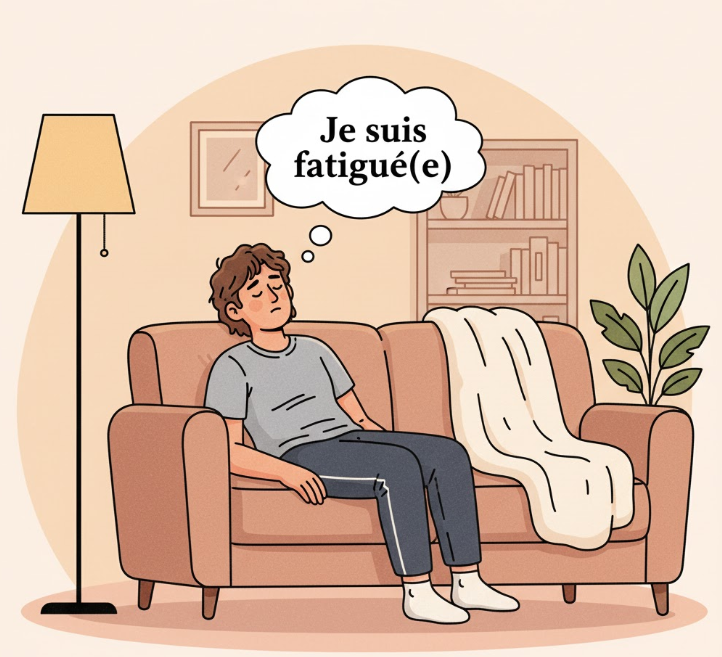
The basic structure for saying “I’m tired” in French revolves around the verb être (to be). The phrase Je suis fatigué(e) is the most straightforward translation, where je means “I,” suis is the first-person singular conjugation of être, and fatigué(e) means “tired.” Note that the adjective fatigué changes to fatiguée for feminine subjects.
Another common structure involves the verb avoir (to have) in expressions like J’ai sommeil (I’m sleepy) or J’ai du vague à l’âme (I feel down). These expressions use avoir to express a feeling or state of being.
Idiomatic expressions often have unique structures that don’t directly translate to English. For example, J’en ai marre (I’m fed up) uses the pronoun en and the verb avoir in a specific construction to convey a sense of being tired of something.
Types and Categories of Expressions
Simple and Common Expressions
These are the most basic and widely used ways to say “I’m tired” in French. They are suitable for most situations and are easily understood.
- Je suis fatigué(e) – I am tired.
- Je suis crevé(e) – I am exhausted (informal).
- J’ai sommeil – I am sleepy.
More Nuanced Expressions
These expressions add a layer of detail or emotion to your statement of tiredness. They can convey the specific type or intensity of your fatigue.
- Je suis épuisé(e) – I am exhausted.
- Je suis las(se) – I am weary.
- Je suis à bout de forces – I am at the end of my strength.
- Je n’en peux plus – I can’t take it anymore.
Idiomatic Expressions
These are colorful and figurative ways to express tiredness. They often have a cultural context and may not be directly translatable to English.
- J’en ai marre – I’m fed up.
- J’en ai ras le bol – I’m fed up to the back teeth (very informal).
- Je suis sur les genoux – I am on my knees (exhausted).
Examples of Expressing Tiredness
The following tables provide various examples of how to express tiredness in French, categorized by the type of expression used. Each table includes a French sentence, its English translation, and a brief note on the context or nuance of the expression.
Examples with Être Fatigué(e)
This table provides examples of using the verb être with the adjective fatigué(e) to express tiredness. Note the agreement of the adjective with the subject’s gender.
| French Sentence | English Translation | Notes |
|---|---|---|
| Je suis fatigué après cette longue journée. | I am tired after this long day. | A simple and common way to express tiredness. |
| Elle est fatiguée après avoir couru le marathon. | She is tired after running the marathon. | Note the feminine form of the adjective: fatiguée. |
| Nous sommes fatigués du voyage. | We are tired from the trip. | Note the plural form of the adjective: fatigués. |
| Ils sont fatigués de travailler tout le temps. | They are tired of working all the time. | Note the masculine plural form of the adjective: fatigués. |
| Je suis très fatigué ce matin. | I am very tired this morning. | Using très to emphasize the tiredness. |
| Tu es fatigué, n’est-ce pas? | You are tired, aren’t you? | A question using n’est-ce pas? |
| Il est fatigué mais il continue à travailler. | He is tired but he continues to work. | Expressing tiredness while continuing to work. |
| Elle est fatiguée parce qu’elle n’a pas dormi. | She is tired because she didn’t sleep. | Explaining the reason for tiredness. |
| Nous sommes fatigués à cause du bruit. | We are tired because of the noise. | Expressing tiredness due to noise. |
| Vous êtes fatigués après le sport. | You are tired after the sport. | Expressing tiredness after physical activity. |
| Je suis fatigué de cette situation. | I am tired of this situation. | Expressing tiredness of a situation. |
| Elle est fatiguée de ses enfants. | She is tired of her children. | Expressing tiredness of someone (can be negative). |
| Ils sont fatigués des mensonges. | They are tired of the lies. | Expressing tiredness of lies. |
| Nous sommes fatigués de la pluie. | We are tired of the rain. | Expressing tiredness of the rain. |
| Je suis fatigué de t’attendre. | I am tired of waiting for you. | Expressing tiredness of waiting. |
| Elle est fatiguée d’étudier toute la nuit. | She is tired of studying all night. | Expressing tiredness of studying. |
| Nous sommes fatigués de marcher. | We are tired of walking. | Expressing tiredness of walking. |
| Ils sont fatigués de répéter la même chose. | They are tired of repeating the same thing. | Expressing tiredness of repeating. |
| Je suis fatigué de répondre à tes questions. | I am tired of answering your questions. | Expressing tiredness of answering. |
| Elle est fatiguée de cuisiner tous les jours. | She is tired of cooking every day. | Expressing tiredness of cooking. |
Examples with Avoir Marre
This table provides examples of using the expression avoir marre to express being fed up or tired of something. This expression is commonly used to express frustration or annoyance.
| French Sentence | English Translation | Notes |
|---|---|---|
| J’en ai marre de ce travail. | I’m fed up with this job. | Expressing frustration with a job. |
| Elle en a marre de ses voisins bruyants. | She’s fed up with her noisy neighbors. | Expressing frustration with neighbors. |
| Nous en avons marre des embouteillages. | We’re fed up with traffic jams. | Expressing frustration with traffic jams. |
| Ils en ont marre de la politique. | They’re fed up with politics. | Expressing frustration with politics. |
| J’en ai marre de t’entendre te plaindre. | I’m fed up with hearing you complain. | Expressing frustration with someone’s complaining. |
| Elle en a marre d’attendre le bus. | She’s fed up with waiting for the bus. | Expressing frustration with waiting. |
| Nous en avons marre de vivre ici. | We’re fed up with living here. | Expressing frustration with living in a place. |
| Ils en ont marre de cette situation. | They’re fed up with this situation. | Expressing frustration with a situation. |
| J’en ai marre de toujours devoir tout faire. | I’m fed up with always having to do everything. | Expressing frustration with having to do everything. |
| Elle en a marre de tes excuses. | She’s fed up with your excuses. | Expressing frustration with someone’s excuses. |
| J’en ai marre de cette musique. | I’m fed up with this music. | Expressing frustration with music. |
| Elle en a marre de la pluie. | She’s fed up with the rain. | Expressing frustration with the rain. |
| Nous en avons marre des problèmes. | We’re fed up with the problems. | Expressing frustration with problems. |
| Ils en ont marre des critiques. | They’re fed up with the criticisms. | Expressing frustration with criticisms. |
| J’en ai marre de tes mensonges. | I’m fed up with your lies. | Expressing frustration with lies. |
| Elle en a marre de son colocataire. | She’s fed up with her roommate. | Expressing frustration with a roommate. |
| Nous en avons marre de cette série. | We’re fed up with this series. | Expressing frustration with a series. |
| Ils en ont marre des réunions. | They’re fed up with the meetings. | Expressing frustration with meetings. |
| J’en ai marre de tes questions. | I’m fed up with your questions. | Expressing frustration with questions. |
| Elle en a marre de ses devoirs. | She’s fed up with her homework. | Expressing frustration with homework. |
Examples with En Avoir Ras Le Bol
This table provides examples of using the expression en avoir ras le bol, which is a more emphatic and informal way of saying “I’m fed up.” It’s used to express a strong sense of frustration or annoyance.
| French Sentence | English Translation | Notes |
|---|---|---|
| J’en ai ras le bol de cette situation! | I’m fed up to the back teeth with this situation! | A strong expression of frustration. |
| Elle en a ras le bol de son travail. | She’s fed up to the back teeth with her job. | Expressing strong frustration with a job. |
| Nous en avons ras le bol des impôts. | We’re fed up to the back teeth with taxes. | Expressing strong frustration with taxes. |
| Ils en ont ras le bol de la circulation. | They’re fed up to the back teeth with the traffic. | Expressing strong frustration with traffic. |
| J’en ai ras le bol de tes excuses bidon! | I’m fed up to the back teeth with your lame excuses! | Expressing strong frustration with excuses. |
| Elle en a ras le bol de ses problèmes de santé. | She’s fed up to the back teeth with her health problems. | Expressing strong frustration with health problems. |
| Nous en avons ras le bol de ce restaurant. | We’re fed up to the back teeth with this restaurant. | Expressing strong frustration with a restaurant. |
| Ils en ont ras le bol de devoir toujours répéter les mêmes choses. | They’re fed up to the back teeth with always having to repeat the same things. | Expressing strong frustration with repeating things. |
| J’en ai ras le bol de tes histoires! | I’m fed up to the back teeth with your stories! | Expressing strong frustration with someone’s stories. |
| Elle en a ras le bol de ses voisins. | She’s fed up to the back teeth with her neighbors. | Expressing strong frustration with neighbors. |
| J’en ai ras le bol du bruit. | I’m fed up to the back teeth with the noise. | Expressing strong frustration with noise. |
| Elle en a ras le bol de la pollution. | She’s fed up to the back teeth with the pollution. | Expressing strong frustration with pollution. |
| Nous en avons ras le bol des factures. | We’re fed up to the back teeth with the bills. | Expressing strong frustration with bills. |
| Ils en ont ras le bol des critiques. | They’re fed up to the back teeth with the criticisms. | Expressing strong frustration with criticisms. |
| J’en ai ras le bol des moustiques. | I’m fed up to the back teeth with mosquitoes. | Expressing strong frustration with mosquitoes. |
| Elle en a ras le bol de son patron. | She’s fed up to the back teeth with her boss. | Expressing strong frustration with a boss. |
| Nous en avons ras le bol de ce film. | We’re fed up to the back teeth with this movie. | Expressing strong frustration with a movie. |
| Ils en ont ras le bol des mensonges. | They’re fed up to the back teeth with the lies. | Expressing strong frustration with lies. |
| J’en ai ras le bol de tes plaintes. | I’m fed up to the back teeth with your complaints. | Expressing strong frustration with complaints. |
| Elle en a ras le bol de ses problèmes. | She’s fed up to the back teeth with her problems. | Expressing strong frustration with problems. |
Examples of Idiomatic Expressions
This table provides examples of idiomatic expressions used to express tiredness or exhaustion in French. These expressions often have a figurative meaning and may not be directly translatable.
| French Sentence | English Translation | Notes |
|---|---|---|
| Je suis sur les genoux. | I am on my knees (exhausted). | Figurative expression for extreme tiredness. |
| Je suis cassé(e). | I am broken (exhausted). | Informal expression for being exhausted. |
| Je suis mort(e) de fatigue. | I am dead from fatigue. | Exaggerated expression for extreme tiredness. |
| Je n’en peux plus. | I can’t take it anymore. | Expressing being overwhelmed and exhausted. |
| Je suis vidé(e). | I am drained. | Expressing a lack of energy. |
| Je suis à plat. | I am flat (out of energy). | Informal expression for being out of energy. |
| Je suis au bout du rouleau. | I am at the end of my rope. | Expressing being at the limit of one’s endurance. |
| Je suis cuit(e). | I am cooked (exhausted). | Informal expression for being exhausted. |
| Je suis fourbu(e). | I am worn out. | Formal expression for being worn out. |
| Je suis HS (hors service). | I am out of service. | Very informal, like a machine that’s broken down. |
Examples of Exaggerated Tiredness
This table shows examples of how to exaggerate your tiredness for emphasis or humor. These phrases are often used in informal contexts.
| French Sentence | English Translation | Notes |
|---|---|---|
| Je suis mort(e) de fatigue. | I’m dead tired. | Very common exaggeration. |
| Je suis plus fatigué(e) qu’un marathonien après la course. | I’m more tired than a marathon runner after the race. | Comparing tiredness to an extremely tired person. |
| Je pourrais dormir pendant une semaine. | I could sleep for a week. | Expressing a desire for a very long sleep. |
| Je suis tellement fatigué(e) que je pourrais m’endormir debout. | I’m so tired I could fall asleep standing up. | Expressing extreme sleepiness. |
| J’ai l’impression d’avoir 100 ans. | I feel like I’m 100 years old. | Exaggerating tiredness by comparing oneself to an old person. |
Usage Rules and Grammar
Agreement of Adjectives
When using the adjective fatigué(e), it’s crucial to ensure it agrees in gender and number with the subject. For a masculine singular subject, use fatigué. For a feminine singular subject, use fatiguée. For masculine plural, use fatigués, and for feminine plural, use fatiguées. This agreement is a fundamental aspect of French grammar.
For example:
- Je suis fatigué. (I am tired – said by a male)
- Je suis fatiguée. (I am tired – said by a female)
- Nous sommes fatigués. (We are tired – group of males or mixed group)
- Nous sommes fatiguées. (We are tired – group of females)
Verb Conjugation
Ensure that the verb être is correctly conjugated in the present tense. The correct form for “I” is suis. Other forms include es (you), est (he/she/it is), sommes (we are), êtes (you are – formal/plural), and sont (they are).
For example:
- Je suis fatigué(e). (I am tired)
- Tu es fatigué(e). (You are tired)
- Il/Elle est fatigué(e). (He/She is tired)
- Nous sommes fatigué(e)s. (We are tired)
- Vous êtes fatigué(e)(s). (You are tired)
- Ils/Elles sont fatigué(e)s. (They are tired)
Register and Formality
Be mindful of the level of formality when choosing your expression. Je suis fatigué(e) is suitable for most situations. However, expressions like Je suis crevé(e) or J’en ai ras le bol are more informal and should be used with friends and family rather than in formal settings.
Using formal language in an informal situation or vice versa can sound awkward or disrespectful. Therefore, it’s important to consider your audience and the context of the conversation when choosing your words.
Common Mistakes to Avoid
One common mistake is forgetting to agree the adjective fatigué(e) with the subject’s gender. For example, a male saying Je suis fatiguée is incorrect. The correct form is Je suis fatigué.
Another mistake is using informal expressions in formal situations. For instance, saying Je suis crevé(e) to your boss is inappropriate. Instead, use the more formal Je suis fatigué(e).
Finally, be careful with idiomatic expressions. Some idioms don’t translate directly, and using them out of context can lead to misunderstandings.
Ensure you understand the meaning and usage of an idiom before using it.
Here are some examples of common mistakes and their corrections:
| Incorrect | Correct | Explanation |
|---|---|---|
| Je suis fatiguée (said by a male) | Je suis fatigué | Adjective agreement with gender. |
| Je suis crevé (said to your boss) | Je suis fatigué | Using appropriate register. |
| J’ai marre de (without “en”) | J’en ai marre de | Correct use of the pronoun “en”. |
Practice Exercises
Test your understanding of how to say “I’m tired” in French with these practice exercises. Choose the correct expression to complete each sentence.
Question: Après avoir travaillé toute la journée, je ____.
Options: a) suis content, b) suis fatigué, c) suis faim
Answer: b) suis fatigué
Question: Elle ____ de toujours faire la vaisselle.
Options: a) en a marre, b) est contente, c) a soif
Answer: a) en a marre
Question: Nous ____ après le long voyage en avion.
Options: a) sommes heureux, b) sommes fatigués, c) sommes prêts
Answer: b) sommes fatigués
Question: Je ____ de cette situation, je veux que ça change!
Options: a) en ai ras le bol, b) suis ravi, c) suis curieux
Answer: a) en ai ras le bol
Question: Après le marathon, il ____.
Options: a) est en forme, b) est fatigué, c) est excité
Answer: b) est fatigué
Question: Je ____, je vais me coucher tôt ce soir.
Options: a) ai soif, b) ai sommeil, c) ai froid
Answer: b) ai sommeil
Question: Tu ____ de toujours travailler trop?
Options: a) en as marre, b) es content, c) as peur
Answer: a) en as marre
Question: Ils ____ après avoir joué au football toute l’après-midi.
Options: a) sont énergiques, b) sont fatigués, c) sont affamés
Answer: b) sont fatigués
Question: Je ____, je n’ai plus d’énergie.
Options: a) suis vidé, b) suis plein, c) suis heureux
Answer: a) suis vidé
Question: Je suis tellement fatigué que je ____.
Options: a) vais courir, b) vais danser, c) vais dormir
Answer: c) vais dormir
Here’s another set of practice exercises. Translate the following sentences into French using the appropriate expression for tiredness:
Question: I am tired after the long meeting.
Answer: Je suis fatigué(e) après la longue réunion.
Question: She is fed up with her noisy neighbors.
Answer: Elle en a marre de ses voisins bruyants.
Question: We are exhausted after the hike.
Answer: Nous sommes épuisés après la randonnée.
Question: I’m fed up to the back teeth with this weather!
Answer: J’en ai ras le bol de ce temps!
Question: He is so tired he could fall asleep standing up.
Answer: Il est tellement fatigué qu’il pourrait s’endormir debout.
Question: I am sleepy, I need a nap.
Answer: J’ai sommeil, j’ai besoin d’une sieste.
Question: She is tired of waiting for him.
Answer: Elle est fatiguée de l’attendre.
Question: We are tired of working too much.
Answer: Nous sommes fatigués de trop travailler.
Question: I am dead tired after the gym.
Answer: Je suis mort(e) de fatigue après la gym.
Question: She is worn out after taking care of the kids all day.
Answer: Elle est fourbue après s’être occupée des enfants toute la journée.
Advanced Topics
Expressing the Cause of Tiredness
To express the cause of your tiredness, you can use phrases like à cause de (because of), en raison de (due to), or parce que (because). For example: Je suis fatigué à cause du travail (I’m tired because of work) or Je suis fatigué parce que je n’ai pas dormi (I’m tired because I didn’t sleep).
These phrases allow you to provide context and explain why you are feeling tired. They can be useful in conversations where you want to give more information about your state of being.
Expressing the Intensity of Tiredness
To express the intensity of your tiredness, you can use adverbs like très (very), vraiment (really), tellement (so), or énormément (enormously). For example: Je suis très fatigué(e) (I am very tired) or Je suis tellement fatigué(e) que je pourrais dormir debout (I am so tired that I could
sleep standing up).
Using these adverbs helps to convey the degree of your tiredness, making your expression more precise and impactful. They can also add emphasis to your statement, highlighting just how tired you are.
Frequently Asked Questions
This section addresses some common questions related to expressing tiredness in French.
What’s the difference between fatigué and épuisé?
Fatigué generally means “tired,” while épuisé means “exhausted.” Épuisé is a stronger term, indicating a greater level of fatigue. You would use épuisé when you are completely drained and have very little energy left.
When should I use J’en ai marre versus J’en ai ras le bol?
J’en ai marre is a common expression meaning “I’m fed up.” It’s suitable for most informal situations. J’en ai ras le bol is a more emphatic and informal version, meaning “I’m fed up to the back teeth.” Use J’en ai ras le bol when you want to express a strong sense of frustration, but be mindful of the context and your audience, as it can be considered quite informal.
How do I ask someone if they are tired in French?
You can ask someone if they are tired using several phrases, depending on the level of formality:
- Êtes-vous fatigué(e)? (Formal) – Are you tired?
- Tu es fatigué(e)? (Informal) – Are you tired?
- T’es fatigué(e)? (Very informal, spoken) – Are you tired?
- Fatigué(e)? (Very informal, as a short question) – Tired?
Can I use fatigué to describe objects or situations?
While fatigué(e) primarily describes a person’s state of being, you can use it metaphorically to describe objects or situations that are worn out or causing fatigue. For example, you might say Cette voiture est fatiguée (This car is worn out), or Cette situation est fatigante (This situation is tiring).
How do I respond when someone asks if I’m tired?
Here are some ways to respond when someone asks if you’re tired:
- Oui, je suis fatigué(e). – Yes, I am tired.
- Un peu. – A little.
- Très fatigué(e). – Very tired.
- Pas du tout. – Not at all.
- Je suis mort(e) de fatigue. – I’m dead tired.
Conclusion
Expressing tiredness in French involves a variety of phrases and expressions, each with its own nuance and level of formality. From simple statements like Je suis fatigué(e) to more colorful idioms like J’en ai ras le bol, mastering these expressions will significantly enhance your ability to communicate effectively in French. Remember to pay attention to adjective agreement, verb conjugation, and the context of your conversation to ensure you are using the most appropriate language.
By practicing the examples and exercises provided in this guide, you will be well-equipped to express your tiredness in French with confidence and accuracy. Whether you’re chatting with friends, working in a French-speaking environment, or simply looking to expand your vocabulary, understanding these expressions is an essential step in your French language journey.
Keep practicing, and you’ll soon find yourself expressing your state of fatigue like a native speaker!