
Expressing uncertainty or possibility is a crucial aspect of any language. In Italian, saying “maybe” involves a range of options that vary in formality, nuance, and context.
Mastering these expressions will significantly enhance your ability to communicate effectively and naturally in Italian. This article provides a detailed exploration of the various ways to say “maybe” in Italian, covering their meanings, usage, and examples.
Whether you’re a beginner or an advanced learner, this guide will help you navigate the subtle differences between these expressions and use them with confidence.
Table of Contents
- Introduction
- Definition of “Maybe” in Italian
- Structural Breakdown
- Types and Categories of “Maybe” in Italian
- Examples of “Maybe” in Italian
- Usage Rules
- Common Mistakes
- Practice Exercises
- Advanced Topics
- FAQ
- Conclusion
Definition of “Maybe” in Italian
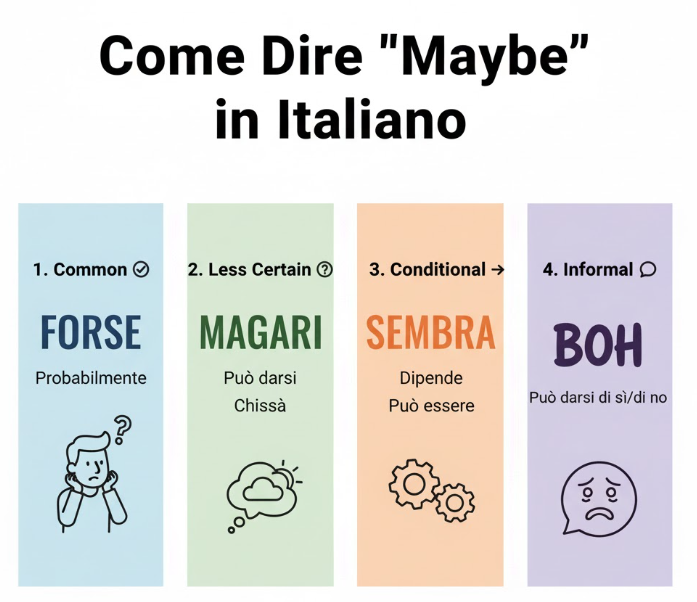
The English word “maybe” expresses uncertainty, possibility, or a lack of commitment. In Italian, there isn’t a single word that perfectly captures all the nuances of “maybe.” Instead, several expressions are used, each with its own specific connotation and level of formality.
These expressions can function as adverbs or phrases, modifying verbs or entire sentences to indicate a degree of doubt or possibility. Understanding the subtle differences between these options is essential for accurate and effective communication in Italian.
Structural Breakdown
The expressions used to convey “maybe” in Italian vary structurally. Some are single words, while others are phrases. For example, forse is a single-word adverb, while può darsi is a phrasal verb construction. The placement of these expressions within a sentence can also affect the emphasis and nuance. Generally, they are placed at the beginning of the sentence or before the verb they modify.
Types and Categories of “Maybe” in Italian
Here’s a breakdown of the most common ways to say “maybe” in Italian, categorized by their specific meanings and usage:
Forse
Forse is the most straightforward and commonly used translation of “maybe.” It expresses possibility or doubt. It’s versatile and can be used in a wide range of contexts.
Può darsi
Può darsi literally translates to “it can be given” or “it may be given.” It implies a possibility that something *might* happen or be true. It often suggests a slightly higher degree of uncertainty than forse.
Magari
Magari is a bit trickier. While it can mean “maybe” in certain contexts, it more often expresses a strong wish or desire, similar to “I wish” or “If only.” When used to mean “maybe,” it often implies a sense of hopefulness or longing.
Probabilmente
Probabilmente translates directly to “probably.” While not exactly “maybe,” it expresses a strong likelihood, leaning towards a positive expectation. It suggests that something is more likely to happen than not.
Eventualmente
Eventualmente means “eventually” or “possibly,” but it can also be used to express “maybe” in the sense of “if the opportunity arises” or “if things work out.” It suggests a conditional possibility.
Chissà
Chissà translates to “who knows?” or “who knows what will happen?” It expresses uncertainty and a lack of knowledge about the future. It’s often used rhetorically to imply that something is uncertain or unpredictable.
Non so
Non so simply means “I don’t know.” While not a direct translation of “maybe,” it can be used to express uncertainty and a lack of commitment, similar to saying “I’m not sure” or “I don’t know maybe” in English.
Examples of “Maybe” in Italian
The following tables provide numerous examples of how to use each expression in context, illustrating their nuances and typical sentence structures.
Table 1: Examples of Forse
This table showcases the versatility of ‘forse’ in expressing uncertainty across various scenarios.
| Italian | English Translation |
|---|---|
| Forse andrò al cinema stasera. | Maybe I’ll go to the cinema tonight. |
| Forse pioverà domani. | Maybe it will rain tomorrow. |
| Forse ho sbagliato. | Maybe I was wrong. |
| Forse è meglio così. | Maybe it’s better this way. |
| Forse dovremmo aspettare. | Maybe we should wait. |
| Forse lui verrà alla festa. | Maybe he’ll come to the party. |
| Forse lei ha ragione. | Maybe she is right. |
| Forse non è vero. | Maybe it’s not true. |
| Forse ho dimenticato qualcosa. | Maybe I forgot something. |
| Forse non ti ho capito bene. | Maybe I didn’t understand you well. |
| Forse è un’idea stupida. | Maybe it’s a stupid idea. |
| Forse è troppo tardi. | Maybe it’s too late. |
| Forse non dovrei dirlo. | Maybe I shouldn’t say it. |
| Forse mi sono spiegato male. | Maybe I explained myself badly. |
| Forse è colpa mia. | Maybe it’s my fault. |
| Forse non ci vediamo più. | Maybe we won’t see each other again. |
| Forse ho perso le chiavi. | Maybe I lost the keys. |
| Forse è meglio che vada. | Maybe it’s better if I go. |
| Forse non lo sa. | Maybe he doesn’t know. |
| Forse è un segreto. | Maybe it’s a secret. |
| Forse è una bugia. | Maybe it’s a lie. |
| Forse è un sogno. | Maybe it’s a dream. |
| Forse è la verità. | Maybe it’s the truth. |
| Forse ho esagerato. | Maybe I exaggerated. |
| Forse non è il momento giusto. | Maybe it’s not the right moment. |
| Forse dovrei scusarmi. | Maybe I should apologize. |
| Forse non mi crederai. | Maybe you won’t believe me. |
| Forse è destino. | Maybe it’s destiny. |
| Forse è solo un’illusione. | Maybe it’s just an illusion. |
Table 2: Examples of Può darsi
This table illustrates how ‘può darsi’ is used to express a possibility, often with a hint of doubt or uncertainty.
| Italian | English Translation |
|---|---|
| Può darsi che abbia ragione. | Maybe he/she is right. |
| Può darsi che piova domani. | Maybe it will rain tomorrow. |
| Può darsi che non venga. | Maybe he/she won’t come. |
| Può darsi che sia vero. | Maybe it’s true. |
| Può darsi che mi sbagli. | Maybe I’m wrong. |
| Può darsi che sia troppo tardi. | Maybe it’s too late. |
| Può darsi che non ci riesca. | Maybe I won’t succeed. |
| Può darsi che tu abbia ragione. | Maybe you are right. |
| Può darsi che non lo sappia. | Maybe he/she doesn’t know. |
| Può darsi che sia un errore. | Maybe it’s a mistake. |
| Può darsi che abbia dimenticato. | Maybe he/she forgot. |
| Può darsi che non sia possibile. | Maybe it’s not possible. |
| Può darsi che non sia la verità. | Maybe it’s not the truth. |
| Può darsi che non sia il momento giusto. | Maybe it’s not the right time. |
| Può darsi che tu non mi capisca. | Maybe you don’t understand me. |
| Può darsi che sia un malinteso. | Maybe it’s a misunderstanding. |
| Può darsi che abbia cambiato idea. | Maybe he/she changed his/her mind. |
| Può darsi che non sia interessato. | Maybe he/she is not interested. |
| Può darsi che sia una coincidenza. | Maybe it’s a coincidence. |
| Può darsi che sia solo una voce. | Maybe it’s just a rumor. |
| Può darsi che sia un segreto. | Maybe it’s a secret. |
| Può darsi che sia un inganno. | Maybe it’s a deception. |
| Può darsi che sia un’illusione. | Maybe it’s an illusion. |
| Può darsi che sia un’opportunità. | Maybe it’s an opportunity. |
| Può darsi che sia un problema. | Maybe it’s a problem. |
| Può darsi che sia una soluzione. | Maybe it’s a solution. |
| Può darsi che sia un caso. | Maybe it’s a matter of chance. |
| Può darsi che sia un miracolo. | Maybe it’s a miracle. |
Table 3: Examples of Magari (as “Maybe”)
These examples demonstrates the use of ‘magari’ to express “maybe” when combined with a sense of wishfulness or hope.
| Italian | English Translation |
|---|---|
| Magari venissi anche io! (sottinteso: magari potessi venire) | Maybe I could come too! (implied: I wish I could come) |
| Magari fosse vero! | Maybe it’s true! (I wish it were true!) |
| Magari vincessi alla lotteria! | Maybe I’ll win the lottery! (I wish I would win the lottery!) |
| Magari mi chiamasse! | Maybe he/she will call me! (I wish he/she would call me!) |
| Magari nevicassse a Natale! | Maybe it will snow on Christmas! (I wish it would snow on Christmas!) |
| Magari mi offrissero un lavoro! | Maybe they’ll offer me a job! (I wish they would offer me a job!) |
| Magari mi perdonasse! | Maybe he/she will forgive me! (I wish he/she would forgive me!) |
| Magari mi dicesse la verità! | Maybe he/she will tell me the truth! (I wish he/she would tell me the truth!) |
| Magari mi amasse! | Maybe he/she loves me! (I wish he/she loved me!) |
| Magari mi invitasse! | Maybe he/she will invite me! (I wish he/she would invite me!) |
| Magari mi raggiungesse! | Maybe he/she will reach me! (I wish he/she would reach me!) |
| Magari mi ascoltasse! | Maybe he/she will listen to me! (I wish he/she would listen to me!) |
| Magari mi capisse! | Maybe he/she will understand me! (I wish he/she would understand me!) |
| Magari mi credesse! | Maybe he/she will believe me! (I wish he/she would believe me!) |
| Magari mi volesse bene! | Maybe he/she will like me! (I wish he/she would like me!) |
| Magari mi sposasse! | Maybe he/she will marry me! (I wish he/she would marry me!) |
| Magari mi scrivesse! | Maybe he/she will write to me! (I wish he/she would write to me!) |
| Magari mi telefonasse! | Maybe he/she will call me! (I wish he/she would call me!) |
| Magari mi venisse a trovare! | Maybe he/she will come to visit me! (I wish he/she would come to visit me!) |
| Magari mi portasse dei fiori! | Maybe he/she will bring me flowers! (I wish he/she would bring me flowers!) |
| Magari mi preparasse la cena! | Maybe he/she will prepare dinner for me! (I wish he/she would prepare dinner for me!) |
| Magari mi leggesse una storia! | Maybe he/she will read me a story! (I wish he/she would read me a story!) |
| Magari mi cantasse una canzone! | Maybe he/she will sing me a song! (I wish he/she would sing me a song!) |
| Magari mi dicesse un complimento! | Maybe he/she will give me a compliment! (I wish he/she would give me a compliment!) |
| Magari mi facesse un regalo! | Maybe he/she will give me a gift! (I wish he/she would give me a gift!) |
| Magari mi desse un abbraccio! | Maybe he/she will give me a hug! (I wish he/she would give me a hug!) |
| Magari mi desse un bacio! | Maybe he/she will give me a kiss! (I wish he/she would give me a kiss!) |
| Magari mi stringesse la mano! | Maybe he/she will shake my hand! (I wish he/she would shake my hand!) |
| Magari mi sorridesse! | Maybe he/she will smile at me! (I wish he/she would smile at me!) |
Table 4: Examples of Probabilmente
The following examples illustrate the usage of ‘probabilmente’ to express probability or likelihood, indicating a higher degree of certainty than ‘forse’ or ‘può darsi’.
| Italian | English Translation |
|---|---|
| Probabilmente arriverò in ritardo. | I’ll probably arrive late. |
| Probabilmente pioverà domani. | It will probably rain tomorrow. |
| Probabilmente lui lo sa già. | He probably already knows. |
| Probabilmente lei accetterà l’offerta. | She will probably accept the offer. |
| Probabilmente non ci saranno problemi. | There probably won’t be any problems. |
| Probabilmente è la scelta giusta. | It’s probably the right choice. |
| Probabilmente mi trasferirò a Roma. | I’ll probably move to Rome. |
| Probabilmente non lo farò. | I probably won’t do it. |
| Probabilmente è già partito. | He has probably already left. |
| Probabilmente mi sono sbagliato. | I probably made a mistake. |
| Probabilmente è troppo caro. | It’s probably too expensive. |
| Probabilmente non è disponibile. | He/she is probably not available. |
| Probabilmente è occupato. | He/she is probably busy. |
| Probabilmente è stanco. | He/she is probably tired. |
| Probabilmente è malato. | He/she is probably sick. |
| Probabilmente è in vacanza. | He/she is probably on vacation. |
| Probabilmente è al lavoro. | He/she is probably at work. |
| Probabilmente è a casa. | He/she is probably at home. |
| Probabilmente è in viaggio. | He/she is probably traveling. |
| Probabilmente è in riunione. | He/she is probably in a meeting. |
| Probabilmente è a cena. | He/she is probably at dinner. |
| Probabilmente è a letto. | He/she is probably in bed. |
| Probabilmente è già addormentato. | He/she is probably already asleep. |
| Probabilmente è al telefono. | He/she is probably on the phone. |
| Probabilmente è in linea. | He/she is probably online. |
| Probabilmente è senza batteria. | He/she probably has no battery. |
| Probabilmente è fuori città. | He/she is probably out of town. |
| Probabilmente è impegnato. | He/she is probably busy. |
Table 5: Examples of Eventualmente
This table provides examples of how ‘eventualmente’ is used to express a conditional possibility or something that might happen if circumstances allow.
| Italian | English Translation |
|---|---|
| Eventualmente, ti chiamerò più tardi. | Maybe I’ll call you later (if I have time). |
| Eventualmente, potremmo andare al mare. | Maybe we could go to the beach (if the weather is good). |
| Eventualmente, ti farò sapere. | Maybe I’ll let you know (if I decide). |
| Eventualmente, ci vediamo domani. | Maybe we’ll see each other tomorrow (if nothing comes up). |
| Eventualmente, ti aiuto io. | Maybe I’ll help you (if you need it). |
| Eventualmente, potremmo parlarne. | Maybe we could talk about it (if you want). |
| Eventualmente, ti accompagno io. | Maybe I’ll accompany you (if you need a ride). |
| Eventualmente, ti presto il mio libro. | Maybe I’ll lend you my book (if you want to read it). |
| Eventualmente, ti do una mano. | Maybe I’ll give you a hand (if you need help). |
| Eventualmente, ti offro un caffè. | Maybe I’ll offer you a coffee (if you’d like one). |
| Eventualmente, ti porto qualcosa. | Maybe I’ll bring you something (if I go shopping). |
| Eventualmente, ti scrivo un messaggio. | Maybe I’ll write you a message (if I have news). |
| Eventualmente, ti mando una foto. | Maybe I’ll send you a photo (if I take one). |
| Eventualmente, ti faccio sapere la mia decisione. | Maybe I’ll let you know my decision (when I make it). |
| Eventualmente, ti spiego tutto. | Maybe I’ll explain everything to you (if you want to know). |
| Eventualmente, ti invito a cena. | Maybe I’ll invite you to dinner (if I have time). |
| Eventualmente, ti presento i miei amici. | Maybe I’ll introduce you to my friends (if we meet). |
| Eventualmente, ti racconto la storia. | Maybe I’ll tell you the story (if you’re interested). |
| Eventualmente, ti mostro le foto. | Maybe I’ll show you the photos (if you want to see them). |
| Eventualmente, ti regalo qualcosa. | Maybe I’ll give you something (if I find the right thing). |
| Eventualmente, ti ringrazio di persona. | Maybe I’ll thank you in person (if I see you). |
| Eventualmente, ti chiedo scusa. | Maybe I’ll apologize to you (if I did something wrong). |
| Eventualmente, ti perdono. | Maybe I’ll forgive you (if you apologize). |
| Eventualmente, ti dimentico. | Maybe I’ll forget you (if you leave). |
| Eventualmente, ti amo ancora. | Maybe I still love you (if you come back). |
| Eventualmente, ti odio. | Maybe I hate you (if you hurt me). |
| Eventualmente, ti lascio. | Maybe I’ll leave you (if you don’t change). |
| Eventualmente, ti sposo. | Maybe I’ll marry you (if you ask me). |
Usage Rules
Each “maybe” expression has specific usage rules to consider:
- Forse: Can be used in most situations to express doubt or possibility. It is placed at the beginning of the sentence or before the verb.
- Può darsi: Implies a slightly higher degree of uncertainty than forse. It is often followed by che and the subjunctive mood.
- Magari: Expresses a wish or desire, and when used as “maybe,” it implies hopefulness. It is often used in the subjunctive mood.
- Probabilmente: Expresses a strong likelihood. It doesn’t require the subjunctive mood.
- Eventualmente: Suggests a conditional possibility. It often implies that something will happen if certain conditions are met.
- Chissà: Expresses uncertainty and a lack of knowledge. It’s often used rhetorically.
- Non so: While not directly “maybe,” it conveys uncertainty and can be used in similar contexts.
Common Mistakes
Here are some common mistakes to avoid when using these expressions:
Mistake 1: Using magari incorrectly.
Incorrect: Magari vado al cinema. (Intended: Maybe I’ll go to the cinema.)
Correct: Forse vado al cinema. or Può darsi che vada al cinema.
Explanation: Magari expresses a wish, not just a possibility. Use forse or può darsi instead.
Mistake 2: Omitting che after può darsi when followed by a clause.
Incorrect: Può darsi piove. (Intended: Maybe it will rain.)
Correct: Può darsi che piova.
Explanation: Può darsi requires che before a subordinate clause, and the verb in the subordinate clause should be in the subjunctive mood.
Mistake 3: Using the indicative mood after può darsi che when the subjunctive is required.
Incorrect: Può darsi che lui viene. (Intended: Maybe he will come.)
Correct: Può darsi che lui venga.
Explanation: After può darsi che, use the subjunctive mood to express uncertainty.
Practice Exercises
Exercise 1: Translate the following sentences into Italian using forse.
Complete the table below by translating each English sentence into Italian using the word ‘forse’.
| English | Italian Translation | Answer |
|---|---|---|
| Maybe I’ll go to Italy next year. | _________________________ | Forse andrò in Italia il prossimo anno. |
| Maybe she’s busy. | _________________________ | Forse è occupata. |
| Maybe it’s a good idea. | _________________________ | Forse è una buona idea. |
| Maybe he doesn’t know. | _________________________ | Forse non lo sa. |
| Maybe we should try again. | _________________________ | Forse dovremmo riprovare. |
| Maybe I’m wrong. | _________________________ | Forse ho sbagliato. |
| Maybe it’s too late. | _________________________ | Forse è troppo tardi. |
| Maybe they’ll come to the party. | _________________________ | Forse verranno alla festa. |
| Maybe it will rain tomorrow. | _________________________ | Forse pioverà domani. |
| Maybe I forgot something. | _________________________ | Forse ho dimenticato qualcosa. |
Exercise 2: Rewrite the following sentences using può darsi che.
Transform each sentence using ‘può darsi che’ to express the same meaning in Italian, ensuring the correct subjunctive form.
| Original Sentence | Sentence with “Può darsi che” | Answer |
|---|---|---|
| Forse ha ragione. | _________________________ | Può darsi che abbia ragione. |
| Forse non verrà. | _________________________ | Può darsi che non venga. |
| Forse è vero. | _________________________ | Può darsi che sia vero. |
| Forse mi sbaglio. | _________________________ | Può darsi che mi sbagli. |
| Forse è troppo tardi. | _________________________ | Può darsi che sia troppo tardi. |
| Forse non ci riesco. | _________________________ | Può darsi che non ci riesca. |
| Forse tu hai ragione. | _________________________ | Può darsi che tu abbia ragione. |
| Forse non lo sa. | _________________________ | Può darsi che non lo sappia. |
| Forse è un errore. | _________________________ | Può darsi che sia un errore. |
| Forse ha dimenticato. | _________________________ | Può darsi che abbia dimenticato. |
Exercise 3: Choose the correct expression to complete the sentence.
Select the most appropriate expression (‘forse’, ‘può darsi’, ‘magari’, ‘probabilmente’, ‘eventualmente’) to fill in the blank, considering the context of each sentence.
| Sentence | Possible Answers | Answer |
|---|---|---|
| __________ andrò in vacanza quest’estate. | a) Magari b) Forse c) Probabilmente | b) Forse |
| __________ che piova nel fine settimana. | a) Probabilmente b) Può darsi c) Magari | b) Può darsi |
| __________ vincessi al superenalotto! | a) Forse b) Probabilmente c) Magari | c) Magari |
| __________ arriverò un po’ in ritardo. | a) Eventualmente b) Probabilmente c) Forse | b) Probabilmente |
| __________ ti chiamerò più tardi se ho tempo. | a) Eventualmente b) Forse c) Magari | a) Eventualmente |
| Non so, __________ è meglio aspettare. | a) magari b) forse c) probabilmente | b) forse |
| __________ che lui | a) può darsi b) probabilmente c) magari | a) può darsi |
Advanced Topics
For advanced learners, exploring the subjunctive mood in depth and understanding regional variations in the usage of these expressions can provide a more nuanced understanding. Additionally, analyzing literary texts and real-life conversations can offer valuable insights into how these expressions are used in authentic contexts.
FAQ
When should I use “forse” versus “può darsi”?
Forse is more general and can be used in most situations. Può darsi implies a slightly higher degree of uncertainty and is often followed by che and the subjunctive mood.
Can “magari” always be used to mean “maybe”?
No, magari primarily expresses a wish or desire. It can mean “maybe” but with a sense of hopefulness or longing.
Is “probabilmente” the same as “maybe”?
Probabilmente means “probably,” so it expresses a higher degree of likelihood than “maybe.”
How do I use “eventualmente” correctly?
Eventualmente suggests a conditional possibility. Use it when something will happen if certain conditions are met.
What’s the best way to remember these expressions?
Practice using them in context, create example sentences, and listen to how native speakers use them in conversations and media.
Conclusion
Mastering the art of expressing “maybe” in Italian involves understanding the subtle nuances of forse, può darsi, magari, probabilmente, eventualmente, chissà, and non so. By practicing their usage and avoiding common mistakes, you can significantly improve your ability to communicate uncertainty and possibility in Italian. Keep practicing, and you’ll become more confident and fluent in expressing these important concepts.