Learning how to express agreement or shared sentiment is crucial in any language. In Italian, saying “me too” goes beyond a simple translation.
It involves understanding the nuances of agreement and choosing the right phrase to match the context. This article provides a comprehensive exploration of how to say “me too” in Italian, covering various expressions, their meanings, and usage.
Whether you’re a beginner or an advanced learner, this guide will equip you with the knowledge and practice you need to confidently express agreement in Italian.
This article is designed for learners of all levels who want to enhance their conversational skills and gain a deeper understanding of Italian grammar and cultural expressions. By mastering these phrases, you can communicate more effectively and build stronger connections with Italian speakers.
Table of Contents
- Introduction
- Definition: Saying “Me Too” in Italian
- Structural Breakdown of “Anche io” and “Anch’io”
- Types and Categories of “Me Too” Expressions
- Examples of “Me Too” in Italian
- Usage Rules and Considerations
- Common Mistakes to Avoid
- Practice Exercises
- Advanced Topics: Nuances and Regional Variations
- Frequently Asked Questions
- Conclusion
Definition: Saying “Me Too” in Italian
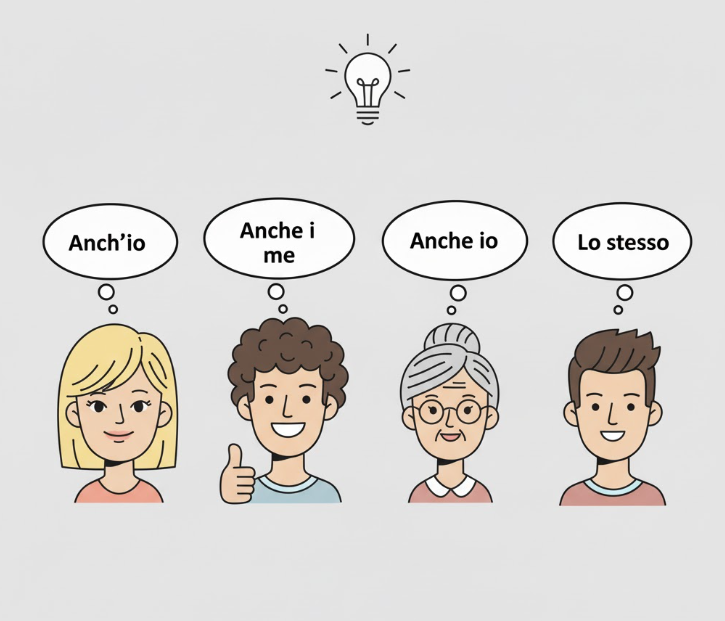
The concept of “me too” in Italian is expressed through various phrases, each with its own subtle meaning and context. The most common translation is “Anche io” or its contracted form, “Anch’io.” These phrases directly translate to “me too” or “I also.” However, Italian offers other options to convey agreement, depending on the specific context and the nuance you want to express. These include regional variations like “Me pure,” as well as phrases such as “Altrettanto,” “Lo stesso,” and “Pure io.” Understanding these different expressions allows for more precise and natural communication.
The function of these expressions is primarily to indicate agreement or shared experience. They are used in response to a statement made by another person, signaling that you share the same feeling, opinion, or experience.
The choice of which expression to use often depends on the specific statement you are agreeing with and the level of formality required. For instance, “Altrettanto” is often used in response to well wishes, while “Anche io” is a more general expression of agreement.
Structural Breakdown of “Anche io” and “Anch’io”
The phrase “Anche io” is composed of two words: “Anche,” meaning “also” or “too,” and “io,” meaning “I.” The contracted form, “Anch’io,” is a combination of the two words, with the final “e” of “anche” elided and replaced with an apostrophe. This contraction is common in Italian to avoid vowel clashes and create a smoother pronunciation. Both forms are grammatically correct and widely used, but “Anch’io” is generally preferred in spoken Italian for its fluidity.
The structure is straightforward: “Anche” modifies “io,” indicating that the speaker is including themselves in the statement previously made. The word order is fixed, with “anche” always preceding “io.” This simple structure makes it easy to incorporate into various conversational contexts.
Understanding the individual components of the phrase helps in recognizing and using it correctly.
Types and Categories of “Me Too” Expressions
While “Anche io” is the most common way to say “me too” in Italian, several other expressions can be used to convey agreement, each with its own specific nuance and context. These variations allow for a more nuanced and natural expression of agreement.
“Anche io” / “Anch’io”: The Most Common Expression
“Anche io” and “Anch’io” are the most versatile and widely used expressions for “me too” in Italian. They can be used in a variety of contexts to indicate agreement or shared experience. The contracted form, “Anch’io,” is generally preferred in spoken language, while “Anche io” is more common in written form, although both are acceptable.
This expression is suitable for both formal and informal settings, making it a reliable choice for most situations. Its simplicity and directness make it easy to understand and use, even for beginners.
“Me pure” (Regional)
“Me pure” is a regional variation, primarily used in Southern Italy. It carries the same meaning as “Anche io” but is more colloquial and informal. While not universally understood throughout Italy, it is a common expression in specific regions.
When using “Me pure,” it’s important to be aware of your audience and the context. It may not be appropriate in formal settings or when speaking with someone unfamiliar with regional dialects.
“Altrettanto”
“Altrettanto” translates to “likewise” or “the same to you.” It’s often used in response to well wishes, compliments, or polite expressions. It’s a more formal and reciprocal way of saying “me too,” indicating that you wish the same for the other person.
For example, if someone says “Buona giornata!” (Have a good day!), you can respond with “Altrettanto!” to wish them the same.
“Lo stesso”
“Lo stesso” means “the same” and can be used to express agreement in certain contexts. It’s less direct than “Anche io” but can be appropriate when referring to a shared situation or feeling.
This expression is often used when someone describes a situation they are in, and you find yourself in a similar situation. It can also be used to express that you feel the same way about something.
“Pure io”
“Pure io” is another way of saying “me too,” similar to “Anche io.” It emphasizes the “also” aspect, highlighting that you are included in the same situation or feeling. It’s slightly less common than “Anche io” but still widely understood.
The word “pure” functions as “also” or “too”. This phrase is generally accepted in most contexts, though it might sound slightly more emphatic than “Anche io.”
“Io sì”
“Io sì” translates to “I do” or “Yes, I do.” This is used to show agreement when confirming something, especially when someone is unsure if you share the same sentiment or experience. It’s more emphatic than “Anche io” and leaves no doubt about your agreement.
For example, if someone asks “Ti piace la pizza?” (Do you like pizza?) and you really love pizza, you can respond with “Io sì!” to emphasize your agreement.
Examples of “Me Too” in Italian
To fully understand how to use these different expressions, let’s look at some examples in various contexts. These examples will illustrate the nuances of each phrase and help you choose the right one for your situation.
Examples Using “Anche io” / “Anch’io”
The following table provides examples of how to use “Anche io” and “Anch’io” in different conversational scenarios. These examples showcase the versatility and broad applicability of these phrases.
| Statement | Response with “Anche io” / “Anch’io” | Translation |
|---|---|---|
| Mi piace il caffè. | Anch’io. | I like coffee. / Me too. |
| Sono stanco oggi. | Anch’io sono stanco. | I’m tired today. / Me too, I’m tired. |
| Non mi piace la pioggia. | Anche io non amo la pioggia. | I don’t like the rain. / Me too, I don’t like the rain. |
| Voglio andare al mare. | Anch’io voglio andare al mare. | I want to go to the beach. / Me too, I want to go to the beach. |
| Ho fame. | Anch’io ho fame. | I’m hungry. / Me too, I’m hungry. |
| Amo la musica italiana. | Anch’io amo la musica italiana. | I love Italian music. / Me too, I love Italian music. |
| Non ho voglia di lavorare. | Anch’io non ho voglia di lavorare. | I don’t feel like working. / Me too, I don’t feel like working. |
| Sono felice di essere qui. | Anch’io sono felice di essere qui. | I’m happy to be here. / Me too, I’m happy to be here. |
| Ho visto un bel film ieri sera. | Anch’io ho visto un bel film ieri sera. | I saw a great movie last night. / Me too, I saw a great movie last night. |
| Non parlo bene l’italiano. | Anch’io non parlo bene l’italiano. | I don’t speak Italian well. / Me too, I don’t speak Italian well. |
| Mi piace questo ristorante. | Anch’io mi piace questo ristorante. | I like this restaurant. / Me too, I like this restaurant. |
| Sono in ritardo. | Anch’io sono in ritardo. | I’m late. / Me too, I’m late. |
| Voglio imparare una nuova lingua. | Anch’io voglio imparare una nuova lingua. | I want to learn a new language. / Me too, I want to learn a new language. |
| Non mi piacciono i broccoli. | Anch’io non mi piacciono i broccoli. | I don’t like broccoli. / Me too, I don’t like broccoli. |
| Ho bisogno di una vacanza. | Anch’io ho bisogno di una vacanza. | I need a vacation. / Me too, I need a vacation. |
| Amo viaggiare. | Anch’io amo viaggiare. | I love to travel. / Me too, I love to travel. |
| Non voglio andare a lavoro domani. | Anch’io non voglio andare a lavoro domani. | I don’t want to go to work tomorrow. / Me too, I don’t want to go to work tomorrow. |
| Sono emozionato per il concerto. | Anch’io sono emozionato per il concerto. | I’m excited for the concert. / Me too, I’m excited for the concert. |
| Ho un esame domani. | Anch’io ho un esame domani. | I have an exam tomorrow. / Me too, I have an exam tomorrow. |
| Non capisco. | Anch’io non capisco. | I don’t understand. / Me too, I don’t understand. |
Examples Using “Me pure”
This table illustrates the use of “Me pure,” a regional expression mainly found in Southern Italy. Remember that this phrase is informal and might not be suitable in all contexts.
| Statement | Response with “Me pure” | Translation |
|---|---|---|
| Sono stanco morto! | Me pure! | I’m dead tired! / Me too! |
| Ho una fame che non ti dico! | Me pure! | I’m so hungry you wouldn’t believe it! / Me too! |
| Non ne posso più di questo caldo! | Me pure! | I can’t stand this heat anymore! / Me too! |
| Voglio andare a casa! | Me pure! | I want to go home! / Me too! |
| Non ho capito niente! | Me pure! | I didn’t understand anything! / Me too! |
| Che fatica! | Me pure! | What a drag! / Me too! |
| Sono stufo di questo lavoro! | Me pure! | I’m fed up with this job! / Me too! |
| Non vedo l’ora che arrivi l’estate! | Me pure! | I can’t wait for summer to come! / Me too! |
| Questo film è noioso! | Me pure! | This movie is boring! / Me too! |
| Non mi sento bene oggi. | Me pure! | I don’t feel well today. / Me too! |
Examples Using “Altrettanto”
The following examples demonstrate the use of “Altrettanto” in response to well wishes or compliments. This expression conveys a sense of reciprocity and politeness.
| Statement | Response with “Altrettanto” | Translation |
|---|---|---|
| Buona giornata! | Altrettanto! | Have a good day! / The same to you! |
| Buon appetito! | Altrettanto! | Enjoy your meal! / The same to you! |
| Buon weekend! | Altrettanto! | Have a good weekend! / The same to you! |
| Buone vacanze! | Altrettanto! | Happy holidays! / The same to you! |
| Complimenti! | Altrettanto! (To the person complimenting you) | Congratulations! / The same to you! (meaning you give them compliments too) |
| In bocca al lupo! | Altrettanto! | Good luck! / The same to you! |
| Spero che tu stia bene! | Altrettanto! | I hope you’re doing well! / The same to you! |
| Ti auguro il meglio! | Altrettanto! | I wish you the best! / The same to you! |
| Buon compleanno! | Altrettanto! (If they are also celebrating) | Happy Birthday! / The same to you! (If it’s also their birthday) |
| Felice di conoscerti! | Altrettanto! | Happy to meet you! / The same to you! |
Examples Using “Lo stesso”
This table shows how “Lo stesso” is used to express that you are in the same situation or feel the same way. It’s a less direct way of saying “me too” but can be effective in certain contexts.
| Statement | Response with “Lo stesso” | Translation |
|---|---|---|
| Sono molto stanco oggi. | Lo stesso. | I’m very tired today. / The same. |
| Ho mal di testa. | Lo stesso. | I have a headache. / The same. |
| Non ho molta fame. | Lo stesso. | I’m not very hungry. / The same. |
| Sono preoccupato per il futuro. | Lo stesso. | I’m worried about the future. / The same. |
| Non mi sento molto bene. | Lo stesso. | I don’t feel very well. / The same. |
| Sono emozionato per domani. | Lo stesso. | I’m excited for tomorrow. / The same. |
| Ho un po’ paura. | Lo stesso. | I’m a little scared. / The same. |
| Sono in difficoltà con questo progetto. | Lo stesso. | I’m struggling with this project. / The same. |
| Non riesco a dormire bene. | Lo stesso. | I can’t sleep well. / The same. |
| Sono stressato per il lavoro. | Lo stesso. | I’m stressed about work. / The same. |
Examples Using “Pure io”
Here are examples of “Pure io” being used to express agreement. This phrase is similar to “Anche io” but can add a bit more emphasis.
| Statement | Response with “Pure io” | Translation |
|---|---|---|
| Mi piace molto questo libro. | Pure io! | I really like this book. / Me too! |
| Non voglio andare al lavoro oggi. | Pure io non voglio andare al lavoro! | I don’t want to go to work today. / Me too, I don’t want to go to work! |
| Sono felice di vederti. | Pure io sono felice di vederti. | I’m happy to see you. / Me too, I’m happy to see you. |
| Ho bisogno di un caffè. | Pure io ho bisogno di un caffè. | I need a coffee. / Me too, I need a coffee. |
| Non mi piace il freddo. | Pure io non mi piace il freddo. | I don’t like the cold. / Me too, I don’t like the cold. |
| Amo la cucina italiana. | Pure io amo la cucina italiana. | I love Italian cuisine. / Me too, I love Italian cuisine. |
| Non ho tempo per fare sport. | Pure io non ho tempo per fare sport. | I don’t have time to play sports. / Me too, I don’t have time to play sports. |
| Sono stanco di studiare. | Pure io sono stanco di studiare. | I’m tired of studying. / Me too, I’m tired of studying. |
| Ho voglia di pizza. | Pure io ho voglia di pizza. | I’m craving pizza. / Me too, I’m craving pizza. |
| Non mi piace guidare in città. | Pure io non mi piace guidare in città. | I don’t like driving in the city. / Me too, I don’t like driving in the city. |
Examples Using “Io sì”
The following examples show how “Io sì” is used to emphatically agree with a statement, especially when confirming something you strongly feel or believe.
| Statement | Response with “Io sì” | Translation |
|---|---|---|
| Ti piace la pizza? | Io sì! | Do you like pizza? / Yes, I do! |
| Sei contento di essere qui? | Io sì! | Are you happy to be here? / Yes, I am! |
| Credi nel destino? | Io sì! | Do you believe in destiny? / Yes, I do! |
| Vuoi venire con noi? | Io sì! | Do you want to come with us? / Yes, I do! |
| Ami il gelato? | Io sì! | Do you love ice cream? / Yes, I do! |
| Pensi che sia una buona idea? | Io sì! | Do you think it’s a good idea? / Yes, I do! |
| Sei d’accordo con me? | Io sì! | Do you agree with me? / Yes, I do! |
| Vuoi un altro bicchiere di vino? | Io sì! | Do you want another glass of wine? / Yes, I do! |
| Sei pronto per la sfida? | Io sì! | Are you ready for the challenge? / Yes, I am! |
| Ti piace la montagna? | Io sì! | Do you like the mountains? / Yes, I do! |
Usage Rules and Considerations
Understanding the rules and considerations for each expression is crucial for using them correctly and appropriately. While some expressions are versatile, others are more specific to certain contexts or regions.
Rules for Using “Anche io” / “Anch’io”
“Anche io” and “Anch’io” are generally safe and versatile choices. They can be used in both formal and informal settings. Remember that “Anch’io” is more common in spoken Italian, while “Anche io” is acceptable in both spoken and written forms. Ensure the verb tense aligns with the original statement when using a full sentence response (e.g., “Anch’io sono stanco” instead of just “Anch’io” if the original statement was “Sono stanco”).
Rules for Using “Me pure”
“Me pure” is a regional expression and should be used with caution outside of Southern Italy. It’s best suited for informal conversations with people who are familiar with this regional dialect. Avoid using it in formal settings or when speaking with someone you don’t know well. It’s typically used as a short, emphatic agreement, similar to “Me too!”
Rules for Using “Altrettanto”
“Altrettanto” is used in response to well wishes, compliments, or polite expressions. It conveys a sense of reciprocity and politeness. It’s not appropriate for expressing general agreement or shared experiences. Ensure that the context involves a positive sentiment or wish being expressed towards you before using “Altrettanto.”
Rules for Using “Lo stesso”
“Lo stesso” is used to express that you are in the same situation or feel the same way. It’s less direct than “Anche io” and is often used when responding to a statement about a state of being or a feeling. It is not used for agreeing with preferences or desires. For example, you wouldn’t say “Lo stesso” if someone said “I want to go to the beach.”
Rules for Using “Pure io”
“Pure io” is very similar in usage to “Anche io.” It can be used in most contexts where “Anche io” is appropriate. It adds a slight emphasis on the “also” aspect of the agreement. However, it’s not as universally common as “Anche io,” so stick to “Anche io” if you are unsure.
Rules for Using “Io sì”
“Io sì” is used to emphatically agree with a statement, especially when confirming something you strongly feel or believe. It’s used in response to a question or a statement that implies a question. It’s not appropriate for expressing general agreement or shared experiences. For instance, you wouldn’t use “Io sì” if someone said “I like pizza.” Instead, you’d use it if they asked, “Do you like pizza?”
Common Mistakes to Avoid
Even with a good understanding of the rules, it’s easy to make mistakes when learning a new language. Here are some common mistakes to avoid when saying “me too” in Italian.
| Incorrect | Correct | Explanation |
|---|---|---|
| Io anche. | Anche io / Anch’io. | The word order is incorrect. “Anche” must precede “io.” |
| Altrettanto sono stanco. | Anch’io sono stanco. | “Altrettanto” is not used to express general agreement. |
| Me pure mi piace il caffè. | Anch’io mi piace il caffè. | “Me pure” is a short, informal expression and doesn’t require additional words. |
| Lo stesso voglio andare al mare. | Anch’io voglio andare al mare. | “Lo stesso” is used when you are in the same situation, not when you want the same thing. |
| Io sì mi piace la pizza. | Io sì! / Mi piace anche a me la pizza! | “Io sì” is used to answer a question, not to state a preference. |
| Pure io sono d’accordo. | Anch’io sono d’accordo. | While not strictly incorrect, “Anch’io sono d’accordo” is much more common. |
| Altrettanto! (to someone saying they are tired) | (No response with “Altrettanto” is appropriate) | “Altrettanto” should only be used in response to good wishes or compliments. |
Practice Exercises
Test your understanding with these practice exercises. Choose the correct way to say “me too” in Italian for each scenario.
| Question | Answer Choices | Correct Answer |
|---|---|---|
| Someone says, “Sono felice oggi.” | a) Altrettanto b) Anch’io c) Lo stesso | b) Anch’io |
| Someone says, “Buona fortuna!” | a) Anch’io b) Me pure c) Altrettanto | c) Altrettanto |
| Someone says, “Ho mal di testa.” | a) Anch’io b) Lo stesso c) Pure io | b) Lo stesso |
| Someone asks, “Ti piace il vino?” | a) Anch’io b) Io sì c) Altrettanto | b) Io sì |
| Someone says (in Southern Italy), “Non ne posso più!” | a) Anch’io b) Altrettanto c) Me pure | c) Me pure |
| Someone says, “Amo viaggiare.” | a) Lo stesso b) Pure io c) Altrettanto | b) Pure io |
| Someone says, “Non voglio cucinare stasera.” | a) Anch’io b) Altrettanto c) Io sì | a) Anch’io |
| Someone says, “Sono stanco di lavorare.” | a) Altrettanto b) Lo stesso c) Io sì | b) Lo stesso |
| Someone says, “Buon Natale!” | a) Anch’io b) Me pure c) Altrettanto | c) Altrettanto |
| Someone asks, “Sei pronto per partire?” | a) Anch’io b) Io sì c) Lo stesso | b) Io sì |
Advanced Topics: Nuances and Regional Variations
Beyond the basic expressions, there are more nuanced ways to express agreement in Italian, often influenced by regional dialects and cultural contexts. For example, in some regions, you might hear variations of “Me pure” with slightly different pronunciations or inflections.
Additionally, the level of formality can influence the choice of expression. In very formal settings, you might opt for a more elaborate response than simply “Anch’io,” such as “Condivido pienamente la sua opinione” (I fully share your opinion).
Understanding these nuances requires exposure to authentic Italian conversations and a deeper understanding of Italian culture. Pay attention to how native speakers express agreement in different situations and try to incorporate these variations into your own speech.
This will help you communicate more naturally and effectively.
Frequently Asked Questions
Here are some frequently asked questions about saying “me too” in Italian.
- What’s the difference between “Anche io” and “Anch’io”?
Both mean “me too,” but “Anch’io” is a contraction of “Anche io” and is more common in spoken Italian. “Anche io” is perfectly acceptable in both spoken and written forms, but “Anch’io” flows more naturally in conversation.
- Is “Me pure” used throughout Italy?
No, “Me pure” is a regional expression primarily used in Southern Italy. While some people from other regions might understand it, it’s best to use it in informal settings with people familiar with Southern Italian dialects.
- When should I use “Altrettanto”?
“Altrettanto” is used in response to well wishes, compliments, or polite expressions. It’s a reciprocal way of saying “the same to you” and conveys politeness.
- Can I use “Lo stesso” in any situation to say “me too”?
No, “Lo stesso” is used to express that you are in the same situation or feel the same way as someone else. It’s not used for agreeing with preferences or desires.
- When is it appropriate to use “Io sì”?
“Io sì” is appropriate when you want to emphatically confirm something, especially when you are asked a question and you want to strongly agree.
- Is it rude to use “Me pure” in a formal setting?
Yes, it’s generally considered inappropriate to use “Me pure” in a formal setting. It’s a very informal expression and should be reserved for casual conversations with people you know well
.
Conclusion
Saying “me too” in Italian is more than just a simple translation; it’s about understanding the nuances of agreement and choosing the right expression for the context. While “Anche io” and “Anch’io” are the most versatile and widely used phrases, knowing regional variations like “Me pure” and context-specific expressions like “Altrettanto,” “Lo stesso,” “Pure io,” and “Io sì” will enhance your conversational skills and allow you to communicate more effectively in Italian. By mastering these expressions, you’ll be able to express agreement naturally and confidently in a variety of situations.
Continue to practice these phrases in real-life conversations and pay attention to how native speakers use them. With time and practice, you’ll develop a keen sense of when to use each expression, making your Italian communication more authentic and engaging.
Buon apprendimento! (Happy learning!)