Knowing how to ask for the location of the bathroom is a fundamental skill when traveling or living in a foreign country. In Italy, this simple question can be phrased in several ways, each with its nuances and levels of formality.
This article provides a comprehensive guide to asking “Where is the bathroom?” in Italian, covering various phrases, their grammatical structures, and cultural contexts. Understanding these nuances will not only help you find the restroom but also improve your overall communication skills in Italian.
This guide is perfect for beginners, intermediate learners, and anyone planning a trip to Italy.
Whether you’re exploring the ancient ruins of Rome, enjoying the canals of Venice, or savoring the cuisine of Tuscany, knowing how to politely inquire about the restroom will ensure a more comfortable and confident experience. Mastering this essential phrase is a key step towards fluency and cultural understanding.
Let’s dive in and explore the various ways to ask “Where is the bathroom?” in Italian.
Table of Contents
- Introduction
- Definition: Asking for the Bathroom in Italian
- Structural Breakdown of Key Phrases
- Types of Phrases
- Examples: Asking for the Bathroom in Italian
- Usage Rules and Considerations
- Common Mistakes to Avoid
- Practice Exercises
- Advanced Topics
- Frequently Asked Questions (FAQ)
- Conclusion
Definition: Asking for the Bathroom in Italian
The most common and direct translation of “Where is the bathroom?” in Italian is “Dov’è il bagno?”. However, there are several other ways to ask this question, depending on the context and your relationship with the person you’re asking. These variations include more formal and informal options, as well as phrases that specify the type of restroom (e.g., toilet, ladies’ room, men’s room). Understanding these variations allows you to communicate effectively and respectfully in different situations.
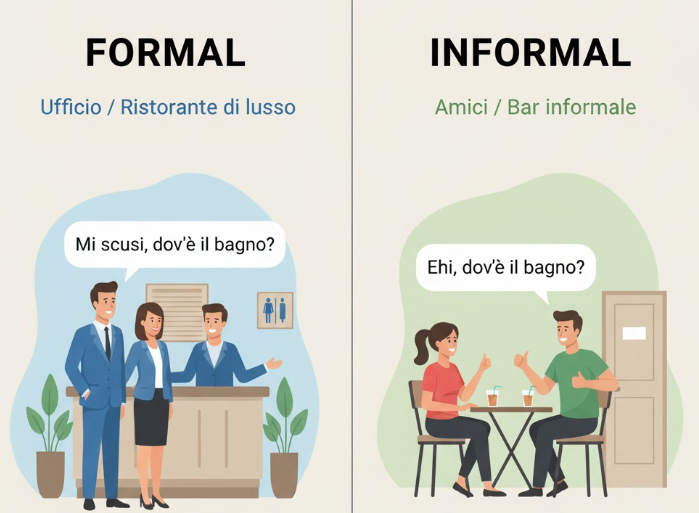
The phrase “Dov’è il bagno?” is generally acceptable in most situations. However, in more formal settings, you might prefer a more polite phrasing. Conversely, with friends or family, you can use a more casual approach. Knowing these nuances is crucial for effective communication and cultural sensitivity.
Structural Breakdown of Key Phrases
Let’s break down the structure of the most common phrase, “Dov’è il bagno?”:
- Dov’è: This is a contraction of “Dove è”, which means “Where is”. “Dove” is the adverb meaning “where,” and “è” is the third-person singular form of the verb “essere” (to be).
- il: This is the definite article “the” (masculine singular).
- bagno: This is the noun meaning “bathroom” or “restroom”.
Therefore, “Dov’è il bagno?” literally translates to “Where is the bathroom?”. The word order is similar to English, making it relatively easy for English speakers to grasp. Understanding the individual components of this phrase will help you understand and use other similar phrases in Italian.
Another important phrase is “Scusi, dov’è il bagno?”. Here, “Scusi” means “Excuse me,” adding a polite introduction to the question. This phrase is particularly useful when addressing strangers or people in a formal setting.
Types of Phrases
There are various ways to ask “Where is the bathroom?” in Italian, each suitable for different situations. Understanding these nuances will help you communicate effectively and respectfully.
Formal Phrases
In formal settings, such as when addressing someone you don’t know or someone in a position of authority, it’s best to use a polite and respectful tone. Here are some formal phrases:
- “Scusi, dov’è il bagno?” – Excuse me, where is the bathroom?
- “Mi scusi, saprebbe indicarmi dov’è il bagno?” – Excuse me, could you tell me where the bathroom is?
- “Per favore, mi può dire dov’è il bagno?” – Please, can you tell me where the bathroom is?
These phrases incorporate polite expressions like “Scusi” (excuse me) and “Per favore” (please), making them suitable for formal situations. Using these phrases demonstrates respect and consideration.
Informal Phrases
With friends, family, or in casual settings, you can use more informal phrases. These phrases are more direct and less formal.
- “Dov’è il bagno?” – Where is the bathroom? (This is acceptable in most situations but leaning towards informal)
- “Scusa, dov’è il bagno?” – Excuse me, where is the bathroom? (Informal ‘excuse me’)
- “Ma, il bagno?” – Hey, the bathroom? (Very informal, used with close friends)
The phrase “Dov’è il bagno?” is generally acceptable in most situations, but it’s slightly less formal than adding “Scusi” or “Per favore”. The phrase “Ma, il bagno?” is extremely informal and should only be used with people you know well.
Other Useful Phrases
In addition to the standard phrases, here are some other useful phrases related to finding the bathroom:
- “Dove sono i servizi?” – Where are the restrooms? (Servizi is a more general term for restrooms)
- “Dove si trova la toilette?” – Where is the toilet located? (Toilette is another word for restroom)
- “C’è un bagno qui vicino?” – Is there a bathroom nearby?
- “Posso usare il bagno?” – Can I use the bathroom?
These phrases offer alternative ways to ask for the bathroom and can be useful in different contexts. For example, “C’è un bagno qui vicino?” is helpful if you’re not sure if there’s a restroom available in the immediate vicinity.
Examples: Asking for the Bathroom in Italian
Here are some examples of how to ask “Where is the bathroom?” in Italian, categorized by formality level. These examples will help you understand the context in which each phrase is most appropriate.
Table 1: Formal Phrases
The following table illustrates formal ways to ask for the bathroom, suitable for addressing strangers or people in positions of authority. Note the use of polite expressions like “Scusi” and “Per favore”.
| Italian Phrase | English Translation | Context |
|---|---|---|
| Scusi, dov’è il bagno? | Excuse me, where is the bathroom? | Asking a stranger in a restaurant. |
| Mi scusi, saprebbe indicarmi dov’è il bagno? | Excuse me, could you tell me where the bathroom is? | Asking a hotel receptionist. |
| Per favore, mi può dire dov’è il bagno? | Please, can you tell me where the bathroom is? | Asking a shop assistant. |
| Scusi, dove sono i servizi igienici? | Excuse me, where are the restrooms? | Asking at a train station. |
| Mi scusi, potrebbe indicarmi la toilette? | Excuse me, could you point me to the toilet? | Asking in a formal event. |
| Per favore, saprebbe dirmi dov’è la toilette? | Please, could you tell me where the toilet is? | Asking in a museum. |
| Scusi, c’è un bagno in questo edificio? | Excuse me, is there a bathroom in this building? | Asking in a public building. |
| Mi scusi, sa per caso dov’è il bagno? | Excuse me, do you happen to know where the bathroom is? | Asking someone on the street. |
| Per favore, potrebbe indicarmi il bagno più vicino? | Please, could you point me to the nearest bathroom? | Asking while traveling. |
| Scusi, ho bisogno di usare il bagno. Dov’è? | Excuse me, I need to use the bathroom. Where is it? | Asking urgently in a store. |
| Mi scusi, dove posso trovare il bagno? | Excuse me, where can I find the bathroom? | Asking at a conference. |
| Per favore, mi può aiutare a trovare il bagno? | Please, can you help me find the bathroom? | Asking for assistance in a library. |
| Scusi, è possibile usare il bagno qui? | Excuse me, is it possible to use the bathroom here? | Asking in a private establishment. |
| Mi scusi, saprebbe dirmi se c’è un bagno qui? | Excuse me, could you tell me if there is a bathroom here? | Asking in a small shop. |
| Per favore, mi può dire se il bagno è libero? | Please, can you tell me if the bathroom is free? | Asking when the bathroom is occupied. |
| Scusi, dove si trova il bagno delle donne? | Excuse me, where is the women’s bathroom located? | Specifically asking for the women’s room. |
| Mi scusi, saprebbe indicarmi il bagno degli uomini? | Excuse me, could you tell me where the men’s bathroom is? | Specifically asking for the men’s room. |
| Per favore, mi può dire se c’è un bagno per disabili? | Please, can you tell me if there is a disabled bathroom? | Asking for a disabled bathroom. |
| Scusi, c’è un fasciatoio nel bagno? | Excuse me, is there a changing table in the bathroom? | Asking about baby changing facilities. |
| Mi scusi, il bagno è a pagamento? | Excuse me, is the bathroom a pay toilet? | Asking if there’s a fee to use the bathroom. |
| Per favore, dov’è la chiave del bagno? | Please, where is the key to the bathroom? | Asking when a key is required. |
| Scusi, il bagno è pulito? | Excuse me, is the bathroom clean? | Asking about the cleanliness of the bathroom. |
| Mi scusi, posso usare il bagno qui anche se non sono un cliente? | Excuse me, can I use the bathroom here even if I am not a customer? | Asking to use the bathroom without being a customer. |
Table 2: Informal Phrases
The following table presents informal ways to ask for the bathroom, suitable for use with friends, family, or in casual settings. These phrases are more direct and less formal.
| Italian Phrase | English Translation | Context |
|---|---|---|
| Dov’è il bagno? | Where is the bathroom? | Asking a friend at their home. |
| Scusa, dov’è il bagno? | Excuse me, where is the bathroom? | Asking a sibling at a family gathering. |
| Ma, il bagno? | Hey, the bathroom? | Asking a close friend while hanging out. |
| Dove sta il bagno? | Where is the bathroom at? | Asking a roommate in your apartment. |
| Hai visto il bagno? | Have you seen the bathroom? | Asking a friend while at a party. |
| Bagno? Dove? | Bathroom? Where? | Quickly asking a friend in a hurry. |
| Mi fai usare il bagno? | Can I use the bathroom? | Asking to use the bathroom at a friend’s house. |
| C’è un bagno qui? | Is there a bathroom here? | Asking a friend in a casual setting. |
| Dove si va in bagno? | Where does one go to the bathroom? | Asking playfully among friends. |
| Uffa, devo andare in bagno! Dov’è? | Ugh, I need to go to the bathroom! Where is it? | Complaining to a close friend about needing the bathroom. |
| Mi scappa! Dov’è il bagno? | I need to go urgently! Where is the bathroom? | Expressing urgency to a friend. |
| Sai dov’è il bagno? | Do you know where the bathroom is? | Asking a friend if they know the location. |
| Ma il bagno è qui? | Is the bathroom here? | Asking for confirmation from a friend. |
| Non trovo il bagno! | I can’t find the bathroom! | Expressing frustration to a friend. |
| Il bagno, per favore! | The bathroom, please! | Directly asking a friend to point you to the bathroom. |
| Mi dici dov’è il bagno? | Can you tell me where the bathroom is? | Asking a friend for directions. |
| Dov’è quel posto? | Where is that place? (referring to the bathroom) | Using a euphemism among friends. |
| Devo andare a fare pipì! Dov’è il bagno? | I need to pee! Where is the bathroom? | Being blunt with a close friend. |
| Qualcuno sa dov’è il bagno? | Does anyone know where the bathroom is? | Asking a group of friends. |
| Bagno urgente! Dove? | Bathroom urgently! Where? | Expressing extreme urgency. |
| Ho bisogno del bagno! | I need the bathroom! | Stating your need directly. |
| Aiuto, il bagno! | Help, the bathroom! | Jokingly calling for help. |
Table 3: Other Useful Phrases
This table provides additional phrases related to finding the bathroom, offering alternative ways to ask and inquire about restroom availability and facilities.
| Italian Phrase | English Translation | Context |
|---|---|---|
| Dove sono i servizi? | Where are the restrooms? | Asking in a public place like a park. |
| Dove si trova la toilette? | Where is the toilet located? | Asking in a more formal setting. |
| C’è un bagno qui vicino? | Is there a bathroom nearby? | Asking if there’s a restroom in the area. |
| Posso usare il bagno? | Can I use the bathroom? | Asking for permission to use the restroom. |
| Il bagno è libero? | Is the bathroom free? | Asking if the bathroom is occupied. |
| Dove posso lavare le mani? | Where can I wash my hands? | Asking specifically for a place to wash hands. |
| C’è un bagno per disabili? | Is there a bathroom for disabled people? | Asking about accessibility. |
| Quanto costa usare il bagno? | How much does it cost to use the bathroom? | Asking about payment for restroom use. |
| Il bagno è pulito? | Is the bathroom clean? | Asking about the cleanliness of the restroom. |
| C’è una nursery qui? | Is there a nursery here? | Asking about baby changing facilities. |
| Dove posso cambiare il bambino? | Where can I change the baby? | Asking for a baby changing area. |
| Il bagno ha la carta igienica? | Does the bathroom have toilet paper? | Asking about toilet paper availability. |
| C’è il sapone nel bagno? | Is there soap in the bathroom? | Asking about soap availability. |
| Dove posso asciugare le mani? | Where can I dry my hands? | Asking about hand drying facilities. |
| Il bagno è chiuso? | Is the bathroom closed? | Asking if the restroom is locked. |
| C’è una chiave per il bagno? | Is there a key for the bathroom? | Asking if a key is needed. |
| Dove posso trovare la chiave del bagno? | Where can I find the key to the bathroom? | Asking where to get the key. |
| Il bagno è fuori servizio? | Is the bathroom out of order? | Asking if the restroom is functional. |
| C’è un altro bagno nelle vicinanze? | Is there another bathroom nearby? | Asking about alternative restrooms. |
| Mi può indicare un bagno sulla mappa? | Can you show me a bathroom on the map? | Asking for directions on a map. |
| È permesso usare il bagno qui? | Is it allowed to use the bathroom here? | Asking for permission. |
| Posso usare il bagno anche se non sono cliente? | Can I use the bathroom even if I am not a customer? | Asking to use the restroom without being a customer. |
| C’è un limite di tempo per usare il bagno? | Is there a time limit to use the bathroom? | Asking about time restrictions. |
Usage Rules and Considerations
When asking for the bathroom in Italian, it’s important to consider the context and your relationship with the person you’re asking. Here are some usage rules and considerations:
- Formality: Use formal phrases like “Scusi, dov’è il bagno?” or “Per favore, mi può dire dov’è il bagno?” when addressing strangers or people in positions of authority. Use informal phrases like “Dov’è il bagno?” or “Scusa, dov’è il bagno?” with friends, family, or in casual settings.
- Politeness: Always be polite and respectful when asking for directions. Using phrases like “Scusi” (excuse me) and “Per favore” (please) can make a big difference.
- Specificity: If you’re looking for a specific type of restroom (e.g., ladies’ room, men’s room, disabled bathroom), use phrases like “Dove si trova il bagno delle donne?”, “Dove si trova il bagno degli uomini?”, or “C’è un bagno per disabili?”.
- Urgency: If you need to use the bathroom urgently, you can say “Mi scappa! Dov’è il bagno?” (I need to go urgently! Where is the bathroom?). However, be mindful of the context and avoid being too abrupt.
By following these usage rules and considerations, you can ensure that you communicate effectively and respectfully when asking for the bathroom in Italian.
Common Mistakes to Avoid
Here are some common mistakes to avoid when asking for the bathroom in Italian:
- Using informal phrases in formal settings: Avoid using phrases like “Dov’è il bagno?” without “Scusi” or “Per favore” when addressing strangers or people in positions of authority.
- Mispronouncing words: Pay attention to the pronunciation of words like “Dov’è”, “bagno”, and “servizi”. Incorrect pronunciation can lead to misunderstandings.
- Using incorrect grammar: Make sure to use the correct verb conjugation and word order. For example, avoid saying “Dove è il bagno?” (without the contraction “Dov’è”) in informal settings.
- Being too direct: Avoid being too direct or demanding when asking for directions. Always be polite and respectful.
Here are some examples of correct and incorrect phrases:
Table 4: Correct vs. Incorrect Phrases
| Incorrect Phrase | Correct Phrase | Explanation |
|---|---|---|
| Dove è il bagno? (Informal, but missing contraction) | Dov’è il bagno? | The contraction “Dov’è” is more natural. |
| Il bagno dove? | Dov’è il bagno? | The word order is incorrect. |
| Scusa, bagno dove? | Scusa, dov’è il bagno? | The word order is incorrect. |
| Bagno, dove? | Dov’è il bagno? | This is too abrupt and informal. |
| Io volere bagno. | Vorrei usare il bagno, per favore. | This is grammatically incorrect and impolite. |
Practice Exercises
Test your understanding with these practice exercises. Translate the following sentences into Italian, focusing on using the appropriate level of formality.
Exercise 1: Translation
Translate the following sentences into Italian, using the appropriate level of formality. Provide both a formal and informal translation where applicable.
Table 5: Practice Exercise 1
| Question | Formal Answer | Informal Answer |
|---|---|---|
| Where is the bathroom? | Scusi, dov’è il bagno? | Dov’è il bagno? |
| Excuse me, where is the restroom? | Scusi, dove sono i servizi igienici? | Scusa, dove sono i servizi? |
| Please, can you tell me where the toilet is? | Per favore, mi può dire dov’è la toilette? | Mi dici dov’è la toilette? |
| Is there a bathroom nearby? | Scusi, c’è un bagno qui vicino? | C’è un bagno qui vicino? |
| Can I use the bathroom? | Mi scusi, posso usare il bagno? | Posso usare il bagno? |
| Where is the ladies’ room? | Scusi, dov’è il bagno delle donne? | Dov’è il bagno delle donne? |
| Where is the men’s room? | Scusi, dov’è il bagno degli uomini? | Dov’è il bagno degli uomini? |
| Is there a disabled bathroom? | Scusi, c’è un bagno per disabili? | C’è un bagno per disabili? |
| I need to use the bathroom urgently! | Mi scusi, ho bisogno di usare il bagno urgentemente! | Mi scappa! Dov’è il bagno? |
| Do you know where the bathroom is? | Scusi, saprebbe dirmi dov’è il bagno? | Sai dov’è il bagno? |
Exercise 2: Fill in the Blanks
Complete the following sentences with the appropriate Italian words or phrases.
Table 6: Practice Exercise 2
| Question | Answer |
|---|---|
| _______, dov’è il bagno? (Excuse me) | Scusi |
| Mi scusi, _______ indicarmi dov’è il bagno? (could you) | saprebbe |
| Per favore, _______ dire dov’è il bagno? (can you) | mi può |
| Dove _______ i servizi? (are) | sono |
| C’è _______ qui vicino? (a bathroom) | un bagno |
| Posso _______ il bagno? (use) | usare |
| Il bagno _______ libero? (is) | è |
| Dove posso _______ le mani? (wash) | lavare |
| _______ un bagno per disabili? (Is there) | C’è |
| Quanto _______ usare il bagno? (costs) | costa |
Advanced Topics
For advanced learners, here are some more complex aspects related to asking for the bathroom in Italian:
- Using the subjunctive mood: In more formal requests, you might use the subjunctive mood to express politeness or uncertainty. For example, “Mi scusi, saprebbe indicarmi dov’è il bagno?” (Excuse me, could you tell me where the bathroom is?) uses the subjunctive form “saprebbe”.
- Understanding regional variations: The specific phrases and expressions used to ask for the bathroom may vary slightly from region to region in Italy. Pay attention to the local customs and language when traveling.
- Using euphemisms: In some situations, people may use euphemisms to refer to the bathroom. For example, “Dove si va?” (Where does one go?) or “Devo andare di là” (I need to go over there).
Mastering these advanced topics will further enhance your communication skills and cultural understanding in Italian.
Frequently Asked Questions (FAQ)
Here are some frequently asked questions about asking for the bathroom in Italian:
- What is the most common way to ask “Where is the bathroom?” in Italian?
The most common way is “Dov’è il bagno?”. It’s generally acceptable in most situations, though slightly informal.
- How do I ask for the bathroom in a formal setting?
Use phrases like “Scusi, dov’è il bagno?” or “Per favore, mi può dire dov’è il bagno?”. These phrases include polite expressions like “Scusi” (excuse me) and “Per favore” (please).
- What is the difference between “bagno” and “servizi”?
“Bagno” specifically refers to the bathroom, while “servizi” is a more general term for restrooms or facilities.
- How do I ask if there is a bathroom nearby?
You can ask “C’è un bagno qui vicino?” (Is there a bathroom nearby?).
- How do I ask to use the bathroom?
You can ask “Posso usare il bagno?” (Can I use the bathroom?).
- How do I ask where the women’s/men’s room is?
For the women’s room, ask “Dove si trova il bagno delle donne?”. For the men’s room, ask “Dove si trova il bagno degli uomini?”.
- How do I express urgency when needing the bathroom?
You can say “Mi scappa! Dov’è il bagno?” (I need to go urgently! Where is the bathroom?).
- Is it acceptable to use English in Italy when asking for the bathroom?
While many people in tourist areas may understand English, it’s always more polite and appreciated to attempt to speak Italian. Even a simple “Scusi” before asking in English can make a difference.
- How can I ask if the bathroom is clean?
You can ask “Il bagno è pulito?” (Is the bathroom clean?).
- What should I do if I can’t find a bathroom?
Ask someone for assistance using one of the phrases provided in this guide. You can also look for signs indicating the location of restrooms.
Conclusion
Knowing how to ask “Where is the bathroom?” in Italian is an essential skill for travelers and language learners. This guide has provided you with various phrases, their grammatical structures, and cultural contexts.
By understanding the nuances of formality and politeness, you can communicate effectively and respectfully in different situations. Remember to practice these phrases and consider the context when using them.
Mastering this fundamental question is a significant step towards fluency and cultural understanding. Keep practicing, and don’t be afraid to use your Italian skills in real-life situations.
With a little effort, you’ll be navigating Italian restrooms with confidence and ease. Buon viaggio!