Knowing how to ask for the location of the bathroom is crucial when traveling or living in a Spanish-speaking country. This simple phrase can save you from awkward situations and ensure your comfort.
This article will provide a comprehensive guide on how to say “Where is the bathroom?” in Spanish, exploring various phrases, grammatical nuances, and cultural considerations. Whether you’re a beginner or an advanced learner, this guide will equip you with the necessary knowledge and practice to confidently ask for directions to the *baño* in any Spanish-speaking context.
Table of Contents
- Introduction
- Definition
- Structural Breakdown
- Types and Categories
- Examples
- Usage Rules
- Common Mistakes
- Practice Exercises
- Advanced Topics
- FAQ
- Conclusion
Definition
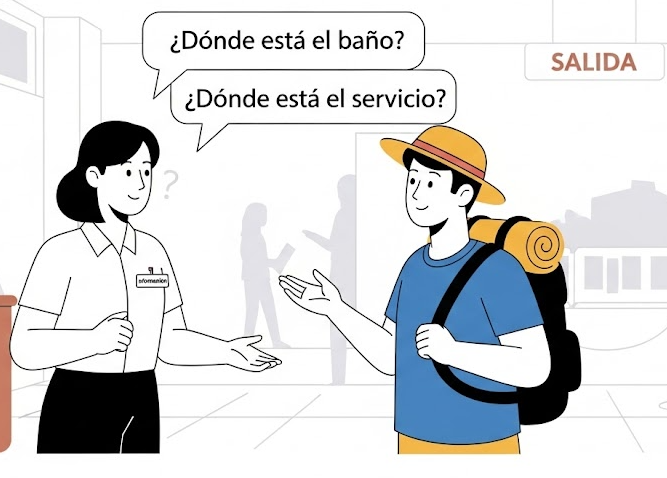
The phrase “Where is the bathroom?” in Spanish translates to several options, with the most common being “¿Dónde está el baño?” This phrase is a direct translation and is widely understood across Spanish-speaking countries. The sentence structure follows a typical question format, beginning with the interrogative adverb dónde (where), followed by the verb estar (to be), and finally the noun phrase el baño (the bathroom). The phrase serves the primary function of inquiring about the location of a restroom. The context usually involves situations where one is in a public place, a private residence, or any unfamiliar location where the restroom’s location isn’t immediately apparent.
Structural Breakdown
The Spanish phrase “¿Dónde está el baño?” can be broken down into its individual components to understand its grammatical structure:
- ¿Dónde?: This is the interrogative adverb, meaning “where.” It begins the question and indicates that you are seeking information about a location. The inverted question mark (¿) at the beginning is essential in Spanish to denote a question.
- está: This is the third-person singular form of the verb estar, which means “to be.” Estar is used to indicate temporary states, conditions, or locations. In this case, it indicates the location of the bathroom.
- el: This is the masculine singular definite article, meaning “the.” It precedes the noun baño, specifying that you are referring to a particular bathroom.
- baño: This is the noun, meaning “bathroom.” It is a masculine noun, hence the use of the masculine article el.
The word order in Spanish questions can sometimes be flexible, but in this case, starting with “¿Dónde?” is the most natural and common way to ask about a location. The entire phrase is a concise and direct way to inquire about the whereabouts of the bathroom.
Types and Categories
Formal vs. Informal Phrases
While “¿Dónde está el baño?” is generally acceptable in most situations, there are more formal and informal ways to ask. In formal settings, you might want to add a polite phrase like “por favor” (please) or use a more indirect question.
In informal settings, you can be more casual. Here’s a comparison:
- Formal: “¿Disculpe, dónde está el baño, por favor?” (Excuse me, where is the bathroom, please?)
- Neutral: “¿Dónde está el baño?” (Where is the bathroom?)
- Informal: “¿Oye, dónde queda el baño?” (Hey, where’s the bathroom?)
Regional Variations
Spanish has regional variations, and while “¿Dónde está el baño?” is universally understood, some regions might prefer different terms for “bathroom” or use slightly different phrasing. For example:
- México: “¿Dónde está el baño?” or “¿Dónde está el sanitario?”
- Spain: “¿Dónde está el baño?” or “¿Dónde está el aseo?”
- Argentina: “¿Dónde está el baño?” or “¿Dónde está el lavabo?”
It’s beneficial to be aware of these variations to better understand and communicate with people from different Spanish-speaking regions. Using the local term can also show respect and cultural sensitivity.
Examples
Basic Phrases
These are the most straightforward ways to ask “Where is the bathroom?” in Spanish. They are suitable for most situations and are easily understood.
The following table provides several examples of basic phrases, along with their English translations and notes on their usage.
| Spanish Phrase | English Translation | Notes |
|---|---|---|
| ¿Dónde está el baño? | Where is the bathroom? | Most common and widely understood. |
| ¿Dónde está el servicio? | Where is the restroom? | A slightly more formal alternative. |
| ¿Dónde está el sanitario? | Where is the toilet? | Common in Mexico and some other Latin American countries. |
| ¿Dónde está el aseo? | Where is the lavatory? | Common in Spain. |
| ¿Dónde queda el baño? | Where is the bathroom located? | Common in some Latin American countries. |
| ¿Me puede decir dónde está el baño? | Can you tell me where the bathroom is? | A polite and indirect way to ask. |
| ¿Sabes dónde está el baño? | Do you know where the bathroom is? | Another polite way to ask, especially if you’re unsure if the person knows. |
| ¿Hay un baño por aquí? | Is there a bathroom around here? | Useful if you’re not sure if there’s a bathroom nearby. |
| ¿Por favor, dónde está el baño? | Please, where is the bathroom? | Adding “por favor” makes the request more polite. |
| Disculpe, ¿dónde está el baño? | Excuse me, where is the bathroom? | Using “disculpe” is a polite way to get someone’s attention. |
| ¿Dónde se encuentra el baño? | Where is the bathroom located? (formal) | A more formal way of asking for the bathroom, suitable for professional settings. |
| ¿Me podría indicar dónde está el baño? | Could you indicate where the bathroom is? (very formal) | An extremely polite and formal way to ask, suitable for very respectful interactions. |
| ¿En qué dirección está el baño? | In which direction is the bathroom? | Helpful if you need general directions. |
| ¿Cuál es el baño más cercano? | Which is the nearest bathroom? | Useful in large spaces where you want to find the closest option. |
| ¿Hay algún baño cerca? | Is there any bathroom nearby? | Similar to “¿Hay un baño por aquí?” |
| ¿Dónde puedo encontrar un baño? | Where can I find a bathroom? | Another way to ask about locating a bathroom. |
| Perdón, ¿dónde está el baño? | Pardon me, where is the bathroom? | Similar to “Disculpe,” a polite way to get attention. |
| Oiga, ¿dónde está el baño? | Hey, where is the bathroom? | More informal, use with people you know or in casual settings. |
| Dime, ¿dónde está el baño? | Tell me, where is the bathroom? | Very informal, use with close friends or family. |
| ¿Usted sabe dónde está el baño? | Do you (formal) know where the bathroom is? | Using “usted” makes it a formal question. |
| ¿Podría decirme dónde se halla el baño? | Could you tell me where the bathroom is located? (very formal) | Extremely formal and polite. Use in highly respectful situations. |
| ¿Podría indicarme la ubicación del baño? | Could you indicate the location of the bathroom? (formal) | A formal and polite way to ask for the bathroom’s location. |
| ¿Cuál es el camino al baño? | Which is the way to the bathroom? | Asking for the route or path to the bathroom. |
| ¿Cómo llego al baño? | How do I get to the bathroom? | Asking for directions to reach the bathroom. |
| ¿Este es el camino correcto para el baño? | Is this the correct way to the bathroom? | Useful if you’re already heading in a direction and want confirmation. |
| ¿El baño está cerca de aquí? | Is the bathroom near here? | Asking if the bathroom is in close proximity. |
| ¿Dónde puedo lavarme las manos? | Where can I wash my hands? | Indirectly asking for the bathroom, useful if you only need to wash your hands. |
Phrases with Politeness
Adding polite phrases to your question can make a significant difference, especially when interacting with strangers or in formal settings. These phrases demonstrate respect and consideration.
The table below illustrates how to incorporate politeness into your request for the bathroom’s location.
| Spanish Phrase | English Translation | Notes |
|---|---|---|
| ¿Disculpe, dónde está el baño? | Excuse me, where is the bathroom? | “Disculpe” is a polite way to get someone’s attention. |
| ¿Perdón, dónde está el baño? | Pardon me, where is the bathroom? | Similar to “Disculpe,” used to apologize for interrupting. |
| ¿Por favor, dónde está el baño? | Please, where is the bathroom? | Adding “por favor” makes the request more courteous. |
| ¿Me puede decir dónde está el baño, por favor? | Can you tell me where the bathroom is, please? | A very polite and indirect way to ask. |
| ¿Podría indicarme dónde está el baño? | Could you indicate where the bathroom is? | A formal and respectful way to ask for directions. |
| Disculpe, ¿me podría decir dónde está el baño? | Excuse me, could you tell me where the bathroom is? | Combining “Disculpe” and “me podría decir” for extra politeness. |
| Perdone, ¿sabe dónde está el baño? | Pardon me, do you know where the bathroom is? | A polite way to ask if someone knows the location. |
| ¿Sería tan amable de indicarme dónde está el baño? | Would you be so kind as to indicate where the bathroom is? | A very formal and polite request. |
| Con permiso, ¿dónde está el baño? | With your permission, where is the bathroom? | A polite way to interrupt someone to ask a question. |
| ¿Me haría el favor de decirme dónde está el baño? | Would you do me the favor of telling me where the bathroom is? | A formal and polite way to ask for a favor. |
| ¿Podría usted decirme dónde está el baño? | Could you (formal) tell me where the bathroom is? | Using “usted” makes the request formal. |
| ¿Le importaría decirme dónde está el baño? | Would you mind telling me where the bathroom is? | A polite and indirect way to ask. |
| ¿Tendría la amabilidad de indicarme dónde está el baño? | Would you have the kindness to indicate where the bathroom is? | A very formal and polite request. |
| ¿Podría mostrarme dónde está el baño? | Could you show me where the bathroom is? | Useful if you need someone to physically show you the way. |
| ¿Me puede ayudar a encontrar el baño? | Can you help me find the bathroom? | Asking for assistance in finding the bathroom. |
| ¿Me podría dar indicaciones para llegar al baño? | Could you give me directions to get to the bathroom? | Asking for detailed directions. |
| ¿Hay alguien que sepa dónde está el baño? | Is there anyone who knows where the bathroom is? | Useful if you’re in a group and need to find someone who knows. |
| ¿Podría preguntarle a alguien dónde está el baño? | Could you ask someone where the bathroom is? | Asking someone to inquire on your behalf. |
| ¿Le molestaría indicarme dónde está el baño? | Would it bother you to indicate where the bathroom is? | A very polite and indirect way to ask. |
| ¿Sería posible que me indicara dónde está el baño? | Would it be possible for you to indicate where the bathroom is? | A formal and polite request. |
| ¿Disculpe las molestias, pero podría indicarme dónde está el baño? | Excuse the inconvenience, but could you indicate where the bathroom is? | Extremely polite, acknowledging you might be causing a slight disturbance. |
| ¿Podría, por favor, señalarme la dirección del baño más cercano? | Could you, please, point me in the direction of the nearest bathroom? | Formal and polite, specifying you want the nearest bathroom. |
| ¿Me permitiría preguntarle dónde se encuentra el baño? | Would you allow me to ask you where the bathroom is located? | Highly formal and respectful way to inquire. |
| ¿Tendría la gentileza de informarme sobre la ubicación del baño? | Would you have the kindness to inform me about the location of the bathroom? | Extremely formal, suitable for very respectful interactions. |
| Si no es mucha molestia, ¿podría decirme dónde está el baño? | If it’s not too much trouble, could you tell me where the bathroom is? | Polite and considerate, showing concern for the other person’s time. |
Asking for Directions
Sometimes, simply knowing the location isn’t enough; you might need directions to get there. These phrases help you ask for specific instructions on how to reach the bathroom.
This table provides examples of how to ask for directions to the bathroom in Spanish.
| Spanish Phrase | English Translation | Notes |
|---|---|---|
| ¿Cómo llego al baño? | How do I get to the bathroom? | A direct way to ask for directions. |
| ¿Me puede dar indicaciones para el baño? | Can you give me directions to the bathroom? | Asking for specific instructions. |
| ¿Cuál es el camino al baño? | Which is the way to the bathroom? | Asking for the route to the bathroom. |
| ¿Podría mostrarme el camino al baño? | Could you show me the way to the bathroom? | Asking someone to physically show you the way. |
| ¿Está lejos el baño? | Is the bathroom far? | Asking about the distance to the bathroom. |
| ¿Está cerca de aquí el baño? | Is the bathroom near here? | Asking if the bathroom is close by. |
| ¿Qué dirección debo tomar para el baño? | Which direction should I take for the bathroom? | Asking for the direction to go. |
| ¿Por dónde se va al baño? | Which way do you go to the bathroom? | Another way to ask for directions. |
| ¿Me puede guiar al baño? | Can you guide me to the bathroom? | Asking someone to lead you to the bathroom. |
| ¿Hay señales para el baño? | Are there signs for the bathroom? | Asking if there are signs indicating the bathroom’s location. |
| ¿Dónde está la señalización para el baño? | Where is the signage for the bathroom? | Asking specifically about the location of the signs. |
| ¿Tengo que subir o bajar para ir al baño? | Do I have to go up or down to go to the bathroom? | Useful in buildings with multiple floors. |
| ¿Está a la derecha o a la izquierda el baño? | Is the bathroom to the right or to the left? | Asking for directional guidance. |
| ¿Hay que caminar mucho para llegar al baño? | Do you have to walk far to get to the bathroom? | Asking about the walking distance. |
| ¿El baño está en este piso? | Is the bathroom on this floor? | Useful in multi-story buildings. |
| ¿Cómo se dice para ir al baño en español? | How do you say “to go to the bathroom” in Spanish? | Useful if you want to learn additional phrases. |
| ¿Hay alguna indicación especial para llegar al baño? | Are there any special directions to get to the bathroom? | Asking for any unique or specific instructions. |
| ¿Me puede dar un punto de referencia para el baño? | Can you give me a landmark for the bathroom? | Asking for a reference point to help locate the bathroom. |
| ¿El baño está cerca de la entrada o la salida? | Is the bathroom near the entrance or the exit? | Useful in large venues. |
| ¿Podría describir el camino más fácil para llegar al baño? | Could you describe the easiest way to get to the bathroom? | Asking for the simplest route, useful for complex layouts. |
| ¿Hay algún ascensor cerca del baño? | Is there an elevator near the bathroom? | Important for those with mobility issues. |
| ¿La ruta al baño está bien señalizada? | Is the route to the bathroom well signposted? | Asking about the clarity of the signage. |
| ¿Qué tan lejos está el baño desde aquí caminando? | How far is the bathroom from here by walking? | Seeking an estimate of the walking distance. |
| ¿Hay alguna escalera mecánica cerca del baño? | Is there an escalator near the bathroom? | Useful in large shopping centers or airports. |
Usage Rules
Verb Conjugation of Estar
The verb estar is crucial in the phrase “¿Dónde está el baño?” Understanding its conjugation is essential for constructing similar sentences. Here’s the present tense conjugation of estar:
- Yo estoy (I am)
- Tú estás (You are – informal)
- Él/Ella/Usted está (He/She/You are – formal)
- Nosotros/Nosotras estamos (We are)
- Vosotros/Vosotras estáis (You are – informal, plural – Spain)
- Ellos/Ellas/Ustedes están (They/You are – plural)
In the phrase “¿Dónde está el baño?”, we use the third-person singular form “está” because we are referring to the location of “el baño” (the bathroom), which is a singular entity. Using the correct form of the verb is extremely important for grammatical accuracy.
Article Agreement
In Spanish, nouns have gender (masculine or feminine), and articles (like “el” or “la”) must agree with the gender of the noun. “Baño” is a masculine noun, so we use the masculine definite article “el.” If we were asking about the location of “la cocina” (the kitchen), which is a feminine noun, we would say “¿Dónde está la cocina?”
Understanding article agreement is essential for constructing grammatically correct sentences in Spanish. Always ensure that the article matches the gender and number of the noun it precedes.
Politeness Levels
As mentioned earlier, politeness is crucial in Spanish-speaking cultures. Using formal pronouns like “usted” and polite phrases like “por favor” can significantly enhance your interactions.
When asking someone you don’t know for directions, it’s always best to err on the side of politeness. A simple “Disculpe” or “Perdón” before asking your question can make a big difference.
In more informal settings, such as with friends or family, you can use more casual language. However, when in doubt, it’s always better to be polite and respectful.
Common Mistakes
Here are some common mistakes that learners make when asking for the bathroom in Spanish, along with corrections:
| Incorrect | Correct | Explanation |
|---|---|---|
| ¿Dónde es el baño? | ¿Dónde está el baño? | “Es” is used for permanent characteristics, while “está” is used for location. |
| ¿Dónde el baño está? | ¿Dónde está el baño? | The verb “estar” usually precedes the noun in questions. |
| ¿Dónde está la baño? | ¿Dónde está el baño? | “Baño” is a masculine noun, so it requires the masculine article “el.” |
| ¿Dónde está un baño? | ¿Dónde está el baño? | Using “un” (a) implies any bathroom, while “el” (the) implies a specific one, which is usually what you mean when asking for directions. |
| ¿Dónde estar el baño? | ¿Dónde está el baño? | Using the infinitive form “estar” is incorrect; you need to conjugate the verb. |
| ¿Dónde está el bano? | ¿Dónde está el baño? | Correct spelling is crucial; the word is “baño” with a tilde. |
| ¿Dónde esta el baño? | ¿Dónde está el baño? | Proper accentuation is important. The verb is “está”, not “esta”. |
Practice Exercises
Test your understanding with these practice exercises. Translate the following sentences into Spanish using the appropriate phrases and grammar.
| # | English Sentence | Your Answer | Correct Answer |
|---|---|---|---|
| 1 | Where is the bathroom? | ¿Dónde está el baño? | |
| 2 | Excuse me, where is the bathroom, please? | Disculpe, ¿dónde está el baño, por favor? | |
| 3 | Can you tell me where the restroom is? | ¿Me puede decir dónde está el servicio? | |
| 4 | Do you know where the toilet is? | ¿Sabes dónde está el sanitario? | |
| 5 | How do I get to the bathroom? | ¿Cómo llego al baño? | |
| 6 | Is there a bathroom around here? | ¿Hay un baño por aquí? | |
| 7 | Which way to the bathroom? | ¿Por dónde se va al baño? | |
| 8 | Where can I find a bathroom? | ¿Dónde puedo encontrar un baño? | |
| 9 | Could you show me the way to the bathroom? | ¿Podría mostrarme el camino al baño? | |
| 10 | Is the bathroom far from here? | ¿Está lejos de aquí el baño? | |
| 11 | Pardon me, where is the lavatory? | Perdón, ¿dónde está el aseo? | |
| 12 | Can you give me directions to the bathroom, please? | ¿Me puede dar indicaciones para el baño, por favor? |
Advanced Topics
Euphemisms for “Bathroom”
In some situations, using euphemisms for “bathroom” might be more appropriate. Here are a few examples:
- Los servicios: The services (a common and polite term)
- El tocador: The powder room (more common for women’s restrooms)
- Un lugar para refrescarse: A place to freshen up
- La sala de descanso: The rest room
These euphemisms can be useful in formal settings or when you want to be more discreet.
Idiomatic Expressions
While there aren’t many idiomatic expressions directly related to asking for the bathroom, it’s helpful to understand related phrases. For example, if someone says “Voy al baño,” they mean “I’m going to the bathroom.” Understanding these phrases can help you better navigate everyday conversations.
FAQ
- Is “¿Dónde está el baño?” always appropriate?Yes, “¿Dónde está el baño?” is generally appropriate in most situations. However, consider the context. In very formal settings, using a more polite phrase like “¿Disculpe, dónde está el baño, por favor?” might be better. With friends, you can be more casual.
- What’s the difference between “baño,” “servicio,” and “aseo”?“Baño” is the most common term for “bathroom” and is widely understood. “Servicio” is a slightly more formal alternative, meaning “restroom.” “Aseo” is commonly used in Spain and means “lavatory.”
- How do I ask for the bathroom if I only speak a little Spanish?Even if you only know a few words, “¿Dónde… el baño?” while pointing can be effective. Adding “por favor” will also be appreciated.
- What if I’m in a restaurant and need to use the bathroom?In a restaurant, you can say “¿Disculpe, dónde está el baño, por favor?” or “¿Me permite usar el baño?” (May I use the bathroom?).
- How do I understand directions given in Spanish?Listen for key words like “derecha” (right), “izquierda” (left), “recto” (straight), “al final de” (at the end of), and “cerca de” (near). If you don’t understand, ask them to repeat slowly or show you.
- Is it rude to ask where the bathroom is immediately after meeting someone?It’s generally not considered rude, especially if you say “Disculpe” or “Perdón” first. People understand that needing to use the bathroom is a common necessity.
- What should I do if I can’t understand the directions I’m given?You can say “Lo siento, no entiendo. ¿Puede repetir más despacio, por favor?” (I’m sorry, I don’t understand. Can you repeat more slowly, please?) or ask them to write it down or show you on a map.
- Are there any cultural differences I should be aware of when asking for the bathroom?In some cultures, it’s considered more polite to use indirect language. However, “¿Dónde está el baño?” is generally acceptable across Spanish-speaking countries. Just remember to be polite and respectful in your tone and demeanor.
Conclusion
Knowing how to ask “Where is the bathroom?” in Spanish is an essential skill for anyone traveling or living in a Spanish-speaking country. This article has provided you with various phrases, grammatical explanations, and cultural considerations to confidently navigate this common situation.
Remember to consider the context and choose the appropriate level of formality. Practice the phrases and usage rules to become more comfortable and fluent.
With a little preparation, you’ll be able to find the *baño* with ease and grace.