Understanding antonyms, or words with opposite meanings, is crucial for enhancing vocabulary, improving communication, and mastering the nuances of the English language. Antonyms not only provide contrasting perspectives but also deepen comprehension of individual words by highlighting their specific connotations.
This article offers a comprehensive exploration of antonyms, covering their definition, types, usage rules, common mistakes, and practical exercises. Whether you’re a student, a language enthusiast, or simply seeking to refine your linguistic skills, this guide will equip you with the knowledge and tools necessary to effectively use and understand antonyms.
Table of Contents
- Definition of Antonyms
- Structural Breakdown of Antonym Relationships
- Types of Antonyms
- Examples of Antonyms
- Usage Rules for Antonyms
- Common Mistakes with Antonyms
- Practice Exercises
- Advanced Topics in Antonymy
- Frequently Asked Questions
- Conclusion
Definition of Antonyms
An antonym is a word that has the opposite meaning of another word. Understanding antonyms is essential for enriching vocabulary and improving one’s ability to express contrasting ideas. Antonyms help to clarify the meaning of words by defining what they are not. They play a significant role in writing, speech, and overall language comprehension, allowing for more precise and nuanced communication. The study of antonyms falls under the broader field of semantics, which explores the meaning of words and their relationships to each other.
Antonyms are classified based on the nature of their opposition. They can be complementary, gradable, relational, or directional, each type exhibiting a unique kind of contrasting relationship.
The function of antonyms is to provide a linguistic tool for expressing contrast, negation, and inverse relationships. They are used in various contexts, from everyday conversation to formal writing, and are crucial for effective communication and rhetorical expression.
Recognizing and utilizing antonyms effectively demonstrates a strong command of the English language.
Structural Breakdown of Antonym Relationships
The relationship between antonyms isn’t always straightforward. It often depends on the specific context and the nature of the words involved.
Understanding the structural breakdown of these relationships helps in correctly identifying and using antonyms. Here are some key aspects to consider:
- Root Words: Many antonyms are formed by adding prefixes like un-, in-, dis-, or non- to a root word. For example, happy becomes unhappy.
- Contextual Dependence: The antonym of a word can change depending on the context. For instance, the antonym of hot could be cold in the context of temperature, but unpopular in the context of a trend.
- Degrees of Opposition: Antonyms can represent absolute opposition (complementary antonyms) or varying degrees of opposition (gradable antonyms).
- Reversibility: Some antonyms imply a reversal of action or state. For example, enter and exit represent opposite directions of movement.
Analyzing these structural elements allows for a deeper understanding of how antonyms function within the English language and how they contribute to precise communication. The relationship between antonyms often reflects underlying semantic structures and logical oppositions that are fundamental to human cognition.
Types of Antonyms
Antonyms are not all created equal. They come in various types, each with its own characteristics and implications.
Recognizing these different types is essential for using antonyms correctly and effectively.
Complementary Antonyms
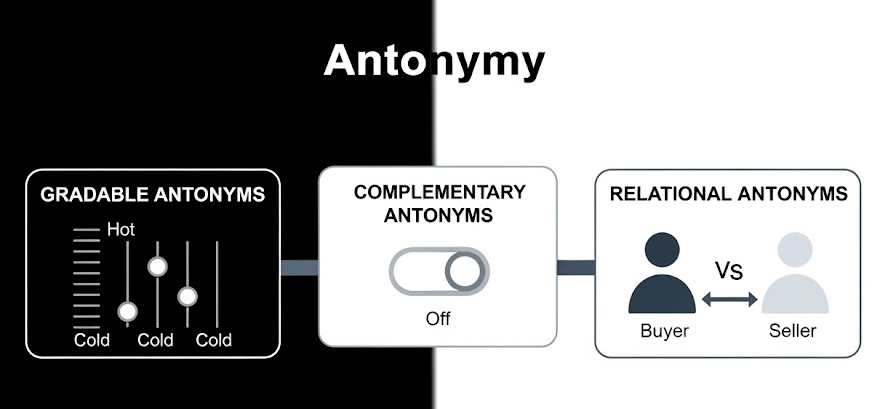
Complementary antonyms are pairs of words where there is no middle ground. One word implies the absence of the other. If one is true, the other must be false. Examples include alive and dead, on and off, or married and single. There’s no spectrum or degree; you are either one or the other.
Gradable Antonyms
Gradable antonyms represent opposite ends of a spectrum. There are degrees of difference between them. Examples include hot and cold, big and small, or happy and sad. These antonyms allow for comparative and superlative forms (e.g., hotter, biggest, saddest) and can be modified by adverbs like very or slightly.
Relational Antonyms
Relational antonyms describe a relationship from opposite perspectives. One word cannot exist without the other. Examples include teacher and student, buyer and seller, or doctor and patient. They represent roles or actions that are inherently linked but opposite in direction or perspective.
Directional Antonyms
Directional antonyms indicate opposite directions or movements. They often involve verbs of motion or spatial prepositions. Examples include up and down, forward and backward, or enter and exit. These antonyms are essential for describing spatial relationships and movement.
Reversional Antonyms
Reversional antonyms imply a reversal of an action or state. One word undoes the action of the other. Examples include open and close, tie and untie, or fill and empty. These antonyms often involve actions that can be reversed to return to the original state.
Multiple Antonyms
Some words can have multiple antonyms depending on the context. For example, the word good can have antonyms like bad, evil, or poor, depending on the specific meaning intended. Understanding the nuances of these multiple antonyms is crucial for precise communication.
Examples of Antonyms
To solidify your understanding, let’s explore various examples of antonyms categorized by type. These examples will illustrate how antonyms are used in different contexts and how they contribute to the richness of the English language.
The following tables provide extensive examples of each type of antonym discussed above. Each table contains at least 20 examples, offering a comprehensive overview of antonym usage.
Complementary Antonyms Examples
Complementary antonyms represent absolute opposites. There is no middle ground between these pairs.
| Word | Antonym |
|---|---|
| Alive | Dead |
| On | Off |
| True | False |
| Married | Single |
| Present | Absent |
| Pass | Fail |
| Guilty | Innocent |
| Male | Female |
| Even | Odd |
| Front | Back |
| Push | Pull |
| Start | Stop |
| Open | Shut |
| Begin | End |
| Day | Night |
| Light | Dark |
| In | Out |
| Up | Down |
| Yes | No |
| Exist | Not Exist |
| Full | Empty |
| Asleep | Awake |
| Accept | Reject |
Gradable Antonyms Examples
Gradable antonyms exist on a spectrum. There are varying degrees between the two opposites.
| Word | Antonym |
|---|---|
| Hot | Cold |
| Big | Small |
| Happy | Sad |
| Good | Bad |
| Fast | Slow |
| High | Low |
| Long | Short |
| Easy | Difficult |
| Rich | Poor |
| Strong | Weak |
| Old | Young |
| Beautiful | Ugly |
| Clean | Dirty |
| Bright | Dim |
| Loud | Quiet |
| Heavy | Light |
| Wide | Narrow |
| Thick | Thin |
| Deep | Shallow |
| Smart | Dumb |
| Generous | Stingy |
| Brave | Cowardly |
| Interesting | Boring |
Relational Antonyms Examples
Relational antonyms describe a relationship from opposite perspectives. One cannot exist without the other.
| Word | Antonym |
|---|---|
| Teacher | Student |
| Buyer | Seller |
| Doctor | Patient |
| Parent | Child |
| Husband | Wife |
| Employer | Employee |
| Landlord | Tenant |
| Predator | Prey |
| Borrower | Lender |
| Winner | Loser |
| Speaker | Listener |
| Questioner | Answerer |
| Giver | Receiver |
| Commander | Subordinate |
| Author | Reader |
| Prosecution | Defense |
| Controller | Controlled |
| Leader | Follower |
| Owner | Renter |
| Source | Destination |
| Expert | Novice |
| Host | Guest |
| Benefactor | Beneficiary |
Directional Antonyms Examples
Directional antonyms indicate opposite directions or movements.
| Word | Antonym |
|---|---|
| Up | Down |
| Forward | Backward |
| Enter | Exit |
| Ascend | Descend |
| Above | Below |
| North | South |
| East | West |
| Inward | Outward |
| Over | Under |
| Advance | Retreat |
| Rise | Fall |
| Climb | Descend |
| Top | Bottom |
| Surface | Submerge |
| Arrive | Depart |
| Lead | Follow |
| Begin | Conclude |
| Extend | Contract |
| Attract | Repel |
| Inflate | Deflate |
| Emerge | Submerge |
| Project | Withdraw |
| Expand | Shrink |
Reversional Antonyms Examples
Reversional antonyms imply a reversal of an action or state.
| Word | Antonym |
|---|---|
| Open | Close |
| Tie | Untie |
| Fill | Empty |
| Lock | Unlock |
| Dress | Undress |
| Pack | Unpack |
| Assemble | Disassemble |
| Connect | Disconnect |
| Ignite | Extinguish |
| Build | Demolish |
| Wrap | Unwrap |
| Fasten | Unfasten |
| Engage | Disengage |
| Start | Stop |
| Turn On | Turn Off |
| Install | Uninstall |
| Load | Unload |
| Cover | Uncover |
| Accept | Reject |
| Approve | Disapprove |
| Include | Exclude |
| Encrypt | Decrypt |
| Activate | Deactivate |
Usage Rules for Antonyms
Using antonyms effectively requires understanding certain usage rules. These rules ensure that antonyms are used correctly and appropriately in various contexts.
- Context Matters: Always consider the context when choosing an antonym. A word can have different antonyms depending on the situation.
- Type Consistency: Ensure that you are using the correct type of antonym for the intended meaning. Using a gradable antonym when a complementary antonym is needed can lead to confusion.
- Prefix Usage: Be mindful of prefixes like un-, in-, dis-, and non-. While they often create antonyms, not all words can be negated in this way. For example, gruntled is not a commonly used word, so ungrunteld would sound awkward.
- Formal vs. Informal: Some antonyms are more appropriate for formal writing, while others are better suited for informal conversation. Choose antonyms that match the tone of your writing or speech.
- Avoid Redundancy: Be careful not to use antonyms in a way that creates redundancy. For example, saying “hot and cold” is acceptable, but saying “ascend up” is redundant because ascend already implies upward movement.
By adhering to these usage rules, you can ensure that your use of antonyms is both accurate and effective, enhancing the clarity and impact of your communication.
Common Mistakes with Antonyms
Even experienced language users sometimes make mistakes when using antonyms. Being aware of these common errors can help you avoid them and improve your overall language proficiency.
Here are some frequent mistakes and how to correct them:
| Incorrect | Correct | Explanation |
|---|---|---|
| The opposite of “always” is “sometimes.” | The opposite of “always” is “never.” | “Sometimes” implies occasional occurrence, while “never” implies complete absence. |
| The opposite of “happy” is “angry.” | The opposite of “happy” is “sad.” | “Angry” is a specific emotion, while “sad” is a more general opposite of “happy.” |
| The opposite of “expensive” is “free.” | The opposite of “expensive” is “cheap.” | “Free” means without cost, while “cheap” means low in price. |
| The opposite of “increase” is “decrease down.” | The opposite of “increase” is “decrease.” | “Decrease down” is redundant; “decrease” already implies downward movement. |
| The opposite of “import” is “export out.” | The opposite of “import” is “export.” | “Export out” is redundant; “export” already implies movement out. |
| The opposite of “alive” is “injured”. | The opposite of “alive” is “dead”. | “Injured” does not imply the absence of life, whereas “dead” does. |
| The opposite of “open” is “slightly closed.” | The opposite of “open” is “closed.” | In a complementary antonym relationship, “closed” suggests a complete opposite. |
| The opposite of “teacher” is “school”. | The opposite of “teacher” is “student”. | “Student” is a relational antonym to “teacher,” representing the opposite side of the relationship. |
| The opposite of “on” is “maybe off”. | The opposite of “on” is “off”. | “On” and “Off” are complementary antonyms with no middle ground. |
| The opposite of “guilty” is “kind”. | The opposite of “guilty” is “innocent”. | “Guilty” and “innocent” are direct opposites in the legal context. |
Practice Exercises
Test your knowledge of antonyms with these practice exercises. Each exercise includes multiple questions to challenge your understanding.
Answers are provided at the end of each exercise.
Exercise 1: Identifying Antonyms
Choose the best antonym for each word.
| Question | Options | Answer |
|---|---|---|
| 1. What is the antonym of “generous”? | (a) Kind (b) Stingy (c) Happy (d) Brave | (b) Stingy |
| 2. What is the antonym of “arrive”? | (a) Stay (b) Depart (c) Visit (d) Meet | (b) Depart |
| 3. What is the antonym of “increase”? | (a) Grow (b) Expand (c) Decrease (d) Add | (c) Decrease |
| 4. What is the antonym of “bright”? | (a) Shiny (b) Dark (c) Colorful (d) Clear | (b) Dark |
| 5. What is the antonym of “easy”? | (a) Simple (b) Difficult (c) Light (d) Quick | (b) Difficult |
| 6. What is the antonym of “include”? | (a) Add (b) Contain (c) Exclude (d) Keep | (c) Exclude |
| 7. What is the antonym of “fast”? | (a) Quick (b) Slow (c) Rapid (d) Swift | (b) Slow |
| 8. What is the antonym of “tie”? | (a) Fasten (b) Loosen (c) Untie (d) Connect | (c) Untie |
| 9. What is the antonym of “lend”? | (a) Give (b) Borrow (c) Share (d) Provide | (b) Borrow |
| 10. What is the antonym of “push”? | (a) Shove (b) Pull (c) Move (d) Lift | (b) Pull |
Exercise 2: Identifying Type of Antonym
Identify the type of antonym in each pair. (Complementary, Gradable, Relational, Directional, Reversional)
| Word Pair | Type of Antonym |
|---|---|
| Alive / Dead | Complementary |
| Hot / Cold | Gradable |
| Teacher / Student | Relational |
| Up / Down | Directional |
| Open / Close | Reversional |
| Happy / Sad | Gradable |
| Enter / Exit | Directional |
| Employer / Employee | Relational |
| True / False | Complementary |
| Tie / Untie | Reversional |
Exercise 3: Using Antonyms in Sentences
Fill in the blank with the best antonym for the word in parentheses.
| Question | Answer |
|---|---|
| 1. The weather today is not hot; it is quite (cold). | cold |
| 2. Instead of agreeing, she decided to (disagree). | disagree |
| 3. He didn’t pass the test, so he must have (failed). | failed |
| 4. Please close the door instead of leaving it (open). | open |
| 5. The glass was not full; it was completely (empty). | empty |
| 6. The question was easy, not (difficult). | difficult |
| 7. Instead of advancing, the army began to (retreat). | retreat |
| 8. The movie was interesting, not (boring). | boring |
| 9. He is a lender, not a (borrower). | borrower |
| 10. The answer was true, not (false). | false |
Advanced Topics in Antonymy
For advanced learners, the study of antonyms extends beyond basic definitions and classifications. It delves into the complexities of semantic relationships and the nuances of language use.
Here are some advanced topics to explore:
- Hyponymy and Hypernymy: Understand how antonyms relate to broader and narrower terms within a semantic hierarchy.
- Polysemy and Antonymy: Explore how words with multiple meanings can have different antonyms for each meaning.
- Antonymy in Literature: Analyze how authors use antonyms to create contrast, highlight themes, and develop characters.
- Cross-linguistic Antonymy: Compare how antonyms are expressed in different languages and cultures.
- Computational Linguistics: Investigate how antonyms are used in natural language processing and machine learning.
These advanced topics provide a deeper understanding of the role of antonyms in language and cognition, offering new perspectives and insights for advanced learners.
Frequently Asked Questions
Here are some frequently asked questions about antonyms, along with detailed answers to clarify common points of confusion.
- What is the difference between an antonym and a synonym?An antonym is a word with the opposite meaning of another word, while a synonym is a word with a similar meaning. Antonyms are used to express contrast, while synonyms are used to provide alternative ways of saying the same thing.
- Can a word have more than one antonym?Yes, a word can have multiple antonyms depending on the context and the specific meaning intended. For example, the word “good” can have antonyms like “bad,” “evil,” or “poor,” depending on the situation.
- How can I improve my knowledge of antonyms?You can improve your knowledge of antonyms by reading widely, using a thesaurus, practicing with exercises, and paying attention to how antonyms are used in different contexts. Regular practice and exposure to new words will help you expand your vocabulary and deepen your understanding of antonyms.
- Are antonyms always exact opposites?Not always. While some antonyms represent absolute opposites (complementary antonyms), others exist on a spectrum (gradable antonyms). The degree of opposition can vary depending on the type of antonym and the context in which it is used.
- How do prefixes like “un-” and “dis-” affect antonyms?Prefixes like “un-“, “in-“, “dis-“, and “non-” are often used to create antonyms by negating the meaning of the root word. However, not all words can be negated in this way, and some negated words may sound awkward or unnatural.
- What are relational antonyms, and how are they different from other types?Relational antonyms describe a relationship from opposite perspectives. One word cannot exist without the other. They are different from other types of antonyms because they represent roles or actions that are inherently linked but opposite in direction or perspective.
- How important are antonyms in writing and communication?Antonyms are crucial for effective writing and communication. They allow you to express contrast, provide balance, and clarify the meaning of words by defining what they are not. Using antonyms effectively can enhance the clarity, precision, and impact of your message.
- Are there any online resources that can help me learn antonyms?Yes, there are many online resources that can help you learn antonyms, including online dictionaries, thesauruses, vocabulary-building websites, and language learning apps. These resources offer a variety of tools and exercises to help you expand your vocabulary and improve your understanding of antonyms.
Conclusion
Understanding antonyms is essential for mastering the English language. This comprehensive guide has explored the definition, types, usage rules, common mistakes, and practical exercises related to antonyms.
By recognizing the different categories of antonyms—complementary, gradable, relational, directional, and reversional—learners can enhance their vocabulary and improve their ability to express contrasting ideas effectively. Through consistent practice and attention to context, anyone can refine their understanding and usage of antonyms, leading to more precise and nuanced communication.
Remember to consider the context, choose the appropriate type of antonym, and be mindful of prefixes and potential redundancies. By avoiding common mistakes and continuously expanding your vocabulary, you can unlock the full potential of antonyms and elevate your language skills.
Keep practicing, keep exploring, and embrace the power of opposites to enrich your communication and deepen your understanding of the English language.