Understanding antonyms, or words with opposite meanings, is crucial for enhancing your vocabulary and improving your communication skills. Antonyms allow you to express contrasting ideas, add depth to your writing, and comprehend nuanced meanings in both spoken and written language.
This article provides a comprehensive guide to antonyms, covering their definition, types, usage rules, common mistakes, and practical exercises. Whether you’re a student, a writer, or simply someone looking to improve their English proficiency, this guide will equip you with the knowledge and skills to confidently use antonyms in your everyday communication.
Table of Contents
- Definition of Antonyms
- Structural Breakdown of Antonym Pairs
- Types of Antonyms
- Examples of Antonyms
- Usage Rules for Antonyms
- Common Mistakes with Antonyms
- Practice Exercises
- Advanced Topics in Antonym Usage
- Frequently Asked Questions (FAQs)
- Conclusion
Definition of Antonyms
An antonym is a word that has the opposite meaning of another word. Antonyms are essential for expressing contrasting ideas, creating balance in writing, and understanding the full spectrum of meaning within the English language. They are classified based on the nature of their opposition and function to provide clarity and precision in communication. Understanding antonyms is not just about knowing a list of opposites; it’s about grasping the nuances of how words relate to each other and how they can be used to convey different perspectives.
Antonyms play a vital role in various contexts. In literature, they can create dramatic tension or highlight character differences.
In everyday conversation, antonyms help us express opinions and make comparisons. In academic writing, they allow for precise and nuanced arguments.
By mastering antonyms, you can significantly improve your ability to communicate effectively and persuasively.
Structural Breakdown of Antonym Pairs
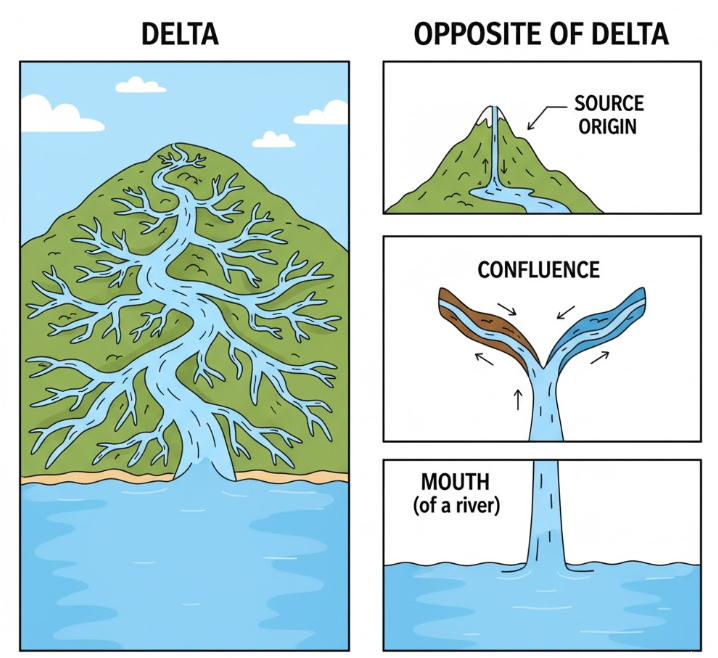
The structure of antonym pairs can vary significantly depending on the words involved. Some antonyms are formed by adding prefixes like “un-,” “in-,” “dis-,” or “non-” to a base word.
For example, “happy” becomes “unhappy,” and “visible” becomes “invisible.” Other antonyms are completely different words with unrelated roots, such as “good” and “bad,” or “hot” and “cold.” The structural relationship between antonyms can provide clues to their meanings and help you remember them more easily. Analyzing the structure can also help you predict the antonym of a new word you encounter.
Understanding how antonyms are structurally related can also aid in vocabulary building. By recognizing common prefixes and suffixes that indicate negation or opposition, you can expand your knowledge of antonyms and improve your ability to infer the meaning of unfamiliar words.
For instance, knowing that “dis-” often indicates the opposite of something can help you understand the meaning of words like “disagree,” “disappear,” and “disapprove.”
Types of Antonyms
Antonyms are not all created equal. They come in different types, each with its own specific characteristics.
Understanding these types can help you use antonyms more accurately and effectively.
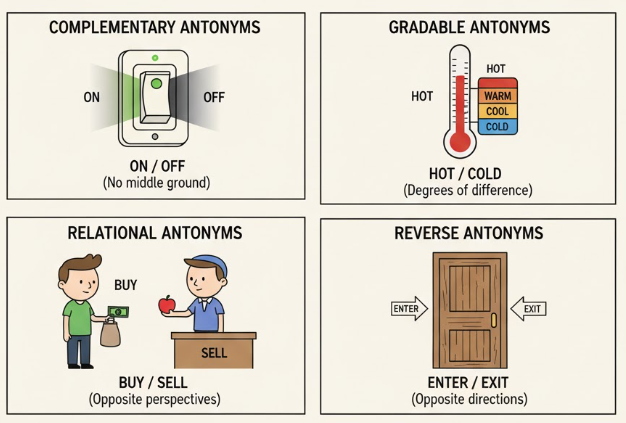
Complementary Antonyms
Complementary antonyms are pairs where the existence of one word implies the non-existence of the other. There is no middle ground between them. For example, “alive” and “dead” are complementary antonyms. Something is either alive or dead; it cannot be both or neither. Other examples include “on” and “off,” “true” and “false,” and “pass” and “fail.” Understanding complementary antonyms is crucial for clear and unambiguous communication.
Gradable Antonyms
Gradable antonyms represent opposite ends of a spectrum. There are degrees of difference between them. For example, “hot” and “cold” are gradable antonyms. Something can be warm, cool, or lukewarm, which fall between hot and cold. Other examples include “big” and “small,” “happy” and “sad,” and “fast” and “slow.” Gradable antonyms often allow for comparative and superlative forms (e.g., hotter, hottest).
Relational Antonyms
Relational antonyms describe a relationship from opposite perspectives. One word implies the other. For example, “buy” and “sell” are relational antonyms. You cannot buy something unless someone else sells it. Other examples include “teacher” and “student,” “parent” and “child,” and “doctor” and “patient.” Relational antonyms highlight the interconnectedness of certain concepts.
Reverse Antonyms
Reverse antonyms indicate movement in opposite directions or processes that undo each other. For example, “enter” and “exit” are reverse antonyms. One involves going in, while the other involves going out. Other examples include “increase” and “decrease,” “ascend” and “descend,” and “inflate” and “deflate.” These antonyms are often used to describe physical actions or changes in state.
Conversational Antonyms
Conversational antonyms depend on the context of the conversation to determine their opposite meaning. These are less direct and more nuanced. For instance, saying “That’s a fine idea” can be sarcastically used to mean “That’s a terrible idea.” The true antonym is determined by tone and situation. Other examples include using “sure” sarcastically to mean “no” or “certainly” to express doubt.
Examples of Antonyms
To solidify your understanding of antonyms, let’s explore a comprehensive list of examples organized by category.
The following table provides examples of complementary antonyms. These pairs have no middle ground; one or the other must be true.
| Word | Antonym |
|---|---|
| Alive | Dead |
| On | Off |
| True | False |
| Pass | Fail |
| Present | Absent |
| Guilty | Innocent |
| Single | Married |
| Open | Closed |
| Start | End |
| Male | Female |
| Push | Pull |
| In | Out |
| Up | Down |
| Light | Dark |
| Empty | Full |
| Accept | Reject |
| Arrive | Depart |
| Begin | Cease |
| Build | Destroy |
| Buy | Sell |
The next table illustrates gradable antonyms, which exist on a spectrum and have varying degrees of difference.
| Word | Antonym |
|---|---|
| Hot | Cold |
| Big | Small |
| Happy | Sad |
| Fast | Slow |
| Good | Bad |
| Tall | Short |
| Heavy | Light |
| Loud | Quiet |
| Near | Far |
| Old | Young |
| Easy | Difficult |
| Rich | Poor |
| Strong | Weak |
| Clean | Dirty |
| Wise | Foolish |
| Brave | Cowardly |
| Kind | Cruel |
| Generous | Stingy |
| Pleasant | Unpleasant |
| Bright | Dim |
Relational antonyms are shown in the following table. These pairs define a relationship from opposing viewpoints.
| Word | Antonym |
|---|---|
| Buy | Sell |
| Teacher | Student |
| Parent | Child |
| Doctor | Patient |
| Employer | Employee |
| Lend | Borrow |
| Give | Receive |
| Above | Below |
| Before | After |
| Husband | Wife |
| Predator | Prey |
| Leader | Follower |
| Winner | Loser |
| Front | Back |
| Top | Bottom |
| Host | Guest |
| Author | Reader |
| Commander | Subordinate |
| Question | Answer |
| Defendant | Plaintiff |
Here is a table featuring reverse antonyms, which describe movement in opposite directions or processes that undo each other.
| Word | Antonym |
|---|---|
| Enter | Exit |
| Increase | Decrease |
| Ascend | Descend |
| Inflate | Deflate |
| Advance | Retreat |
| Build | Demolish |
| Tighten | Loosen |
| Include | Exclude |
| Add | Subtract |
| Expand | Contract |
| Import | Export |
| Open | Close |
| Remember | Forget |
| Wake | Sleep |
| Arrive | Leave |
| Fill | Empty |
| Heat | Cool |
| Connect | Disconnect |
| Attach | Detach |
| Accelerate | Decelerate |
Usage Rules for Antonyms
Using antonyms correctly involves understanding not only their meanings but also the context in which they are appropriate. Consider the specific nuance you want to convey and choose the antonym that best fits that nuance.
For example, while “sad” is an antonym of “happy,” in some contexts, “depressed” or “miserable” might be more appropriate antonyms.
Pay attention to the register of the language. Some antonyms are formal, while others are informal.
Using a formal antonym in an informal setting, or vice versa, can sound awkward. For example, “deceased” is a formal antonym of “alive,” while “dead” is more common in everyday conversation.
Be aware of potential ambiguities. Some words have multiple meanings, and their antonyms may vary depending on the intended meaning.
For example, the antonym of “light” (in weight) is “heavy,” but the antonym of “light” (in brightness) is “dark.” Context is key to choosing the correct antonym.
Common Mistakes with Antonyms
One common mistake is using synonyms instead of antonyms. For example, using “unhappy” instead of “sad” when you need a direct opposite of “happy.” While “unhappy” conveys a negative emotion, it’s not a perfect antonym because it doesn’t necessarily imply the complete absence of happiness.
Another mistake is choosing an antonym that doesn’t fit the context. For example, using “thin” as the antonym of “wide” when you’re talking about a river.
In this case, “narrow” would be a more appropriate antonym. Always consider the specific situation and the intended meaning.
A frequent error is creating antonyms by simply adding a negative prefix without considering whether the resulting word is actually used. For example, while you can technically say “unperfect,” the more common and accepted antonym of “perfect” is “imperfect.”
Here are some examples of common mistakes and their corrections:
| Incorrect | Correct | Explanation |
|---|---|---|
| The room was very big, not small. | The room was very big, not tiny. | “Tiny” is a stronger and more appropriate antonym for “big” in this context. |
| He was feeling unhappy, not happy. | He was feeling sad, not happy. | “Sad” is a more direct and common antonym for “happy.” |
| The door was unopen. | The door was closed. | “Closed” is the established antonym of “open.” |
| She was disallowing him to go. | She was forbidding him to go. | While “disallowing” is understandable, “forbidding” is the more common and precise antonym of “allowing.” |
| The water was not hot; it was cool. | The water was not hot; it was cold. | While “cool” is related, “cold” is the direct antonym of “hot.” |
| He’s not rich, he’s impoverished. | He’s not rich, he’s poor. | “Poor” is the more common and direct antonym of “rich.” |
| The answer is incorect. | The answer is incorrect. | “Incorrect” is the correct spelling and antonym of “correct.” |
| The plant is undeath. | The plant is dead. | “Dead” is the correct antonym of “alive.” |
| The movie was disinteresting. | The movie was boring. | “Boring” is a better antonym for “interesting” in this context. |
| He’s very unkind. | He’s very cruel. | “Cruel” is a stronger and possibly more appropriate antonym, depending on context. |
Practice Exercises
Below are some practice to help you master the concept of antonyms.
Exercise 1: Choose the best antonym for the given word.
| Question | Options | Answer |
|---|---|---|
| What is the antonym of “generous”? | (a) kind (b) stingy (c) friendly (d) helpful | (b) stingy |
| What is the antonym of “optimist”? | (a) pessimist (b) realist (c) idealist (d) cynic | (a) pessimist |
| What is the antonym of “expand”? | (a) grow (b) increase (c) contract (d) develop | (c) contract |
| What is the antonym of “include”? | (a) involve (b) comprise (c) exclude (d) contain | (c) exclude |
| What is the antonym of “ancient”? | (a) old (b) modern (c) historic (d) antique | (b) modern |
| What is the antonym of “permit”? | (a) allow (b) forbid (c) enable (d) assist | (b) forbid |
| What is the antonym of “voluntary”? | (a) optional (b) required (c) willing (d) free | (b) required |
| What is the antonym of “exterior”? | (a) outer (b) surface (c) interior (d) outside | (c) interior |
| What is the antonym of “temporary”? | (a) brief (b) fleeting (c) permanent (d) passing | (c) permanent |
| What is the antonym of “transparent”? | (a) clear (b) lucid (c) opaque (d) translucent | (c) opaque |
Exercise 2: Fill in the blank with the antonym of the word in parentheses.
| Question | Answer |
|---|---|
| The weather today is _______ (worse) than yesterday. | better |
| The question was very _______ (easy); everyone answered correctly. | difficult |
| She felt _______ (sad) when she received the good news. | happy |
| The store is _______ (closed) on Sundays. | open |
| He _______ (failed) the exam despite studying hard. | passed |
| The glass was _______ (full), so she poured some out. | empty |
| The answer was _______ (false); it needed correction. | true |
| He decided to _______ (reject) the offer because it wasn’t suitable. | accept |
| The road was _______ (narrow), making it hard to drive through. | wide |
| She spoke in a _______ (quiet) voice so as not to disturb anyone. | loud |
Exercise 3: Identify the type of antonym pair in each sentence (complementary, gradable, relational, reverse).
| Question | Answer |
|---|---|
| You can either pass or fail the test; there’s no in-between. | Complementary |
| The weather is hot today, but it was cold yesterday. | Gradable |
| She’s the teacher, and they are her students. | Relational |
| To increase the volume, you turn it up; to decrease it, you turn it down. | Reverse |
| The door was either open or closed; I can’t remember which. | Complementary |
| The soup is either too salty or not salty enough. | Gradable |
| He bought the car from her, and she sold it to him. | Relational |
| To enter the building, you go in; to leave, you go out. | Reverse |
| The statement is either true or false; there’s no maybe. | Complementary |
| The room is very bright during the day and dim at night. | Gradable |
Advanced Topics in Antonym Usage
At an advanced level, understanding antonyms involves recognizing their use in rhetoric and figurative language. Antithesis, for example, is a literary device that uses contrasting ideas in parallel structure to create a balanced and impactful statement.
For instance, “It was the best of times, it was the worst of times” (Charles Dickens, *A Tale of Two Cities*).
Another advanced topic is understanding how antonyms can be context-dependent and culturally influenced. What is considered the opposite of a word in one culture may not be the same in another.
This is particularly relevant in cross-cultural communication and translation.
Exploring the etymology of antonyms can also provide deeper insights into their meanings and usage. Understanding the historical roots of words and their opposites can reveal subtle nuances and connections that might not be immediately apparent.
For example, the word “sinister” (meaning evil or unlucky) comes from the Latin word for “left,” reflecting a historical bias against the left hand.
Frequently Asked Questions (FAQs)
Here are some frequently asked questions about antonyms:
- What is the difference between an antonym and a synonym?An antonym is a word with the opposite meaning of another word, while a synonym is a word with a similar meaning. Antonyms are used to express contrast, while synonyms are used to provide alternatives or enhance clarity.
- How can understanding antonyms improve my writing?Understanding antonyms can improve your writing by allowing you to express contrasting ideas more effectively, create balance and rhythm in your sentences, and add depth and nuance to your descriptions. Using antonyms can make your writing more engaging and persuasive.
- Are there any words that don’t have antonyms?Yes, some words don’t have direct antonyms. These are often unique concepts or specific terms that don’t have a natural opposite. For example, words like “purple” or “computer” don’t have clear antonyms.
- Can a word have multiple antonyms?Yes, a word can have multiple antonyms, depending on the context and the specific meaning you want to convey. For example, the antonym of “good” can be “bad,” “evil,” or “poor,” depending on the situation.
- How can I improve my vocabulary of antonyms?You can improve your vocabulary of antonyms by reading widely, using a thesaurus, practicing with vocabulary exercises, and paying attention to how antonyms are used in everyday conversation and writing. Making flashcards with words and their antonyms can also be helpful.
- What are some common prefixes used to form antonyms?Common prefixes used to form antonyms include “un-,” “in-,” “dis-,” “non-,” “im-,” and “anti-.” These prefixes can be added to a base word to create a word with the opposite meaning (e.g., “happy” becomes “unhappy,” “visible” becomes “invisible”).
- Why is it important to understand the different types of antonyms?Understanding the different types of antonyms (complementary, gradable, relational, reverse) allows you to use them more accurately and effectively. Each type has its own specific characteristics and is appropriate for different contexts. Knowing the distinctions can help you choose the best antonym to convey the intended meaning.
- How do antonyms contribute to figurative language?Antonyms are essential in figurative language, particularly in devices like antithesis, where contrasting ideas are juxtaposed to create a strong effect. They also contribute to irony, sarcasm, and other forms of figurative expression by highlighting the difference between what is said and what is meant.
Conclusion
Mastering antonyms is an essential step in expanding your vocabulary and improving your English communication skills. By understanding the different types of antonyms, their usage rules, and common mistakes, you can confidently use them to express contrasting ideas, add depth to your writing, and comprehend nuanced meanings.
Remember to practice regularly, pay attention to context, and explore the etymology of words to deepen your understanding.
Continue to challenge yourself with new words and their opposites. The more you practice, the more natural and intuitive the use of antonyms will become.
Embrace the power of contrast to enhance your communication and express yourself with greater precision and clarity. With consistent effort, you’ll find that your vocabulary and overall language proficiency will significantly improve.