
Understanding the antonyms of “detriment” is crucial for expressing positive outcomes, benefits, and advantages in English. While “detriment” refers to harm, damage, or disadvantage, knowing its opposites allows you to articulate the positive impacts of actions, policies, or decisions.
This knowledge enhances your ability to write persuasively, communicate effectively, and appreciate the nuances of language. This article offers a comprehensive exploration of the antonyms of “detriment,” providing clear definitions, examples, and practical exercises suitable for English learners of all levels.
Whether you are a student aiming to improve your writing skills, a professional seeking to refine your communication, or simply an enthusiast eager to expand your vocabulary, this guide will equip you with the tools to express benefits and advantages with precision and confidence. By mastering the antonyms of “detriment,” you can enrich your vocabulary and communicate more effectively about positive outcomes.
Table of Contents
- Introduction
- Definition of Detriment
- Antonyms of Detriment
- Usage Rules
- Examples
- Common Mistakes
- Practice Exercises
- Advanced Topics
- FAQ
- Conclusion
Definition of Detriment
Detriment is a noun that refers to something that causes harm, damage, or disadvantage. It implies a negative impact or consequence, often hindering progress or causing loss. Detriment can be tangible, such as physical damage to property, or intangible, such as harm to one’s reputation or well-being. It is commonly used in legal, financial, and general contexts to describe adverse effects.
In essence, “detriment” signifies a condition or action that makes something worse or less valuable. Understanding this concept is essential for recognizing and avoiding potentially harmful situations.
The term often appears in discussions about risk management, policy evaluation, and personal decision-making. Its presence highlights the importance of considering potential negative outcomes before taking action.
Antonyms of Detriment
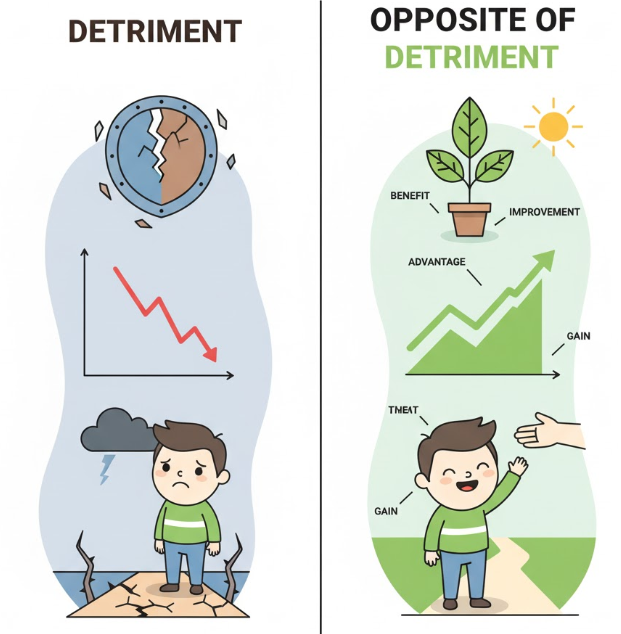
The antonyms of “detriment” encompass a wide range of words that describe positive outcomes, benefits, and advantages. Understanding these antonyms is crucial for expressing the opposite of harm or disadvantage.
Here are some key antonyms of “detriment,” each with its own nuance and specific context of use.
Benefit
Benefit refers to an advantage or profit gained from something. It signifies a positive outcome or improvement resulting from a particular action, policy, or circumstance. Benefits can be tangible, such as financial gains, or intangible, such as improved health or well-being.
The term “benefit” is widely used in various contexts, including economics, healthcare, and social welfare. It often implies a deliberate effort to produce a positive result.
For example, a new government policy might be implemented to provide benefits to underprivileged communities. The concept of benefit is central to understanding the positive consequences of actions and decisions.
Advantage
Advantage denotes a condition or circumstance that puts one in a favorable position. It implies a competitive edge or a superior opportunity compared to others. An advantage can arise from various factors, such as skill, knowledge, resources, or favorable conditions.
The term “advantage” is frequently used in business, sports, and strategic planning. It emphasizes the idea of gaining an upper hand or outperforming competitors.
For instance, a company with superior technology has a significant advantage over its rivals. Recognizing and leveraging advantages is crucial for success in many fields.
Asset
Asset refers to a valuable resource or quality that can be used to one’s advantage. It signifies something that contributes positively to one’s wealth, strength, or capability. Assets can be tangible, such as property or equipment, or intangible, such as skills or knowledge.
The term “asset” is commonly used in finance and business to describe resources that have economic value. However, it can also refer to personal qualities or attributes that contribute to success.
For example, a strong work ethic is a valuable asset in any profession. Identifying and developing assets is essential for achieving personal and professional goals.
Boon
Boon signifies a timely benefit or blessing. It implies a fortunate event or circumstance that brings significant advantage or happiness. A boon is often unexpected or particularly welcome.
The term “boon” is often used in a more literary or formal context to describe a particularly favorable outcome. For example, a sudden breakthrough in medical research could be considered a boon to public health.
The concept of a boon highlights the role of luck and unexpected benefits in shaping outcomes.
Profit
Profit refers to the financial gain or benefit derived from a business transaction or investment. It signifies the excess of revenue over expenses. Profit is a key indicator of financial success and is essential for the sustainability of businesses.
The term “profit” is primarily used in the context of business and finance. It emphasizes the idea of generating wealth or increasing financial value.
For instance, a company that sells a product for more than it costs to produce is making a profit. Maximizing profit is a primary goal for many businesses.
Gain
Gain signifies an increase or improvement in something. It implies acquiring something positive, whether it be knowledge, wealth, or skill. Gain can refer to both tangible and intangible acquisitions.
The term “gain” is versatile and can be used in various contexts. For example, one might gain experience through work or gain knowledge through education.
It emphasizes the idea of progress and improvement. Continuous learning and development often lead to significant gains in personal and professional life.
Help
Help refers to assistance or support given to someone in need. It implies providing aid or resources to alleviate difficulties or achieve a goal. Help can be tangible, such as physical assistance, or intangible, such as emotional support.
The term “help” is widely used in everyday conversation and professional settings. It emphasizes the importance of cooperation and mutual support.
Providing help to others can strengthen relationships and contribute to a positive community environment. Seeking help when needed is also a sign of strength and self-awareness.
Aid
Aid is similar to help but often refers to more formal or organized assistance. It implies providing resources or support to address specific needs or problems. Aid is commonly used in the context of humanitarian assistance or international development.
The term “aid” is often used to describe government or non-governmental organization (NGO) efforts to support communities in need. For example, providing food and shelter to refugees is a form of humanitarian aid.
Aid can play a crucial role in alleviating suffering and promoting sustainable development.
Welfare
Welfare refers to the overall well-being or prosperity of an individual or community. It encompasses physical, mental, and social health. Welfare is often used in the context of social programs and policies aimed at improving the lives of citizens.
The term “welfare” is commonly used in discussions about government responsibility and social justice. For example, providing access to healthcare and education are essential components of social welfare.
Promoting welfare is a key goal for many governments and organizations.
Amelioration
Amelioration refers to the act of making something better or improving a situation. It implies a deliberate effort to mitigate negative effects or enhance positive outcomes. Amelioration is often used in the context of environmental protection or social reform.
The term “amelioration” is often used in formal or technical contexts to describe the process of improvement. For example, implementing new farming practices to reduce soil erosion is a form of environmental amelioration.
The concept of amelioration highlights the importance of continuous improvement and innovation.
Usage Rules
Understanding the nuances of each antonym of “detriment” is essential for using them correctly. Here are some usage rules to guide you:
- Benefit is often used to describe a positive outcome or advantage gained from something. Example: “The new policy will benefit the local community.”
- Advantage implies a competitive edge or superior opportunity. Example: “Having a strong network is a significant advantage in business.”
- Asset refers to a valuable resource or quality. Example: “Her communication skills are a valuable asset to the team.”
- Boon signifies a timely benefit or blessing. Example: “The unexpected rain was a boon to the drought-stricken farmers.”
- Profit is used to describe financial gain. Example: “The company reported a significant profit this quarter.”
- Gain signifies an increase or improvement. Example: “She gained valuable experience during her internship.”
- Help refers to assistance or support. Example: “He offered to help me with the project.”
- Aid is similar to help but often refers to more formal or organized assistance. Example: “The government provided aid to the victims of the earthquake.”
- Welfare refers to overall well-being or prosperity. Example: “The government is committed to improving the welfare of its citizens.”
- Amelioration refers to the act of making something better. Example: “The new regulations aim to promote the amelioration of environmental conditions.”
Consider the context and the specific meaning you want to convey when choosing an antonym of “detriment.” Each word has its own unique connotation and is appropriate for different situations.
Examples
To illustrate the usage of antonyms of “detriment,” here are several examples organized by category.
Benefit Examples
The following table provides examples of how “benefit” is used in different contexts. Each example highlights a positive outcome or advantage gained from a particular action or situation.
| Sentence | Context |
|---|---|
| The new healthcare policy will benefit millions of citizens. | Government Policy |
| Regular exercise can benefit your overall health and well-being. | Health |
| Investing in education will benefit your future career prospects. | Education |
| The company’s new marketing strategy benefited their sales significantly. | Business |
| The community benefited from the new park, which provided a green space for recreation. | Community Development |
| Learning a new language can benefit your cognitive abilities. | Cognitive Development |
| The scholarship benefited her greatly, allowing her to pursue her dreams. | Personal Development |
| The new technology benefited the production process, making it more efficient. | Technological Advancement |
| The new trade agreement benefited both countries involved. | International Relations |
| Volunteering can benefit both the volunteers and the community they serve. | Community Service |
| The merger will benefit shareholders by increasing the company’s value. | Finance |
| The new infrastructure project will benefit the region by improving transportation. | Infrastructure |
| The environmental regulations will benefit future generations. | Environmental Protection |
| The new training program will benefit employees by enhancing their skills. | Employee Development |
| The research grant will benefit the scientific community by funding important studies. | Scientific Research |
| The new law will benefit consumers by protecting them from unfair practices. | Consumer Protection |
| The mentorship program will benefit young professionals by providing guidance and support. | Mentorship |
| The cultural exchange program will benefit participants by broadening their perspectives. | Cultural Exchange |
| The new agricultural techniques will benefit farmers by increasing crop yields. | Agriculture |
| The investment in renewable energy will benefit the environment by reducing pollution. | Environmental Sustainability |
| The new educational program will benefit underprivileged children by providing them with opportunities. | Social Equity |
| The community garden will benefit residents by providing fresh produce and a sense of community. | Community Engagement |
| The new transportation system will benefit commuters by reducing travel time and congestion. | Urban Planning |
| The new cybersecurity measures will benefit businesses by protecting them from cyber threats. | Cybersecurity |
Advantage Examples
The following table provides examples of how “advantage” is used in different contexts. Each example highlights a favorable position or competitive edge.
| Sentence | Context |
|---|---|
| Having a strong network is a significant advantage in the job market. | Career |
| The company’s innovative technology gives them an advantage over their competitors. | Business |
| Studying abroad can give you a cultural advantage in today’s globalized world. | Education |
| Early access to information provided him with an advantage in the negotiation. | Negotiation |
| The athlete’s superior speed gave her an advantage in the race. | Sports |
| Being bilingual is a considerable advantage in many professions. | Language Skills |
| The company’s reputation for quality gives them a competitive advantage. | Business Reputation |
| Having a mentor provides a young professional with a valuable advantage. | Mentorship |
| The location of the store gives it an advantage over other businesses. | Business Location |
| The team’s experience gave them an advantage in the championship game. | Team Experience |
| A strong online presence gives a business an advantage in reaching customers. | Online Marketing |
| Having a diverse skillset gives you an advantage in a rapidly changing job market. | Career Skills |
| The country’s natural resources give it an economic advantage. | Economic Resources |
| The university’s research facilities give its students an academic advantage. | Academic Resources |
| The company’s customer service gives it an advantage over competitors with poor service. | Customer Service |
| The politician’s charisma gave him an advantage during the election. | Politics |
| The organization’s strong leadership gave it an advantage in achieving its goals. | Leadership |
| The company’s brand recognition gives it a marketing advantage. | Brand Recognition |
| The city’s infrastructure gives it an advantage in attracting businesses. | Infrastructure |
| The company’s patents gave them a technological advantage. | Patents and Technology |
| The early bird gets the advantage of finding the best deals. | Opportunity |
| Her fluency in multiple languages gave her an advantage when traveling abroad. | Travel |
| Understanding market trends gives investors an advantage to make better financial decisions. | Finance |
| The home team had the advantage of playing in front of their fans. | Home Advantage |
Asset Examples
The following table provides examples of how “asset” is used in different contexts. Each example highlights a valuable resource or quality.
| Sentence | Context |
|---|---|
| Her communication skills are a valuable asset to the team. | Team Dynamics |
| The company’s intellectual property is a significant asset. | Business |
| A strong work ethic is an important asset in any profession. | Career |
| The organization’s reputation for integrity is a priceless asset. | Reputation |
| The city’s parks and green spaces are valuable environmental assets. | Environment |
| His experience in the field is a considerable asset to the project. | Project Management |
| The company’s skilled workforce is its most important asset. | Human Resources |
| The community’s diversity is a cultural asset. | Community |
| The university’s research facilities are a major asset for students and faculty. | Education |
| The company’s strong financial position is a valuable asset during economic downturns. | Finance |
| Her knowledge of multiple languages is a significant asset in international business. | International Business |
| The organization’s volunteers are its most dedicated asset. | Volunteering |
| The company’s customer loyalty is a valuable asset that contributes to its success. | Customer Loyalty |
| His ability to solve complex problems is a valuable asset in his role as a consultant. | Problem-Solving |
| The company’s brand name is a major asset in the market. | Branding |
| Her positive attitude is a great asset in dealing with challenging situations. | Personal Qualities |
| The farm’s fertile soil is a crucial asset for producing high-quality crops. | Agriculture |
| The entrepreneur’s vision is a key asset in driving the company forward. | Entrepreneurship |
| The library’s extensive collection of books is an invaluable asset to the community. | Community Resources |
| The musician’s creativity is their greatest asset. | Creativity |
| The company’s data analytics capabilities are a strategic asset. | Business Strategy |
| The city’s historical landmarks are cultural assets that attract tourists. | Tourism |
| Her organizational skills are a significant asset when managing complex projects. | Project Management |
| The company’s commitment to sustainability is a valuable asset. | Sustainability |
Common Mistakes
One common mistake is using “benefit” and “advantage” interchangeably without considering their specific meanings. “Benefit” refers to a positive outcome, while “advantage” implies a competitive edge.
For example, saying “The company has a benefit over its competitors” is incorrect; it should be “The company has an advantage over its competitors.”
Another mistake is using “asset” to describe a temporary advantage. “Asset” refers to a long-term, valuable resource.
Avoid saying “His lucky streak was a valuable asset”; instead, say “His lucky streak was a temporary advantage.” Understanding these distinctions will improve the accuracy and clarity of your writing.
Practice Exercises
Test your understanding of the antonyms of “detriment” with these practice exercises.
Exercise 1: Fill in the Blanks
Choose the best antonym of “detriment” to complete each sentence.
| Question | Answer |
|---|---|
| 1. The new policy will __________ the local economy. | benefit |
| 2. Having a mentor can give you a significant __________ in your career. | advantage |
| 3. Her positive attitude is a valuable __________ to the team. | asset |
| 4. The unexpected rain was a __________ to the drought-stricken farmers. | boon |
| 5. The company reported a significant __________ this quarter. | profit |
| 6. She __________ valuable experience during her internship. | gained |
| 7. He offered to __________ me with the project. | help |
| 8. The government provided __________ to the victims of the earthquake. | aid |
| 9. The government is committed to improving the __________ of its citizens. | welfare |
| 10. The new regulations aim to promote the __________ of environmental conditions. | amelioration |
Exercise 2: Sentence Completion
Complete each sentence using an appropriate antonym of “detriment.”
| Question | Answer |
|---|---|
| 1. Investing in renewable energy will __________ the environment by reducing carbon emissions. | benefit |
| 2. A strong online presence gives a business a competitive __________ in reaching customers. | advantage |
| 3. The company’s brand name is a major __________ in the market, attracting loyal customers. | asset |
| 4. The unexpected discovery of a new water source was a __________ for the village facing drought. | boon |
| 5. The real estate investment yielded a substantial __________ after just one year. | profit |
| 6. Through hard work and dedication, she __________ recognition within her industry. | gained |
| 7. The community came together to __________ the family after their home was destroyed in the fire. | help |
| 8. The international community provided __________ to the countries affected by the tsunami. | aid |
| 9. The new social program aims to improve the __________ of families living in poverty. | welfare |
| 10. Conservation efforts focus on the __________ of degraded ecosystems. | amelioration |
Advanced Topics
For advanced learners, exploring the etymology and historical usage of the antonyms of “detriment” can provide deeper insights. Researching the legal and economic contexts in which these words are used can also enhance understanding.
Additionally, studying synonyms and related terms can further expand your vocabulary and improve your ability to express nuanced meanings.
Consider exploring the philosophical implications of “detriment” and its antonyms. How do different cultures and societies view the concepts of harm and benefit?
How do ethical frameworks address the balance between potential detriments and potential benefits? Engaging with these questions can deepen your understanding of the complex relationship between language and thought.
FAQ
Here are some frequently asked questions about the antonyms of “detriment.”
- What is the difference between “benefit” and “advantage”?While both words describe positive outcomes, “benefit” refers to a general positive effect or gain, whereas “advantage” implies a competitive edge or superior position. A benefit is a positive result of something, while an advantage is something that puts you ahead of others.
- When should I use “asset” instead of “advantage”?“Asset” should be used when referring to a valuable resource or quality that contributes to long-term success or value. “Advantage” is more appropriate when describing a specific circumstance that provides a competitive edge in a particular situation.
- Is “boon” a common word in modern English?While “boon” is still used in modern English, it is more common in formal or literary contexts. It signifies a particularly welcome or fortunate benefit.
- How does “welfare” differ from “help” or “aid”?“Welfare” refers to overall well-being and prosperity, often in the context of social programs. “Help” and “aid” refer to specific assistance given to someone in need, with “aid” often implying more formal or organized assistance.
- What is the best way to improve my understanding of these words?The best way to improve your understanding is through consistent practice, reading widely, and paying attention to the contexts in which these words are used. Try using these words in your own writing and speaking to solidify your understanding.
- Can “profit” be used in contexts other than business?While “profit” is primarily used in business and finance to describe financial gain, it can also be used metaphorically to describe non-financial benefits. For example, “He profited from the experience by learning valuable lessons.”
- How can I avoid common mistakes when using these words?Pay close attention to the specific meanings and connotations of each word. Use a dictionary or thesaurus to clarify the nuances of each term. Practice using the words in different contexts and seek feedback from native English speakers.
- What are some related terms I can study to expand my vocabulary?Consider studying synonyms such as “merit,” “virtue,” “strength,” “plus,” “upside,” “windfall,” “prosperity,” “betterment,” and “improvement.” Exploring these related terms will enrich your vocabulary and improve your ability to express nuanced meanings.
Conclusion
Mastering the antonyms of “detriment” is essential for expressing positive outcomes, benefits, and advantages with precision and clarity. By understanding the nuances of words like “benefit,” “advantage,” “asset,” “boon,” “profit,” “gain,” “help,” “aid,” “welfare,” and “amelioration,” you can enhance your communication skills and express yourself more effectively.
Consistent practice, careful attention to context, and a willingness to learn from mistakes are key to mastering these valuable vocabulary terms.
Continue to expand your vocabulary and explore the intricacies of the English language. By doing so, you will not only improve your communication skills but also gain a deeper appreciation for the richness and complexity of language.
Remember that language learning is a continuous journey, and every effort you make will contribute to your growth and development.