
Understanding antonyms is crucial for expanding vocabulary and enhancing communication skills. This article delves into the various words that represent the opposite of “full,” exploring their nuances and usage in different contexts.
Whether you’re a student, a writer, or simply someone looking to improve your grasp of the English language, this guide provides a thorough exploration of antonyms for “full.” This comprehensive exploration will equip you with the knowledge to use these words accurately and effectively, ultimately enriching your vocabulary and enhancing your communication skills. Mastering these antonyms will allow you to express a wider range of ideas with precision and clarity.
So, let’s embark on this linguistic journey to uncover the diverse and fascinating world of words that stand in opposition to “full.”
Table of Contents
- Introduction
- Definition of “Full” and Its Antonyms
- Structural Breakdown: Understanding Opposites
- Types and Categories of Antonyms for “Full”
- Examples of Antonyms in Sentences
- Usage Rules and Considerations
- Common Mistakes to Avoid
- Practice Exercises
- Advanced Topics: Nuances and Connotations
- Frequently Asked Questions
- Conclusion
Definition of “Full” and Its Antonyms
The word “full” generally means containing as much as can be held or accommodated; having no empty space. It can also describe a state of satiation, completion, or abundance. Understanding the antonyms of “full” requires considering the specific context in which it is used. The opposite of “full” can vary depending on whether we’re talking about a container, a feeling, or a state of being.
Antonyms, in general, are words that have opposite meanings. They are essential for expressing contrasting ideas, creating balance in language, and adding depth to writing and conversation.
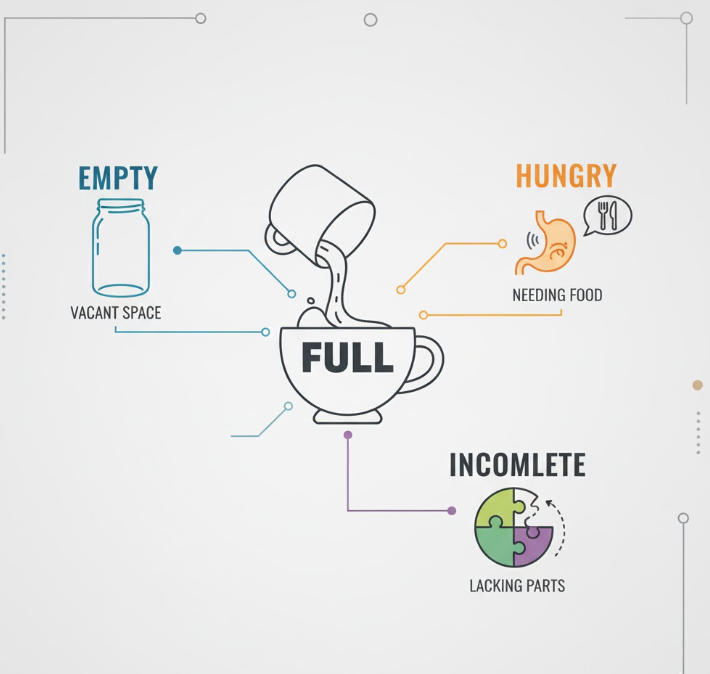
Identifying the right antonym for “full” depends on the specific meaning you wish to convey. For instance, if you’re describing a glass, “empty” might be the most appropriate antonym.
However, if you’re describing a person’s stomach, “hungry” might be more fitting. Recognizing these nuances is key to effective communication.
Structural Breakdown: Understanding Opposites
Understanding how antonyms are formed can help in recognizing and using them correctly. Some antonyms are created by adding prefixes like “un-,” “in-,” “im-,” “dis-,” or “a-” to a word (e.g., happy/unhappy, complete/incomplete).
However, many antonyms are completely different words (e.g., hot/cold, big/small). “Full” falls into the latter category, as its antonyms are distinct words with separate origins.
The structure of antonyms can also be analyzed in terms of their relationship to the original word. Some antonyms are complementary, meaning that the absence of one implies the presence of the other (e.g., alive/dead). Others are gradable, existing on a spectrum (e.g., hot/cold, with warm and cool in between). Still others are relational, where one word implies the existence of the other (e.g., buy/sell). When considering antonyms for “full,” it is important to understand which type of opposition is most relevant to the specific context.
Types and Categories of Antonyms for “Full”
The antonyms of “full” can be categorized based on the context in which “full” is used. Here are some common categories and their corresponding antonyms:
Empty
Empty is perhaps the most direct antonym of “full” when referring to containers or spaces. It signifies the absence of contents.
Example sentences:
- The glass is empty.
- The room was empty of furniture.
- Her heart felt empty after he left.
Vacant
Vacant implies unoccupied or empty, often referring to spaces or positions.
Example sentences:
- The seat was vacant.
- The position is currently vacant.
- The building stood vacant for years.
Lacking
Lacking indicates the absence of something necessary or desirable.
Example sentences:
- The project is lacking in detail.
- He is lacking in experience.
- They were lacking the necessary resources.
Deficient
Deficient suggests a shortage or inadequacy, often in a specific quality or quantity.
Example sentences:
- The soil is deficient in nutrients.
- He is deficient in vitamin D.
- The report was deficient in accuracy.
Void
Void describes a state of emptiness or nullity, often used in a more abstract or legal sense.
Example sentences:
- The contract was declared void.
- Her life felt void of meaning.
- The universe is not a void, but full of dark matter.
Bare
Bare implies lacking covering or adornment; empty of contents or occupants.
Example sentences:
- The shelves were bare.
- The room was bare except for a single chair.
- The tree was bare of leaves in winter.
Depleted
Depleted means having been reduced in quantity or strength.
Example sentences:
- The resources were depleted.
- His energy was depleted after the marathon.
- The soil was depleted of minerals.
Exhausted
Exhausted suggests completely used up or depleted, often referring to resources or energy.
Example sentences:
- The supply of water was exhausted.
- She felt exhausted after the long day.
- The batteries were exhausted.
Hungry
Hungry describes the feeling of needing or wanting food; an antonym of “full” in the context of satiation.
Example sentences:
- I am hungry.
- The children were hungry after playing outside.
- He was hungry for success.
Thirsty
Thirsty describes the feeling of needing or wanting to drink; an antonym of “full” in the context of hydration.
Example sentences:
- I am thirsty.
- The plants were thirsty after the drought.
- He was thirsty for knowledge.
Examples of Antonyms in Sentences
The following tables provide examples of how these antonyms are used in sentences, categorized by the context of “full” they oppose.
Table 1: Antonyms of “Full” Describing Physical Space
This table showcases examples where the antonym of ‘full’ is used to describe physical spaces, containers, or objects.
| “Full” Sentence | Antonym Sentence |
|---|---|
| The glass is full of water. | The glass is empty. |
| The parking lot was full. | The parking lot was vacant. |
| The warehouse is full of supplies. | The warehouse is bare. |
| The tank is full of fuel. | The tank is depleted. |
| The stadium was full of fans. | The stadium was empty after the game. |
| The drawer was full of socks. | The drawer was empty. |
| The inbox is full of messages. | The inbox is empty. |
| The backpack was full of books. | The backpack was bare. |
| The bottle is full of juice. | The bottle is empty. |
| The jar is full of cookies. | The jar is empty. |
| The theater was full. | The theater was vacant. |
| The hard drive is full of data. | The hard drive is empty. |
| The piggy bank is full of coins. | The piggy bank is empty. |
| The attic is full of old boxes. | The attic is bare. |
| The bus was full of people. | The bus was empty at the last stop. |
| The auditorium was full for the concert. | The auditorium was vacant the next morning. |
| The suitcase is full of clothes. | After the trip, the suitcase was nearly empty. |
| The gas tank is full. | The gas tank is nearly depleted. |
| The bookshelf is full of novels. | One shelf was noticeably bare. |
| The shopping cart was full. | After returning items, the cart was practically empty. |
| The bag is full of groceries. | The bag is now empty, I put everything away. |
| My schedule is full for the week. | I have some vacant slots in my schedule next week. |
| The swimming pool is full. | The swimming pool is empty, it needs to be refilled. |
Table 2: Antonyms of “Full” Describing States of Being
This table illustrates examples where the antonym of ‘full’ describes a state of being, feeling, or condition.
| “Full” Sentence | Antonym Sentence |
|---|---|
| After the meal, I felt full. | Before the meal, I was hungry. |
| The project was full of potential. | The project was lacking in resources. |
| His life was full of joy. | His life felt void after the loss. |
| The battery is full of charge. | The battery is exhausted. |
| After drinking water, I felt full. | Before drinking water, I was thirsty. |
| He was full of energy. | He felt exhausted after the race. |
| Her heart was full of love. | Her heart felt empty after the breakup. |
| The report was full of details. | The report was deficient in key information. |
| The class was full of students. | The classroom was vacant during the break. |
| His response was full of enthusiasm. | His response was lacking in excitement. |
| The concert was full of life. | After the storm, the area was void of all life. |
| The room was full of laughter. | The room was empty of sound. |
| The day was full of sunshine. | The day was lacking in light. |
| The meeting was full of ideas. | The meeting was deficient in actionable steps. |
| The speaker was full of confidence. | The speaker was lacking in assurance. |
| The performance was full of passion. | The performance was void of emotion. |
| The garden was full of flowers. | The garden was bare after the frost. |
| His account was full of discrepancies. | His account was lacking in truth. |
| The event was full of surprises. | The event was void of any excitement. |
| The story was full of adventure. | The story was lacking in intrigue. |
| The presentation was full of information. | The presentation was deficient in visual aids. |
| The movie was full of suspense. | The movie was void of any thrills. |
| The landscape was full of trees. | The landscape was bare after the fire. |
Table 3: Antonyms of “Full” Describing Abstract Concepts
This table provides examples of how antonyms of “full” apply to abstract concepts, ideas, or situations.
| “Full” Sentence | Antonym Sentence |
|---|---|
| The argument was full of flaws. | The argument was lacking in logic. |
| The plan was full of potential risks. | The plan was deficient in safety measures. |
| The agreement was full of loopholes. | The agreement was void due to legal issues. |
| The account was full of errors. | The account was lacking in accuracy. |
| The project was full of challenges. | The project was deficient in support. |
| The statement was full of contradictions. | The statement was lacking in coherence. |
| The system was full of bugs. | The system was deficient in testing. |
| The proposal was full of unrealistic goals. | The proposal was lacking in practicality. |
| The explanation was full of jargon. | The explanation was deficient in clarity. |
| The essay was full of irrelevant information. | The essay was lacking in focus. |
| The strategy was full of weaknesses. | The strategy was deficient in planning. |
| The presentation was full of distractions. | The presentation was lacking in engagement. |
| The report was full of inconsistencies. | The report was deficient in evidence. |
| The solution was full of compromises. | The solution was lacking in effectiveness. |
| The analysis was full of assumptions. | The analysis was deficient in data. |
| The forecast was full of uncertainties. | The forecast was lacking in precision. |
| The investigation was full of obstacles. | The investigation was deficient in resources. |
| The response was full of evasions. | The response was lacking in honesty. |
| The design was full of imperfections. | The design was deficient in aesthetics. |
| The implementation was full of delays. | The implementation was lacking in coordination. |
| The feedback was full of criticism. | The feedback was deficient in praise. |
| The approach was full of risks. | The approach was deficient in safety. |
| The interpretation was full of biases. | The interpretation was lacking in objectivity. |
Usage Rules and Considerations
Choosing the correct antonym for “full” depends heavily on context. Consider the following rules and considerations:
- Physical Containers: Use “empty” or “bare” for physical containers like glasses, rooms, or shelves.
- Space or Positions: Use “vacant” for unoccupied spaces or positions.
- Necessary Elements: Use “lacking” or “deficient” when something is missing or inadequate.
- Abstract Concepts: Use “void” for emptiness in an abstract or legal sense.
- Satiation: Use “hungry” or “thirsty” when referring to the feeling of needing food or drink.
- Depletion: Use “depleted” or “exhausted” when referring to resources or energy that have been used up.
It’s also important to consider the specific connotation you want to convey. “Empty” is a neutral term, while “bare” can suggest starkness or simplicity.
“Deficient” implies a specific lack or inadequacy, while “lacking” is more general. Understanding these subtle differences will help you choose the most appropriate antonym for your needs.
Always consider the specific situation and the intended meaning when selecting an antonym for “full.”
Common Mistakes to Avoid
Here are some common mistakes to avoid when using antonyms of “full”:
- Using “empty” for non-physical entities: It’s incorrect to say “He was empty of ideas.” Instead, use “He was lacking in ideas.”
- Using “hungry” for non-food contexts: While you can say “He was hungry for success,” avoid using “hungry” in contexts where it doesn’t relate to a need for something.
- Interchanging “deficient” and “lacking” without considering nuance: “Deficient” implies a specific inadequacy, while “lacking” is more general. For example, “The report was deficient in data” is more specific than “The report was lacking data.”
Table 4: Correct vs. Incorrect Usage
This table shows examples of common mistakes made when using antonyms of “full,” along with the correct alternatives.
| Incorrect Usage | Correct Usage | Explanation |
|---|---|---|
| The idea was empty. | The idea was lacking substance. | “Empty” is typically used for physical containers, not abstract ideas. |
| He was hungry for knowledge. (Less Common) | He was thirsty for knowledge. | “Thirsty” is more commonly used metaphorically to describe a strong desire for knowledge or information. |
| The project was lacking of funds. | The project was lacking funds. | The correct preposition is “in” or no preposition is needed after “lacking”. |
| The soil was deficient of nutrients. | The soil was deficient in nutrients. | The correct preposition to use after “deficient” is “in”. |
| Her heart was vacant after the loss. | Her heart was empty after the loss. | “Vacant” is usually used to describe unoccupied spaces, while “empty” describes a feeling of loss or emptiness. |
| The battery is bare. | The battery is exhausted. | “Bare” means uncovered, while “exhausted” means used up. |
| The contract was lacking because of legal issues. | The contract was void because of legal issues. | “Void” is the correct term in legal contexts to describe something that is not legally binding. |
Practice Exercises
Test your understanding of the antonyms of “full” with these exercises.
Exercise 1: Fill in the Blanks
Fill in the blank with the most appropriate antonym of “full” from the list provided: (empty, vacant, lacking, deficient, void)
| Question | Answer |
|---|---|
| 1. The bottle is __________. | empty |
| 2. The seat is __________. | vacant |
| 3. The project is __________ in resources. | lacking |
| 4. The soil is __________ in nutrients. | deficient |
| 5. Her life felt __________ after the tragedy. | void |
| 6. The glass is ___________. | empty |
| 7. The parking space was ___________. | vacant |
| 8. His argument was __________ in logic. | lacking |
| 9. The diet was __________ in essential vitamins. | deficient |
| 10. The contract was declared __________. | void |
Exercise 2: Multiple Choice
Choose the best antonym of “full” for each sentence.
| Question | Options | Answer |
|---|---|---|
| 1. The tank is no longer full; it is __________. | a) overflowing b) depleted c) abundant d) sufficient | b) depleted |
| 2. After the long run, she felt not full, but __________. | a) satisfied b) content c) exhausted d) energetic | c) exhausted |
| 3. The theater wasn’t full; it was almost __________. | a) crowded b) packed c) vacant d) overflowing | c) vacant |
| 4. The recipe is not full of flavor; it is __________. | a) rich b) abundant c) lacking d) overflowing | c) lacking |
| 5. His response was not full of details, but rather __________. | a) comprehensive b) thorough c) deficient d) ample | c) deficient |
| 6. The refrigerator is not full, it is __________. | a) packed b) complete c) empty d) overflowing | c) empty |
| 7. The position isn’t full, it is __________. | a) occupied b) crammed c) vacant d) teeming | c) vacant |
| 8. The essay is not full of information, but __________. | a) abundant b) overflowing c) lacking d) sufficient | c) lacking |
| 9. The diet isn’t full of nutrients, but rather __________. | a) abundant b) overflowing c) deficient d) sufficient | c) deficient |
| 10. His life isn’t full of happiness, but __________. | a) overflowing b) packed c) void d) abundant | c) void |
Exercise 3: Sentence Completion
Complete each sentence by providing an antonym for “full” that makes sense in the context.
| Question | Answer |
|---|---|
| 1. The glass, once full of milk, is now __________. | empty |
| 2. The stadium, once full of cheering fans, is now __________ and silent. | vacant |
| 3. The recipe, though promising, was __________ in flavor. | lacking |
| 4. The report, though lengthy, was __________ in concrete data. | deficient |
| 5. His life, once full of purpose, felt __________ after retirement. | void |
| 6. The container, once full, is now completely __________. | empty |
| 7. The job position is currently __________ and needs to be filled. | vacant |
| 8. The presentation was __________ in visual aids, making it less engaging. | lacking |
| 9. The diet was __________ in essential vitamins, leading to health problems. | deficient |
| 10. After years of war, the land felt __________ of hope. | void |
Advanced Topics: Nuances and Connotations
Beyond basic definitions, understanding the nuances and connotations of antonyms can elevate your language skills. For instance, consider the difference between “empty” and “vacant.” While both mean not full, “empty” often refers to a container or space that has been emptied of its contents, while “vacant” typically refers to a space that is temporarily unoccupied but could be filled again.
Using “vacant” to describe a glass would be unusual, just as using “empty” to describe a parking space would be less precise.
Furthermore, some antonyms carry emotional weight. “Void” often implies a sense of loss or emptiness, while “bare” can suggest simplicity or starkness.
Consider the impact of each word on the overall tone and message of your writing. Explore the etymology of antonyms to gain a deeper understanding of their historical and cultural context.
Understanding these subtle differences allows for more precise and impactful communication. Pay attention to how different antonyms resonate with your audience and choose the words that best convey your intended meaning.
By mastering these nuances, you can transform your writing and speech from simple communication to a powerful form of expression.
Frequently Asked Questions
Here are some frequently asked questions about the antonyms of “full”:
- What is the most common antonym of “full”?The most common antonym is “empty,” especially when referring to physical containers or spaces.
- When should I use “vacant” instead of “empty”?“Vacant” is best used for spaces or positions that are temporarily unoccupied, implying they could be filled again. For example, a vacant seat or a vacant job position.
- What is the difference between “lacking” and “deficient”?“Lacking” is a more general term indicating the absence of something, while “deficient” suggests a specific inadequacy or shortage. For example, a project might be “lacking” in resources, while a diet might be “deficient” in vitamin D.
- Is “hungry” always the antonym of “full” when referring to people?Yes, “hungry” is the primary antonym of “full” when describing a person’s state of satiation. However, “thirsty” is a similar antonym that relates to hydration rather than food.
- Can “void” be used in physical contexts?While “void” primarily refers to abstract or legal emptiness, it can sometimes be used in physical contexts to emphasize a complete absence of something. For instance, “The explosion left a void where the building once stood.”
- What does “depleted” mean, and how is it different from “exhausted”?“Depleted” means reduced in quantity or strength, while “exhausted” implies completely used up. For example, resources can be depleted, while energy can be exhausted.
- Are there any situations where “full” doesn’t have a direct antonym?Yes, in some metaphorical usages, “full” might not have a clear-cut antonym. For example, if you say “His life was full of adventure,” finding a single antonym is difficult. You might say “His life was lacking adventure” or “His life was void of excitement,” but the best choice depends on the specific meaning you want to convey.
- How can I improve my understanding of antonyms in general?Reading widely, using a thesaurus, and paying attention to context are all helpful strategies. Practice using antonyms in your own writing and speaking, and ask for feedback from others. The more you engage with language, the better you’ll become at recognizing and using antonyms effectively.
Conclusion
Mastering the antonyms of “full” is a valuable step in expanding your vocabulary and enhancing your ability to communicate effectively. By understanding the nuances and contexts in which these words are used, you can express a wider range of ideas with precision and clarity.
This guide has provided a comprehensive overview of the various antonyms of “full,” along with examples, usage rules, and practice exercises to solidify your understanding. Remember to consider the specific situation and intended meaning when choosing an antonym, and avoid common mistakes to ensure accurate and impactful communication.
Continue to explore the rich tapestry of the English language, and embrace the power of words to express your thoughts and ideas with eloquence and precision. Practice using these antonyms in your everyday conversations and writing.
The more you use them, the more natural they will become. Keep learning, keep exploring, and keep expanding your linguistic horizons.
With consistent effort, you can achieve fluency and mastery in the English language.