
Understanding the nuances of language involves more than just knowing the definitions of words. It requires grasping their relationships, especially antonyms.
This article focuses on the antonyms of “organized,” exploring the various ways we describe a lack of order. Mastering these terms will significantly enhance your ability to communicate precisely and effectively, whether in writing or conversation.
This is particularly useful for students, professionals, and anyone seeking to improve their English proficiency.
By delving into the different shades of meaning associated with words like “disorganized,” “chaotic,” and “messy,” you’ll gain a deeper appreciation for the English language’s richness and flexibility. This knowledge will not only expand your vocabulary but also refine your ability to convey subtle differences in meaning, making your communication clearer and more impactful.
Table of Contents
- Introduction
- Definition of “Organized” and Its Antonyms
- Structural Breakdown of Antonyms
- Types and Categories of Antonyms
- Examples of Antonyms in Use
- Usage Rules and Considerations
- Common Mistakes to Avoid
- Practice Exercises
- Advanced Topics
- Frequently Asked Questions (FAQ)
- Conclusion
Definition of “Organized” and Its Antonyms
The word “organized” generally refers to a state of being structured, systematic, and efficient. It implies that things are arranged in a logical and orderly manner, making them easy to find, use, and understand.
An organized person or system exhibits planning, control, and a clear sense of purpose. The antonyms of “organized,” therefore, describe the opposite: a lack of structure, system, or efficiency.
These antonyms can be classified broadly as adjectives, describing the state or quality of something. However, they can also function as adverbs when modifying verbs, indicating how an action is performed. For instance, “He filed the documents organizedly” (though less common) describes the manner of filing, while “He filed the documents disorganizedly” describes the opposite.
Understanding the context is crucial when choosing the most appropriate antonym. While all antonyms share the core meaning of a lack of order, they each carry slightly different connotations.
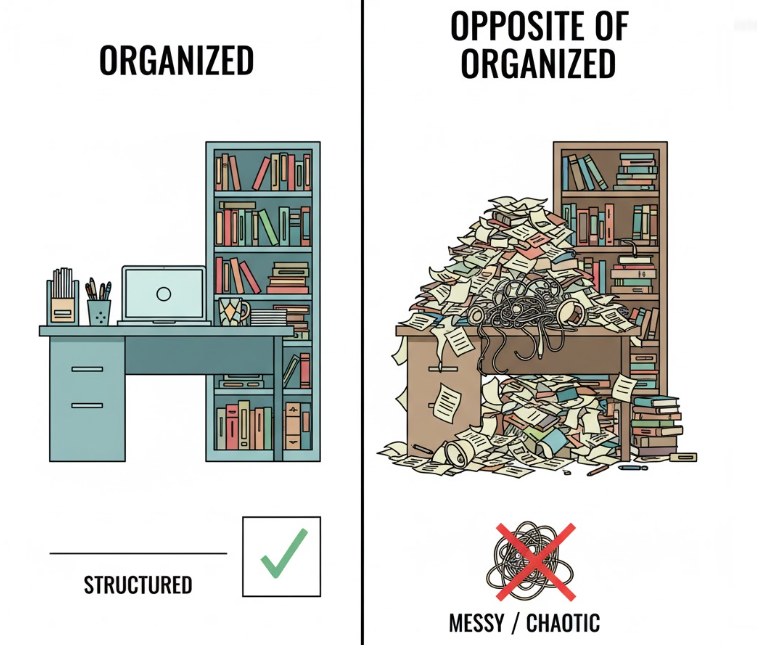
“Messy” might describe a desk covered in papers, while “chaotic” suggests a more widespread and disruptive lack of order, perhaps in a project or a social situation. The choice depends on the specific nuance you wish to convey.
Structural Breakdown of Antonyms
Many antonyms of “organized” are formed by adding prefixes to root words. The most common prefix is “dis-,” which indicates negation or reversal.
For example, “disorganized” is formed by adding “dis-” to “organized.” Other prefixes that can create antonyms include “un-” (e.g., “unsystematic”) and “ir-” (though less common in this specific context). Understanding these prefixes can help you quickly identify and understand new antonyms.
Another structural element to consider is the use of suffixes. While suffixes typically don’t create direct antonyms, they can change the part of speech of a word and thus affect its usage in a sentence.
For example, “disorder” (noun) is related to “disorderly” (adjective). Recognizing these relationships can expand your vocabulary and improve your grammatical accuracy.
Finally, some antonyms are entirely different words with no shared root. These are often the most challenging to learn, as they require memorization rather than deduction.
Examples include “chaotic” and “topsy-turvy,” which have no direct morphological connection to “organized.”
Types and Categories of Antonyms
The antonyms of “organized” can be grouped into several categories based on their specific connotations and the contexts in which they are typically used. Here are some of the most common categories:
Disorganized
“Disorganized” is perhaps the most direct and common antonym of “organized.” It implies a lack of structure, planning, and system. It suggests that things are not arranged in a logical or efficient manner.
Messy
“Messy” refers to a state of untidiness and disorder, often involving physical objects. It suggests that things are scattered, dirty, or generally unpleasant to look at.
Chaotic
“Chaotic” describes a state of complete disorder and confusion. It implies a lack of control and predictability, often leading to disruption and instability.
This word conveys a stronger sense of disorder than “disorganized” or “messy.”
Unruly
“Unruly” typically applies to people or things that are difficult to control or manage. It suggests a resistance to order and discipline, often resulting in disruptive behavior.
Disorderly
“Disorderly” is similar to “disorganized” but often implies a violation of rules or norms. It suggests a lack of proper arrangement and can also refer to disruptive or unlawful behavior.
Unsystematic
“Unsystematic” describes a lack of a clear or consistent method. It implies that things are done in a haphazard or random way, without a logical plan or structure.
Jumbled
“Jumbled” refers to things that are mixed up or confused, often in a disorderly pile. It suggests a lack of clear arrangement and can imply difficulty in sorting or understanding.
Scrambled
“Scrambled” is similar to “jumbled” but often implies a more forceful or chaotic mixing. It suggests that things have been thrown together in a disorderly and confused manner.
Topsy-Turvy
“Topsy-turvy” describes a state of being inverted or turned upside down. It implies a complete reversal of the normal order or arrangement, often resulting in a comical or chaotic situation.
Examples of Antonyms in Use
The following tables provide examples of how these antonyms are used in sentences. Each table focuses on a specific category of antonym, illustrating its meaning and usage in different contexts.
These examples will help you understand the subtle differences between the words and choose the most appropriate one for your needs.
The first table focuses on the antonym “disorganized” and its usage in various contexts. It includes examples related to personal habits, work environments, and projects.
| Sentence | Context |
|---|---|
| His desk was completely disorganized, with papers and files scattered everywhere. | Work environment |
| She felt disorganized and overwhelmed by the amount of work she had to do. | Personal feeling |
| The project became disorganized due to a lack of clear leadership. | Project management |
| His thoughts were disorganized, making it difficult for him to express himself clearly. | Mental state |
| The filing system was so disorganized that it took hours to find a single document. | Office administration |
| Her schedule was disorganized, resulting in missed appointments and deadlines. | Time management |
| The team’s efforts were disorganized, leading to duplicated work and wasted resources. | Teamwork |
| The kitchen cabinets were disorganized, making it hard to find ingredients while cooking. | Home organization |
| His approach to studying was disorganized, which affected his grades negatively. | Study habits |
| The event was disorganized due to poor planning and communication. | Event planning |
| The company’s finances were disorganized, leading to financial instability. | Business management |
| The instructions were disorganized and difficult to follow. | Documentation |
| His personal life was disorganized after the move. | Personal life |
| The database was disorganized, making it difficult to retrieve information. | Data management |
| The presentation was disorganized, and the audience struggled to understand the main points. | Presentation skills |
| Their travel plans were disorganized, resulting in missed flights and hotel bookings. | Travel planning |
| The classroom was disorganized after the art project. | Classroom management |
| The government’s response was disorganized, leading to public criticism. | Government response |
| Her wardrobe was disorganized, making it hard to find matching outfits. | Personal organization |
| The website was disorganized, causing visitors to leave quickly. | Website design |
| The notes from the meeting were completely disorganized. | Note-taking |
| Their strategy for the game was disorganized, which led to their defeat. | Sports strategy |
| The report was disorganized and lacked a clear structure. | Report writing |
The next table illustrates the use of “messy” as an antonym of “organized.” It includes examples related to physical environments, personal appearance, and abstract situations.
| Sentence | Context |
|---|---|
| The kitchen was messy, with dirty dishes piled in the sink. | Home environment |
| His hair was messy and uncombed. | Personal appearance |
| The situation became messy when conflicting interests emerged. | Abstract situation |
| Her desk was always messy, but she claimed she knew where everything was. | Work environment |
| The children’s room was incredibly messy after their playdate. | Children’s room |
| The paint job was messy, with drips and uneven coverage. | Home improvement |
| The breakup was messy, involving accusations and hurt feelings. | Personal relationship |
| The garden was messy, overgrown with weeds and unpruned plants. | Garden maintenance |
| The handwriting was messy and difficult to read. | Handwriting |
| The data was messy and required significant cleaning before analysis. | Data analysis |
| The crime scene was messy, indicating a struggle. | Crime scene |
| The process was messy and inefficient. | Business process |
| The wound was messy and required immediate medical attention. | Medical condition |
| The divorce proceedings were messy and dragged on for years. | Legal proceedings |
| The evidence was messy and inconclusive. | Legal evidence |
| The project’s implementation was messy due to poor planning. | Project management |
| The artist’s studio was charmingly messy, filled with paints and canvases. | Artist’s studio |
| The experiment’s results were messy and difficult to interpret. | Scientific experiment |
| The negotiation process became messy when tempers flared. | Negotiation |
| The aftermath of the party was messy, with decorations scattered everywhere. | Party aftermath |
| His emotional state was messy, a mix of sadness and anger. | Emotional state |
| The construction site was messy, with materials strewn about. | Construction site |
| The political situation was messy and unpredictable. | Political situation |
This table provides examples of “chaotic” in use, highlighting situations involving widespread disorder and confusion.
| Sentence | Context |
|---|---|
| The city became chaotic after the earthquake. | Natural disaster |
| The meeting descended into chaotic shouting match. | Meeting dynamics |
| The classroom was chaotic when the teacher left the room. | Classroom management |
| The stock market became chaotic during the financial crisis. | Financial market |
| The traffic was chaotic during rush hour. | Traffic conditions |
| The political situation in the country was chaotic. | Political situation |
| The emergency room was chaotic after the accident. | Emergency room |
| The project became chaotic due to constant changes in requirements. | Project management |
| His life felt chaotic after losing his job and his home. | Personal life |
| The festival turned chaotic when a fight broke out. | Festival event |
| The company’s reorganization led to a chaotic transition period. | Business transition |
| The evacuation process was chaotic due to poor communication. | Evacuation process |
| The children’s birthday party turned chaotic with too many games and activities. | Birthday party |
| The band’s performance was deliberately chaotic and unconventional. | Artistic performance |
| The conference became chaotic after the keynote speaker cancelled unexpectedly. | Conference event |
| The online forum became chaotic with endless arguments and personal attacks. | Online forum |
| The construction site was chaotic with workers running in every direction. | Construction site |
| The legal case was chaotic due to conflicting testimonies. | Legal case |
| The dance floor was chaotic with people moving without coordination. | Dance floor |
| The newsroom was chaotic as reporters rushed to meet deadlines. | Newsroom |
| The server room was chaotic, with wires tangled everywhere. | Server room |
| The art installation was designed to be chaotic and unsettling. | Art installation |
| The manager’s leadership style was chaotic, leading to confusion among employees. | Leadership style |
This table illustrates the use of “unruly,” “disorderly,” “unsystematic,” “jumbled,” “scrambled,” and “topsy-turvy”.
| Sentence | Antonym | Context |
|---|---|---|
| The unruly crowd pushed and shoved to get closer to the stage. | Unruly | Crowd behavior |
| The disorderly conduct of the fans resulted in several arrests. | Disorderly | Public behavior |
| His approach to the problem was unsystematic and ineffective. | Unsystematic | Problem-solving |
| The letters were jumbled and hard to decipher. | Jumbled | Text arrangement |
| The eggs were scrambled with cheese and vegetables. | Scrambled | Food preparation |
| The world felt topsy-turvy after the unexpected election results. | Topsy-Turvy | Political situation |
| The unruly hair refused to stay in place. | Unruly | Personal appearance |
| The disorderly array of books made the shelf look unattractive. | Disorderly | Home decor |
| Her unsystematic approach to research slowed down the project. | Unsystematic | Research methodology |
| The collection of photos was jumbled in a box. | Jumbled | Photo storage |
| The code was scrambled to protect sensitive information. | Scrambled | Data security |
| Everything in the room was topsy-turvy after the playful fight. | Topsy-Turvy | Room condition |
| The unruly students made it difficult for the teacher to maintain order. | Unruly | Classroom management |
| The disorderly queue at the airport caused delays and frustration. | Disorderly | Queue management |
| His unsystematic notes made it impossible to review the material effectively. | Unsystematic | Note-taking |
| The contents of the drawer were jumbled, with no clear organization. | Jumbled | Drawer organization |
| The signal was scrambled to prevent unauthorized access. | Scrambled | Signal security |
| The entire plan went topsy-turvy when the key partner backed out. | Topsy-Turvy | Business planning |
| The unruly branches of the tree needed to be trimmed. | Unruly | Gardening |
| The disorderly arrangement of products detracted from the store’s appeal. | Disorderly | Retail display |
| Their unsystematic spending habits led to financial problems. | Unsystematic | Financial management |
| The files were jumbled together in the archive. | Jumbled | File management |
| The conversation felt scrambled, jumping from topic to topic. | Scrambled | Conversation flow |
| After the accident, her life felt completely topsy-turvy. | Topsy-Turvy | Personal life |
Usage Rules and Considerations
When using antonyms of “organized,” it’s essential to consider the specific context and the nuance you wish to convey. While all these words describe a lack of order, they do so in different ways.
“Disorganized” is a general term that can apply to various situations, while “messy” typically refers to physical untidiness. “Chaotic” suggests a more severe and disruptive lack of order, and “unruly” often applies to people or things that are difficult to control.
Grammatically, these antonyms function primarily as adjectives, modifying nouns to describe their state or quality. However, some can also be used as adverbs, modifying verbs to describe how an action is performed.
Remember to choose the correct form based on the grammatical structure of the sentence.
Pay attention to the connotations of each word. Some antonyms may carry negative connotations, while others may be more neutral.
For example, “messy” can sometimes be used in a playful or endearing way, while “chaotic” almost always implies a negative situation.
Common Mistakes to Avoid
One common mistake is using “disorganized” and “chaotic” interchangeably. While both describe a lack of order, “chaotic” implies a much more severe and disruptive state.
Using “disorganized” when “chaotic” is more appropriate can weaken your message. Similarly, using “messy” when “disorganized” is more accurate can be misleading.
Another mistake is using the wrong part of speech. For example, using “disorder” (noun) instead of “disorganized” (adjective) to describe a person’s desk.
Make sure to choose the correct form based on the grammatical structure of the sentence.
Here are some examples of common mistakes and their corrections:
| Incorrect | Correct | Explanation |
|---|---|---|
| The room was chaos. | The room was chaotic. | “Chaos” is a noun; “chaotic” is an adjective. |
| He is very disorder. | He is very disorganized. | “Disorder” is a noun; “disorganized” is an adjective. |
| She felt mess. | She felt messy. | “Mess” is a noun; “messy” is an adjective. |
| The project was unruly planned. | The project was poorly planned. | “Unruly” describes behavior; “poorly” describes planning. |
| The data was jumble. | The data was jumbled. | “Jumble” is a noun/verb; “jumbled” is an adjective. |
Practice Exercises
The following exercises will help you practice using the antonyms of “organized” correctly. Choose the most appropriate word from the options provided to complete each sentence.
Exercise 1: Choose the best word to complete each sentence.
| Question | Options | Answer |
|---|---|---|
| His desk was so ________ that he couldn’t find anything. | a) organized b) messy c) chaotic d) tidy | b) messy |
| The meeting turned into a ________ shouting match. | a) organized b) chaotic c) planned d) structured | b) chaotic |
| The students were ________ and difficult to control. | a) organized b) unruly c) disciplined d) well-behaved | b) unruly |
| The files were ________ and hard to sort. | a) organized b) jumbled c) arranged d) systematic | b) jumbled |
| Her approach to the project was ________, lacking any clear plan. | a) systematic b) unsystematic c) methodical d) structured | b) unsystematic |
| After the party, the house was ________. | a) neat b) tidy c) messy d) orderly | c) messy |
| The situation became ________ when several people started arguing. | a) calm b) peaceful c) chaotic d) serene | c) chaotic |
| The children were ________ and refused to listen to their parents. | a) obedient b) unruly c) compliant d) well-behaved | b) unruly |
| The data was ________ and needed to be cleaned before analysis. | a) structured b) organized c) messy d) clear | c) messy |
| The room was ________ after the earthquake. | a) orderly b) tidy c) topsy-turvy d) neat | c) topsy-turvy |
Exercise 2: Rewrite the following sentences using a more appropriate antonym of “organized.”
| Question | Answer |
|---|---|
| The desk was very structured. | The desk was very messy. |
| The meeting was very planned. | The meeting was very chaotic. |
| The students were very disciplined. | The students were very unruly. |
| The files were very arranged. | The files were very jumbled. |
| Her approach was very systematic. | Her approach was very unsystematic. |
| The house was very neat. | The house was very messy. |
| The situation was very calm. | The situation was very chaotic. |
| The children were very obedient. | The children were very unruly. |
| The data was very clear. | The data was very messy. |
| The room was very orderly. | The room was very topsy-turvy. |
Advanced Topics
For advanced learners, exploring the subtle nuances between these antonyms can be a rewarding exercise. Consider the role of context in determining the most appropriate word.
For example, in a scientific setting, “unsystematic” might be preferred over “disorganized” to describe a flawed experimental design.
Another advanced topic is the use of these antonyms in figurative language. Metaphors and similes can effectively convey the degree of disorder or chaos.
For instance, “His mind was like a jumbled box of old photos” paints a vivid picture of confusion and disarray.
Finally, explore the etymology of these words to gain a deeper understanding of their meanings and origins. Tracing the historical development of words like “chaotic” and “topsy-turvy” can reveal interesting insights into their usage and connotations.
Frequently Asked Questions (FAQ)
Here are some frequently asked questions about the antonyms of “organized”:
- What is the most common antonym of “organized”?
“Disorganized” is generally considered the most common and direct antonym of “organized.” It is widely used and understood in various contexts. - What is the difference between “messy” and “disorganized”?
“Messy” typically refers to physical untidiness, while “disorganized” implies a lack of structure or system. A desk can be both messy (covered in papers) and disorganized (lacking a filing system). - When should I use “chaotic” instead of “disorganized”?
Use “chaotic” when you want to emphasize a complete and disruptive lack of order. “Chaotic” suggests a more severe and unpredictable situation than “disorganized.” - Can “unruly” be used to describe objects?
Yes, but it’s more common to use “unruly” to describe people or things that are difficult to control. For example, “unruly hair” or “unruly branches.” - Is “disorderly” the same as “disorganized”?
“Disorderly” is similar to “disorganized” but often implies a violation of rules or norms. It can also refer to disruptive or unlawful behavior. - How can I improve my vocabulary of antonyms?
Read widely, use a thesaurus, and pay attention to the context in which words are used. Practice using new words in your writing and conversation. - Are there any positive connotations associated with being “messy” or “disorganized”?
In some cases, “messy” can be associated with creativity or a relaxed attitude. However, generally, the antonyms of “organized” carry negative connotations. - How do I choose the right antonym for “organized” in a sentence?
Consider the specific context and the nuance you want to convey. Think about the degree of disorder, the physical or abstract nature of the situation, and the connotations of each word.
Conclusion
Mastering the antonyms of “organized” is crucial for precise and effective communication. By understanding the subtle differences between words like “disorganized,” “messy,” “chaotic,” and “unruly,” you can convey nuanced meanings and avoid common mistakes.
This knowledge will enhance your vocabulary, improve your writing, and refine your overall language skills.
Remember to practice using these antonyms in various contexts and pay attention to the connotations they carry. With consistent effort, you can confidently choose the most appropriate word to express your intended meaning.
Continue to expand your vocabulary and explore the richness of the English language. Good luck with your language learning journey!