Understanding figurative language is crucial for mastering English, and while personification is a well-known concept, its counterpart, deobjectification (also known as reification), is often overlooked. Deobjectification involves treating people or abstract concepts as inanimate objects, stripping them of their human qualities.
This article delves into the intricacies of deobjectification, exploring its definition, structural components, types, usage rules, common mistakes, and providing ample examples and practice exercises. Mastering deobjectification enhances your ability to analyze literature, construct compelling arguments, and express nuanced ideas effectively.
This guide is designed for English language learners, literature students, and anyone seeking to deepen their understanding of grammar and rhetoric.
This article will explore how deobjectification functions in language, its various forms, and how to use it effectively while avoiding common pitfalls. By the end of this guide, you will have a comprehensive understanding of deobjectification and its role in shaping meaning and impact in both spoken and written English.
Table of Contents
- Introduction
- Definition of Deobjectification
- Structural Breakdown
- Types and Categories of Deobjectification
- Examples of Deobjectification
- Usage Rules
- Common Mistakes
- Practice Exercises
- Advanced Topics
- FAQ: Frequently Asked Questions
- Conclusion
Definition of Deobjectification
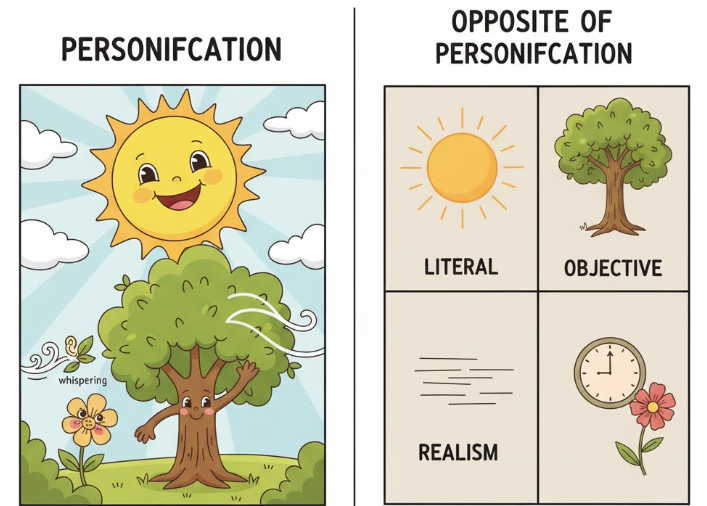
Deobjectification, also known as reification, is a literary device and rhetorical technique where a person or abstract concept is treated as a concrete object. It is essentially the opposite of personification, which assigns human qualities to non-human entities.
Deobjectification strips away the inherent humanity, agency, or complexity of a subject, reducing it to a mere thing. This can be done subtly or overtly, and its effects can range from humorous to deeply offensive.
Classification
Deobjectification falls under the broader category of figurative language, specifically as a type of metaphor. While personification imbues non-human entities with human traits, deobjectification divests human or abstract entities of their inherent qualities, often for rhetorical or artistic effect.
It’s also related to dehumanization, although deobjectification is a broader term that doesn’t always imply malicious intent.
Function
The primary function of deobjectification is to simplify or diminish the subject being described. This can be used for various purposes, including: creating a sense of detachment, emphasizing the vulnerability of a person, criticizing societal structures, or even satirizing certain behaviors.
The effect of deobjectification often hinges on the context and the intent of the speaker or writer. It serves to highlight a specific aspect of the subject, often at the expense of other, more complex characteristics.
Contexts of Use
Deobjectification is prevalent in various contexts, including literature, advertising, political discourse, and everyday conversation. In literature, authors might use it to portray characters who feel alienated or oppressed.
In advertising, it can be used to create a sense of desire for a product by associating it with a person’s identity. In political discourse, it can be used to dehumanize opponents, making it easier to justify harmful actions against them.
Understanding the different contexts in which deobjectification is used helps us to critically analyze its effects and implications.
Structural Breakdown
The structure of deobjectification typically involves the use of language that describes a person or concept in terms that are normally reserved for inanimate objects. This often includes the use of verbs and nouns that emphasize passivity, lack of control, or physical properties.
For example, instead of saying “She felt overwhelmed by the situation,” one might say “She was crushed by the weight of the situation.” The verb “crushed” and the noun “weight” evoke a sense of physical oppression, effectively deobjectifying the person by reducing her experience to a purely physical one.
Key elements often include:
- Nouns referring to objects: Using words that typically describe things rather than people.
- Passive voice: Emphasizing that the person is acted upon, rather than acting.
- Metaphors and similes: Comparing the person to an object.
- Lack of emotional or psychological description: Focusing on physical attributes or external reactions.
Types and Categories of Deobjectification
Deobjectification can manifest in several forms, each with its own nuances and implications. Understanding these types allows for a more nuanced analysis of its effects.
Metaphorical Deobjectification
This type involves using metaphors to compare a person or concept to an object. The comparison highlights certain characteristics while diminishing others.
For instance, saying someone is “a cog in the machine” reduces their role to a small, replaceable part, ignoring their individual skills and contributions. Metaphorical deobjectification often relies on implied comparisons, requiring the audience to make the connection between the person and the object.
Physical Deobjectification
Physical deobjectification focuses on reducing a person to their physical attributes, often ignoring their personality, intellect, or emotions. This can involve describing someone as a “trophy” or “possession,” emphasizing their appearance over their inner qualities.
This type is particularly common in discussions of objectification within social contexts, especially concerning gender and body image.
Abstract Deobjectification
This involves treating abstract concepts as if they were concrete objects. For example, saying “Justice is a blind scale” turns the abstract concept of justice into a physical object that can be measured and weighed.
While this can be a useful rhetorical device, it can also oversimplify complex issues and obscure the nuances of the concept being discussed. Abstract deobjectification often involves personifying the object to which the abstract concept is being compared, creating a layered effect.
Examples of Deobjectification
To illustrate the various types of deobjectification, consider the following examples. These examples are organized by category to help you understand the subtle differences between each type.
Metaphorical Examples
The following table provides examples of metaphorical deobjectification, showing how people or concepts are compared to objects to diminish their qualities.
| Example | Explanation |
|---|---|
| He was just a pawn in their game. | Reduces the person to a disposable piece in a larger strategy, devoid of agency. |
| She felt like a puppet on a string. | Implies complete lack of control, with someone else dictating her actions. |
| They treated him like a disposable tool. | Suggests he was used and discarded without regard for his well-being. |
| The city was a concrete jungle. | Compares the urban environment to a wild, uncivilized place, devoid of human warmth. |
| Her heart was a stone. | Indicates a lack of emotion or empathy, reducing her emotional capacity to an inanimate object. |
| He’s a machine when it comes to work. | Highlights his efficiency and tireless effort, but at the expense of his humanity. |
| She’s just another brick in the wall. | Suggests a lack of individuality and importance, blending into the masses. |
| He’s a number in the system. | Reduces him to a mere statistic, ignoring his personal identity. |
| She’s a trophy wife. | Implies she is valued for her appearance rather than her personality or intellect. |
| He’s a clockwork soldier. | Highlights his obedience and precision, but at the cost of his free will. |
| They see their employees as resources. | Reduces people to commodities to be exploited for profit. |
| She was a fragile doll. | Suggests vulnerability and lack of autonomy, emphasizing her physical appearance. |
| He was a broken record. | Implies repetitive and unoriginal behavior. |
| Life is a game of chess. | Reduces human existence to a strategic competition. |
| He’s a human calculator. | Highlights his mathematical abilities, ignoring other aspects of his personality. |
| She’s a blank canvas. | Implies she lacks inherent qualities and is defined by external influences. |
| He’s a doormat. | Suggests he is easily taken advantage of and lacks self-respect. |
| They treat their customers like ATMs. | Reduces customers to a source of money, disregarding their individual needs. |
| She’s a walking advertisement. | Implies she is valued for her ability to promote products rather than her own merits. |
| He’s a robot at work. | Highlights his efficiency and lack of emotion, making him seem less human. |
| The internet is an information superhighway. | Reduces the complex network of information to a simple transportation route. |
| Society is a pressure cooker. | Implies that societal tensions are building up and could explode at any moment. |
| The legal system is a labyrinth. | Compares the complex legal system to a confusing maze. |
| Education is the key to success. | Simplifies the path to success by reducing it to a single object. |
| Time is money. | Reduces the concept of time to a quantifiable economic resource. |
Physical Examples
The following table illustrates physical deobjectification, where people are reduced to their physical attributes or treated as objects of desire.
| Example | Explanation |
|---|---|
| He saw her as a piece of meat. | Reduces her to a purely physical object, devoid of personality or emotions. |
| She was treated like a mannequin. | Implies she was valued only for her appearance and expected to be silent and passive. |
| He objectified women as mere bodies. | Focuses on their physical forms, ignoring their intellect and character. |
| She felt like an ornament in his collection. | Suggests she was valued for her aesthetic appeal rather than her intrinsic worth. |
| They paraded her around like a prized possession. | Implies she was shown off for status and admiration, not respected as an individual. |
| He viewed her as a plaything. | Reduces her to an object of amusement, disregarding her feelings. |
| She was a living doll. | Emphasizes her appearance and passivity, suggesting she lacked agency. |
| He saw her as an object of desire. | Focuses solely on her physical attractiveness, ignoring her other qualities. |
| They treated him like a show pony. | Implies he was valued for his physical performance rather than his personality. |
| She felt like a display model. | Suggests she was only valued for her visual appeal. |
| He reduced her to her measurements. | Focuses solely on her physical dimensions, ignoring her inner self. |
| She was handled like a fragile artifact. | Emphasizes her physical vulnerability, implying a lack of resilience. |
| He viewed her as a status symbol. | Implies she was valued for the social status she conferred. |
| She felt like a painted canvas. | Suggests she was valued for her outward appearance rather than her true self. |
| He treated women as commodities. | Reduces them to objects that can be bought and sold. |
| She was judged solely on her looks. | Implies that her appearance was the only thing that mattered. |
| He saw her as a beautiful specimen. | Treats her like a scientific exhibit, devoid of personal connection. |
| She felt like a decorative accessory. | Suggests she was valued for her aesthetic contribution rather than her individuality. |
| He viewed her as a piece of property. | Reduces her to something that can be owned and controlled. |
| She was treated like a mannequin in a shop window. | Implies she was put on display for public consumption. |
Abstract Examples
The following table provides examples of abstract deobjectification, where abstract concepts are treated as concrete objects.
| Example | Explanation |
|---|---|
| Justice is a blind scale. | Turns justice into a physical object that can be measured, ignoring its complexities. |
| Love is a battlefield. | Reduces the complex emotion of love to a site of conflict and struggle. |
| Time is a thief. | Personifies time as an entity that steals from us, simplifying its nature. |
| Knowledge is a treasure. | Treats knowledge as a valuable object to be acquired and hoarded. |
| Hope is a fragile thing. | Turns hope into a delicate object that can be easily broken. |
| Fear is a cage. | Reduces fear to a physical barrier that confines and restricts. |
| Grief is a heavy burden. | Turns grief into a physical weight that must be carried. |
| Success is a ladder. | Reduces the complex process of achieving goals to a linear ascent. |
| Failure is a pit. | Turns failure into a physical trap that is difficult to escape. |
| Memory is a photograph. | Reduces the complex process of remembering to a static image. |
| The past is a closed book. | Turns the past into an object that is inaccessible and unchangeable. |
| The future is a blank page. | Reduces the future to an empty space waiting to be filled. |
| Truth is a shining light. | Turns truth into a source of illumination and clarity. |
| Lies are a tangled web. | Reduces deceit to a complex and confusing structure. |
| Power is a dangerous weapon. | Turns power into an instrument of harm and control. |
| Freedom is a precious jewel. | Treats freedom as a valuable object to be protected. |
| Faith is a guiding star. | Turns faith into a source of direction and hope. |
| Doubt is a dark cloud. | Reduces doubt to a source of gloom and uncertainty. |
| Ambition is a burning fire. | Turns ambition into a consuming force. |
| Regret is a haunting ghost. | Reduces regret to a persistent and unwelcome presence. |
Usage Rules
Using deobjectification effectively requires understanding its nuances and potential implications. While it can be a powerful tool for expression, it’s important to use it responsibly and ethically.
Formal Rules
In formal writing, deobjectification should be used deliberately and with a clear purpose. Avoid using it carelessly or in a way that could be misinterpreted.
Ensure that the comparison between the person or concept and the object is clear and logical. Pay attention to the tone and context to avoid unintended offense.
Informal Rules
In informal settings, deobjectification can be used more freely, but it’s still important to be mindful of its potential impact. Consider your audience and the context of the conversation before using deobjectification.
Be aware that some people may find it offensive, even if it’s not your intention.
Ethical Considerations
Deobjectification can have significant ethical implications, particularly when it’s used to dehumanize or marginalize individuals or groups. It’s crucial to be aware of these implications and to avoid using deobjectification in ways that could perpetuate harmful stereotypes or contribute to discrimination.
Consider the power dynamics at play and whether your use of deobjectification could reinforce existing inequalities.
Common Mistakes
One common mistake is using deobjectification without considering its potential for harm. For example, saying “She’s just a pretty face” reduces a woman to her appearance, ignoring her intelligence and skills.
Another mistake is using deobjectification inconsistently, creating a confusing or contradictory message.
Here are some examples of common mistakes and their corrections:
| Incorrect | Correct | Explanation |
|---|---|---|
| He was a brick wall of happiness. | He was a brick wall of resistance. | “Brick wall” typically implies resistance or impenetrability, not happiness. |
| She felt like a car engine. | She felt like a well-oiled machine. | While “car engine” could be linked to machinery, “well-oiled machine” is a more common metaphor for efficiency. |
| The idea was a stone of hope. | The idea was a seed of hope. | “Stone” implies immovability and lack of life, whereas “seed” suggests potential for growth. |
| He treated his employees like flowers. | He treated his employees like cogs in a machine. | Treating someone like a flower implies care and nurturing, the opposite of deobjectification. |
| She was a mountain of joy. | She was a mountain of stress. | “Mountain” usually implies something heavy and difficult to overcome, not joy. |
Practice Exercises
Test your understanding of deobjectification with the following exercises.
Exercise 1: Identifying Deobjectification
Identify whether the following sentences contain deobjectification. If they do, explain what is being deobjectified and how.
| Question | Answer |
|---|---|
| 1. The company sees its employees as human capital. | Yes. Employees are being reduced to economic resources. |
| 2. The sun smiled down on the earth. | No. This is an example of personification. |
| 3. She was a beautiful ornament on his arm. | Yes. She is being reduced to a decorative object. |
| 4. He felt like a cog in the machine of bureaucracy. | Yes. He is being reduced to a small, insignificant part of a larger system. |
| 5. The wind whispered through the trees. | No. This is an example of personification. |
| 6. They treated her like a porcelain doll. | Yes. She is being reduced to a fragile and ornamental object. |
| 7. He was a rock in her life. | Yes. He is being reduced to a source of stability and strength, lacking complexity. |
| 8. The rain cried down from the sky. | No. This is an example of personification. |
| 9. She felt like a mannequin in a store window. | Yes. She is being reduced to a lifeless object on display. |
| 10. He was a tool to get the job done. | Yes. He is being reduced to a means to an end, lacking intrinsic value. |
Exercise 2: Rewriting Sentences
Rewrite the following sentences to incorporate deobjectification.
| Question | Answer |
|---|---|
| 1. She felt overwhelmed by the pressure. | She was crushed by the weight of the pressure. |
| 2. He was easily manipulated by others. | He was a puppet on their strings. |
| 3. The city was chaotic and impersonal. | The city was a concrete jungle. |
| 4. She lacked empathy for others. | Her heart was a stone. |
| 5. He worked tirelessly and efficiently. | He was a machine when it came to work. |
| 6. She felt insignificant in the crowd. | She was just another brick in the wall. |
| 7. He was just a statistic to the government. | He was a number in the system. |
| 8. She was valued for her beauty. | She was a trophy wife. |
| 9. He followed orders without question. | He was a clockwork soldier. |
| 10. The company exploited its workers for profit. | They saw their employees as resources. |
Exercise 3: Using Deobjectification in Writing
Write a short paragraph using at least three examples of deobjectification to describe a character or situation.
Example Answer
In the factory, Maria felt like a cog in a vast, uncaring machine. Her days were a monotonous cycle, each task as repetitive as a broken record.
She was just a number on a timesheet, her individuality lost in the relentless pursuit of profit. The management saw her and her colleagues as mere resources, expendable parts in their grand scheme.
Advanced Topics
For advanced learners, it’s important to understand the deeper implications of deobjectification and its connection to other concepts.
Deobjectification and Dehumanization
Dehumanization is a more extreme form of deobjectification that involves stripping individuals or groups of their humanity, portraying them as less than human. While deobjectification doesn’t always imply malicious intent, dehumanization is often used to justify violence, discrimination, and oppression.
Understanding the link between these two concepts is crucial for analyzing propaganda and hate speech.
Deobjectification in Political Rhetoric
Deobjectification is a common tool in political rhetoric, used to simplify complex issues, demonize opponents, and mobilize support for certain policies. Politicians might use deobjectification to portray immigrants as “invaders” or to describe social programs as “entitlements,” framing them as burdens on society.
Analyzing these rhetorical strategies helps us to critically evaluate political messages and resist manipulation.
FAQ: Frequently Asked Questions
Here are some frequently asked questions about deobjectification.
- What is the difference between personification and deobjectification?
Personification gives human qualities to non-human things, while deobjectification takes human qualities away, treating people or abstract concepts as objects. They are essentially opposites. - Is deobjectification always negative?
Not necessarily. While it can be used to dehumanize or diminish, it can also be used for artistic effect or to highlight certain aspects of a subject. The context and intent are crucial. - How can I identify deobjectification in writing?
Look for language that reduces people or concepts to objects. This often involves the use of nouns and verbs that emphasize passivity, lack of control, or physical properties. - What are the ethical considerations when using deobjectification?
Be mindful of the potential to dehumanize or marginalize individuals or groups. Avoid using it in ways that could perpetuate harmful stereotypes or contribute to discrimination. - How does deobjectification relate to dehumanization?
Dehumanization is a more extreme form of deobjectification. It involves stripping individuals or groups of their humanity, portraying them as less than human. - Can deobjectification be used unintentionally?
Yes, it’s possible to use deobjectification unintentionally, especially in casual conversation. Being aware of the concept can help you avoid making unintentional offensive statements. - How can I avoid using deobjectification in my own writing?
Be mindful of the language you use to describe people and abstract concepts. Focus on their complexity and individuality, and avoid reducing them to simple objects. - Where else can I find examples of deobjectification?
You can find examples of deobjectification in literature, advertising, political discourse, and everyday conversation. Pay attention to the language used in these contexts and analyze its effects.
Conclusion
Deobjectification is a powerful rhetorical device that can be used to simplify, diminish, or even dehumanize individuals and concepts. Understanding its definition, structural components, types, and usage rules is essential for mastering English and critically analyzing the language around you.
By recognizing deobjectification, you can become a more discerning reader, a more effective writer, and a more ethically conscious communicator. Be mindful of the potential impact of your words and strive to use language that promotes respect and understanding.
Continue to practice identifying and analyzing deobjectification in various contexts. Experiment with using it in your own writing, but always be mindful of its potential implications.
By mastering this concept, you’ll enhance your linguistic skills and develop a deeper appreciation for the power of language.