Understanding antonyms is crucial for expanding vocabulary and enhancing communication skills. When we consider the word “valuable,” we immediately think of worth, importance, and desirability.
But what about its opposites? Exploring the antonyms of “valuable” allows us to appreciate the nuances of language and express a wider range of meanings.
This article delves into the various antonyms of “valuable,” providing definitions, examples, and practice exercises to help you master this aspect of English vocabulary. This guide is perfect for English language learners, writers, and anyone looking to improve their command of the language through a deeper understanding of word relationships.
Table of Contents
- Introduction
- Definition of Valuable
- Structural Breakdown of “Valuable”
- Types of Antonyms for “Valuable”
- Examples of Antonyms in Sentences
- Usage Rules for Antonyms of “Valuable”
- Common Mistakes
- Practice Exercises
- Advanced Topics
- FAQ
- Conclusion
Introduction
Expanding one’s vocabulary is an ongoing journey, and understanding antonyms is a vital part of this process. The word “valuable” is frequently used to describe something of great worth or significance.
Recognizing its antonyms allows for more precise and nuanced communication. This article provides a comprehensive exploration of words that stand in opposition to “valuable,” enhancing your ability to express varying degrees of worthlessness, insignificance, and expendability.
By examining these antonyms, we gain a better appreciation for the richness and flexibility of the English language.
Definition of Valuable
The word “valuable” is an adjective that describes something having great worth or importance. It can refer to monetary value, as in “a valuable painting,” or to intangible value, as in “valuable advice.” Something valuable is considered desirable and worth protecting or cherishing.
Its value can be determined by its rarity, utility, or emotional significance.
Classification: Adjective
Function: To describe the worth, importance, or usefulness of a noun.
Contexts: Business, personal relationships, art, history, and everyday situations.
Structural Breakdown of “Valuable”
The word “valuable” is formed from the noun “value” and the suffix “-able.” The suffix “-able” means “capable of” or “worthy of.” Therefore, “valuable” literally means “worthy of value” or “having value.” Understanding this breakdown can help in recognizing other words with similar structures and meanings. The root word “value” itself comes from the Latin word *valere*, meaning “to be strong, be worth.” This etymological understanding further clarifies the concept of “valuable” as something possessing inherent strength and worth.
Types of Antonyms for “Valuable”
The antonyms of “valuable” can be categorized based on the specific aspect of “valuable” they negate. For example, some antonyms relate to monetary worth, while others relate to importance or usefulness.
Here are some key categories and examples:
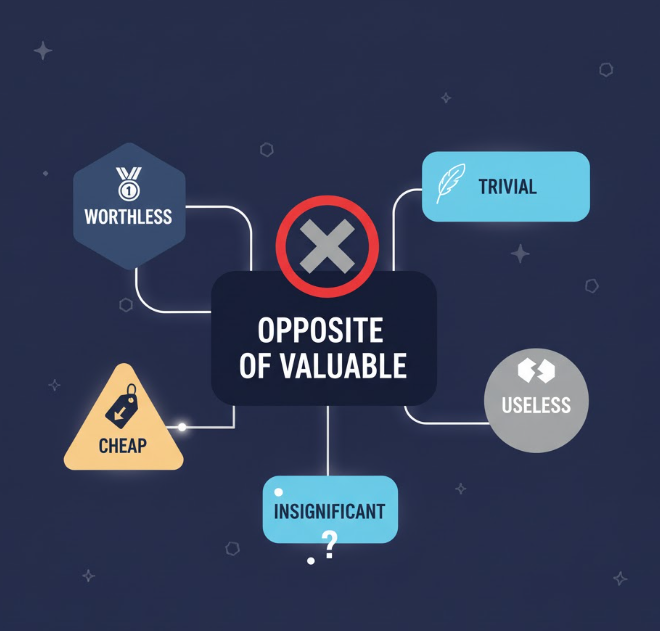
Worthless
Definition: Having no practical or material value.
Usage: Describes something that is not worth any money or effort.
Useless
Definition: Not able to be used for any practical purpose or of no help.
Usage: Describes something that does not serve a purpose or is ineffective.
Cheap
Definition: Low in price; inexpensive.
Usage: Describes something that has a low monetary value, especially compared to similar items.
Insignificant
Definition: Too small or unimportant to be worth consideration.
Usage: Describes something that lacks importance or consequence.
Trivial
Definition: Of little value or importance.
Usage: Describes something that is not serious or important; frivolous.
Unimportant
Definition: Lacking in importance or significance.
Usage: Similar to “insignificant” but can also refer to something that is not essential.
Expendable
Definition: Of little significance when compared to an overall purpose, and therefore easily abandoned; able to be used up and then discarded or replaced.
Usage: Describes something that can be sacrificed or discarded without significant loss.
Deficient
Definition: Not having enough of a specified quality or ingredient.
Usage: Describes something that lacks an essential quality or component, making it less valuable.
Examples of Antonyms in Sentences
Here are some examples of antonyms of “valuable” used in sentences, categorized for clarity. The tables below provide a comprehensive overview.
| Antonym | Example Sentence |
|---|---|
| Worthless | The antique turned out to be a worthless imitation. |
| Worthless | His promises were worthless, as he never kept them. |
| Worthless | The abandoned mine was full of worthless rocks. |
| Worthless | She considered the gossip to be worthless information. |
| Worthless | The broken toy was now worthless to the child. |
| Worthless | His attempt to fix the car was worthless, as he lacked the skills. |
| Worthless | The company declared the old equipment as worthless assets. |
| Worthless | The treasure map led to a worthless pile of dirt. |
| Worthless | The politician’s empty promises were worthless to the voters. |
| Worthless | The coupon had expired and was now worthless. |
| Useless | The broken umbrella was useless in the rain. |
| Useless | Trying to argue with him is useless; he never listens. |
| Useless | The software update rendered the old program useless. |
| Useless | Without a power source, the device is useless. |
| Useless | The rusty tool was useless for the repair job. |
| Useless | The instruction manual was useless, as it was poorly written. |
| Useless | Her attempt to reason with the angry crowd was useless. |
| Useless | The old car was useless without a working engine. |
| Useless | The outdated map was useless in the modern city. |
| Useless | His vast knowledge of ancient history was useless in his current job. |
The table above illustrates the usage of “worthless” and “useless” as antonyms of “valuable,” highlighting their different contexts and meanings.
| Antonym | Example Sentence |
|---|---|
| Cheap | He bought a cheap watch that broke after a week. |
| Cheap | The restaurant served cheap ingredients, resulting in poor-quality meals. |
| Cheap | She regretted buying the cheap shoes, as they were uncomfortable. |
| Cheap | The hotel room was cheap, but it lacked basic amenities. |
| Cheap | The company used cheap materials to cut costs. |
| Cheap | The furniture was cheap and poorly constructed. |
| Cheap | He opted for the cheap flight, despite the long layover. |
| Cheap | The cheap plastic toy broke easily. |
| Cheap | The cheap fabric faded after only one wash. |
| Cheap | She found a cheap alternative to the expensive brand. |
| Insignificant | The error in the report was insignificant and easily corrected. |
| Insignificant | His contribution to the project was insignificant. |
| Insignificant | The difference between the two options was insignificant. |
| Insignificant | The amount of money lost was insignificant to the company. |
| Insignificant | The detail was considered insignificant during the planning phase. |
| Insignificant | Her role in the event was insignificant. |
| Insignificant | The change in temperature was insignificant. |
| Insignificant | The impact of the new policy was insignificant. |
| Insignificant | The amount of time spent on the task was insignificant. |
| Insignificant | The risk involved was insignificant. |
This table presents examples of “cheap” and “insignificant” as antonyms, showing how they relate to monetary value and importance, respectively.
| Antonym | Example Sentence |
|---|---|
| Trivial | They argued over a trivial detail. |
| Trivial | The concerns he raised were trivial in the grand scheme of things. |
| Trivial | She dismissed the issue as trivial. |
| Trivial | The amount of time spent on the trivial task was excessive. |
| Trivial | The topic of the conversation was trivial and uninteresting. |
| Trivial | He worried about trivial matters instead of focusing on the important ones. |
| Trivial | The mistake was trivial and easily overlooked. |
| Trivial | The difference between the two brands was trivial. |
| Trivial | The complaint was considered trivial by the management. |
| Trivial | The impact of the change was trivial. |
| Unimportant | The meeting discussed several unimportant issues. |
| Unimportant | Whether you wear that shirt or not is unimportant. |
| Unimportant | The details she mentioned were unimportant to the overall story. |
| Unimportant | The task was considered unimportant and was delegated to an intern. |
| Unimportant | His opinion on the matter was unimportant to the decision-making process. |
| Unimportant | The side effects of the medication were deemed unimportant by the doctor. |
| Unimportant | The fact that he was late was unimportant, considering the circumstances. |
| Unimportant | The small details were unimportant compared to the main goal. |
| Unimportant | The amount of money spent was unimportant compared to the benefits gained. |
| Unimportant | The question he asked was unimportant to the discussion. |
This table showcases “trivial” and “unimportant,” highlighting their use in describing matters of little significance.
| Antonym | Example Sentence |
|---|---|
| Expendable | The company considered the temporary workers expendable. |
| Expendable | In the game, the soldiers were expendable resources. |
| Expendable | The old equipment was deemed expendable and was replaced. |
| Expendable | The low-priority tasks were expendable if time ran out. |
| Expendable | The outdated technology was expendable and was scheduled for disposal. |
| Expendable | The extra supplies were expendable and could be used for other projects. |
| Expendable | The company viewed the entry-level positions as expendable. |
| Expendable | The initial investment was expendable if the project failed. |
| Expendable | The older models were expendable and were being phased out. |
| Expendable | The experimental units were expendable and were used for testing purposes. |
| Deficient | The soil was deficient in nutrients, affecting the plant growth. |
| Deficient | His diet was deficient in vitamins and minerals. |
| Deficient | The product was deficient in quality and did not meet the standards. |
| Deficient | The training program was deficient in practical skills. |
| Deficient | The report was deficient in data and analysis. |
| Deficient | The team was deficient in leadership and coordination. |
| Deficient | The building was deficient in safety features. |
| Deficient | The explanation was deficient in detail and clarity. |
| Deficient | The company was deficient in resources and funding. |
| Deficient | The system was deficient in security measures. |
This final table illustrates the usage of “expendable” and “deficient” as antonyms, highlighting their meanings related to dispensability and lacking essential qualities.
Usage Rules for Antonyms of “Valuable”
Using antonyms correctly requires understanding the specific context and intended meaning. Here are some rules to consider:
- Worthless is used when something has no value, either monetary or practical.
- Useless is used when something cannot be used or does not serve a purpose.
- Cheap is used when something has a low monetary value, often implying low quality.
- Insignificant is used when something is not important or consequential.
- Trivial is used when something is of little value or importance, often implying it is frivolous.
- Unimportant is used when something lacks significance or is not essential.
- Expendable is used when something can be sacrificed or discarded without significant loss.
- Deficient is used when something lacks an essential quality or component.
Exceptions: Sometimes, the choice of antonym depends on the specific nuance you want to convey. For example, “cheap” might be appropriate when discussing the price of an item, while “worthless” might be more appropriate when discussing the value of a promise.
Special Cases: In some cases, a phrase might be a more appropriate antonym than a single word. For example, instead of saying something is “unimportant,” you might say it is “of no consequence.”
Common Mistakes
Here are some common mistakes to avoid when using antonyms of “valuable”:
- Confusing “worthless” and “useless”: “Worthless” implies a lack of inherent value, while “useless” implies a lack of functionality.
- Using “cheap” when “inexpensive” is more appropriate: “Cheap” can have a negative connotation, implying low quality, while “inexpensive” is more neutral.
- Overusing “insignificant”: Consider whether “trivial” or “unimportant” might be a more precise choice.
| Incorrect | Correct | Explanation |
|---|---|---|
| The advice was cheap. | The advice was worthless. | “Cheap” refers to monetary value, while “worthless” refers to the value of advice. |
| The tool was unimportant for the job. | The tool was useless for the job. | “Unimportant” implies a lack of significance, while “useless” implies a lack of functionality. |
| The information was expendable. | The information was trivial. | “Expendable” suggests it can be sacrificed, while “trivial” suggests it is of little importance. |
Practice Exercises
Test your understanding with these practice exercises.
- Choose the best antonym for “valuable” in the following sentence: The antique was found to be ______.
- expensive
- worthless
- useful
- important
- Replace the word in bold with an antonym: The valuable painting was stolen from the museum.
- cheap
- priceless
- significant
- original
- Which word is the closest antonym of “valuable” in the context of advice?
- costly
- helpful
- useless
- significant
- Choose the best antonym for “valuable” in the following sentence: The old map was ______.
- expensive
- worthless
- helpful
- important
- Replace the word in bold with an antonym: The valuable information was crucial to the investigation.
- cheap
- priceless
- insignificant
- original
- Which word is the closest antonym of “valuable” in the context of a tool?
- costly
- helpful
- useless
- significant
- Choose the best antonym for “valuable” in the following sentence: The company considered the old equipment ______.
- expensive
- expendable
- useful
- important
- Replace the word in bold with an antonym: The valuable contribution was recognized by the team.
- cheap
- priceless
- insignificant
- original
- Which word is the closest antonym of “valuable” in the context of a skill?
- costly
- helpful
- deficient
- significant
- Choose the best antonym for “valuable” in the following sentence: The old toy was ______.
- expensive
- worthless
- useful
- important
Answer Key:
- b
- a
- c
- b
- c
- c
- b
- c
- c
- b
Advanced Topics
For advanced learners, consider the following:
- Connotation and nuance: Explore how the connotations of different antonyms can affect the meaning of a sentence.
- Figurative language: Analyze how antonyms are used in metaphors, similes, and other figures of speech.
- Etymology: Investigate the origins of the antonyms and how their meanings have evolved over time.
FAQ
- What is the difference between “worthless” and “useless”?Worthless means lacking value, either monetary or inherent. For example, a counterfeit bill is worthless because it has no recognized monetary value. Useless means not able to be used or serving no purpose. For example, a broken tool is useless because it cannot perform its intended function.
- When should I use “cheap” instead of “inexpensive”?Cheap often carries a negative connotation, suggesting low quality or poor construction. Inexpensive is a more neutral term simply indicating a low price. Use “cheap” when you want to emphasize the low quality, and “inexpensive” when you only want to state the low price without judgment.
- How is “insignificant” different from “unimportant”?Both words mean lacking importance, but insignificant often refers to something that is too small or trivial to be considered, while unimportant can refer to something that is not essential or necessary. “Insignificant” is often used to describe details or amounts, while “unimportant” is used to describe broader concepts or tasks.
- What is the best antonym for “valuable” in the context of time?In the context of time, a good antonym for “valuable” might be wasted or unproductive. Valuable time is time well-spent, while wasted or unproductive time is time that did not yield beneficial results or achievements.
- Can “harmful” be considered an antonym of “valuable”?While not a direct antonym, “harmful” can be considered an indirect antonym in certain contexts. Something valuable is often considered beneficial or helpful, while something harmful is detrimental or damaging. Thus, in terms of overall effect, “harmful” stands in contrast to “valuable.”
- Is there a situation where “expensive” could be an antonym of “valuable”?No, “expensive” is not an antonym of “valuable.” While something expensive may or may not be valuable, the terms describe different qualities. “Expensive” refers to the high cost of something, while “valuable” refers to its worth or importance.
- How does the context of a sentence affect the choice of antonym?The context of a sentence is crucial in determining the most appropriate antonym. For instance, when discussing a skill, “deficient” might be a suitable antonym for “valuable,” highlighting a lack of essential qualities. However, when discussing an object, “worthless” or “useless” may be more fitting antonyms, focusing on the object’s lack of value or functionality. Therefore, consider the specific aspect of “valuable” being negated to choose the most accurate antonym.
- What are some other words that are similar to “expendable”?Some words similar to “expendable” include disposable, replaceable, and nonessential. These words all convey the idea that something can be used up or discarded without significant loss or consequence. “Expendable” often implies that something is of lesser importance compared to an overall goal or purpose.
Conclusion
Understanding the antonyms of “valuable” is essential for enhancing your vocabulary and improving your ability to communicate effectively. By exploring words like “worthless,” “useless,” “cheap,” “insignificant,” and others, you can express a wider range of meanings and nuances.
Remember to consider the context and intended meaning when choosing the most appropriate antonym.
Continue practicing with these words in various contexts to solidify your understanding. Pay attention to how native speakers use these antonyms in their speech and writing.
With consistent effort, you can master this aspect of English vocabulary and communicate with greater precision and clarity.