English offers a rich tapestry of words to express negativity, displeasure, or inadequacy. While “bad” serves as a fundamental adjective, relying solely on it can limit the nuance and impact of your communication.
This article delves into a comprehensive exploration of adjectives synonymous with “bad,” providing you with the tools to precisely convey the degree and nature of something unfavorable. Understanding and utilizing these adjectives effectively will significantly enhance your descriptive abilities, making your writing and speech more vivid and compelling.
This guide is perfect for English language learners, writers, and anyone looking to expand their vocabulary and improve their command of the English language.
Whether you’re describing a poorly executed plan, a disagreeable experience, or a morally reprehensible action, the right adjective can make all the difference. By exploring a wide array of alternatives to “bad,” you’ll gain the ability to paint a more accurate and evocative picture for your audience.
This article provides definitions, examples, and practical exercises to help you master the art of describing the undesirable with precision and flair.
Table of Contents
- Definition of “Bad” and Its Synonyms
- Structural Breakdown of Adjectives
- Types of Adjectives for “Bad”
- Examples of Adjectives for “Bad”
- Usage Rules for Adjectives
- Common Mistakes When Using Adjectives for “Bad”
- Practice Exercises
- Advanced Topics: Nuances and Connotations
- Frequently Asked Questions
- Conclusion
Definition of “Bad” and Its Synonyms
The word “bad” is a fundamental adjective in the English language used to describe something that is not good, desirable, or satisfactory. It’s a versatile term applicable to a wide range of contexts, from describing the quality of an object to the morality of an action.
However, its broad application can sometimes lack the precision needed to convey specific nuances. Therefore, expanding your vocabulary with synonyms of “bad” is crucial for effective communication.
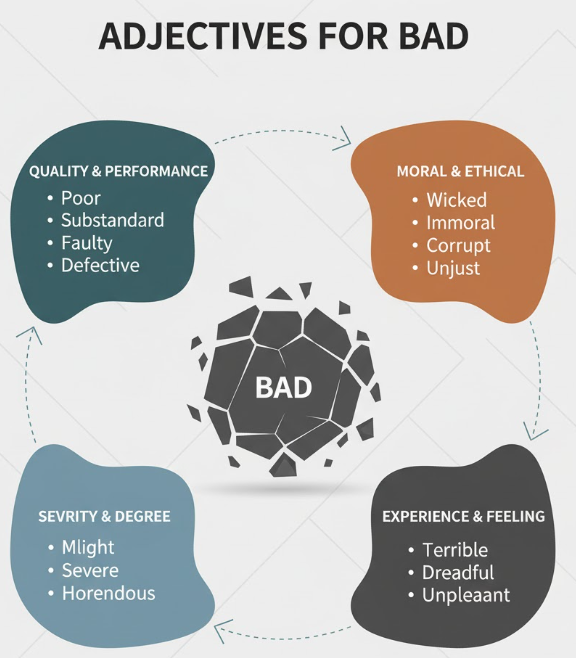
Synonyms for “bad” offer more specific and descriptive alternatives, allowing you to convey the precise nature of the negativity you wish to express. These synonyms can be categorized based on the specific aspect of “bad” they emphasize.
For example, “awful” might describe a terrible experience, while “wicked” might describe immoral behavior. Understanding these nuances allows for more precise and impactful communication.
Structural Breakdown of Adjectives
Adjectives, including those for “bad,” typically precede the noun they modify (e.g., “a terrible storm”) or follow a linking verb such as “is,” “are,” “was,” “were,” “seem,” or “become” (e.g., “The food tasted awful“). Understanding this basic structure is essential for proper sentence construction. Adjectives can also be modified by adverbs to intensify or qualify their meaning (e.g., “extremely awful,” “slightly unpleasant”).
Many adjectives are formed by adding suffixes to nouns or verbs. For example, adding “-ful” to the noun “harm” creates the adjective “harmful.” Similarly, adding “-less” to “harm” creates “harmless.” Recognizing these patterns can help you understand and remember the meanings of various adjectives.
Some adjectives are also formed through compounding, such as “ill-advised.”
Types of Adjectives for “Bad”
Adjectives for “bad” can be categorized based on the specific aspect of negativity they convey. Understanding these categories helps you choose the most appropriate word for the situation.
These categories include adjectives describing negative quality, unpleasant experiences, harmful effects, immoral behavior, and inadequate skill or performance.
Adjectives Describing Negative Quality
These adjectives describe something that is inherently flawed or of poor quality. They focus on the characteristics of the object or situation itself, rather than its effects or consequences.
Examples include “inferior,” “substandard,” “deficient,” and “flawed.”
Adjectives Describing Unpleasant Experiences
These adjectives focus on the negative emotional or sensory impact of something. They describe experiences that are disagreeable, uncomfortable, or distressing.
Examples include “awful,” “dreadful,” “horrible,” “unpleasant,” “disagreeable,” and “miserable.”
Adjectives Describing Harmful Effects
These adjectives describe something that causes damage, injury, or negative consequences. They emphasize the impact of the object or situation on people, animals, or the environment.
Examples include “detrimental,” “injurious,” “pernicious,” “harmful,” and “destructive.”
Adjectives Describing Immoral Behavior
These adjectives describe actions or behaviors that are considered morally wrong or unethical. They focus on the violation of moral principles and societal norms.
Examples include “wicked,” “evil,” “corrupt,” “immoral,” “nefarious,” and “unscrupulous.”
Adjectives Describing Inadequate Skill or Performance
These adjectives describe a lack of skill, competence, or ability. They focus on the failure to meet a certain standard of performance or achievement.
Examples include “inadequate,” “poor,” “unsatisfactory,” “deficient,” “incompetent,” and “amateurish.”
Examples of Adjectives for “Bad”
The following tables provide numerous examples of adjectives that can be used in place of “bad,” categorized by the type of negativity they express. Each example is presented within a sentence to illustrate its usage in context.
Table 1: Adjectives Describing Negative Quality
This table showcases adjectives that denote something of poor or inferior quality. Each adjective is used in a sentence to illustrate its specific meaning and application.
| Adjective | Example Sentence |
|---|---|
| Inferior | The inferior quality of the materials caused the product to break easily. |
| Substandard | The restaurant received complaints about its substandard food and service. |
| Deficient | The soil was deficient in nutrients, resulting in a poor harvest. |
| Flawed | The diamond was beautiful, but it had a flawed cut. |
| Imperfect | The painting was imperfect, but it still held a certain charm. |
| Shoddy | The construction work was shoddy, and the building soon began to fall apart. |
| Mediocre | The student’s performance was mediocre; he needed to improve to pass. |
| Second-rate | The hotel was second-rate, offering few amenities and poor service. |
| Common | His behavior was common and distasteful. |
| Awful | The play was simply awful, with terrible acting and a confusing plot. |
| Lousy | I had a lousy day at work, everything seemed to go wrong. |
| Dreadful | The weather was dreadful, with constant rain and strong winds. |
| Terrible | The accident was terrible, leaving many people injured. |
| Atrocious | The driving conditions were atrocious due to the heavy fog. |
| Abysmal | The team’s performance was abysmal, they lost by a large margin. |
| Crude | The joke was crude and offensive to many people. |
| Coarse | His language was coarse and inappropriate for the formal setting. |
| Vulgar | The comedian’s act was considered vulgar by some audience members. |
| Tasteless | The decoration was tasteless and lacked any sense of style. |
| Garish | The bright colors were garish and overwhelming. |
Table 2: Adjectives Describing Unpleasant Experiences
This table provides adjectives to describe experiences that are disagreeable or distressing, enhancing your ability to express negative feelings and situations vividly.
| Adjective | Example Sentence |
|---|---|
| Awful | The traffic was awful this morning, I was late for work. |
| Dreadful | The news was dreadful; a major earthquake had struck the region. |
| Horrible | The food tasted horrible; it was overcooked and bland. |
| Unpleasant | The meeting was unpleasant due to the constant arguments. |
| Disagreeable | The weather was disagreeable, with cold rain and strong winds. |
| Miserable | I felt miserable after failing the exam. |
| Depressing | The movie was depressing, leaving me feeling sad and empty. |
| Grim | The situation looked grim after the company announced layoffs. |
| Bleak | The future seemed bleak after the economic downturn. |
| Distressing | The news report was distressing, detailing the suffering of the refugees. |
| Regrettable | It was a regrettable incident that could have been avoided. |
| Unfortunate | It was an unfortunate accident that caused significant damage. |
| Lamentable | The state of education in the region is lamentable. |
| Deplorable | The living conditions in the slum were deplorable. |
| Wretched | He felt wretched after losing his job and his home. |
| Appalling | The lack of clean water was appalling in the drought-stricken area. |
| Revolting | The smell in the abandoned building was revolting. |
| Disgusting | The sight of the polluted river was disgusting. |
| Nauseating | The ride on the boat was nauseating due to the rough seas. |
| Offensive | The comedian’s jokes were offensive to many in the audience. |
| Repugnant | The idea of exploiting animals for entertainment is repugnant to me. |
| Abhorrent | Racism is an abhorrent ideology. |
| Loathsome | He was a loathsome character, despised by everyone who knew him. |
Table 3: Adjectives Describing Harmful Effects
This table lists adjectives that describe something causing damage or negative consequences, helping you articulate the impact of harmful situations or objects.
| Adjective | Example Sentence |
|---|---|
| Harmful | Smoking is harmful to your health. |
| Detrimental | The lack of exercise is detrimental to your physical well-being. |
| Injurious | The sharp edges of the broken glass were injurious. |
| Pernicious | Gossip can have a pernicious effect on relationships. |
| Damaging | The flood caused damaging to the crops. |
| Destructive | The hurricane was destructive, leveling entire towns. |
| Ruinous | The economic crisis was ruinous for many small businesses. |
| Adverse | The medication had adverse side effects. |
| Unhealthy | Eating too much processed food is unhealthy. |
| Toxic | The factory released toxic fumes into the air. |
| Poisonous | The mushrooms were poisonous and should not be eaten. |
| Virulent | The disease was highly virulent and spread rapidly. |
| Corrosive | The acid was highly corrosive and could burn through metal. |
| Debilitating | The illness was debilitating, leaving him weak and unable to work. |
| Crippling | The injury was crippling, preventing him from walking. |
| Lethal | The snake’s venom was lethal. |
| Malignant | The tumor was malignant and required immediate treatment. |
| Baneful | The influence of the corrupt politician was baneful to the city. |
| Baleful | His baleful stare made her feel uneasy. |
| Catastrophic | The oil spill had catastrophic consequences for the marine environment. |
| Devastating | The earthquake was devastating, causing widespread destruction and loss of life. |
| Dire | The consequences of climate change are dire if we don’t take action. |
Table 4: Adjectives Describing Immoral Behavior
This table contains adjectives that describe morally wrong or unethical actions, helping you express disapproval and condemnation.
| Adjective | Example Sentence |
|---|---|
| Wicked | The wicked stepmother mistreated Cinderella. |
| Evil | The evil villain plotted to take over the world. |
| Corrupt | The corrupt official accepted bribes. |
| Immoral | His actions were immoral and unethical. |
| Nefarious | The nefarious plot involved stealing the company’s secrets. |
| Unscrupulous | The unscrupulous businessman exploited his workers. |
| Dishonest | His dishonest behavior ruined his reputation. |
| Deceitful | The deceitful politician lied to the public. |
| Treacherous | He was a treacherous friend who betrayed everyone. |
| Base | The base act of stealing from the poor was despicable. |
| Vile | His vile comments were offensive and hurtful. |
| Heinous | The heinous crime shocked the entire community. |
| Atrocious | The atrocious treatment of the prisoners was condemned by human rights groups. |
| Depraved | The depraved individual committed unspeakable acts. |
| Iniquitous | The iniquitous system favored the rich and powerful. |
| Sinful | The priest warned against sinful thoughts and actions. |
| Perfidious | The perfidious spy betrayed his country. |
| Machiavellian | His Machiavellian tactics involved manipulating people for his own gain. |
| Unethical | The company’s unethical practices were exposed by the whistleblower. |
| Reprehensible | His reprehensible behavior was unacceptable. |
| Despicable | The despicable act of vandalism angered the community. |
Table 5: Adjectives Describing Inadequate Skill or Performance
This table showcases adjectives to describe a lack of skill or poor performance, allowing you to provide nuanced feedback and assessments.
| Adjective | Example Sentence |
|---|---|
| Inadequate | His preparation was inadequate for the difficult exam. |
| Poor | The student’s writing skills were poor and needed improvement. |
| Unsatisfactory | The results of the experiment were unsatisfactory. |
| Deficient | His knowledge of the subject was deficient. |
| Incompetent | The incompetent worker made several mistakes. |
| Amateurish | The film had an amateurish quality due to the poor lighting and sound. |
| Inept | He was inept at handling the delicate equipment. |
| Clumsy | The clumsy waiter spilled the drinks. |
| Awkward | His awkward movements made it difficult for him to dance. |
| Unskilled | The unskilled laborer struggled to complete the task. |
| Subpar | The team’s performance was subpar compared to previous games. |
| Inferior | The inferior product did not meet the company’s standards. |
| Lacking | The presentation was lacking in detail. |
| Insufficient | There was insufficient evidence to prove his guilt. |
| Incomplete | The report was incomplete and needed more information. |
| Flawed | The plan was flawed from the beginning. |
| Imperfect | The diamond was imperfect but still beautiful. |
| Faulty | The equipment was faulty and did not work properly. |
| Defective | The product was defective and had to be returned. |
| Erroneous | The report contained erroneous information. |
Usage Rules for Adjectives
Adjectives generally precede the noun they modify. For example, “a terrible experience.” However, they can also follow linking verbs like “is,” “are,” “was,” “were,” “seem,” “become,” and “feel.” For example, “The food tasted awful.”
Adjectives are not pluralized, regardless of the number of nouns they modify. For example, “The harmful effects” (not “harmfuls effects”). When using multiple adjectives to describe a noun, there’s a general order to follow: opinion, size, age, shape, color, origin, material, and purpose. For example, “a beautiful large old round brown Italian leather chair.”
Some adjectives have comparative and superlative forms to indicate degrees of negativity. These are usually formed by adding “-er” and “-est” (e.g., “worse,” “worst”) or by using “more” and “most” (e.g., “more detrimental,” “most detrimental”).
Irregular adjectives like “bad” have irregular comparative and superlative forms: “worse” and “worst,” respectively.
Common Mistakes When Using Adjectives for “Bad”
One common mistake is using “badly” when “bad” is required. “Bad” is an adjective, used to describe nouns, while “badly” is an adverb, used to describe verbs. Incorrect: “He felt badly.” Correct: “He felt bad.”
Another frequent error involves the incorrect use of comparative and superlative forms. Ensure you use the correct form, especially with irregular adjectives. Incorrect: “This is the most bad movie I’ve ever seen.” Correct: “This is the worst movie I’ve ever seen.”
Over-reliance on the word “bad” itself is another common issue. While grammatically correct, it often lacks precision and impact. Using a more specific synonym enhances the clarity and effectiveness of your communication. Less Effective: “The food was bad.” More Effective: “The food was disgusting.”
Practice Exercises
Exercise 1: Fill in the Blanks
Choose the most appropriate adjective from the list to complete each sentence: (awful, detrimental, wicked, inadequate, inferior)
| Question | Answer |
|---|---|
| 1. The weather was _____, with constant rain and strong winds. | awful |
| 2. The lack of exercise is _____ to your health. | detrimental |
| 3. The _____ stepmother mistreated Cinderella. | wicked |
| 4. His preparation was _____ for the difficult exam. | inadequate |
| 5. The _____ quality of the materials caused the product to break easily. | inferior |
| 6. The news was _____; a major earthquake had struck the region. | awful |
| 7. The company’s _____ practices were exposed by the whistleblower. | wicked |
| 8. His knowledge of the subject was _____. | inadequate |
| 9. The team’s performance was _____ compared to previous games. | inferior |
| 10. The judge called the defendant’s actions _____. | wicked |
Exercise 2: Sentence Transformation
Rewrite each sentence using a more descriptive adjective for “bad.”
| Question | Answer |
|---|---|
| 1. The food tasted bad. | The food tasted revolting. |
| 2. The movie was bad. | The movie was depressing. |
| 3. The behavior was bad. | The behavior was reprehensible. |
| 4. The quality of the product was bad. | The quality of the product was substandard. |
| 5. The accident was bad. | The accident was devastating. |
| 6. His manners were bad. | His manners were coarse. |
| 7. The news was bad. | The news was grim. |
| 8. The conditions were bad. | The conditions were deplorable. |
| 9. The plan was bad. | The plan was flawed. |
| 10. Her performance was bad. | Her performance was inadequate. |
Exercise 3: Multiple Choice
Choose the best adjective to replace “bad” in the following sentences.
| Question | Answer |
|---|---|
| 1. The smell was bad. (a) unpleasant (b) nice (c) good | (a) unpleasant |
| 2. The results were bad. (a) excellent (b) satisfactory (c) unsatisfactory | (c) unsatisfactory |
| 3. The influence was bad. (a) beneficial (b) harmful (c) positive | (b) harmful |
| 4. The deed was bad. (a) moral (b) ethical (c) immoral | (c) immoral |
| 5. The acting was bad. (a) competent (b) amateurish (c) skilled | (b) amateurish |
| 6. The situation is bad. (a) hopeful (b) grim (c) optimistic | (b) grim |
| 7. The decision was bad. (a) sage (b) prudent (c) ill-advised | (c) ill-advised |
| 8. The storm was bad. (a) mild (b) fierce (c) gentle | (b) fierce |
| 9. The taste was bad. (a) delicious (b) palatable (c) disgusting | (c) disgusting |
| 10. The experience was bad. (a) delightful (b) dreadful (c) pleasant | (b) dreadful |
Advanced Topics: Nuances and Connotations
Beyond the basic definitions, adjectives carry subtle nuances and connotations that can significantly impact the meaning and tone of your communication. Some adjectives have stronger emotional associations than others.
For example, “horrific” is more intense than “unpleasant.”
The context in which an adjective is used also plays a crucial role in its interpretation. An adjective that is appropriate in one situation may be inappropriate in another.
For example, “wicked” can be used playfully to describe a delicious dessert but would be highly inappropriate to describe a serious crime.
Register, or the level of formality, is another important consideration. Some adjectives are more formal than others.
For example, “deplorable” is more formal than “awful.” Choosing the appropriate register ensures that your language is suitable for the audience and situation.
Frequently Asked Questions
Q1: How can I improve my vocabulary of adjectives for “bad”?
A: Reading widely, paying attention to the language used in different contexts, and actively using new adjectives in your own writing and speech are all effective ways to expand your vocabulary. Use a thesaurus to find synonyms and explore their nuances.
Q2: What’s the difference between “bad” and “badly”?
A: “Bad” is an adjective used to describe nouns, while “badly” is an adverb used to describe verbs. For example, “He is a bad driver” (adjective) vs.
“He drives badly” (adverb).
Q3: How do I choose the right adjective for “bad” in a specific situation?
A: Consider the specific aspect of negativity you want to convey, the intensity of the feeling, and the context of the situation. Think about the emotional impact you want to create and choose an adjective that aligns with your intention.
Q4: Are there any adjectives for “bad” that should be avoided?
A: Avoid using adjectives that are offensive, discriminatory, or inappropriate for the context. Be mindful of the potential impact of your words on others and choose language that is respectful and considerate.
Q5: How do I use multiple adjectives effectively?
A: Follow the general order of adjectives: opinion, size, age, shape, color, origin, material, and purpose. Use commas to separate adjectives of equal importance, but avoid using too many adjectives in a single sentence, as it can become cumbersome.
Q6: How can I learn the connotations of different adjectives?
A: Pay attention to how native speakers use the adjectives in different contexts. Read widely and consult dictionaries and thesauruses that provide information about the nuances and connotations of words.
Q7: What are some formal alternatives to “bad”?
A: Some formal alternatives to “bad” include “unfavorable,” “unsatisfactory,” “detrimental,” “inadequate,” and “reprehensible.”
Q8: How do I avoid being repetitive when describing something negative?
A: Use a variety of adjectives and synonyms to express different aspects of negativity. Vary your sentence structure and use figurative language to add interest and depth to your writing.
Conclusion
Mastering adjectives for “bad” is essential for effective and nuanced communication in English. By expanding your vocabulary and understanding the subtle differences between these words, you can express your thoughts and feelings with greater precision and impact.
Remember to consider the context, intensity, and connotations of each adjective to choose the most appropriate word for the situation.
Continue to practice using these adjectives in your writing and speech to solidify your understanding and improve your fluency. Pay attention to the language used by native speakers and don’t be afraid to experiment with new words.
With consistent effort, you can master the art of describing the undesirable and enhance your overall command of the English language.