
Bees, those tiny, buzzing creatures, play a vital role in our ecosystem. Describing them accurately and vividly requires a nuanced understanding of adjectives.
This article delves into the world of adjectives used to characterize bees, covering their types, functions, and proper usage. Mastering these descriptive words enhances both writing and comprehension, allowing us to appreciate the intricate details of these fascinating insects.
Whether you’re a student, writer, or simply a bee enthusiast, this guide will equip you with the tools to paint a vivid picture of bees with words.
From the fuzzy bumblebee to the industrious honeybee, each species has unique characteristics that can be captured through precise and evocative language. Understanding how to use adjectives effectively not only improves our writing but also deepens our appreciation for the natural world.
This comprehensive guide will provide you with the knowledge and practice you need to confidently describe these essential pollinators.
Table of Contents
- Definition of Adjectives for Bees
- Structural Breakdown
- Types and Categories of Adjectives for Bees
- Examples of Adjectives for Bees
- Usage Rules for Adjectives
- Common Mistakes
- Practice Exercises
- Advanced Topics
- FAQ
- Conclusion
Definition of Adjectives for Bees
An adjective is a word that modifies a noun or pronoun, providing more information about it. When describing bees, adjectives help us to specify their characteristics, such as their size, color, behavior, or origin.
These descriptive words are essential for creating a clear and detailed image of bees in writing and speech. They add depth and precision to our descriptions, enabling us to differentiate between various types of bees and their roles in the environment.
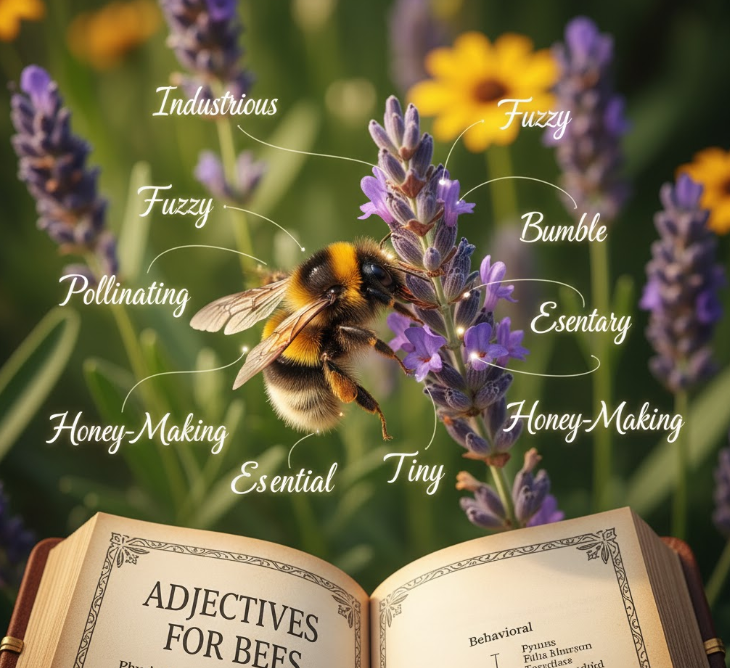
Adjectives related to bees can be classified based on what they describe. For example, some adjectives describe physical attributes (e.g., fuzzy, striped), while others describe behavior (e.g., industrious, aggressive). Understanding these classifications helps in choosing the most appropriate adjective for a given context. The function of these adjectives is to enhance the clarity and vividness of our descriptions, making them more engaging and informative. In scientific contexts, precise adjectives are critical for accurate documentation and communication.
Structural Breakdown
Adjectives typically precede the noun they modify (e.g., busy bee) but can also follow a linking verb (e.g., the bee is small). Their position impacts sentence structure and flow. In English, multiple adjectives can modify the same noun, often following a specific order based on their type (e.g., opinion, size, age, shape, color, origin, material, purpose). For instance, you might say “a small, fuzzy, brown bee,” adhering to the general order of adjectives.
Understanding the order of adjectives is crucial for constructing grammatically correct and natural-sounding sentences. While the rules aren’t always rigid, following the general guidelines enhances clarity. Incorrect placement can lead to awkward or confusing sentences. Consider the difference between “a striped, busy bee” and “a busy, striped bee.” While both are grammatically correct, the former flows more naturally due to the typical order of descriptive adjectives before behavioral ones.
Types and Categories of Adjectives for Bees
Adjectives for bees can be categorized based on various aspects, including physical appearance, behavior, habitat, species, and impact. Each category offers a unique perspective on describing these insects.
Physical Appearance
These adjectives describe the visual characteristics of bees, such as their size, color, and shape. They help to create a vivid mental image of the bee.
- Fuzzy: Covered in soft, fine hairs.
- Striped: Marked with bands of color.
- Small: Of limited size.
- Large: Of considerable size.
- Golden: Having a yellow or yellowish-brown color.
- Black: Having a dark color.
- Winged: Having wings.
- Hairy: Covered in hair.
- Plump: Round and full in shape.
- Slender: Gracefully thin.
Behavioral Traits
These adjectives describe the actions and habits of bees, such as their industriousness or aggressiveness.
- Industrious: Hardworking and diligent.
- Busy: Actively engaged in work.
- Pollinating: Transferring pollen from flower to flower.
- Buzzing: Making a humming sound.
- Social: Living in organized communities.
- Solitary: Living alone.
- Aggressive: Ready to attack or confront.
- Peaceful: Free from disturbance; tranquil.
- Diligent: Showing care and perseverance in work.
- Foraging: Searching for food.
Habitat and Environment
These adjectives describe the places where bees live and the environment they inhabit.
- Floral: Relating to flowers.
- Wild: Living in a natural state.
- Domesticated: Tamed and kept as a pet or on a farm.
- Rural: In the countryside.
- Urban: In a town or city.
- Meadow: Living in a field of grass.
- Forest: Living in a wooded area.
- Garden: Living in a cultivated area.
- Apiary: Relating to a place where bees are kept.
- Natural: Existing in or caused by nature.
Species-Related Adjectives
These adjectives describe specific types or species of bees, highlighting their unique characteristics.
- Honey: Relating to honeybees.
- Bumble: Relating to bumblebees.
- Mason: Relating to mason bees.
- Carpenter: Relating to carpenter bees.
- Africanized: Relating to Africanized honeybees.
- European: Relating to European honeybees.
- Native: Originating in a particular region.
- Wild: Existing in a natural, untamed state (referring to species).
- Domestic: Bred and kept by humans (referring to species).
- Specialized: Adapted to a particular food source or environment.
Impact and Importance
These adjectives describe the role and significance of bees in the ecosystem and human society.
- Essential: Absolutely necessary.
- Pollinating: Contributing to pollination.
- Beneficial: Producing good results or effects.
- Ecological: Relating to the environment.
- Agricultural: Relating to farming.
- Vital: Absolutely necessary or important.
- Crucial: Decisive or critical.
- Significant: Sufficiently great or important to be worthy of attention.
- Productive: Producing or able to produce large amounts of crops, goods, or other commodities.
- Environmental: Relating to the natural world and the impact of human activity on its condition.
Examples of Adjectives for Bees
Here are several tables providing examples of adjectives used to describe bees, categorized for clarity.
The following table showcases adjectives related to the physical appearance of bees. These words help us visualize the bees’ characteristics, such as their size, color, and texture.
Each example sentence demonstrates how the adjective can be used in context to provide a clearer description of the bee.
| Adjective | Example Sentence |
|---|---|
| Fuzzy | The fuzzy bumblebee landed on the sunflower. |
| Striped | A striped bee flew into the hive. |
| Small | The small bee collected nectar from the tiny flower. |
| Large | A large carpenter bee drilled into the wooden fence. |
| Golden | The golden bee buzzed around the garden. |
| Black | A black bee was seen near the rocks. |
| Winged | The winged bee soared through the air. |
| Hairy | A hairy bee crawled on the leaf. |
| Plump | The plump bee was full of nectar. |
| Slender | A slender bee visited the lavender bush. |
| Dark | The dark bee disappeared into the shadows. |
| Bright | The bright bee stood out against the green foliage. |
| Delicate | The delicate bee carefully extracted pollen. |
| Stout | The stout bee struggled to carry its heavy load. |
| Shiny | The shiny bee reflected the sunlight. |
| Tiny | The tiny bee explored the depths of the blossom. |
| Banded | The banded bee was easily identifiable. |
| Marked | The marked bee had distinctive patterns. |
| Long-legged | The long-legged bee moved quickly. |
| Short-bodied | The short-bodied bee flew close to the ground. |
| Broad | The broad bee had a sturdy appearance. |
| Narrow | The narrow bee moved swiftly. |
| Colorful | The colorful bee brightened the garden. |
The following table illustrates adjectives that describe the behavioral traits of bees. These words help convey how bees act and interact with their environment.
The example sentences provide context for understanding the behavioral characteristics of bees.
| Adjective | Example Sentence |
|---|---|
| Industrious | The industrious bee worked tirelessly to collect nectar. |
| Busy | A busy bee flew from flower to flower. |
| Pollinating | The pollinating bee is essential for plant reproduction. |
| Buzzing | The buzzing bee filled the air with sound. |
| Social | Social bees live in complex hives. |
| Solitary | The solitary bee builds its own nest. |
| Aggressive | An aggressive bee might sting if provoked. |
| Peaceful | The peaceful bee enjoys the quiet garden. |
| Diligent | The diligent bee is a valuable member of the ecosystem. |
| Foraging | The foraging bee searches for food. |
| Active | The active bee is always on the move. |
| Tireless | The tireless bee works all day long. |
| Persistent | The persistent bee searches every flower. |
| Hardworking | The hardworking bee is essential for pollination. |
| Gentle | The gentle bee rarely stings. |
| Docile | The docile bee is easy to observe. |
| Vigilant | The vigilant bee guards its hive. |
| Alert | The alert bee quickly notices danger. |
| Cooperative | The cooperative bees work together seamlessly. |
| Resourceful | The resourceful bee finds nectar even in difficult conditions. |
| Curious | The curious bee investigates new flowers. |
| Determined | The determined bee completes its task. |
| Skilled | The skilled bee navigates with precision. |
The following table provides examples of adjectives related to the habitat and environment of bees. These descriptions help to understand where bees live and how they interact with their surroundings.
The example sentences provide context for understanding the habitat preferences of different bee species.
| Adjective | Example Sentence |
|---|---|
| Floral | The floral bee thrives in gardens full of flowers. |
| Wild | A wild bee makes its home in the forest. |
| Domesticated | The domesticated bee lives in a managed hive. |
| Rural | The rural bee enjoys the open countryside. |
| Urban | An urban bee adapts to city gardens. |
| Meadow | The meadow bee gathers pollen from wildflowers. |
| Forest | The forest bee nests in tree cavities. |
| Garden | The garden bee pollinates vegetables and fruits. |
| Apiary | The apiary bee is well-cared for by beekeepers. |
| Natural | The natural bee lives in an undisturbed habitat. |
| Arboreal | The arboreal bee lives high in the trees. |
| Terrestrial | The terrestrial bee nests in the ground. |
| Mountain | The mountain bee thrives at high altitudes. |
| Desert | The desert bee is adapted to arid conditions. |
| Coastal | The coastal bee lives near the ocean. |
| Tropical | The tropical bee thrives in warm climates. |
| Temperate | The temperate bee is suited to moderate temperatures. |
| Suburban | The suburban bee finds food in residential gardens. |
| Agricultural | The agricultural bee pollinates crops. |
| Open | The open bee prefers fields and meadows. |
| Shady | The shady bee seeks shelter from the sun. |
| Protected | The protected bee lives in a managed reserve. |
| Remote | The remote bee inhabits isolated areas. |
The following table provides examples of adjectives describing the impact and importance of bees. These adjectives underscore their role in the ecosystem and in human endeavors like agriculture.
The example sentences show how bees contribute to the environment and economy.
| Adjective | Example Sentence |
|---|---|
| Essential | Bees are essential for the pollination of many crops. |
| Pollinating | The pollinating bee is vital for plant reproduction. |
| Beneficial | Bees are beneficial insects that help maintain ecosystems. |
| Ecological | Bees play an ecological role in maintaining biodiversity. |
| Agricultural | Bees are crucial for agricultural productivity. |
| Vital | Bees are vital for the health of our planet. |
| Crucial | Bees are crucial for the survival of many plant species. |
| Significant | Bees have a significant impact on food production. |
| Productive | Productive bees ensure a plentiful harvest. |
| Environmental | Bees contribute to environmental sustainability. |
| Economic | Bees have an economic impact on the honey industry. |
| Fundamental | Bees are fundamental to the food chain. |
| Integral | Bees are an integral part of the ecosystem. |
| Important | Bees are important for maintaining ecological balance. |
| Valuable | Bees are valuable pollinators. |
| Pivotal | Bees play a pivotal role in agriculture. |
| Strategic | Bees are strategic for food security. |
| Sustainable | Bees contribute to sustainable agriculture. |
| Critical | Bees are critical for crop yields. |
| Essential | Bees are essential for diverse plant life. |
| Necessary | Bees are necessary for healthy ecosystems. |
| Indispensable | Bees are indispensable for many crops. |
| Key | Bees are a key component of agriculture. |
Usage Rules for Adjectives
Adjectives must agree with the nouns they modify in terms of number and gender in some languages, but not in English. In English, adjectives remain the same regardless of the noun’s form. The position of adjectives is also important. They usually come before the noun (attributive adjectives) but can also follow linking verbs (predicative adjectives). For example: “The yellow bee” (attributive) vs. “The bee is yellow” (predicative).
When using multiple adjectives, there’s a general order to follow: opinion, size, age, shape, color, origin, material, and purpose. For example, “a beautiful, small, young, round, yellow, European, wooden bee sculpture.” While this is a general guideline, the most important aspect is clarity and flow. Avoid using too many adjectives as it can make the sentence cumbersome. Choose the most relevant and impactful adjectives to convey your meaning effectively. There are also exceptions to the order, based on emphasis and stylistic choices. For instance, you might say “a yellow, little bee” if you want to emphasize the color.
Common Mistakes
One common mistake is using adjectives incorrectly as adverbs. For example, saying “The bee flew quick” instead of “The bee flew quickly.” Another mistake is misusing comparative and superlative forms. For example, saying “more small” instead of “smaller,” or “most small” instead of “smallest.” Avoid using redundant adjectives (e.g., “a yellow colored bee”). Also, be mindful of the order of adjectives; while not always rigid, incorrect order can sound awkward.
Another common error is the incorrect use of articles with adjectives. For instance, saying “bee is industrious” instead of “the bee is industrious” or “a bee is industrious,” depending on the context. Overusing adjectives can also weaken your writing. Choose adjectives that add significant value to the description, rather than using them excessively. Always double-check the spelling of your adjectives to avoid errors that can distract the reader. Finally, ensure that the adjectives you use accurately reflect the characteristics of the bee you are describing.
| Incorrect | Correct |
|---|---|
| The bee flew quick. | The bee flew quickly. |
| A more small bee. | A smaller bee. |
| Yellow colored bee. | Yellow bee. |
| Bee is industrious. | The bee is industrious. / A bee is industrious. |
| Industrious, pollinating, busy bee. | Industrious, busy bee. (Redundant) |
Practice Exercises
Test your understanding of adjectives for bees with these exercises.
Exercise 1: Fill in the Blanks
Choose the best adjective to complete each sentence.
| Question | Options | Answer |
|---|---|---|
| The ______ bee buzzed around the garden. | (a) happy (b) buzzing (c) quick | (b) buzzing |
| A ______ bee is essential for plant reproduction. | (a) pollinating (b) flying (c) eating | (a) pollinating |
| The ______ bumblebee landed on the flower. | (a) soft (b) fuzzy (c) round | (b) fuzzy |
| The ______ bee collected nectar from the blossoms. | (a) sleepy (b) industrious (c) lazy | (b) industrious |
| A ______ bee might sting if provoked. | (a) friendly (b) aggressive (c) shy | (b) aggressive |
| The ______ bee lives in a complex hive. | (a) solitary (b) social (c) lonely | (b) social |
| The ______ bee is well-cared for by beekeepers. | (a) wild (b) apiary (c) forest | (b) apiary |
| A ______ bee makes its home in the forest. | (a) urban (b) rural (c) wild | (c) wild |
| The ______ bee is vital for the health of our planet. | (a) unimportant (b) vital (c) useless | (b) vital |
| The ______ bee gathers pollen from wildflowers. | (a) meadow (b) city (c) house | (a) meadow |
Exercise 2: Correct the Adjective Usage
Identify and correct the incorrect adjective usage in each sentence.
| Question | Corrected Sentence |
|---|---|
| The bee flew quick to the hive. | The bee flew quickly to the hive. |
| A more small bee visited the garden. | A smaller bee visited the garden. |
| The yellow colored bee landed on the rose. | The yellow bee landed on the rose. |
| Bee is industrious and important. | The bee is industrious and important. |
| That bee is most big in the garden. | That bee is the biggest in the garden. |
| The bee is happy and quick. | The bee is happily and quickly moving. |
| The industrious hardworking bee. | The industrious bee. |
| The striped long bee flew away. | The long, striped bee flew away. |
| A foraging diligent bee. | A diligent, foraging bee. |
| The beneficial ecological bee. | The ecological, beneficial bee. |
Exercise 3: Sentence Construction
Create a sentence using the given noun and adjective to describe a bee.
| Noun | Adjective | Sentence |
|---|---|---|
| Bee | Industrious | The industrious bee diligently collected nectar. |
| Bumblebee | Fuzzy | The fuzzy bumblebee landed gently on the flower. |
| Bee | Golden | A golden bee buzzed around the sunflower. |
| Bee | Pollinating | The pollinating bee is vital for the garden’s health. |
| Bee | Social | Social bees work together in a complex hive. |
| Bee | Solitary | The solitary bee builds its nest alone. |
| Bee | Small | The small bee flew into the flower. |
| Bee | Large | The large bee rested on the branch. |
| Bee | Peaceful | The peaceful bee enjoyed the garden. |
| Bee | Active | The active bee is always on the move. |
Advanced Topics
Advanced learners can explore the nuances of adjective order, the use of compound adjectives (e.g., honey-producing bee), and the stylistic impact of adjective choice. Delving into literary uses of adjectives for bees can also be insightful, analyzing how authors use descriptive language to evoke specific emotions or imagery. The subtleties of comparative and superlative forms, especially irregular adjectives (e.g., good, better, best), also present a complex area for advanced study. Furthermore, the etymology of adjectives related to bees provides a deeper understanding of their historical and linguistic roots.
Another advanced topic is the use of participial adjectives (e.g., pollinated flowers, buzzing wings). Understanding how these verb forms function as adjectives adds another layer of complexity. Pay attention to the context in which adjectives are used, as their meaning can subtly shift depending on the surrounding words and phrases. Finally, explore the use of metaphorical adjectives to describe bees, such as calling them “nature’s tiny engineers” or “golden ambassadors of the garden.”
FAQ
Here are some frequently asked questions about using adjectives for bees.
- What is the correct order for multiple adjectives describing a bee?The general order is: opinion, size, age, shape, color, origin, material, purpose. For example: “a beautiful, small, young, round, yellow, European, wooden bee sculpture.” However, clarity and flow are most important, so adjust as needed.
- Can I use too many adjectives to describe a bee?Yes, overusing adjectives can make your writing cumbersome. Choose the most relevant and impactful adjectives to convey your meaning effectively. Avoid repetition and redundancy.
- What’s the difference between attributive and predicative adjectives?Attributive adjectives come before the noun (e.g., “the yellow bee”), while predicative adjectives follow a linking verb (e.g., “the bee is yellow“).
- How do I avoid using adjectives incorrectly as adverbs?Adjectives modify nouns, while adverbs modify verbs, adjectives, or other adverbs. Ensure that you are using the correct form for the word’s function in the sentence. For example, use “quickly” (adverb) instead of “quick” (adjective) to describe how a bee flies.
- What are some common adjectives for describing bumblebees?Common adjectives for bumblebees include fuzzy, large, plump, striped, industrious, and pollinating.
- How can I make my descriptions of bees more vivid and engaging?Use sensory details (sight, sound, touch) and choose adjectives that evoke specific emotions or imagery. For example, instead of saying “a bee,” say “a golden bee buzzing busily through the fragrant garden.”
- Are there any adjectives that should be avoided when describing bees?Avoid adjectives that are vague or overused (e.g., “nice,” “good”). Also, be careful with adjectives that might promote harmful stereotypes or misinformation about bees.
- How do I use comparative and superlative adjectives correctly?For most adjectives, add “-er” for comparative (e.g., “smaller”) and “-est” for superlative (e.g., “smallest”). For longer adjectives, use “more” and “most” (e.g., “more industrious,” “most industrious”). Be aware of irregular forms (e.g., “good, better, best”).
Conclusion
Mastering adjectives for bees enhances your ability to communicate effectively and vividly about these important creatures. By understanding the different types of adjectives, their proper usage, and common mistakes to avoid, you can create compelling descriptions that capture the essence of bees and their role in the world.
This knowledge not only improves your writing but also deepens your appreciation for the natural world around you.
Remember to practice regularly, pay attention to the context in which you use adjectives, and continue to expand your vocabulary. As you become more familiar with descriptive language, you’ll find yourself crafting increasingly engaging and informative descriptions of bees and the vital work they perform.
Keep buzzing with enthusiasm and continue exploring the fascinating world of language!