
Adjectives are the colorful words that bring our language to life. They add detail and depth to our descriptions, allowing us to paint vivid pictures with words.
Understanding adjectives is crucial for anyone learning English, as they are essential for expressing thoughts, ideas, and observations effectively. This guide will provide a comprehensive introduction to adjectives, covering their definition, types, usage, and common mistakes.
Whether you’re a complete beginner or looking to brush up on your grammar skills, this article will equip you with the knowledge you need to master adjectives and enhance your English communication.
Table of Contents
- Definition of Adjectives
- Function of Adjectives
- Structural Breakdown of Adjectives
- Types of Adjectives
- Examples of Adjectives
- Usage Rules for Adjectives
- Common Mistakes with Adjectives
- Practice Exercises
- Advanced Topics: Comparative and Superlative Adjectives
- Frequently Asked Questions (FAQ)
- Conclusion
Definition of Adjectives
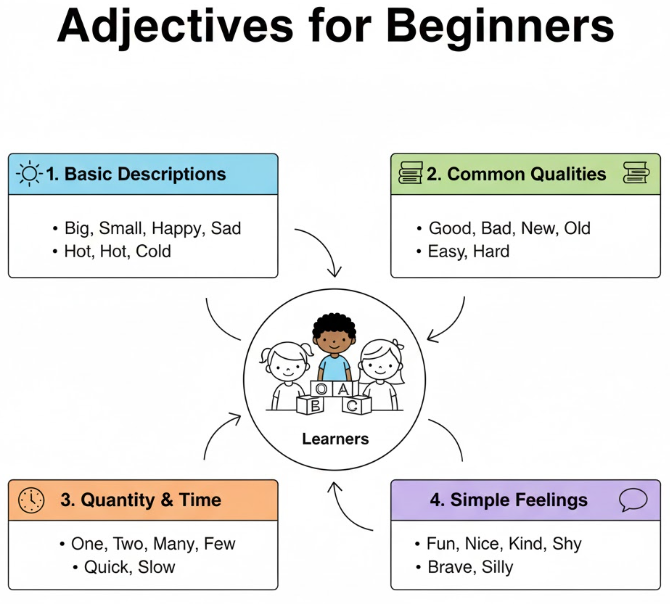
An adjective is a word that describes or modifies a noun or pronoun. Adjectives provide information about the qualities, characteristics, or attributes of the nouns they modify. They answer questions like: What kind? Which one? or How many? Adjectives add detail and specificity to our language, making it more expressive and engaging. Without adjectives, our sentences would be bland and lack the necessary descriptive power to convey our intended meaning effectively.
Function of Adjectives
The primary function of an adjective is to modify nouns or pronouns. This means that adjectives provide additional information about these words, helping to clarify their meaning and create a more vivid image in the reader’s or listener’s mind. Adjectives can specify color, size, shape, texture, origin, and other qualities. They help us distinguish between different objects or people and provide a more complete understanding of the subject being discussed. For example, instead of simply saying “a car,” we can say “a red car” or “a fast car,” using adjectives to add detail.
Structural Breakdown of Adjectives
Adjectives usually appear before the noun they modify: for example, “a beautiful flower.” However, they can also appear after a linking verb (such as is, are, was, were, seems, appears): for example, “The flower is beautiful.” In this case, the adjective is called a predicate adjective. Additionally, adjectives can be modified by adverbs, which further enhance their descriptive power. For example, in the phrase “very tall building,” the adverb “very” modifies the adjective “tall,” making the description more precise.
Types of Adjectives
There are several types of adjectives, each serving a slightly different purpose in describing nouns. Understanding these different types can help you use adjectives more effectively and accurately.
Here’s a breakdown of some of the most common types of adjectives:
Descriptive Adjectives
Descriptive adjectives, also known as qualitative adjectives, describe the qualities or characteristics of a noun. They provide information about color, size, shape, texture, taste, smell, sound, or other attributes. These are the most common type of adjectives and are used to create vivid and detailed descriptions. Examples include red, large, round, soft, sweet, fragrant, and loud.
Quantitative Adjectives
Quantitative adjectives indicate the quantity or amount of a noun. They answer the question “How many?” or “How much?” These adjectives can be specific numbers or general terms indicating quantity. Examples include one, two, many, few, some, all, no, and several.
Demonstrative Adjectives
Demonstrative adjectives point out specific nouns. They indicate which noun is being referred to. The demonstrative adjectives are this, that, these, and those. This and these refer to nouns that are near in proximity or time, while that and those refer to nouns that are farther away. Examples: This book, That car, These flowers, Those shoes.
Possessive Adjectives
Possessive adjectives show ownership or possession. They indicate who or what owns the noun. The possessive adjectives are my, your, his, her, its, our, and their. Examples: My house, Your car, His book, Her dress, Its bone, Our garden, Their toys.
Interrogative Adjectives
Interrogative adjectives are used to ask questions about nouns. They are always followed by a noun. The interrogative adjectives are which, what, and whose. Examples: Which book do you want? What color is your car? Whose shoes are these?
Proper Adjectives
Proper adjectives are formed from proper nouns and describe something related to that noun. They are always capitalized. Examples include American flag (from America), French bread (from France), Shakespearean sonnet (from Shakespeare), and Victorian architecture (from Victoria).
Compound Adjectives
Compound adjectives are formed by combining two or more words, often connected by a hyphen. They act as a single adjective to describe a noun. Examples include well-known author, high-speed train, blue-eyed child, state-of-the-art technology, and long-term investment.
Examples of Adjectives
To further illustrate the different types of adjectives, here are some examples organized by category:
Descriptive Adjective Examples
Descriptive adjectives provide details about the qualities of nouns. The following table showcases a variety of descriptive adjectives used in sentences.
| Sentence | Descriptive Adjective |
|---|---|
| The sky is blue. | blue |
| She has long hair. | long |
| The elephant is large. | large |
| The pillow is soft. | soft |
| The coffee is bitter. | bitter |
| The rose is fragrant. | fragrant |
| The music is loud. | loud |
| He is a brave man. | brave |
| The movie was funny. | funny |
| She wore a beautiful dress. | beautiful |
| The cat is fluffy. | fluffy |
| The water is cold. | cold |
| The pizza is delicious. | delicious |
| The room is dark. | dark |
| The test was easy. | easy |
| The story is exciting. | exciting |
| The garden is green. | green |
| The house is old. | old |
| The road is narrow. | narrow |
| The tea is hot. | hot |
| The shirt is clean. | clean |
| The answer is correct. | correct |
| The task is difficult. | difficult |
| The problem is complex. | complex |
Quantitative Adjective Examples
Quantitative adjectives specify the amount or number of nouns. Here are several examples demonstrating their use.
| Sentence | Quantitative Adjective |
|---|---|
| I have one apple. | one |
| She has two cats. | two |
| There are many people in the room. | many |
| He has few friends. | few |
| I need some water. | some |
| All students passed the test. | all |
| There are no tickets left. | no |
| She has several options. | several |
| He ate half the pizza. | half |
| I have enough money. | enough |
| She spent little time on the project. | little |
| He has much experience. | much |
| There are numerous stars in the sky. | numerous |
| They have plenty of food. | plenty |
| We need sufficient resources. | sufficient |
| He has several ideas. | several |
| She has a lot of books. | a lot of |
| They have a few apples. | a few |
| He has a little water. | a little |
| She has a number of friends. | a number of |
| There are dozens of eggs. | dozens of |
| He has hundreds of stamps. | hundreds of |
Demonstrative Adjective Examples
Demonstrative adjectives point out specific nouns. This table illustrates their usage.
| Sentence | Demonstrative Adjective |
|---|---|
| This book is interesting. | This |
| That car is expensive. | That |
| These flowers are beautiful. | These |
| Those shoes are comfortable. | Those |
| I like this song. | This |
| That movie was boring. | That |
| These cookies are delicious. | These |
| Those birds are singing. | Those |
| This is my favorite pen. | This |
| That house is very old. | That |
| These apples are ripe. | These |
| Those chairs are broken. | Those |
| I want this dress. | This |
| That idea is brilliant. | That |
| These questions are difficult. | These |
| Those answers are correct. | Those |
| This phone is new. | This |
| That computer is slow. | That |
| These plants are growing. | These |
| Those clouds look ominous. | Those |
Possessive Adjective Examples
Possessive adjectives indicate ownership. Here are examples of how they are used in sentences.
| Sentence | Possessive Adjective |
|---|---|
| My car is red. | My |
| Your house is big. | Your |
| His book is interesting. | His |
| Her dress is beautiful. | Her |
| The dog wagged its tail. | Its |
| Our garden is blooming. | Our |
| Their children are well-behaved. | Their |
| This is my pen. | My |
| Is that your bag? | Your |
| His favorite color is blue. | His |
| Her smile is contagious. | Her |
| The company announced its profits. | Its |
| Our team won the game. | Our |
| Their decision was final. | Their |
| My job is challenging. | My |
| Your effort is appreciated. | Your |
| His performance was outstanding. | His |
| Her advice was helpful. | Her |
| The cat cleaned its paws. | Its |
| Our plan is working. | Our |
| Their success is inspiring. | Their |
Interrogative Adjective Examples
Interrogative adjectives are used to ask questions about nouns. These examples show how to use them properly.
| Sentence | Interrogative Adjective |
|---|---|
| Which book do you want? | Which |
| What color is your car? | What |
| Whose shoes are these? | Whose |
| Which way should we go? | Which |
| What time is it? | What |
| Whose phone is ringing? | Whose |
| Which movie should we watch? | Which |
| What kind of music do you like? | What |
| Whose car is parked outside? | Whose |
| Which dress should I wear? | Which |
| What is your favorite food? | What |
| Whose idea was this? | Whose |
| Which restaurant do you recommend? | Which |
| What is your name? | What |
| Whose bag is this? | Whose |
Usage Rules for Adjectives
Using adjectives correctly involves understanding their placement and agreement with the nouns they modify. Here are some important usage rules to keep in mind:
Adjective Order
When using multiple adjectives to describe a noun, there is a general order to follow: Opinion, Size, Age, Shape, Color, Origin, Material, Purpose. For example: “a beautiful, large, old, round, blue, Italian, wooden table.” While native speakers may not consciously think about this order, following it will make your writing sound more natural.
Adjective Agreement
In English, adjectives do not change form to agree with the noun they modify in terms of number or gender, unlike in some other languages. The adjective remains the same regardless of whether the noun is singular or plural, masculine or feminine. For example, we say “a tall man” and “tall women.”
Adjectives as Predicate Adjectives
As mentioned earlier, adjectives can function as predicate adjectives, appearing after a linking verb. In this case, the adjective describes the subject of the sentence. For example: “The sky is blue.” Here, “blue” describes the subject “sky.”
Exceptions to the Rules
While the rules above generally apply, there are some exceptions and nuances. For example, some adjectives can also function as nouns (e.g., “the poor“). Additionally, some compound adjectives have specific rules regarding hyphenation.
Common Mistakes with Adjectives
Even experienced English learners sometimes make mistakes with adjectives. Here are some common errors to watch out for:
- Incorrect: The car red. Correct: The car is red. (Missing linking verb)
- Incorrect: A old house. Correct: An old house. (Incorrect article usage)
- Incorrect: She is more tall than me. Correct: She is taller than me. (Incorrect comparative form)
- Incorrect: This is the most tallest building. Correct: This is the tallest building. (Superfluous use of “most”)
- Incorrect: I have many informations. Correct: I have much information. (Information is uncountable)
Understanding these common mistakes can help you avoid them in your own writing and speaking.
Practice Exercises
Test your understanding of adjectives with these practice exercises:
Exercise 1: Identify the adjective in each sentence.
| Question | Answer |
|---|---|
| 1. The tall building is impressive. | tall |
| 2. She has a beautiful voice. | beautiful |
| 3. I need some water. | some |
| 4. This book is interesting. | This |
| 5. Is that your car? | your |
| 6. Which way should we go? | Which |
| 7. He is a brave man. | brave |
| 8. The tea is hot. | hot |
| 9. They have several options. | several |
| 10. Those chairs are broken. | Those |
Exercise 2: Fill in the blank with an appropriate adjective.
| Question | Answer |
|---|---|
| 1. The ______ dog barked loudly. | large/small/brown |
| 2. She wore a ______ dress to the party. | elegant/beautiful/red |
| 3. I need ______ information about the project. | more/some/additional |
| 4. ______ car is parked outside? | Whose |
| 5. ______ flowers are blooming in the garden. | These |
| 6. He is ______ than his brother. | taller/shorter |
| 7. The coffee is too ______. | hot/cold |
| 8. We need ______ time to finish the task. | more/extra |
| 9. ______ idea was brilliant. | That |
| 10. ______ favorite color is blue. | His/Her |
Exercise 3: Correct the adjective errors in these sentences.
| Question | Answer |
|---|---|
| 1. The car red is fast. | The red car is fast. / The car is red. |
| 2. She is more taller than her sister. | She is taller than her sister. |
| 3. I have many informations. | I have much information. |
| 4. This is the most tallest building. | This is the tallest building. |
| 5. A old book is on the table. | An old book is on the table. |
| 6. Which you book want? | Which book do you want? |
| 7. Those shoe are mine. | Those shoes are mine. |
| 8. Her smile is most beautiful. | Her smile is very beautiful. / Her smile is the most beautiful. |
| 9. He is a man brave. | He is a brave man. |
| 10. What time it is? | What time is it? |
Advanced Topics: Comparative and Superlative Adjectives
Once you have a solid understanding of basic adjectives, you can move on to more advanced topics like comparative and superlative adjectives. Comparative adjectives are used to compare two things (e.g., “taller,” “faster”), while superlative adjectives are used to compare three or more things (e.g., “tallest,” “fastest”).
Learning how to form and use these adjectives correctly will further enhance your ability to describe and compare things in English.
To form comparative adjectives, you generally add “-er” to the end of short adjectives (e.g., “tall” becomes “taller”). For longer adjectives, you use “more” before the adjective (e.g., “beautiful” becomes “more beautiful”).
To form superlative adjectives, you generally add “-est” to the end of short adjectives (e.g., “tall” becomes “tallest”). For longer adjectives, you use “most” before the adjective (e.g., “beautiful” becomes “most beautiful”).
There are also irregular adjectives that have different forms for comparative and superlative (e.g., “good,” “better,” “best”).
Frequently Asked Questions (FAQ)
Here are some frequently asked questions about adjectives:
- What is the difference between an adjective and an adverb?
Adjectives modify nouns or pronouns, while adverbs modify verbs, adjectives, or other adverbs. Adjectives describe things, while adverbs describe actions, qualities, or manners. For example, “a beautiful flower” (adjective) vs. “She sings beautifully” (adverb).
- Can a noun be used as an adjective?
Yes, a noun can sometimes be used as an adjective. This is called a noun adjunct or attributive noun. For example, in the phrase “school bus,” the noun “school” is used to describe the type of bus.
- What are the rules for using commas with multiple adjectives?
Use commas to separate coordinate adjectives, which are adjectives that independently modify the noun and can be rearranged without changing the meaning. For example, “a tall, handsome man.” Do not use a comma between cumulative adjectives, which build on each other to modify the noun. For example, “a small wooden box.”
- How do I know which adjective order to use?
The general order is: Opinion, Size, Age, Shape, Color, Origin, Material, Purpose. While not always strictly followed, this order helps sentences sound more natural.
- Are there any adjectives that can only be used before a noun?
Yes, some adjectives are typically only used before a noun (attributive adjectives). Examples include “chief,” “main,” and “only.” For example, “the chief reason” is correct, but “the reason is chief” is not.
- What is a participial adjective?
A participial adjective is an adjective that is formed from a verb’s participle form (either present or past). These adjectives often describe a state or condition resulting from the action of the verb. For example, “broken window” (past participle) or “running water” (present participle).
- How can I improve my vocabulary of adjectives?
Read widely and pay attention to the adjectives that authors use. Make a note of new adjectives and their meanings. Practice using them in your own writing and speaking. Use a thesaurus to find synonyms for common adjectives to add variety to your language.
- Is it possible to have too many adjectives in a sentence?
Yes, using too many adjectives can make your writing sound cluttered and unnatural. It’s important to choose adjectives carefully and use only those that add significant detail or meaning to the sentence. Focus on quality over quantity.
Conclusion
Adjectives are essential building blocks of the English language, enabling us to express ourselves with clarity and precision. By understanding the different types of adjectives, their usage rules, and common mistakes, you can significantly improve your English communication skills.
Continue to practice using adjectives in your writing and speaking, and don’t be afraid to experiment with different combinations to create vivid and engaging descriptions. The more you practice, the more confident you will become in your ability to use adjectives effectively.