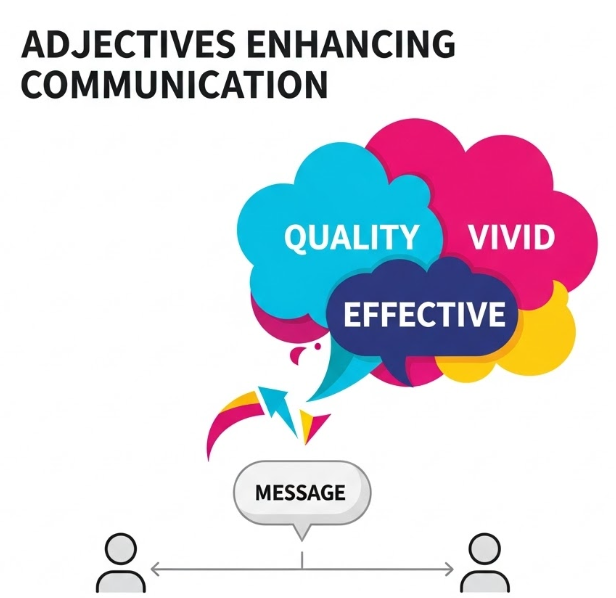
Effective communication hinges on the ability to convey ideas clearly and vividly. Descriptive adjectives, words that paint a picture for the listener or reader, are crucial for achieving this.
Understanding how to use these adjectives correctly can significantly enhance your English proficiency, making your speech and writing more engaging and precise. This article provides a comprehensive guide to descriptive adjectives, exploring their types, usage rules, common mistakes, and offering ample practice to solidify your understanding.
Whether you’re a beginner or an advanced learner, this guide will equip you with the tools to use descriptive adjectives confidently and effectively.
This article is designed for English language learners of all levels, from beginners seeking a foundational understanding to advanced learners aiming to refine their communication skills. Native English speakers can also benefit from a review of the nuances and complexities of descriptive adjective usage.
Table of Contents
- Definition of Descriptive Adjectives
- Structural Breakdown
- Types of Descriptive Adjectives
- Examples of Descriptive Adjectives
- Usage Rules
- Common Mistakes
- Practice Exercises
- Advanced Topics
- FAQ
- Conclusion
Definition of Descriptive Adjectives
Descriptive adjectives are words that describe the qualities, characteristics, or attributes of nouns or pronouns. They add detail, making sentences more informative and engaging.
These adjectives answer questions like “What kind?”, “Which one?”, “How many?”, or “How much?” about the noun or pronoun they modify. They are a fundamental part of English grammar, enriching our ability to express ourselves.
Descriptive adjectives are also known as attributive adjectives when they directly precede the noun they modify, for example, “a beautiful flower.” They can also function as predicate adjectives when they follow a linking verb (such as is, are, was, were, seems, becomes) and describe the subject of the sentence, for example, “The flower is beautiful.” Understanding this distinction is crucial for correct adjective placement and sentence construction.
Structural Breakdown
Descriptive adjectives typically appear before the noun they modify. This is the most common structure in English.
The order of adjectives can also follow specific rules, especially when multiple adjectives are used to describe the same noun. Generally, the order follows this pattern: opinion, size, age, shape, color, origin, material, and purpose.
This order isn’t rigid, but it provides a helpful guideline for creating natural-sounding sentences.
For example, consider the phrase “a beautiful, small, old, round, red, Italian, leather writing desk.” This follows the general order of opinion (beautiful), size (small), age (old), shape (round), color (red), origin (Italian), and material (leather). While rearranging these adjectives might not always result in grammatically incorrect sentences, it can sound awkward to native English speakers.
Types of Descriptive Adjectives
Descriptive adjectives can be categorized based on the type of information they convey. Understanding these categories can help you choose the most appropriate adjective for your intended meaning and improve the clarity and precision of your communication.
Adjectives of Quality
Adjectives of quality describe the general characteristics or attributes of a noun. They answer the question “What kind?”.
These are some of the most commonly used descriptive adjectives.
Examples include: good, bad, beautiful, ugly, intelligent, foolish, brave, cowardly, honest, dishonest, kind, cruel, generous, stingy, happy, sad, exciting, boring.
Adjectives of Size and Shape
Adjectives of size and shape describe the physical dimensions or form of a noun. They provide information about how big or small something is, or its overall shape.
Examples include: big, small, large, tiny, huge, gigantic, tall, short, long, wide, narrow, round, square, rectangular, triangular, oval.
Adjectives of Age
Adjectives of age describe how old or new something is. They provide information about the duration of existence or the stage of development.
Examples include: old, new, young, ancient, modern, antique, elderly, youthful, mature, immature.
Adjectives of Color
Adjectives of color describe the hue or shade of a noun. They add visual detail and help to create a more vivid image in the reader’s or listener’s mind.
Examples include: red, blue, green, yellow, orange, purple, pink, brown, black, white, gray, silver, golden.
Adjectives of Origin
Adjectives of origin describe the place where a noun comes from. They indicate the nationality, region, or source of something.
Examples include: American, British, French, Italian, Chinese, Japanese, German, Spanish, African, European, Asian.
Adjectives of Material
Adjectives of material describe what a noun is made of. They provide information about the substance or composition of something.
Examples include: wooden, metal, plastic, glass, paper, cotton, wool, silk, leather, rubber, ceramic.
Adjectives of Purpose
Adjectives of purpose describe the intended use or function of a noun. They indicate what something is designed to do.
Examples include: writing (desk), sleeping (bag), cooking (oil), reading (lamp), swimming (pool), hiking (boots), gardening (tools).
Examples of Descriptive Adjectives
The following tables provide numerous examples of descriptive adjectives in different categories, illustrating how they can be used to enhance communication. Each table includes a sentence showcasing the adjective in context.
The table below showcases adjective of quality and their usage in sentences.
| Adjective | Example Sentence |
|---|---|
| Good | She is a good student. |
| Bad | He had a bad experience. |
| Beautiful | The sunset was beautiful. |
| Ugly | That building is quite ugly. |
| Intelligent | She is an intelligent woman. |
| Foolish | It was a foolish decision. |
| Brave | The firefighter was very brave. |
| Cowardly | His actions were cowardly. |
| Honest | He is an honest man. |
| Dishonest | She was found to be dishonest. |
| Kind | She is a very kind person. |
| Cruel | His words were cruel. |
| Generous | He is a generous donor. |
| Stingy | She is known to be stingy. |
| Happy | The children are very happy. |
| Sad | She felt sad after the movie. |
| Exciting | The roller coaster was exciting. |
| Boring | The lecture was quite boring. |
| Interesting | The book was very interesting. |
| Difficult | The test was very difficult. |
| Easy | The puzzle was quite easy. |
| Important | This is an important matter. |
| Necessary | It is necessary to complete the task. |
| Possible | It is possible to achieve your goals. |
| Impossible | It is impossible to do it alone. |
The table below showcases adjective of size and shape and their usage in sentences.
| Adjective | Example Sentence |
|---|---|
| Big | That is a big car. |
| Small | She has a small dog. |
| Large | They bought a large house. |
| Tiny | There was a tiny spider. |
| Huge | The elephant was huge. |
| Gigantic | They saw a gigantic wave. |
| Tall | He is a tall man. |
| Short | She is a short woman. |
| Long | It was a long journey. |
| Wide | The river is very wide. |
| Narrow | The street is quite narrow. |
| Round | The table is round. |
| Square | The box is square. |
| Rectangular | The room is rectangular. |
| Triangular | The flag is triangular. |
| Oval | The mirror is oval. |
| Deep | The lake is very deep. |
| Shallow | The water is shallow. |
| High | The mountain is very high. |
| Low | The ceiling is very low. |
| Thick | The book is very thick. |
| Thin | The paper is very thin. |
| Flat | The surface is flat. |
| Curved | The road is curved. |
| Straight | The line is straight. |
The table below showcases adjective of age and their usage in sentences.
| Adjective | Example Sentence |
|---|---|
| Old | That is an old house. |
| New | She has a new car. |
| Young | He is a young man. |
| Ancient | The ruins are ancient. |
| Modern | It is a modern building. |
| Antique | The furniture is antique. |
| Elderly | The elderly woman needed help. |
| Youthful | She has a youthful appearance. |
| Mature | He is a mature student. |
| Immature | His behavior was immature. |
| Fresh | The bread is fresh. |
| Stale | The bread is stale. |
| Recent | It was a recent event. |
| Early | It was an early start. |
| Late | It was a late arrival. |
| Old-fashioned | That is an old-fashioned dress. |
| Up-to-date | The information is up-to-date. |
| Timeless | It is a timeless classic. |
| Brand-new | The phone is brand-new. |
| Second-hand | I bought a second-hand car. |
The table below showcases adjective of color and their usage in sentences.
| Adjective | Example Sentence |
|---|---|
| Red | The car is red. |
| Blue | The sky is blue. |
| Green | The grass is green. |
| Yellow | The sun is yellow. |
| Orange | The fruit is orange. |
| Purple | The flowers are purple. |
| Pink | The dress is pink. |
| Brown | The table is brown. |
| Black | The cat is black. |
| White | The snow is white. |
| Gray | The clouds are gray. |
| Silver | The jewelry is silver. |
| Golden | The statue is golden. |
| Crimson | The crimson rose was beautiful. |
| Beige | The walls are painted beige. |
| Turquoise | The water was a stunning turquoise. |
| Lavender | She wore a lavender dress. |
| Maroon | The curtains were a deep maroon. |
| Olive | The skin tone was olive. |
| Teal | The color of the ocean was teal. |
Usage Rules
Several rules govern the proper use of descriptive adjectives in English. Adhering to these rules ensures clarity and grammatical correctness in your writing and speech.
- Placement: Adjectives usually precede the noun they modify, but predicate adjectives follow a linking verb.
- Order: When using multiple adjectives, follow the general order: opinion, size, age, shape, color, origin, material, and purpose.
- Commas: Use commas to separate coordinate adjectives, which are adjectives that equally modify the same noun. For example, “a tall, handsome man.” Do not use a comma if the adjectives are not coordinate, such as “a small round table.”
- Articles: Use the correct article (a, an, the) based on the adjective and noun that follow. For example, “an interesting book” (an is used because “interesting” starts with a vowel sound) versus “a difficult task.”
- Comparative and Superlative Forms: Use the correct comparative (-er) and superlative (-est) forms for short adjectives, or “more” and “most” for longer adjectives. For example, “smaller” and “smallest” versus “more beautiful” and “most beautiful.”
Exceptions: There are exceptions to these rules, particularly concerning adjective order. Sometimes, emphasis or stylistic choice may warrant a different arrangement. However, adhering to the general guidelines will ensure clarity and avoid awkward phrasing in most cases.
Common Mistakes
Several common mistakes are made when using adjectives. Being aware of these errors can help you avoid them and improve the accuracy of your English.
- Incorrect Adjective Order: Placing adjectives in the wrong order can sound unnatural.
- Incorrect: “a red big ball”
- Correct: “a big red ball”
- Missing Commas: Forgetting commas between coordinate adjectives can make sentences confusing.
- Incorrect: “a tall handsome man”
- Correct: “a tall, handsome man”
- Incorrect Article Usage: Using the wrong article (a, an, the) before an adjective-noun combination.
- Incorrect: “a interesting book”
- Correct: “an interesting book”
- Misusing Comparative and Superlative Forms: Incorrectly forming comparative and superlative adjectives.
- Incorrect: “more smaller”
- Correct: “smaller”
- Incorrect: “most smallest”
- Correct: “smallest”
- Using Adjectives as Adverbs: Confusing adjectives with adverbs.
- Incorrect: “He ran quick.”
- Correct: “He ran quickly.”
Practice Exercises
These practice exercises will help you solidify your understanding of descriptive adjectives and their correct usage. Each exercise focuses on a different aspect of adjectives, from identifying them in sentences to using them in the correct order.
Exercise 1: Identifying Adjectives
Instructions: Identify the descriptive adjectives in the following sentences.
| Question | Answer |
|---|---|
| 1. The old house stood on a hill. | old |
| 2. She wore a beautiful dress to the party. | beautiful |
| 3. The small dog barked loudly. | small, loud |
| 4. He is a kind and generous man. | kind, generous |
| 5. The red car sped down the street. | red |
| 6. The intelligent student aced the test. | intelligent |
| 7. The delicious meal was prepared quickly. | delicious |
| 8. The broken window let in the cold air. | broken, cold |
| 9. The heavy box was difficult to lift. | heavy, difficult |
| 10. The funny movie made everyone laugh. | funny |
Exercise 2: Correct Adjective Order
Instructions: Rewrite the following phrases with the adjectives in the correct order.
| Question | Answer |
|---|---|
| 1. a red, big ball | a big, red ball |
| 2. an old, wooden, brown table | an old, brown, wooden table |
| 3. a small, black, new car | a small, new, black car |
| 4. a beautiful, long, silk dress | a beautiful, long, silk dress |
| 5. a round, small, metal button | a small, round, metal button |
| 6. a delicious, Italian, large pizza | a large, delicious, Italian pizza |
| 7. a comfortable, old, leather chair | a comfortable, old, leather chair |
| 8. a blue, new, cotton shirt | a new, blue, cotton shirt |
| 9. a tall, handsome, young man | a tall, handsome, young man |
| 10. a green, large, plastic bucket | a large, green, plastic bucket |
Exercise 3: Using Commas with Adjectives
Instructions: Add commas where necessary in the following sentences.
| Question | Answer |
|---|---|
| 1. She is a kind generous woman. | She is a kind, generous woman. |
| 2. He is a tall dark man. | He is a tall, dark man. |
| 3. The house had a large sunny garden. | The house had a large, sunny garden. |
| 4. It was a cold wet day. | It was a cold, wet day. |
| 5. The book was interesting informative. | The book was interesting, informative. |
| 6. He is a smart dedicated student. | He is a smart, dedicated student. |
| 7. The cake was rich delicious. | The cake was rich, delicious. |
| 8. She wore a beautiful elegant dress. | She wore a beautiful, elegant dress. |
| 9. The movie was long boring. | The movie was long, boring. |
| 10. It was a difficult challenging task. | It was a difficult, challenging task. |
Exercise 4: Comparative and Superlative Adjectives
Instructions: Complete the sentences using the correct comparative or superlative form of the adjective in parentheses.
| Question | Answer |
|---|---|
| 1. This book is (interesting) ______ than that one. | more interesting |
| 2. She is the (tall) ______ girl in the class. | tallest |
| 3. This is the (good) ______ restaurant in town. | best |
| 4. He is (old) ______ than his brother. | older |
| 5. This is the (difficult) ______ test I have ever taken. | most difficult |
| 6. She is (happy) ______ now than she was before. | happier |
| 7. This is the (bad) ______ movie I have ever seen. | worst |
| 8. He is (smart) ______ than I am. | smarter |
| 9. This is the (beautiful) ______ flower in the garden. | most beautiful |
| 10. She is (young) ______ than her sister. | younger |
Advanced Topics
For advanced learners, exploring more complex aspects of descriptive adjectives can further refine your language skills. This includes understanding the nuances of adjective order in specific contexts, using compound adjectives effectively, and mastering the art of using adjectives for stylistic effect.
Compound Adjectives: Compound adjectives are formed by combining two or more words, often with a hyphen. For example, “well-known,” “high-quality,” and “English-speaking.” These adjectives function as a single unit and should be used carefully to ensure clarity and conciseness.
Stylistic Use of Adjectives: Skilled writers and speakers use adjectives not just to describe, but to evoke emotions, create imagery, and enhance the overall impact of their message. This involves choosing adjectives that are not only accurate but also evocative and memorable. For example, instead of saying “a big house,” one might say “a sprawling mansion” to create a more vivid impression.
FAQ
Here are some frequently asked questions about descriptive adjectives:
- What is the difference between an adjective and an adverb?Adjectives modify nouns or pronouns, while adverbs modify verbs, adjectives, or other adverbs. Adjectives describe what something *is*, while adverbs describe *how* something is done. For example, “He is a *fast* runner” (adjective) versus “He runs *fast*” (adverb).
- Can a noun be used as an adjective?Yes, nouns can sometimes function as adjectives, often called attributive nouns. For example, in the phrase “school bus,” the noun “school” modifies the noun “bus,” indicating its purpose.
- What are limiting adjectives?Limiting adjectives specify the quantity or number of nouns. Examples include “few,” “many,” “some,” “all,” “one,” “two,” etc. They provide specific information about the extent or amount of something.
- How do I know when to use a comma between adjectives?Use a comma between coordinate adjectives, which are adjectives that independently modify the same noun. You can test this by seeing if you can replace the comma with “and” or reverse the order of the adjectives without changing the meaning. For example, “a tall, handsome man” (a tall and handsome man) versus “a small round table” (cannot say “a small and round table” or “a round small table”).
- What is a predicate adjective?A predicate adjective follows a linking verb (such as *is, are, was, were, seems, becomes*) and describes the subject of the sentence. For example, “The flower *is beautiful*.”
- Can I use too many adjectives in a sentence?Yes, using too many adjectives can make your writing or speech sound cluttered and unclear. It’s best to choose adjectives carefully and use only those that add significant detail or meaning.
- How can I improve my vocabulary of descriptive adjectives?Read widely, pay attention to how adjectives are used in different contexts, and make a conscious effort to learn new adjectives. Use a thesaurus to find synonyms for common adjectives and expand your range of expression.
- Why is adjective order important?Adjective order, while not a strict rule, helps ensure clarity and natural-sounding language. Native English speakers tend to follow a specific order (opinion, size, age, shape, color, origin, material, purpose), and deviating from this order can sound awkward or confusing.
Conclusion
Mastering the use of descriptive adjectives is essential for effective communication in English. By understanding the different types of adjectives, their correct usage rules, and common mistakes to avoid, you can significantly enhance the clarity, precision, and impact of your writing and speech.
Practice the exercises provided, expand your vocabulary, and pay attention to how adjectives are used in real-world contexts.
Remember that language learning is a continuous process. Keep practicing, keep exploring, and keep refining your skills.
With dedication and effort, you’ll be able to use descriptive adjectives confidently and effectively, enriching your communication and achieving your language goals. Embrace the power of descriptive adjectives to paint vivid pictures with your words and connect with your audience on a deeper level.