Describing crowds effectively is a valuable skill in English, whether you’re writing a news report, crafting a fictional scene, or simply recounting an experience. The right adjectives can paint a vivid picture of the size, behavior, and atmosphere of a crowd, adding depth and nuance to your communication.
This article provides a comprehensive guide to using adjectives to describe crowds, covering a wide range of options and their specific connotations. By understanding these adjectives and their proper usage, you’ll be able to express yourself more precisely and engagingly.
This guide is designed for English language learners of all levels, from beginners looking to expand their vocabulary to advanced speakers aiming to refine their descriptive skills. We’ll explore various categories of adjectives, provide numerous examples, and offer practical exercises to help you master this essential aspect of English grammar.
Table of Contents
- Definition: Adjectives for Crowds
- Structural Breakdown
- Types and Categories of Adjectives for Crowds
- Examples of Adjectives for Crowds
- Usage Rules for Adjectives Describing Crowds
- Common Mistakes When Using Adjectives for Crowds
- Practice Exercises
- Advanced Topics
- Frequently Asked Questions (FAQ)
- Conclusion
Definition: Adjectives for Crowds
Adjectives used to describe crowds are words that modify a noun (the crowd) to provide more information about its characteristics. These adjectives can describe various aspects of the crowd, such as its size, behavior, emotional state, demographic makeup, or the overall atmosphere it creates.
They help to paint a more detailed and evocative picture of the crowd in question.
In terms of classification, these adjectives are primarily descriptive adjectives, as they describe qualities or characteristics. They function to enhance the reader’s understanding of the crowd, making the description more vivid and informative. The context in which these adjectives are used can greatly influence their impact. For instance, describing a crowd as “angry” in a news report about a protest carries a different weight than describing a crowd as “excited” at a concert.
Structural Breakdown
The structure of adjective usage with crowds is relatively straightforward. Typically, the adjective precedes the noun it modifies. For example, “a large crowd,” where “large” is the adjective and “crowd” is the noun. Adjectives can also be used after linking verbs such as “is,” “are,” “was,” and “were.” For example, “The crowd was restless.”
Multiple adjectives can be used to describe a crowd, often separated by commas or connected by conjunctions. When using multiple adjectives, the order is generally determined by the type of adjective. Opinion adjectives (e.g., “amazing”) usually come before descriptive adjectives (e.g., “large”). For example, “an amazing, large crowd.”
The structure can also involve adjective phrases, which are groups of words that function as an adjective. An example would be, “a crowd filled with anticipation,” where “filled with anticipation” is the adjective phrase describing the crowd.
Types and Categories of Adjectives for Crowds
Adjectives for crowds can be categorized based on the aspect they describe. Here are some key categories:
Adjectives Describing Size
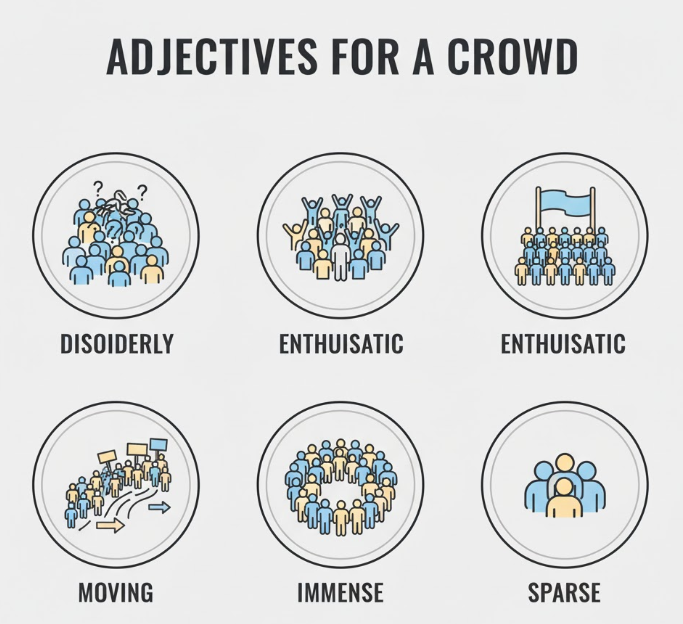
These adjectives indicate the number of people in the crowd, ranging from small gatherings to massive congregations. Examples include: small, large, massive, huge, immense, considerable, sizable, packed, sparse, teeming, overflowing, substantial, limited, expansive, vast, congested, uncrowded, dense, minimal, jam-packed.
Adjectives Describing Behavior
These adjectives describe how the crowd is acting or behaving. They can convey the crowd’s level of activity, its organization, or its overall demeanor.
Examples include: rowdy, orderly, chaotic, peaceful, unruly, boisterous, excited, restless, agitated, frenzied, calm, subdued, enthusiastic, disciplined, milling, surging, stampeding, responsive, attentive, passive, volatile.
Adjectives Describing Emotion
These adjectives express the prevailing emotion or mood of the crowd. They can indicate whether the crowd is happy, angry, fearful, or a combination of emotions.
Examples include: happy, angry, fearful, joyous, jubilant, hostile, somber, anxious, excited, apprehensive, enthusiastic, optimistic, despondent, enraged, terrified, delighted, melancholic, hopeful, worried, furious.
Adjectives Describing Demographics
These adjectives describe the characteristics of the people who make up the crowd, such as their age, background, or affiliations. Examples include: youthful, elderly, diverse, homogeneous, mixed, professional, student, local, foreign, partisan, religious, working-class, affluent, academic, international, regional, ethnic, political, fanatical, general.
Adjectives Describing Atmosphere
These adjectives describe the overall feeling or atmosphere created by the crowd. They can capture the energy, mood, or tone of the event.
Examples include: electric, tense, festive, lively, charged, oppressive, celebratory, somber, vibrant, expectant, anticipatory, heavy, exciting, subdued, thrilling, ominous, buzzing, palpable, electrifying, charged.
Examples of Adjectives for Crowds
The following tables provide examples of how to use different adjectives to describe crowds in various contexts. Each table focuses on a specific category of adjectives and offers a range of sentences to illustrate their usage.
Size Adjectives Examples
This table provides example sentences using adjectives that describe the size of a crowd. These adjectives help to convey the scale and magnitude of the gathering.
| Adjective | Example Sentence |
|---|---|
| Small | A small crowd gathered for the poetry reading. |
| Large | A large crowd attended the music festival. |
| Massive | A massive crowd filled the stadium for the championship game. |
| Huge | A huge crowd lined the streets for the parade. |
| Immense | An immense crowd celebrated the victory in the town square. |
| Considerable | A considerable crowd showed up despite the rain. |
| Sizable | A sizable crowd protested the new legislation. |
| Packed | The concert hall was packed with eager fans. |
| Sparse | A sparse crowd attended the early morning lecture. |
| Teeming | The market was teeming with shoppers on Saturday. |
| Overflowing | The venue was overflowing with attendees. |
| Substantial | A substantial crowd gathered outside the courthouse. |
| Limited | Due to restrictions, a limited crowd was allowed inside. |
| Expansive | An expansive crowd stretched across the entire park. |
| Vast | A vast crowd assembled to witness the historical event. |
| Congested | The streets were congested with a large crowd. |
| Uncrowded | The beach was surprisingly uncrowded on a weekday. |
| Dense | A dense crowd made it difficult to move through the area. |
| Minimal | Only a minimal crowd was present at the event. |
| Jam-packed | The train was jam-packed with commuters. |
| Swarming | A swarming crowd of tourists clogged the narrow streets. |
| Populous | The populous crowd eagerly awaited the celebrity’s arrival. |
| Numerous | Numerous crowds gathered around the various street performers. |
| Heaving | The dance floor was heaving with a vibrant crowd of dancers. |
Behavior Adjectives Examples
This table showcases adjectives that describe the behavior of a crowd. These adjectives provide insight into how the crowd is acting and interacting.
| Adjective | Example Sentence |
|---|---|
| Rowdy | A rowdy crowd disrupted the peace of the neighborhood. |
| Orderly | An orderly crowd waited patiently in line. |
| Chaotic | A chaotic crowd surged towards the exit after the announcement. |
| Peaceful | A peaceful crowd gathered to protest peacefully. |
| Unruly | An unruly crowd began to push and shove. |
| Boisterous | A boisterous crowd cheered loudly for the home team. |
| Excited | An excited crowd anticipated the start of the concert. |
| Restless | A restless crowd grew impatient during the delay. |
| Agitated | An agitated crowd demanded answers from the officials. |
| Frenzied | A frenzied crowd rushed the stage. |
| Calm | A calm crowd listened attentively to the speaker. |
| Subdued | A subdued crowd mourned the loss. |
| Enthusiastic | An enthusiastic crowd welcomed the performers. |
| Disciplined | A disciplined crowd followed the instructions carefully. |
| Milling | A milling crowd waited for the doors to open. |
| Surging | A surging crowd threatened to overwhelm the barriers. |
| Stampeding | A stampeding crowd caused widespread panic. |
| Responsive | A responsive crowd reacted positively to the comedian’s jokes. |
| Attentive | An attentive crowd listened intently to the lecture. |
| Passive | A passive crowd watched the events unfold without intervening. |
| Volatile | The volatile crowd was on the verge of rioting. |
| Animated | The animated crowd participated enthusiastically in the discussions. |
| Dispersing | The dispersing crowd gradually left the stadium after the game. |
| Gathering | A gathering crowd started to form around the speaker. |
| Participating | The participating crowd actively engaged in the interactive performance. |
Emotion Adjectives Examples
This table provides examples of adjectives that describe the emotional state of a crowd. These adjectives help to convey the feelings and sentiments of the group.
| Adjective | Example Sentence |
|---|---|
| Happy | A happy crowd celebrated the victory. |
| Angry | An angry crowd protested the government’s decision. |
| Fearful | A fearful crowd scattered after the explosion. |
| Joyous | A joyous crowd welcomed the returning heroes. |
| Jubilant | A jubilant crowd danced in the streets. |
| Hostile | A hostile crowd confronted the police. |
| Somber | A somber crowd gathered for the memorial service. |
| Anxious | An anxious crowd awaited news of the missing hikers. |
| Excited | An excited crowd cheered for their favorite band. |
| Apprehensive | An apprehensive crowd watched the approaching storm. |
| Enthusiastic | An enthusiastic crowd supported the local team. |
| Optimistic | An optimistic crowd hoped for a positive outcome. |
| Despondent | A despondent crowd mourned the tragic event. |
| Enraged | An enraged crowd demanded justice. |
| Terrified | A terrified crowd fled the scene. |
| Delighted | A delighted crowd enjoyed the fireworks display. |
| Melancholic | A melancholic crowd remembered the past. |
| Hopeful | A hopeful crowd looked forward to the future. |
| Worried | A worried crowd awaited updates on the situation. |
| Furious | A furious crowd protested the unfair decision. |
| Ecstatic | The ecstatic crowd erupted in cheers after the final goal. |
| Disappointed | The disappointed crowd slowly dispersed after the cancellation. |
| Grateful | The grateful crowd applauded the firefighters for their bravery. |
| Apathetic | The apathetic crowd showed little interest in the political rally. |
| Hopeful | A hopeful crowd gathered outside the hospital, awaiting news. |
Demographic Adjectives Examples
This table provides examples of adjectives that describe the demographic makeup of a crowd. These adjectives help to identify the characteristics of the people who make up the group.
| Adjective | Example Sentence |
|---|---|
| Youthful | A youthful crowd attended the music festival. |
| Elderly | An elderly crowd gathered for the senior center event. |
| Diverse | A diverse crowd celebrated the cultural festival. |
| Homogeneous | A homogeneous crowd consisted mainly of students. |
| Mixed | A mixed crowd of locals and tourists filled the square. |
| Professional | A professional crowd attended the business conference. |
| Student | A student crowd protested the tuition increase. |
| Local | A local crowd supported the community event. |
| Foreign | A foreign crowd visited the historical landmark. |
| Partisan | A partisan crowd cheered for their political candidate. |
| Religious | A religious crowd gathered for the prayer service. |
| Working-class | A working-class crowd attended the labor rally. |
| Affluent | An affluent crowd attended the charity gala. |
| Academic | An academic crowd participated in the symposium. |
| International | An international crowd attended the global summit. |
| Regional | A regional crowd gathered for the state fair. |
| Ethnic | An ethnic crowd celebrated their heritage. |
| Political | A political crowd demonstrated their views. |
| Fanatical | A fanatical crowd supported their favorite team. |
| General | A general crowd of people attended the public event. |
| Multicultural | The multicultural crowd celebrated the diversity of the city. |
| Intergenerational | An intergenerational crowd participated in the family-friendly festival. |
| Predominantly female | A predominantly female crowd attended the women’s empowerment conference. |
| Predominantly male | The predominantly male crowd cheered loudly at the sports event. |
Atmosphere Adjectives Examples
This table provides examples of adjectives that describe the atmosphere created by a crowd. These adjectives help to capture the overall feeling and tone of the event.
| Adjective | Example Sentence |
|---|---|
| Electric | The atmosphere was electric with anticipation. |
| Tense | The atmosphere was tense as the negotiations continued. |
| Festive | The atmosphere was festive during the holiday celebration. |
| Lively | The atmosphere was lively at the street fair. |
| Charged | The atmosphere was charged with emotion. |
| Oppressive | The atmosphere was oppressive under the scorching sun. |
| Celebratory | The atmosphere was celebratory after the team’s victory. |
| Somber | The atmosphere was somber during the memorial service. |
| Vibrant | The atmosphere was vibrant at the art exhibition. |
| Expectant | The atmosphere was expectant before the announcement. |
| Anticipatory | The atmosphere was anticipatory before the concert began. |
| Heavy | The atmosphere was heavy with grief. |
| Exciting | The atmosphere was exciting during the championship game. |
| Subdued | The atmosphere was subdued after the disappointing news. |
| Thrilling | The atmosphere was thrilling during the roller coaster ride. |
| Ominous | The atmosphere was ominous as the storm approached. |
| Buzzing | The atmosphere was buzzing with excitement. |
| Palpable | The tension was palpable in the crowded room. |
| Electrifying | The performance created an electrifying atmosphere. |
| Charged | The air was charged with anticipation. |
| Welcoming | The atmosphere was welcoming and inclusive at the community gathering. |
| Intense | The atmosphere was intense during the crucial moments of the competition. |
| Relaxed | The relaxed atmosphere made everyone feel comfortable and at ease. |
| Festive | The festive atmosphere was enhanced by music and decorations. |
Usage Rules for Adjectives Describing Crowds
When using adjectives to describe crowds, it’s important to follow certain rules to ensure clarity and accuracy:
- Adjective Placement: Generally, adjectives are placed before the noun they modify. For example, “a large crowd.”
- Multiple Adjectives: When using multiple adjectives, follow the correct order: opinion, size, physical quality, shape, age, color, origin, material, type, and purpose. For example, “an amazing, large, diverse crowd.”
- Linking Verbs: After linking verbs (is, are, was, were, seem, become), adjectives are used as predicate adjectives. For example, “The crowd was enthusiastic.”
- Adjective Phrases: Adjective phrases can be used to provide more detailed descriptions. For example, “a crowd filled with excitement.”
- Context Matters: Choose adjectives that are appropriate for the context. The same crowd can be described differently depending on the situation.
- Avoid Overuse: Using too many adjectives can make your writing cumbersome. Select the most impactful adjectives to convey your message effectively.
- Specificity: Be specific in your adjective choices. Instead of “good” or “bad,” use more precise words like “joyous” or “hostile.”
Common Mistakes When Using Adjectives for Crowds
Here are some common mistakes to avoid when using adjectives to describe crowds:
| Incorrect | Correct | Explanation |
|---|---|---|
| The crowd was very good. | The crowd was very enthusiastic. | “Good” is too vague. “Enthusiastic” provides a more specific description. |
| A big and excited and happy crowd. | A big, excited, happy crowd. | Adjectives should be separated by commas. |
| The crowd are large. | The crowd is large. | “Crowd” is a singular noun and requires a singular verb. |
| The crowd was interest. | The crowd was interested. | Use the correct form of the adjective (“interested” instead of “interest”). |
| Many crowds were there. | A large crowd was there. | “Crowd” is typically used as a singular collective noun. If referring to multiple gatherings, use “groups” or “gatherings.” |
| The crowd was angrily. | The crowd was angry. | Use the adjective form “angry” instead of the adverb form “angrily.” |
| The crowd’s behavior was good. | The crowd’s behavior was orderly. | “Good” is too general. “Orderly” is more descriptive. |
| The crowd was many. | The crowd was large. | “Many” describes countable items. For crowd size, use “large.” |
Practice Exercises
Test your understanding of adjectives for crowds with these exercises. Choose the best adjective to complete each sentence.
| Question | Options | Answer |
|---|---|---|
| 1. The _______ crowd cheered as the ball went into the net. | a) happy b) happiness c) happily | a) happy |
| 2. The _______ crowd waited patiently for the concert to begin. | a) orderly b) order c) ordering | a) orderly |
| 3. The _______ crowd dispersed quickly after the event. | a) large b) largely c) largeness | a) large |
| 4. The _______ atmosphere made everyone feel welcome. | a) festive b) festively c) festival | a) festive |
| 5. The _______ crowd consisted mainly of students. | a) youth b) youthful c) youthfully | b) youthful |
| 6. The _______ crowd demanded answers from the authorities. | a) angry b) anger c) angrily | a) angry |
| 7. The _______ crowd surged forward, eager to get a glimpse of the celebrity. | a) excited b) excite c) excitement | a) excited |
| 8. The _______ crowd listened intently to the speaker’s message. | a) attentive b) attention c) attentively | a) attentive |
| 9. The _______ crowd celebrated the team’s championship victory. | a) jubilant b) jubilation c) jubilantly | a) jubilant |
| 10. The _______ crowd gathered to protest the new regulations. | a) sizable b) size c) sized | a) sizable |
Answers: 1. a) happy, 2. a) orderly, 3. a) large, 4. a) festive, 5. b) youthful, 6. a) angry, 7. a) excited, 8. a) attentive, 9. a) jubilant, 10. a) sizable
More Practice: Rewrite the following sentences, adding appropriate adjectives to describe the crowd:
- The crowd watched the performance.
- The crowd protested the decision.
- The crowd celebrated the victory.
- The crowd waited for the announcement.
- The crowd filled the stadium.
Example Answers:
- The enthusiastic crowd watched the captivating performance.
- The angry crowd protested the unfair decision.
- The joyous crowd celebrated the hard-fought victory.
- The expectant crowd waited for the important announcement.
- The massive crowd filled the iconic stadium.
Advanced Topics
For advanced learners, consider the following more complex aspects of using adjectives for crowds:
- Figurative Language: Explore the use of metaphors and similes to describe crowds. For example, “The crowd was a sea of faces.”
- Subtleties of Connotation: Understand the subtle differences in meaning between similar adjectives. For example, “excited” vs. “thrilled.”
- Cultural Context: Recognize how cultural norms can influence the perception and description of crowds.
- Literary Techniques: Analyze how authors use adjectives to create specific effects when describing crowds in literature.
- Nuance in Word Choice: The specific choice of adjectives can dramatically impact the tone and perception of a crowd. For instance, describing a crowd as “determined” versus “stubborn” can significantly alter the reader’s understanding and emotional response.
Frequently Asked Questions (FAQ)
- What is the best way to choose the right adjective for a crowd?
Consider the context, the size of the crowd, its behavior, its emotional state, and the overall atmosphere you want to convey. Choose adjectives that are specific and accurate. - Can I use more than three adjectives to describe a crowd?
While it’s grammatically correct, using too many adjectives can make your writing cumbersome. It’s best to select the most impactful adjectives. - Are there any adjectives that should be avoided when describing crowds?
Avoid using vague or overly general adjectives like “good” or “bad.” Instead, opt for more specific and descriptive words. - How do I know the correct order to use multiple adjectives?
Follow the general order: opinion, size, physical quality, shape, age, color, origin, material, type, and purpose. Remember, not all categories will always be applicable. - Is it okay to use an adjective phrase instead of a single adjective?
Yes, adjective phrases can provide more detailed and vivid descriptions. For example, “a crowd filled with anticipation” is perfectly acceptable. - How does the context influence the choice of adjectives?
The context is crucial. A crowd at a sports game might be described as “boisterous,” while a crowd at a funeral might be described as “somber.” - What is the difference between a collective noun and a plural noun when describing groups of people?
A collective noun (like “crowd”) refers to a group as a single unit and takes a singular verb. A plural noun refers to multiple individuals and takes a plural verb. - How can I improve my vocabulary of adjectives for describing crowds?
Read widely, pay attention to how authors and journalists describe crowds, and practice using new adjectives in your own writing. Use a thesaurus to find synonyms and expand your options.
Conclusion
Mastering the use of adjectives to describe crowds is an essential skill for effective communication in English. By understanding the different categories of adjectives, following usage rules, and avoiding common mistakes, you can paint a more vivid and accurate picture of crowds in your writing and speaking.
Remember to consider the context, be specific in your choices, and practice regularly to improve your vocabulary and descriptive abilities.
Continue to explore new adjectives and refine your understanding of their connotations. The more you practice, the more confident and skilled you will become in describing crowds and conveying their unique characteristics.
With a rich vocabulary and a keen eye for detail, you can bring your descriptions to life and captivate your audience.