Rainbows, with their vibrant colors and ethereal beauty, have captivated humanity for centuries. Describing these natural wonders requires a rich vocabulary of adjectives that can convey their unique qualities.
Understanding which adjectives to use and how to use them effectively is crucial for both creative writing and precise scientific descriptions. This article explores a wide range of adjectives suitable for describing rainbows, providing examples, usage rules, and practice exercises to help you master this aspect of English grammar.
Whether you’re a student, a writer, or simply an admirer of rainbows, this guide will enhance your ability to articulate their splendor.
Table of Contents
- Definition: What are Adjectives and Rainbows?
- Structural Breakdown: Adjectives and Noun Phrases
- Types of Adjectives to Describe Rainbows
- Examples of Adjectives for Rainbows
- Usage Rules for Adjectives
- Common Mistakes with Adjectives
- Practice Exercises
- Advanced Topics: Figurative Language and Adjectives
- Frequently Asked Questions
- Conclusion
Definition: What are Adjectives and Rainbows?
An adjective is a word that modifies a noun or pronoun, providing more information about it. Adjectives describe qualities, characteristics, or states of being. They answer questions like “What kind?”, “Which one?”, or “How many?”. In the context of describing rainbows, adjectives help us paint a vivid picture of their appearance, intensity, and emotional impact.
A rainbow is a meteorological phenomenon caused by reflection, refraction, and dispersion of light in water droplets resulting in a spectrum of light appearing in the sky. It takes the form of a multicoloured arc. Rainbows caused by sunlight always appear in the section of sky directly opposite the sun. Rainbows can be described using a variety of adjectives that capture their visual and emotional essence.
Structural Breakdown: Adjectives and Noun Phrases
Adjectives typically appear before the noun they modify, forming a noun phrase. The basic structure is: (Adjective) + Noun.
For example, “vibrant rainbow” follows this pattern. Multiple adjectives can also be used to describe a single noun, usually separated by commas if they are coordinate adjectives (adjectives of equal rank that modify the noun independently).
If they are cumulative adjectives (where one adjective modifies the adjective that follows), commas are not used and the order matters.
Coordinate Adjectives: These adjectives independently modify the noun and can be rearranged without changing the meaning. They are separated by commas. Example: “a bright, colorful rainbow.”
Cumulative Adjectives: These adjectives build upon each other to modify the noun, and their order is important. They are not separated by commas. Example: “a faint double rainbow.” Here, “double” modifies “rainbow,” and “faint” modifies the combined “double rainbow.”
Types of Adjectives to Describe Rainbows
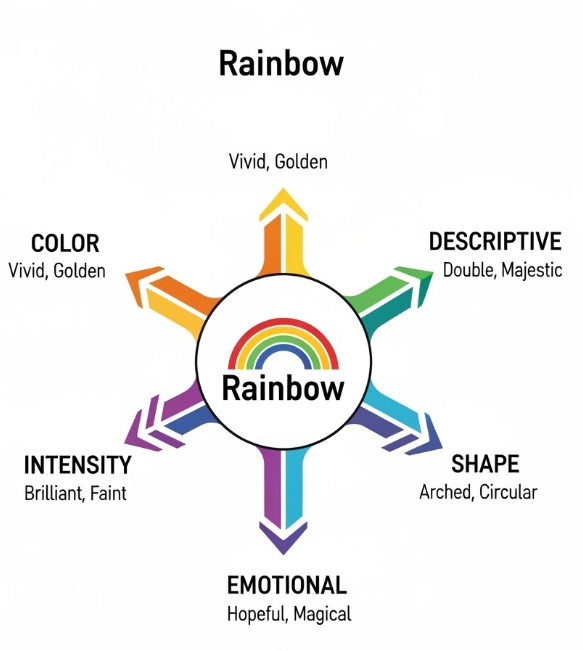
Several types of adjectives can be used to describe rainbows, each highlighting different aspects of their appearance and impact.
Color Adjectives
Color adjectives are perhaps the most obvious and essential for describing rainbows. They specify the hues present in the arc.
These adjectives can be simple color names or more descriptive terms.
Descriptive Adjectives
Descriptive adjectives provide general information about the rainbow’s appearance, such as its size, clarity, or position in the sky. These adjectives add depth to the description, going beyond just the colors present.
Intensity Adjectives
Intensity adjectives describe the strength or vividness of the rainbow’s colors. These adjectives help convey how noticeable or striking the rainbow is.
Shape Adjectives
Shape adjectives describe the form or structure of the rainbow. These adjectives can refer to the completeness of the arc or any unique features in its shape.
Emotional Adjectives
Emotional adjectives describe the feelings or emotions that the rainbow evokes. These adjectives add a subjective element to the description, reflecting the viewer’s personal experience.
Examples of Adjectives for Rainbows
Here are examples of how to use different types of adjectives to describe rainbows, categorized for clarity.
Color Adjective Examples
This table showcases various color adjectives used to describe different aspects of a rainbow’s hues. These examples provide a spectrum of color descriptions that can be applied to capture the visual essence of a rainbow.
| Adjective | Example Sentence |
|---|---|
| Red | The red band of the rainbow was particularly vibrant. |
| Orange | A distinct orange hue separated the red and yellow. |
| Yellow | The yellow arc seemed to glow against the dark clouds. |
| Green | A clear green band marked the middle of the rainbow. |
| Blue | The blue section of the rainbow faded into indigo. |
| Indigo | The indigo was a deep, rich color. |
| Violet | The violet edge of the rainbow was almost lost in the distance. |
| Multicolor | The multicolor arc stretched across the entire sky. |
| Crimson | A touch of crimson highlighted the upper edge of the rainbow. |
| Golden | The golden yellow band was especially luminous. |
| Azure | The azure blue blended seamlessly into the indigo. |
| Emerald | An emerald green section shone brightly. |
| Scarlet | The scarlet red was intense and captivating. |
| Amber | An amber hue appeared where the yellow met the orange. |
| Lavender | A faint lavender tint completed the rainbow’s spectrum. |
| Teal | A subtle band of teal was visible near the base. |
| Magenta | The magenta tones were deep and vibrant. |
| Cerulean | A cerulean blue added a touch of brightness. |
| Chartreuse | A unique chartreuse section was briefly visible. |
| Rainbow-colored | The rainbow-colored arc was a sight to behold. |
| Variegated | The variegated hues of the rainbow painted the sky. |
| Luminous | The luminous bands of color were captivating. |
| Prismatic | The prismatic display of colors was stunning. |
| Iridescent | The iridescent rainbow shimmered in the sunlight. |
Descriptive Adjective Examples
This table presents descriptive adjectives that characterize the rainbow’s general attributes such as size, clarity, and position. These adjectives enhance the description by providing details beyond just the colors, allowing for a more comprehensive understanding of the rainbow’s appearance.
| Adjective | Example Sentence |
|---|---|
| Bright | A bright rainbow appeared after the storm. |
| Faint | A faint rainbow was barely visible in the distance. |
| Large | A large rainbow arched across the entire horizon. |
| Small | A small rainbow appeared briefly near the waterfall. |
| Complete | A complete rainbow formed a perfect semicircle. |
| Partial | Only a partial rainbow was visible through the trees. |
| Double | A stunning double rainbow graced the sky. |
| Clear | A clear rainbow showed distinct bands of color. |
| Vivid | The vivid rainbow captivated everyone who saw it. |
| Ethereal | The ethereal rainbow seemed almost otherworldly. |
| Majestic | The majestic rainbow dominated the landscape. |
| Arched | The arched rainbow stretched from one horizon to the other. |
| High | A high rainbow appeared after a brief shower. |
| Low | A low rainbow touched the fields in the distance. |
| Fleeting | The fleeting rainbow disappeared as quickly as it came. |
| Spectacular | The spectacular rainbow drew gasps from onlookers. |
| Distant | A distant rainbow marked the edge of the storm. |
| Close | A close rainbow felt almost within reach. |
| Mystical | The mystical rainbow seemed to hold secrets. |
| Glowing | The glowing rainbow lit up the sky. |
| Perfect | The perfect rainbow seemed almost too good to be true. |
| Ephemeral | The ephemeral rainbow was a reminder of nature’s fleeting beauty. |
| Brilliant | The brilliant rainbow shone with intense light. |
| Shimmering | The shimmering rainbow danced in the mist. |
Intensity Adjective Examples
This table provides intensity adjectives that describe the strength and vividness of the colors in a rainbow. These adjectives are crucial for conveying how striking or subtle the rainbow’s appearance is, adding another layer of detail to its description.
| Adjective | Example Sentence |
|---|---|
| Intense | An intense rainbow lit up the sky after the rain. |
| Pale | A pale rainbow was barely visible against the grey clouds. |
| Vibrant | The vibrant colors of the rainbow were breathtaking. |
| Faded | The faded rainbow hinted at a passing storm. |
| Strong | A strong rainbow dominated the horizon. |
| Weak | A weak rainbow appeared briefly and then vanished. |
| Bold | The bold rainbow stood out against the dark backdrop. |
| Subtle | A subtle rainbow added a delicate touch to the landscape. |
| Deep | The deep colors of the rainbow were mesmerizing. |
| Light | A light rainbow seemed almost translucent. |
| Radiant | The radiant rainbow shone brightly. |
| Dim | A dim rainbow was hard to see. |
| Brilliant | The brilliant rainbow was a sight to behold. |
| Muted | The muted colors of the rainbow were soft and gentle. |
| Luminous | The luminous rainbow seemed to glow from within. |
| Dull | The dull rainbow lacked vibrancy. |
| Striking | The striking rainbow captured everyone’s attention. |
| Soft | The soft rainbow was a gentle reminder of nature’s beauty. |
| Rich | The rich hues of the rainbow painted the sky. |
| Delicate | The delicate rainbow was a fleeting vision. |
Shape Adjective Examples
This table focuses on shape adjectives that describe the form and structure of a rainbow. These adjectives are useful for specifying whether the rainbow is a complete arc, a partial one, or has any unique structural features, providing a detailed picture of its physical appearance.
| Adjective | Example Sentence |
|---|---|
| Arched | The arched rainbow stretched across the horizon. |
| Curved | The curved rainbow appeared after the brief shower. |
| Circular | A nearly circular rainbow was visible from the mountaintop. |
| Semi-circular | A semi-circular rainbow framed the waterfall. |
| Fragmented | A fragmented rainbow appeared between the buildings. |
| Broken | The broken rainbow was interrupted by the trees. |
| Perfect | A perfect rainbow formed a complete arc. |
| Incomplete | An incomplete rainbow faded before reaching the ground. |
| Wide | The wide rainbow spanned a large portion of the sky. |
| Narrow | A narrow rainbow appeared briefly. |
| Full | A full rainbow arched over the valley. |
| Partial | A partial rainbow was all we could see through the clouds. |
| Well-defined | The well-defined rainbow stood out sharply. |
| Hazy | A hazy rainbow was softened by the mist. |
| Distinct | The distinct rainbow had clear bands of color. |
Emotional Adjective Examples
This table showcases emotional adjectives that describe the feelings and emotions a rainbow evokes. These adjectives add a subjective layer to the description, reflecting the viewer’s personal experience and emotional response to the rainbow’s beauty.
| Adjective | Example Sentence |
|---|---|
| Beautiful | A beautiful rainbow appeared after the rain. |
| Hopeful | The hopeful rainbow symbolized a new beginning. |
| Magical | The magical rainbow seemed to transport us to another world. |
| Inspiring | The inspiring rainbow filled us with awe. |
| Dreamlike | The dreamlike rainbow felt surreal. |
| Joyful | The joyful rainbow brought smiles to everyone’s faces. |
| Peaceful | The peaceful rainbow calmed our spirits. |
| Serene | The serene rainbow created a tranquil atmosphere. |
| Wonderful | The wonderful rainbow was a delightful surprise. |
| Awe-inspiring | The awe-inspiring rainbow left us speechless. |
| Enchanting | The enchanting rainbow captivated our hearts. |
| Mystical | The mystical rainbow seemed to hold ancient secrets. |
| Uplifting | The uplifting rainbow brightened our day. |
| Gratifying | The gratifying rainbow reminded us of nature’s beauty. |
| Delightful | The delightful rainbow was a welcome sight. |
Usage Rules for Adjectives
Using adjectives correctly involves understanding their placement, order, and agreement with the nouns they modify.
- Placement: Adjectives usually come before the noun they modify (e.g., “a vibrant rainbow”). They can also follow a linking verb (e.g., “The rainbow is vibrant”).
- Order: When using multiple adjectives, follow a general order: opinion, size, age, shape, color, origin, material, purpose (OSASCOMP). However, this is a guideline, and the most natural-sounding order should be prioritized.
- Agreement: In English, adjectives do not change form to agree with the number or gender of the noun they modify.
- Commas: Use commas between coordinate adjectives (e.g., “a bright, colorful rainbow”), but not between cumulative adjectives (e.g., “a faint double rainbow”).
Common Mistakes with Adjectives
Here are some common mistakes to avoid when using adjectives:
| Incorrect | Correct | Explanation |
|---|---|---|
| The rainbow is brightly. | The rainbow is bright. | Adjectives, not adverbs, follow linking verbs like “is.” |
| A rainbow colorful bright. | A bright, colorful rainbow. | Adjectives usually precede the noun and coordinate adjectives are separated by commas. |
| A double faint rainbow. | A faint double rainbow. | Cumulative adjectives need to be in the correct order. |
Practice Exercises
Test your understanding of adjectives with these exercises.
Exercise 1: Identify the Adjectives
Identify the adjectives in the following sentences.
| Question | Answer |
|---|---|
| 1. The vibrant rainbow arched across the sky. | vibrant |
| 2. A faint, double rainbow appeared after the storm. | faint, double |
| 3. The magical sight filled everyone with joy. | magical |
| 4. We saw a complete, perfect rainbow. | complete, perfect |
| 5. The intense colors were breathtaking. | intense |
| 6. A beautiful, arched rainbow appeared suddenly. | beautiful, arched |
| 7. The distant rainbow was barely visible. | distant |
| 8. The serene view calmed our minds. | serene |
| 9. A partial rainbow shimmered in the sunlight. | partial |
| 10. The colorful arc was a welcome sight. | colorful |
Exercise 2: Fill in the Blanks
Fill in the blanks with appropriate adjectives to describe the rainbow.
| Question | Answer |
|---|---|
| 1. The ______ rainbow stretched across the horizon. | vibrant/arched |
| 2. We saw a ______ rainbow after the rain. | faint/double |
| 3. The ______ colors of the rainbow were mesmerizing. | intense/bright |
| 4. A ______ rainbow appeared briefly. | fleeting/small |
| 5. The ______ sight filled us with joy. | beautiful/magical |
| 6. It was a ______ and ______ rainbow. | complete, perfect |
| 7. The ______ rainbow was barely visible in the distance. | distant/pale |
| 8. The ______ view calmed our spirits. | serene/peaceful |
| 9. Only a ______ rainbow was visible through the trees. | partial |
| 10. The ______ arc was a welcome sight after the storm. | colorful/bright |
Exercise 3: Correct the Sentences
Correct the following sentences that contain errors in adjective usage.
| Question | Answer |
|---|---|
| 1. The rainbow is brightly. | The rainbow is bright. |
| 2. A rainbow colorful bright appeared. | A bright, colorful rainbow appeared. |
| 3. We saw a double faint rainbow. | We saw a faint double rainbow. |
| 4. The sight magical was breathtaking. | The magical sight was breathtaking. |
| 5. An arched beautiful rainbow appeared. | A beautiful, arched rainbow appeared. |
| 6. The colors intense were stunning. | The intense colors were stunning. |
| 7. A distant pale rainbow faded. | A pale, distant rainbow faded. |
| 8. The view serene was calming. | The serene view was calming. |
| 9. The partial rainbow was shimmeringly. | The partial rainbow was shimmering. |
| 10. A welcome colorful arc appeared. | A colorful, welcome arc appeared. |
Advanced Topics: Figurative Language and Adjectives
Adjectives can be used creatively in figurative language to enhance descriptions of rainbows. Similes, metaphors, and personification can add depth and emotional resonance.
- Simile: Comparing the rainbow to something else using “like” or “as.” Example: “The rainbow was as vibrant as a painter’s palette.”
- Metaphor: Describing the rainbow as something else to emphasize its qualities. Example: “The rainbow was a bridge to another world.”
- Personification: Giving the rainbow human qualities. Example: “The rainbow smiled down on the valley.”
Frequently Asked Questions
- What is the correct order of adjectives when describing a rainbow?The general order is opinion, size, age, shape, color, origin, material, and purpose (OSASCOMP). However, prioritize what sounds most natural. For example, “a beautiful, large, arched rainbow” sounds better than “a large, beautiful, arched rainbow,” though both could be grammatically correct depending on the intended emphasis. In practice, it’s rare to use more than three or four adjectives before a noun.
- Can I use too many adjectives in a sentence?Yes, using too many adjectives can make your writing sound cluttered and unnatural. It’s best to choose the most impactful adjectives that convey the essential qualities of the rainbow. Overuse can dilute the power of your description. Aim for clarity and conciseness.
- Are there any adjectives that should be avoided when describing rainbows?Avoid adjectives that are vague or redundant. For example, using “colorful” to describe a rainbow is somewhat redundant since rainbows are inherently colorful. Instead, opt for more specific and descriptive adjectives that highlight unique aspects of the rainbow’s appearance.
- How can I make my descriptions of rainbows more vivid?Use a variety of adjectives that appeal to the senses. Consider the colors, intensity, shape, and emotional impact of the rainbow. Incorporate figurative language like similes and metaphors to create a more evocative and memorable image in the reader’s mind. Don’t be afraid to use less common adjectives for a more unique description.
- What is the difference between coordinate and cumulative adjectives?Coordinate adjectives independently modify the noun and can be rearranged without changing the meaning. They are separated by commas (e.g., “a bright, colorful rainbow”). Cumulative adjectives build upon each other to modify the noun, and their order is important. They are not separated by commas (e.g., “a faint double rainbow”).
- Do adjectives change form based on the noun they modify in English?No, adjectives in English do not change form to agree with the number or gender of the noun they modify. This makes adjective usage relatively straightforward compared to languages where adjective agreement is required.
- How do I choose the best adjectives to describe a rainbow?Consider the specific characteristics you want to emphasize. Are you focusing on the colors, the shape, the intensity, or the emotional impact? Choose adjectives that accurately and vividly convey those qualities. Think about the context of your writing and the audience you are writing for. A scientific description will use different adjectives than a poem.
- Can I use adverbs instead of adjectives to describe a rainbow?No, adverbs modify verbs, adjectives, or other adverbs, not nouns. To describe a rainbow, you need adjectives. However, you can use adverbs to modify the adjectives themselves (e.g., “a very bright rainbow”). The key is to use adjectives to directly describe the noun “rainbow.”
Conclusion
Mastering the use of adjectives to describe rainbows allows for more vivid and nuanced communication. By understanding the different types of adjectives, their proper placement, and common pitfalls, you can effectively capture the beauty and wonder of these natural phenomena in your writing.
Remember to vary your adjective choices, consider the emotional impact, and practice using them in different contexts. With these tools, you can paint a picture with words that truly reflects the splendor of a rainbow.