Knowing how to express your origin is a fundamental aspect of introducing yourself in any language. In Spanish, saying “I’m from” goes beyond a simple translation; it involves understanding the nuances of the verb ser and its various forms. This article provides a comprehensive guide to expressing your origin in Spanish, covering everything from basic phrases to more advanced constructions. Whether you’re a beginner looking to introduce yourself or an advanced learner aiming for fluency, this article will equip you with the necessary knowledge and practice to confidently express your origin in Spanish.
This article is designed for anyone learning Spanish, from absolute beginners to advanced students. It will be particularly helpful for those who are traveling to Spanish-speaking countries, interacting with Spanish speakers, or simply interested in expanding their language skills.
By the end of this guide, you will have a solid understanding of how to say “I’m from” in Spanish and be able to use it confidently in various contexts.
Table of Contents
- Introduction
- Definition: Expressing Origin in Spanish
- Structural Breakdown: The Verb Ser
- Types of Origin
- Examples: Saying “I’m From” in Spanish
- Usage Rules and Considerations
- Common Mistakes to Avoid
- Practice Exercises
- Advanced Topics
- Frequently Asked Questions (FAQ)
- Conclusion
Definition: Expressing Origin in Spanish
In Spanish, expressing your origin primarily involves using the verb ser (to be) in conjunction with a place name. The basic structure is “Yo soy de…” which translates directly to “I am from…” However, there are nuances and variations depending on the specific context and the level of formality. Understanding these nuances is crucial for effective communication and cultural sensitivity.
The verb ser is used to describe permanent or inherent characteristics, including origin, nationality, and profession. Therefore, when stating where you are from, you are essentially defining a part of your identity. It’s important to distinguish ser from estar, which is used for temporary states or conditions. Using estar to express origin would be grammatically incorrect.
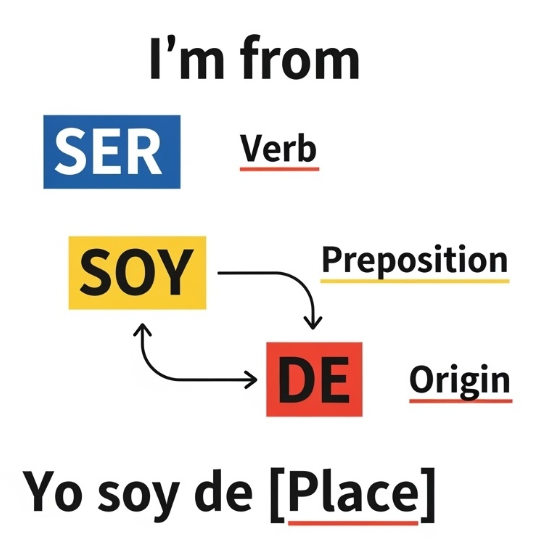
The phrase “Yo soy de…” is the most common and widely understood way to express origin in Spanish. It can be used to indicate your country, city, region, or even a specific neighborhood. The preposition de indicates origin or possession, connecting the verb ser with the place you are from.
Structural Breakdown: The Verb Ser
The verb ser is an irregular verb, meaning its conjugation doesn’t follow the standard patterns. Here’s the conjugation of ser in the present tense, which is most commonly used when expressing origin:
| Pronoun | Conjugation | Translation |
|---|---|---|
| Yo | Soy | I am |
| Tú | Eres | You are (informal) |
| Él/Ella/Usted | Es | He/She/You are (formal) |
| Nosotros/Nosotras | Somos | We are |
| Vosotros/Vosotras | Sois | You are (informal, Spain) |
| Ellos/Ellas/Ustedes | Son | They/You are (formal) |
When expressing origin, you will typically use the first-person singular form, “Yo soy de…”. However, it’s also important to understand the other forms to comprehend when others are expressing their origin or asking about yours. For example, “¿De dónde eres?” means “Where are you from?” (informal).
The structure is straightforward: [Pronoun] + [Conjugation of Ser] + de + [Place]. While the pronoun (e.g., yo) can often be omitted because the verb conjugation implies the subject, it’s generally included for clarity, especially for beginners.
Types of Origin
The phrase “Yo soy de…” can be used to express different levels of origin, ranging from abroad country to a specific neighborhood. Understanding these variations allows for more precise and nuanced self-expression.
Country of Origin
This is the most common and general way to express your origin. You simply state the country you are from.
For example, “Yo soy de España” (I am from Spain).
City of Origin
You can also specify your city of origin. This is useful when you want to be more specific or when you are talking to someone from the same country.
For example, “Yo soy de Madrid” (I am from Madrid).
Region of Origin
In some cases, you might want to mention the region or province you are from, especially in countries with strong regional identities. For example, “Yo soy de Andalucía” (I am from Andalusia).
Examples: Saying “I’m From” in Spanish
This section provides a variety of examples to illustrate how to express your origin in Spanish, categorized by country, city, and region.
Examples: Country of Origin
The following table provides examples of expressing your country of origin in Spanish.
| Spanish | English |
|---|---|
| Yo soy de Argentina. | I am from Argentina. |
| Yo soy de Brasil. | I am from Brazil. |
| Yo soy de Canadá. | I am from Canada. |
| Yo soy de China. | I am from China. |
| Yo soy de Egipto. | I am from Egypt. |
| Yo soy de Francia. | I am from France. |
| Yo soy de Alemania. | I am from Germany. |
| Yo soy de Grecia. | I am from Greece. |
| Yo soy de India. | I am from India. |
| Yo soy de Italia. | I am from Italy. |
| Yo soy de Japón. | I am from Japan. |
| Yo soy de Kenia. | I am from Kenya. |
| Yo soy de México. | I am from Mexico. |
| Yo soy de Noruega. | I am from Norway. |
| Yo soy de Perú. | I am from Peru. |
| Yo soy de Rusia. | I am from Russia. |
| Yo soy de Suecia. | I am from Sweden. |
| Yo soy de Turquía. | I am from Turkey. |
| Yo soy de Uruguay. | I am from Uruguay. |
| Yo soy de Venezuela. | I am from Venezuela. |
| Yo soy de los Estados Unidos. | I am from the United States. |
| Soy de Australia. | I am from Australia. |
| Soy de Corea del Sur. | I am from South Korea. |
| Soy de Sudáfrica. | I am from South Africa. |
| Soy de Irlanda. | I am from Ireland. |
| Soy de Polonia. | I am from Poland. |
| Soy de Tailandia. | I am from Thailand. |
Examples: City of Origin
The following table provides examples of expressing your city of origin in Spanish.
| Spanish | English |
|---|---|
| Yo soy de Buenos Aires. | I am from Buenos Aires. |
| Yo soy de Río de Janeiro. | I am from Rio de Janeiro. |
| Yo soy de Toronto. | I am from Toronto. |
| Yo soy de Pekín. | I am from Beijing. |
| Yo soy de El Cairo. | I am from Cairo. |
| Yo soy de París. | I am from Paris. |
| Yo soy de Berlín. | I am from Berlin. |
| Yo soy de Atenas. | I am from Athens. |
| Yo soy de Nueva Delhi. | I am from New Delhi. |
| Yo soy de Roma. | I am from Rome. |
| Yo soy de Tokio. | I am from Tokyo. |
| Yo soy de Nairobi. | I am from Nairobi. |
| Yo soy de Ciudad de México. | I am from Mexico City. |
| Yo soy de Oslo. | I am from Oslo. |
| Yo soy de Lima. | I am from Lima. |
| Yo soy de Moscú. | I am from Moscow. |
| Yo soy de Estocolmo. | I am from Stockholm. |
| Yo soy de Ankara. | I am from Ankara. |
| Yo soy de Montevideo. | I am from Montevideo. |
| Yo soy de Caracas. | I am from Caracas. |
| Yo soy de Nueva York. | I am from New York. |
| Soy de Sídney. | I am from Sydney. |
| Soy de Seúl. | I am from Seoul. |
| Soy de Johannesburgo. | I am from Johannesburg. |
| Soy de Dublín. | I am from Dublin. |
| Soy de Varsovia. | I am from Warsaw. |
| Soy de Bangkok. | I am from Bangkok. |
Examples: Region of Origin
The following table provides examples of expressing your region of origin in Spanish. Note that the use of regions is more common within specific Spanish-speaking countries and may not always translate directly to regions in other countries.
| Spanish | English |
|---|---|
| Yo soy de Andalucía. | I am from Andalusia. (Spain) |
| Yo soy de Cataluña. | I am from Catalonia. (Spain) |
| Yo soy de Galicia. | I am from Galicia. (Spain) |
| Yo soy de Castilla y León. | I am from Castile and León. (Spain) |
| Yo soy de la Pampa. | I am from La Pampa. (Argentina) |
| Yo soy de la Patagonia. | I am from Patagonia. (Argentina/Chile) |
| Yo soy del Valle del Cauca. | I am from Valle del Cauca. (Colombia) |
| Yo soy del Eje Cafetero. | I am from the Coffee Axis. (Colombia) |
| Yo soy de la Costa Caribe. | I am from the Caribbean Coast. (Colombia) |
| Yo soy de Antioquia. | I am from Antioquia. (Colombia) |
| Yo soy del Bajío. | I am from El Bajío. (Mexico) |
| Yo soy de Yucatán. | I am from Yucatan. (Mexico) |
| Yo soy de Jalisco. | I am from Jalisco. (Mexico) |
| Yo soy del Norte. | I am from the North. (Mexico, referring to the northern states) |
| Yo soy del Centro. | I am from the Center. (Mexico, referring to the central states) |
| Yo soy del Sur. | I am from the South. (Mexico, referring to the southern states) |
| Yo soy de Valparaíso. | I am from Valparaíso. (Chile) |
| Yo soy de la Región Metropolitana. | I am from the Metropolitan Region. (Chile) |
| Yo soy de la Región de Los Lagos. | I am from the Lake District. (Chile) |
| Yo soy de la Región de Atacama. | I am from the Atacama Region. (Chile) |
| Soy de Montevideo. | I am from Montevideo. (Uruguay, also a region) |
| Soy de Canelones. | I am from Canelones. (Uruguay) |
| Soy de Maldonado. | I am from Maldonado. (Uruguay) |
| Soy de Tacuarembó. | I am from Tacuarembó. (Uruguay) |
| Soy de Rivera. | I am from Rivera. (Uruguay) |
| Soy de Paysandú. | I am from Paysandú. (Uruguay) |
Examples: Specific Places within a Region
Sometimes, you might want to provide even more specific information about your origin, referring to a particular neighborhood, town, or landmark. In these cases, you can still use “Yo soy de,” but be mindful of the context.
| Spanish | English |
|---|---|
| Yo soy del barrio de La Boca. | I am from the La Boca neighborhood. (Buenos Aires) |
| Yo soy del centro de Madrid. | I am from the center of Madrid. |
| Yo soy de las afueras de Barcelona. | I am from the outskirts of Barcelona. |
| Yo soy de la costa de Valencia. | I am from the coast of Valencia. |
| Yo soy de una pequeña aldea en Galicia. | I am from a small village in Galicia. |
| Yo soy de la montaña en Antioquia. | I am from the mountains in Antioquia. |
| Yo soy de una finca cafetera en el Eje Cafetero. | I am from a coffee farm in the Coffee Axis. |
| Yo soy de cerca de las playas de Yucatán. | I am from near the beaches of Yucatan. |
| Yo soy de un pueblo mágico en Jalisco. | I am from a magical town in Jalisco. |
| Yo soy de la capital de Uruguay. | I am from the capital of Uruguay. |
| Yo soy de la ciudad costera de Maldonado. | I am from the coastal city of Maldonado. |
| Yo soy de un pueblo pequeño cerca de Rivera. | I am from a small town near Rivera. |
| Yo soy de la frontera con Brasil. | I am from the border with Brazil. |
| Yo soy de las sierras de Minas. | I am from the Minas mountains. |
| Yo soy de la zona rural de Canelones. | I am from the rural area of Canelones. |
Usage Rules and Considerations
While the basic structure “Yo soy de…” is straightforward, there are some important usage rules and considerations to keep in mind for accurate and natural communication.
Gender and Number Agreement
In most cases, gender agreement is not a concern when using “Yo soy de…” because de is a preposition and doesn’t change based on gender. However, when using adjectives to describe the place, gender agreement is essential. For example, if you are from a “beautiful city,” you would say “Yo soy de una ciudad bonita” (feminine) or “Yo soy de un pueblo bonito” (masculine).
Use of Articles
Generally, you do not use articles (el, la, los, las) with countries or cities when using “Yo soy de…” However, there are exceptions. For example, “Yo soy de los Estados Unidos” (I am from the United States) requires the article because “Estados Unidos” is a plural noun. Also, some country names inherently include an article, such as “El Salvador.” So you would say “Yo soy de El Salvador.”
When referring to regions or specific places within a city, you often need to use articles. For example, “Yo soy del centro de Madrid” (I am from the center of Madrid).
Formal vs. Informal Situations
The phrase “Yo soy de…” is suitable for both formal and informal situations. However, in formal settings, you might want to add a polite introduction, such as “Mucho gusto, yo soy de…” (Nice to meet you, I am from…).
When asking someone where they are from, use “¿De dónde eres?” in informal situations and “¿De dónde es usted?” in formal situations. Remember to use the appropriate pronoun and verb conjugation based on the level of formality.
Common Mistakes to Avoid
Here are some common mistakes to avoid when expressing your origin in Spanish:
| Incorrect | Correct | Explanation |
|---|---|---|
| Yo estoy de España. | Yo soy de España. | Using estar instead of ser. |
| Yo soy a España. | Yo soy de España. | Using the wrong preposition (a instead of de). |
| Yo soy España. | Yo soy de España. | Omitting the preposition de. |
| Yo soy el Madrid. | Yo soy de Madrid. | Using the article “el” before the city name (usually incorrect). |
| Yo soy Estados Unidos. | Yo soy de los Estados Unidos. | Omitting the article “los” before “Estados Unidos.” |
| De dónde es tú? | ¿De dónde eres tú? | Incorrect word order and verb conjugation in the question. |
| Soy de Nueva York ciudad. | Soy de la ciudad de Nueva York. | More natural and grammatically correct phrasing. |
Practice Exercises
Test your understanding with these practice exercises. Answers are provided at the end of each exercise.
Exercise 1: Fill in the Blanks
Complete the following sentences with the correct form of the verb ser and the preposition de.
| Question | Answer |
|---|---|
| Yo _______ _______ México. | Yo soy de México. |
| ¿Tú _______ _______ dónde? | ¿Tú eres de dónde? |
| Él _______ _______ Argentina. | Él es de Argentina. |
| Nosotros _______ _______ España. | Nosotros somos de España. |
| Ellos _______ _______ Brasil. | Ellos son de Brasil. |
| Ella _______ _______ París. | Ella es de París. |
| Usted _______ _______ los Estados Unidos. | Usted es de los Estados Unidos. |
| Vosotros _______ _______ Chile. | Vosotros sois de Chile. |
| Yo _______ _______ Canadá. | Yo soy de Canadá. |
| ¿De dónde _______ _______ ustedes? | ¿De dónde son de ustedes? |
Exercise 2: Translation
Translate the following sentences into Spanish.
| English | Spanish |
|---|---|
| I am from Italy. | Yo soy de Italia. |
| Where are you from? (informal) | ¿De dónde eres? |
| He is from Germany. | Él es de Alemania. |
| We are from Peru. | Nosotros somos de Perú. |
| They are from Japan. | Ellos son de Japón. |
| She is from London. | Ella es de Londres. |
| You are from the United States. (formal) | Usted es de los Estados Unidos. |
| I am from a small town in Spain. | Soy de un pueblo pequeño en España. |
| We are from the capital of Argentina. | Somos de la capital de Argentina. |
| Where are you all from? (formal) | ¿De dónde son ustedes? |
Exercise 3: Question and Answer
Answer the following questions in Spanish, providing your own origin.
| Question | Example Answer |
|---|---|
| ¿De dónde eres? | Yo soy de [Your City/Country]. |
| ¿Eres de una ciudad grande o un pueblo pequeño? | Soy de una ciudad grande. / Soy de un pueblo pequeño. |
| ¿De qué país son tus padres? | Mis padres son de [Parents’ Country]. |
| ¿Te gusta ser de tu país? | Sí, me gusta ser de mi país. / No, no me gusta ser de mi país. |
| ¿Qué es lo que más te gusta de tu ciudad? | Lo que más me gusta de mi ciudad es [Favorite Thing]. |
| ¿Has vivido siempre en tu país de origen? | Sí, siempre he vivido en mi país de origen. / No, no siempre he vivido en mi país de origen. |
| ¿Qué idiomas se hablan en tu país? | En mi país se hablan [Languages]. |
| ¿Cómo describirías tu región a un extranjero? | Describiría mi región como [Description]. |
| ¿Qué tradiciones son típicas de tu país? | Algunas tradiciones típicas de mi país son [Traditions]. |
| ¿Recomendarías visitar tu país? ¿Por qué? | Sí, recomendaría visitar mi país porque [Reasons]. |
Advanced Topics
For advanced learners, here are some more complex aspects of expressing origin in Spanish:
Expressing Ancestry
To express your ancestry or heritage, you can use phrases like “Tengo ascendencia…” (I have ancestry…) or “Mis antepasados son de…” (My ancestors are from…). For example, “Tengo ascendencia italiana” (I have Italian ancestry) or “Mis antepasados son de Irlanda” (My ancestors are from Ireland).
Double Nationality
If you have double nationality, you can say “Tengo doble nacionalidad” (I have double nationality) and then specify the countries. For example, “Tengo doble nacionalidad, soy español y británico” (I have double nationality, I am Spanish and British).
Idiomatic Expressions
There are some idiomatic expressions related to origin, such as “Ser de pura cepa” (to be purebred, meaning to have a strong and authentic connection to a place or culture) or “Tener la sangre de…” (to have the blood of…, meaning to have a certain heritage or characteristic). These expressions are more nuanced and require a deeper understanding of the culture.
Frequently Asked Questions (FAQ)
Here are some frequently asked questions about expressing origin in Spanish:
- Is it always necessary to include the pronoun “Yo” when saying “Yo soy de…”?
No, it’s not always necessary. The verb conjugation “soy” already indicates that the subject is “yo.” However, including “Yo” can provide emphasis or clarity, especially for beginners. - Can I use “estar” instead of “ser” to express my origin?
No, using “estar” to express your origin is grammatically incorrect. “Ser” is used for permanent or inherent characteristics, while “estar” is used for temporary states or conditions. - How do I ask someone where they are from in a formal situation?
In a formal situation, you would ask “¿De dónde es usted?” using the formal pronoun “usted” and the corresponding verb conjugation. - When should I use “del” instead of “de” when expressing origin?
You use “del” when the place you are referring to requires the masculine singular article “el.” For example, “Yo soy del centro de la ciudad” (I am from the city center). “Del” is a contraction of “de” + “el.” - Are there any exceptions to the rule of not using articles with countries?
Yes, there are exceptions. Some countries, like “los Estados Unidos” or “El Salvador,” require the use of articles. - How can I express that my family is from a different country than I am?
You can say “Nací en [Your Country], pero mi familia es de [Family’s Country]” (I was born in [Your Country], but my family is from [Family’s Country]). - What’s the difference between “nacionalidad” and “origen”?
“Nacionalidad” refers to your legal citizenship, while “origen” refers to where you come from or where you were born. You can have a different nationality from your place of origin. - How can I politely ask someone about their origin if I’m unsure of their nationality?
You can ask “¿De dónde eres originario/a?” (Where are you originally from?) This is a polite way to inquire about someone’s background without making assumptions about their nationality.
Conclusion
Mastering the art of expressing your origin in Spanish is a crucial step towards fluency and cultural understanding. By understanding the nuances of the verb ser, the correct use of prepositions and articles, and the various levels of specificity, you can confidently and accurately express your background in a variety of contexts. Remember to practice regularly and pay attention to how native speakers express their origin to refine your skills.
This article has provided a comprehensive guide to saying “I’m from” in Spanish, covering everything from basic phrases to advanced topics. With the knowledge and practice provided here, you are well-equipped to introduce yourself and connect with Spanish speakers on a deeper level.
Keep practicing, and don’t be afraid to make mistakes – they are a natural part of the learning process!