Understanding how adjectives can be used to create rhyme is crucial for poets, songwriters, and anyone interested in enhancing their command of the English language. Adjectives, words that describe nouns, can be strategically selected not only for their meaning but also for their sound.
This article provides a detailed exploration of adjectives in the context of rhyme, covering different types of rhymes, structural considerations, usage rules, common mistakes, and practical exercises to improve your rhyming skills. This guide is designed for both beginners and advanced learners looking to refine their grasp of poetic language and stylistic expression.
Table of Contents
- Introduction
- Definition of Adjectives for Rhyme
- Structural Breakdown
- Types of Rhyme
- Examples of Adjectives for Rhyme
- Usage Rules
- Common Mistakes
- Practice Exercises
- Advanced Topics
- FAQ
- Conclusion
Introduction
Rhyme is a fundamental element of poetry and songwriting, adding musicality and memorability to language. While rhyme is often associated with nouns and verbs, adjectives play a significant role in creating rich and nuanced rhyming patterns.
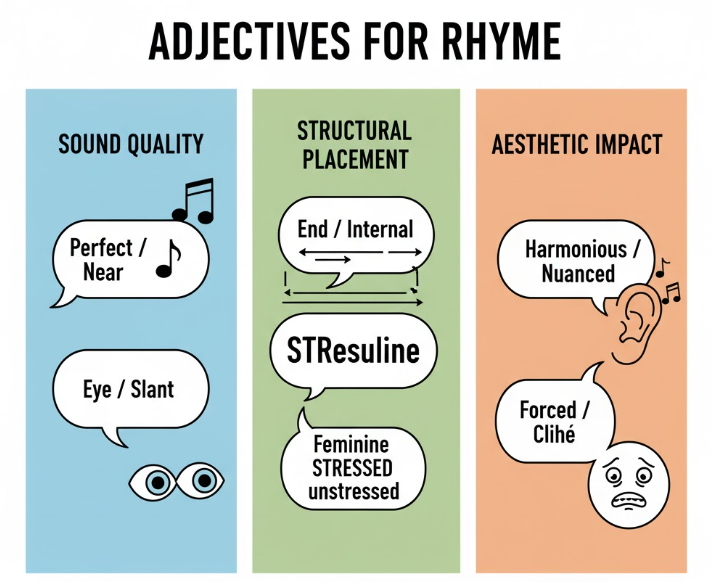
By carefully choosing adjectives that not only convey the desired meaning but also share similar sounds, writers can craft more engaging and aesthetically pleasing compositions. This article delves into the intricacies of using adjectives for rhyme, providing a comprehensive guide for mastering this essential skill.
Definition of Adjectives for Rhyme
Adjectives for rhyme are adjectives that are specifically chosen or crafted to create a rhyming effect within a line of poetry, song lyrics, or other forms of creative writing. The function of adjectives in rhyme extends beyond mere description; they serve to connect words through sound, enhancing the musicality and aesthetic appeal of the text. These adjectives can participate in various types of rhymes, including end rhymes, internal rhymes, and slant rhymes. Understanding the phonetic properties of adjectives is crucial for effectively using them in rhyming schemes.
Adjectives for rhyme can be classified based on the type of rhyme they participate in:
- Perfect Rhyme: Adjectives that share identical sounds from the stressed vowel to the end of the word (e.g., bright and light).
- Near Rhyme (Slant Rhyme): Adjectives that share similar, but not identical, sounds (e.g., warm and storm, blue and true).
- Eye Rhyme: Adjectives that look like they should rhyme based on spelling but do not rhyme in pronunciation (e.g., rough and cough).
- Internal Rhyme: Adjectives that rhyme within the same line of verse (e.g., “The grand old man had a planned stand”).
Structural Breakdown
The structure of adjectives plays a crucial role in their ability to create effective rhymes. The placement of the stressed syllable and the phonetic composition of the word significantly impact its rhyming potential.
Consider the following structural elements:
- Syllable Count: The number of syllables in an adjective influences its compatibility with other words in a rhyme scheme. Monosyllabic adjectives (e.g., bold, fair) are often easier to rhyme than polysyllabic adjectives (e.g., fantastic, delightful).
- Stress Pattern: The location of the stressed syllable is critical for creating perfect rhymes. Words with the same stress pattern are more likely to rhyme effectively (e.g., intense and defense).
- Phonetic Composition: The specific sounds within an adjective determine its rhyming potential. Identical or similar vowel sounds and consonant clusters are essential for creating strong rhymes (e.g., fleet and sweet).
Adjectives can also be analyzed based on their suffixes and prefixes, which can influence their sound and rhyming capabilities. For example, adjectives ending in “-ing” (e.g., singing, swinging) or “-ed” (e.g., pleased, eased) can create predictable rhyming patterns. Similarly, adjectives with common prefixes like “un-” (e.g., untrue, anew) can be paired with other words sharing the same prefix and rhyming stem.
Types of Rhyme
Understanding the different types of rhyme is essential for effectively using adjectives in creative writing. Here’s an overview of the main types:
Perfect Rhyme
Perfect rhyme, also known as full rhyme, involves identical sounds from the stressed vowel to the end of the word. This is the most common and easily recognizable type of rhyme.
When using adjectives, perfect rhyme creates a strong and harmonious connection between words.
Near Rhyme (Slant Rhyme)
Near rhyme, also called slant rhyme or half rhyme, involves similar but not identical sounds. This type of rhyme can add subtlety and complexity to a poem or song, creating a more nuanced and less predictable effect.
Slant rhyme is particularly useful when perfect rhymes are difficult to find or when a more understated effect is desired.
Eye Rhyme
Eye rhyme, also known as visual rhyme, occurs when words look like they should rhyme based on their spelling but do not rhyme in pronunciation. While eye rhyme can be used intentionally for stylistic effect, it is often considered a weaker form of rhyme compared to perfect or near rhyme.
Internal Rhyme
Internal rhyme involves rhyming words within the same line of verse. This technique can add musicality and emphasis to specific phrases or ideas.
Adjectives can be effectively used in internal rhyme to create a more dynamic and engaging reading experience.
Examples of Adjectives for Rhyme
The following tables provide extensive examples of adjectives used in different types of rhymes. These examples illustrate how adjectives can be strategically selected to create various rhyming effects.
Perfect Rhyme Examples
This table showcases adjectives that create perfect rhymes, sharing identical sounds from the stressed vowel onward.
| Adjective 1 | Adjective 2 | Example Sentence |
|---|---|---|
| Bright | Light | The bright star gave off a gentle light. |
| Grand | Planned | The grand ceremony was carefully planned. |
| Free | Plea | A free bird heard my desperate plea. |
| Deep | Sleep | The deep ocean lulled him to sleep. |
| Keen | Seen | Her keen eyes had seen the truth. |
| Fair | Dare | A fair maiden, I dare to approach. |
| Bold | Old | The bold knight was brave and old. |
| New | True | A new love that felt true. |
| Blue | Knew | The blue sky, like I knew. |
| Late | Fate | Too late to change fate. |
| Great | Weight | The great responsibility’s weight. |
| Fine | Sign | A fine day, a good sign. |
| Kind | Mind | A kind heart and open mind. |
| Right | Night | The right time of night. |
| Tall | Call | A tall tree heard my call. |
| Small | All | Too small to hold all the dreams. |
| Fast | Last | The fast runner came in last. |
| Best | Rest | Give it your best, then rest. |
| Lost | Cost | The lost treasure’s cost. |
| Just | Dust | From just us, to dust. |
| Sharp | Harp | The sharp sound of the harp. |
| Warm | Swarm | A warm day brought a swarm. |
| Weak | Speak | Too Weak to speak. |
| Full | Pull | Too full to pull the weight. |
| Quick | Thick | The quick mud was thick. |
Near Rhyme (Slant Rhyme) Examples
This table presents adjectives that create near rhymes, sharing similar but not identical sounds.
| Adjective 1 | Adjective 2 | Example Sentence |
|---|---|---|
| Storm | Warm | After the storm, the air felt warm. |
| Green | Clean | The green grass looked so clean. |
| Brave | Knave | The brave soldier fought the knave. |
| Calm | Harm | A calm sea did no harm. |
| Cold | World | A cold feeling in this world. |
| Drawn | Morn | Drawn to the early morn. |
| Crown | Down | The crown fell down. |
| Own | Stone | His own heart felt like stone. |
| Gone | Upon | Gone and set upon. |
| Plan | Man | A plan for every man. |
| Fan | Hand | A fan in my hand. |
| Land | Stand | A land where I could stand. |
| Sand | End | Sand to the very end. |
| Thin | Wind | Thin air and strong wind. |
| Win | Been | To win, where he’s been. |
| Run | Sun | To run under the sun. |
| Fun | Done | Fun when it’s done. |
| Hope | Drop | Hope I didn’t drop it. |
| Slope | Stop | The slope made him stop. |
| Grope | Up | To grope it up. |
| Near | There | Near you there. |
| Fear | Air | Fear in the air. |
| Bear | Were | The bear that were. |
| Sure | Poor | Sure, I’m poor. |
| Tour | Your | A tour for your pleasure. |
Eye Rhyme Examples
This table illustrates adjectives that create eye rhymes, where words look like they should rhyme but do not due to pronunciation differences.
| Adjective 1 | Adjective 2 | Example Sentence |
|---|---|---|
| Rough | Cough | The rough texture made him cough. |
| Though | Through | Even though we went through it. |
| Bough | Enough | The bough was not strong enough. |
| Slough | Ough | A slough wasn’t ough. |
| Love | Move | I did love to move. |
| Have | Grave | To have a shallow grave. |
| Give | Naive | To give to the naive. |
| Live | Forgive | To live to forgive. |
| Said | Paid | What I said, I paid. |
| Head | Dead | To head to the dead. |
| Bread | Lead | Bread to the lead. |
| Read | Lead | To read to the lead. |
| Tear | Bear | To tear with a bear. |
| Wear | Fear | To wear my fear. |
| Hear | Clear | I hear it clear. |
| Here | Where | Here is where. |
| Eye | Buy | With my eye I buy. |
| Lie | Die | To lie to die. |
| Toe | Foe | Toe to foe. |
| Row | Low | A row to the low. |
Internal Rhyme Examples
This table provides examples of adjectives used in internal rhyme, where rhyming words occur within the same line.
| Line with Internal Rhyme | Rhyming Adjectives |
|---|---|
| The grand old man had a planned stand. | Grand, Planned |
| In the deep, dark night, I couldn’t sleep. | Deep, Sleep |
| A bright, white star brought pure light. | Bright, Light |
| The fair maiden didn’t dare to speak. | Fair, Dare |
| The keen eyes had seen the truth. | Keen, Seen |
| He was bold, and growing old. | Bold, Old |
| The love was new, and felt so true. | New, True |
| The sky was blue, like I always knew. | Blue, Knew |
| It was too late, sealing their fate. | Late, Fate |
| The burden felt great, with much weight. | Great, Weight |
| A day so fine, a promising sign. | Fine, Sign |
| The person was so kind, with an open mind. | Kind, Mind |
| The time felt right, in the middle of the night. | Right, Night |
| The tree was tall, answering my call. | Tall, Call |
| The bag was small, not holding it all. | Small, All |
| He ran so fast, coming in last. | Fast, Last |
| Give it your best, then take a rest. | Best, Rest |
| The treasure was lost, at such a high cost. | Lost, Cost |
| From just us, reduced to dust. | Just, Dust |
| The sound was so sharp, coming from the harp. | Sharp, Harp |
| The day was so warm, bringing forth a swarm. | Warm, Swarm |
| Too weak, not able to speak. | Weak, Speak |
| Too full, not able to pull. | Full, Pull |
| The mud was so quick, so very thick. | Quick, Thick |
Usage Rules
When using adjectives for rhyme, it’s essential to follow certain rules to ensure that the rhymes are effective and aesthetically pleasing. These rules encompass phonetic considerations, grammatical accuracy, and stylistic choices.
- Maintain Phonetic Consistency: Ensure that the rhyming adjectives share consistent vowel sounds and consonant clusters. Avoid pairing words with significantly different pronunciations, as this can create jarring or ineffective rhymes.
- Consider Grammatical Context: Ensure that the adjectives fit grammatically within the sentence or line of verse. The adjectives should modify the nouns they are intended to describe and should align with the overall grammatical structure of the text.
- Pay Attention to Syllable Count: Be mindful of the number of syllables in the rhyming adjectives. While it is not always necessary to match syllable counts exactly, maintaining a similar rhythm can enhance the flow and musicality of the verse.
- Use Rhyme Scheme Consistently: If you are using a specific rhyme scheme (e.g., AABB, ABAB), ensure that the adjectives adhere to the established pattern. Consistency in rhyme scheme contributes to the overall coherence and structure of the poem or song.
Exceptions and Special Cases: There are instances where breaking the rules can be effective for stylistic purposes. For example, using slant rhyme intentionally can create a more subtle or nuanced effect. However, it’s important to be aware of the rules before breaking them, to ensure that the deviation is deliberate and serves a specific artistic purpose.
Common Mistakes
Several common mistakes can undermine the effectiveness of adjectives used for rhyme. Being aware of these errors can help you avoid them and improve your rhyming skills.
- Forcing Rhymes: Avoid choosing adjectives solely for their rhyming potential, without considering their meaning or relevance to the context. Forced rhymes can sound unnatural and detract from the overall quality of the writing.
- Ignoring Pronunciation: Pay close attention to the pronunciation of adjectives, especially when dealing with words that have multiple pronunciations or regional variations. Mispronouncing words can lead to ineffective or nonsensical rhymes.
- Overusing Common Rhymes: Try to avoid relying too heavily on common or cliché rhymes. While familiar rhymes can be effective in certain contexts, overuse can make the writing sound predictable and unoriginal.
Here are some examples of common mistakes and corrections:
| Incorrect | Correct | Explanation |
|---|---|---|
| The glad cat was very bad. | The glad cat was slightly mad. | “Bad” doesn’t fit the context of a glad cat; ‘mad’ is a better fit. |
| A new idea, shinning like glue. | A new idea, shining like true. | “Glue” is a forced rhyme; “true” is more appropriate and meaningful. |
| The rough wind was enough to laugh. | The rough wind caused a hacking cough. | “Laugh” is an eye rhyme but doesn’t sound alike; “cough” is better. |
Practice Exercises
The following exercises are designed to help you practice using adjectives for rhyme. These exercises cover different types of rhymes and various levels of difficulty.
Exercise 1: Perfect Rhyme Completion
Complete the following sentences by adding an adjective that creates a perfect rhyme with the given word.
| Sentence | Answer |
|---|---|
| The star was very _____, giving off a radiant light. (bright) | light |
| The plan was _____, and it was a grand thing. (grand) | planned |
| The bird seemed very _____, in its glee. (free) | plea |
| It was a very ____ ocean, as I fell asleep. (deep) | sleep |
| The man was ____, he had seen so much. (keen) | seen |
| The maiden was ____, I dare speak. (fair) | dare |
| The knight was ____, brave and old. (bold) | old |
| The love was ____, and so true. (new) | true |
| The sky was ____, like I always knew. (blue) | knew |
| It was too ____, sealing their fate. (late) | fate |
Exercise 2: Near Rhyme Identification
Identify the near rhyme in each of the following pairs of adjectives.
| Adjective Pair | Answer |
|---|---|
| Storm, Warm | Near Rhyme |
| Green, Clean | Near Rhyme |
| Brave, Knave | Near Rhyme |
| Calm, Harm | Near Rhyme |
| Cold, World | Near Rhyme |
Exercise 3: Eye Rhyme Recognition
Identify the eye rhyme in each of the following pairs of adjectives.
| Adjective Pair | Answer |
|---|---|
| Rough, Cough | Eye Rhyme |
| Though, Through | Eye Rhyme |
| Said, Paid | Eye Rhyme |
| Head, Dead | Eye Rhyme |
| Eye, Buy | Eye Rhyme |
Exercise 4: Internal Rhyme Creation
Create a line of verse that includes internal rhyme using adjectives.
| Your Line of Verse |
|---|
| The bright, white star brought pure light. |
| The grand old man had a planned stand. |
| The eyes were so keen, as to be seen. |
Advanced Topics
For advanced learners, exploring more complex aspects of adjectives for rhyme can further enhance their poetic skills. These topics include:
- Complex Rhyme Schemes: Experiment with intricate rhyme schemes such as terza rima, villanelle, and sestina, which require careful planning and execution of rhyming patterns.
- Multi-Syllabic Rhymes: Incorporate adjectives with multiple syllables to create more elaborate and sophisticated rhymes. This can add depth and complexity to the verse.
- Sound Devices: Combine adjectives for rhyme with other sound devices such as alliteration, assonance, and consonance to create a richer and more textured auditory experience.
- Cultural and Linguistic Context: Consider the cultural and linguistic context of the adjectives used for rhyme. Different languages and cultures may have unique conventions and expectations regarding rhyme and sound patterns.
FAQ
Here are some frequently asked questions about using adjectives for rhyme:
- What is the difference between perfect rhyme and near rhyme?Perfect rhyme involves identical sounds from the stressed vowel to the end of the word, while near rhyme involves similar but not identical sounds. Near rhyme can add subtlety and complexity to a poem or song.
- How can I improve my ability to find rhyming adjectives?Practice regularly, expand your vocabulary, and pay close attention to the sounds of words. Use rhyming dictionaries and thesauruses to explore different options and experiment with various combinations.
- Is it okay to use eye rhyme in poetry?Eye rhyme can be used intentionally for stylistic effect, but it is generally considered a weaker form of rhyme compared to perfect or near rhyme. Use it sparingly and with purpose.
- How important is syllable count when using adjectives for rhyme?While it is not always necessary to match syllable counts exactly, maintaining a similar rhythm can enhance the flow and musicality of the verse. Pay attention to the overall rhythmic structure of the poem or song.
- What are some common mistakes to avoid when using adjectives for rhyme?Avoid forcing rhymes, ignoring pronunciation, and overusing common rhymes. Ensure that the adjectives fit grammatically within the sentence and contribute to the overall meaning and aesthetic appeal of the text.
- Can I use adjectives for internal rhyme?Yes, adjectives can be effectively used in internal rhyme to create a more dynamic and engaging reading experience. Experiment with different combinations and placements to achieve the desired effect.
- Are there any specific types of adjectives that are easier to rhyme?Monosyllabic adjectives are generally easier to rhyme than polysyllabic adjectives due to their simpler phonetic structure. Adjectives with common suffixes or prefixes can also create predictable rhyming patterns.
- How can I make my rhymes sound more original and less cliché?Avoid relying too heavily on common or cliché rhymes. Explore less common words and experiment with different types of rhymes, such as slant rhyme or internal rhyme, to create a more unique and memorable effect.
Conclusion
Using adjectives for rhyme is a valuable skill for poets, songwriters, and anyone interested in enhancing their command of the English language. By understanding the different types of rhymes, structural considerations, usage rules, and common mistakes, you can effectively incorporate adjectives into your writing to create more engaging and aesthetically pleasing compositions.
Remember to practice regularly, expand your vocabulary, and experiment with different techniques to develop your own unique style.
Mastering the art of rhyming adjectives requires dedication and attention to detail, but the rewards are well worth the effort. By carefully selecting adjectives that not only convey the desired meaning but also share similar sounds, you can elevate your writing to new heights and create works that resonate with readers and listeners alike.
Embrace the challenge, explore the possibilities, and let your creativity soar.