Understanding and using adjectives of size correctly is crucial for clear and vivid communication in English. These adjectives allow us to provide specific details about objects, people, and places, making our descriptions more engaging and informative.
This guide is designed for English language learners of all levels, from beginners to advanced speakers, who want to enhance their vocabulary and improve their descriptive abilities. By mastering these adjectives, you’ll be able to paint more detailed pictures with your words and express yourself with greater precision.
Table of Contents
- Introduction
- Definition of Size Adjectives
- Structural Breakdown
- Types and Categories of Size Adjectives
- Examples of Size Adjectives
- Usage Rules for Size Adjectives
- Common Mistakes with Size Adjectives
- Practice Exercises
- Advanced Topics
- Frequently Asked Questions (FAQ)
- Conclusion
Definition of Size Adjectives
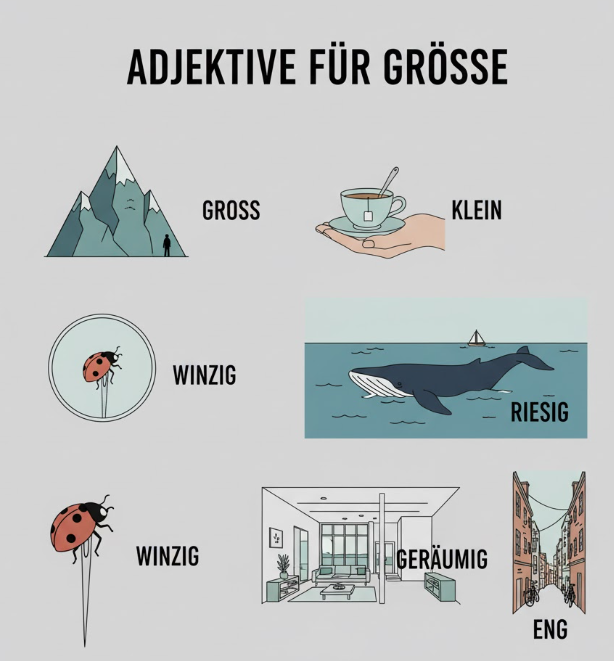
Size adjectives are words that describe the dimensions or extent of a noun. They provide information about how big or small something is, helping to create a more detailed and accurate picture in the reader’s or listener’s mind. These adjectives are essential for effective communication, allowing us to differentiate between objects and convey precise information about their physical characteristics.
Size adjectives function as attributive adjectives, meaning they typically appear before the noun they modify (e.g., a large house, a small car). They can also function as predicative adjectives, appearing after a linking verb (e.g., The house is large, The car is small). Understanding their function is crucial for constructing grammatically correct and meaningful sentences.
The context in which size adjectives are used greatly influences their interpretation. For example, “a big problem” doesn’t refer to physical size but rather to the significance or severity of the issue.
Therefore, it’s important to consider the surrounding words and the overall meaning of the sentence when using or interpreting size adjectives.
Structural Breakdown
The structure of sentences using size adjectives is generally straightforward. The adjective typically precedes the noun it modifies, providing immediate information about the noun’s size.
This structure helps to create a clear and concise description.
Basic Structure: Adjective + Noun (e.g., tall building, tiny insect)
When using multiple adjectives, size adjectives usually come before adjectives of color, origin, or material. This follows the general rule of adjective order in English.
For example: “a large red car” (size before color), “a small Italian restaurant” (size before origin).
Here’s a more complex example showing the standard adjective order: “a beautiful large old brown wooden table.” In this case, the order is opinion, size, age, color, material, and noun. Understanding this structure helps ensure grammatically correct and natural-sounding sentences.
Types and Categories of Size Adjectives
Size adjectives can be categorized based on the type of size they describe. The three main categories are absolute size, relative size, and figurative size.
Absolute Size Adjectives
Absolute size adjectives describe the actual dimensions of an object, without comparing it to anything else. These adjectives provide a clear and objective measurement of size.
Examples of absolute size adjectives include: tall, short, wide, narrow, long, big, small, large, tiny, huge, enormous, gigantic, microscopic.
Using absolute size adjectives allows for precise descriptions, enabling the listener or reader to visualize the object accurately. For example, saying “a tall building” gives a clearer picture than simply saying “a building.”
Relative Size Adjectives
Relative size adjectives describe the size of an object in comparison to something else. These adjectives are subjective and depend on the context.
Examples of relative size adjectives include: bigger, smaller, larger, tinier, huger, more enormous, more gigantic. These are typically comparative forms of absolute size adjectives.
Consider the sentence: “This elephant is larger than that one.” The size of the elephant is being compared to another elephant, making “larger” a relative size adjective. The interpretation depends on the size of the other elephant.
Figurative Size Adjectives
Figurative size adjectives are used metaphorically to describe something’s importance, impact, or intensity, rather than its physical size. These adjectives add depth and emotion to descriptions.
Examples of figurative size adjectives include: big (problem), small (matter), huge (success), enormous (impact).
When we say, “That’s a big decision,” we are not referring to the physical size of the decision but rather its significance. Similarly, “a small act of kindness” refers to the act’s impact rather than its physical dimensions.
Examples of Size Adjectives
To further illustrate the use of size adjectives, let’s examine several examples categorized by the types discussed above.
General Size Adjectives
This table provides examples of general size adjectives used in different contexts. These adjectives are commonly used to describe the overall size of objects and are essential for basic descriptions.
| Adjective | Example Sentence |
|---|---|
| Big | The big dog barked loudly. |
| Small | She lives in a small apartment. |
| Large | The company has a large workforce. |
| Tiny | I found a tiny spider in the garden. |
| Huge | They live in a huge mansion. |
| Enormous | The museum has an enormous collection of artifacts. |
| Gigantic | A gigantic statue stood in the town square. |
| Tall | He is a tall basketball player. |
| Short | She has short hair. |
| Long | The long road stretched ahead. |
| Wide | The river is very wide here. |
| Narrow | They walked down a narrow alley. |
| Microscopic | The scientist studied microscopic organisms. |
| Immense | The ocean is immense and mysterious. |
| Substantial | The company made a substantial profit this year. |
| Considerable | There was a considerable amount of damage after the storm. |
| Minute | The minute details made all the difference. |
| Petite | She is a petite woman with a big personality. |
| Bulky | The package was too bulky to fit in the mailbox. |
| Compact | He bought a compact car for city driving. |
| Voluminous | She wore a dress with a voluminous skirt. |
| Expansive | The ranch had expansive fields of wheat. |
| Diminutive | The dollhouse had diminutive furniture. |
Specific Size Adjectives
This table showcases examples of size adjectives used to describe specific dimensions or shapes. These adjectives provide more precise and detailed descriptions.
| Adjective | Example Sentence |
|---|---|
| Square | The table has a square top. |
| Round | They sat around a round table. |
| Circular | The garden has a circular path. |
| Rectangular | The room is rectangular in shape. |
| Triangular | The sign was triangular. |
| Deep | The lake is very deep. |
| Shallow | The stream is shallow enough to wade through. |
| Thick | The book has a thick cover. |
| Thin | She wore a thin sweater. |
| High | The mountain is very high. |
| Low | The ceiling is quite low. |
| Broad | The road is broad and well-maintained. |
| Slender | She has a slender figure. |
| Plump | The robin was a plump little bird. |
| Stout | He was a stout man with a friendly smile. |
| Lean | The athlete had a lean and muscular physique. |
| Lanky | He was a lanky teenager. |
| Dwarfish | The plant remained dwarfish despite the good soil. |
| Gargantuan | The ship was of gargantuan proportions. |
| Puny | He felt puny compared to the weightlifters. |
| Weighty | The report was a weighty tome. |
| Hefty | The bill was a hefty sum. |
| Featherweight | The boxer was a featherweight contender. |
Figurative Size Adjectives
This table presents examples of figurative size adjectives, where the size refers to the importance, impact, or intensity of something rather than its physical dimensions. These adjectives add a layer of meaning beyond the literal size.
| Adjective | Example Sentence |
|---|---|
| Big | It’s a big problem that needs to be addressed. |
| Small | It’s just a small misunderstanding. |
| Large | The company has a large influence on the industry. |
| Tiny | There’s a tiny chance of success. |
| Huge | The concert was a huge success. |
| Enormous | The project had an enormous impact on the community. |
| Gigantic | The scandal caused a gigantic uproar. |
| Tall | That’s a tall order to fulfill. |
| Short | The meeting was short and to the point. |
| Long | It has been a long and difficult journey. |
| Wide | The politician has wide support. |
| Narrow | The margin of victory was narrow. |
| Deep | She has a deep understanding of the subject. |
| Shallow | Their relationship is quite shallow. |
| Thick | The tension in the room was thick. |
| Thin | His excuse was very thin. |
| High | Expectations were very high for the new product. |
| Low | Morale was low after the company layoffs. |
| Broad | The comedian has a broad appeal. |
| Substantial | They made a substantial contribution to the charity. |
| Immense | The pressure to succeed was immense. |
| Considerable | There was considerable debate about the new policy. |
| Minute | They analyzed the minute details of the contract. |
Usage Rules for Size Adjectives
Using size adjectives correctly involves following specific rules regarding adjective order, comparative and superlative forms, and their use with countable and uncountable nouns.
Adjective Order
In English, adjectives generally follow a specific order. When using multiple adjectives, size adjectives usually come before adjectives of color, origin, or material.
The general order is: Opinion, Size, Age, Shape, Color, Origin, Material, Type, Purpose.
For example: “a beautiful large old brown wooden table.” Here, “beautiful” (opinion) comes first, followed by “large” (size), “old” (age), “brown” (color), and “wooden” (material).
Another example: “a small red Italian car.” Here, “small” (size) comes before “red” (color) and “Italian” (origin). Following this order ensures that your sentences sound natural and grammatically correct.
Comparative and Superlative Forms
Size adjectives, like other adjectives, have comparative and superlative forms to indicate degrees of size.
Comparative Form: Used to compare the size of two things. For most one-syllable adjectives, add “-er” (e.g., bigger, taller, shorter). For longer adjectives, use “more” (e.g., more enormous, more substantial).
Superlative Form: Used to indicate the largest or smallest size among a group of things. For most one-syllable adjectives, add “-est” (e.g., biggest, tallest, shortest). For longer adjectives, use “most” (e.g., most enormous, most substantial).
Examples:
- Comparative: This building is taller than that one.
- Superlative: This is the tallest building in the city.
- Comparative: This problem is more substantial than I thought.
- Superlative: This is the most substantial challenge we have faced.
Use with Countable and Uncountable Nouns
Size adjectives can be used with both countable and uncountable nouns, but the specific adjective used may vary depending on the noun.
Countable Nouns: Nouns that can be counted (e.g., books, cars, people). Size adjectives describe the size of individual items (e.g., a large book, a small car).
Uncountable Nouns: Nouns that cannot be counted (e.g., water, sand, information). Size adjectives often describe the amount or extent of the noun (e.g., a large amount of water, a small quantity of sand). In these cases, you might also use adjectives like “great” or “little” to describe the extent.
Examples:
- Countable: There are many small houses in the neighborhood.
- Uncountable: There was a large amount of rain this year.
- Countable: He has a great number of friends.
- Uncountable: She has a great deal of knowledge.
Common Mistakes with Size Adjectives
Several common mistakes can occur when using size adjectives. Being aware of these errors can help you avoid them and improve your accuracy.
Incorrect Adjective Order: Placing size adjectives in the wrong order relative to other adjectives.
- Incorrect: a red large car
- Correct: a large red car
Misusing Comparative and Superlative Forms: Incorrectly forming or using comparative and superlative forms.
- Incorrect: This is the most big house.
- Correct: This is the biggest house.
Using the Wrong Adjective for the Noun: Choosing an inappropriate size adjective for the noun it modifies.
- Incorrect: a tall amount of water
- Correct: a large amount of water
Confusing Figurative and Literal Meanings: Misinterpreting whether a size adjective is being used literally or figuratively.
- Incorrect: He has a large head (when referring to intelligence).
- Correct: He has a big head (when referring to intelligence).
Overusing “Very”: Relying too heavily on “very” to intensify size adjectives, when a stronger adjective would be more effective.
- Less Effective: The house is very big.
- More Effective: The house is enormous.
Practice Exercises
Test your understanding of size adjectives with these practice exercises. Each exercise focuses on different aspects of using size adjectives correctly.
Exercise 1: Fill in the Blanks
Fill in the blanks with the most appropriate size adjective from the list: big, small, large, tiny, huge, tall, short, long, wide, narrow.
| Question | Answer |
|---|---|
| 1. The elephant is a ______ animal. | big |
| 2. The mouse is a ______ animal. | small |
| 3. The company has a ______ office in New York. | large |
| 4. I saw a ______ insect crawling on the leaf. | tiny |
| 5. They live in a ______ mansion on the hill. | huge |
| 6. He is a ______ basketball player. | tall |
| 7. She has ______ hair. | short |
| 8. The ______ bridge connects the two cities. | long |
| 9. The river is very ______ at this point. | wide |
| 10. They walked down a ______ alley. | narrow |
Exercise 2: Correct the Sentences
Correct the sentences below that contain errors in the use of size adjectives.
| Question | Answer |
|---|---|
| 1. This is the most big building in the city. | This is the biggest building in the city. |
| 2. She lives in a red small house. | She lives in a small red house. |
| 3. He has a tall amount of money. | He has a large amount of money. |
| 4. The problem is very huge. | The problem is enormous. |
| 5. It was a short and long meeting. | It was a long and short meeting. (less common, but grammatically correct if emphasizing the length) OR It was a short meeting. |
| 6. The narrow wide road was dangerous. | The narrow road was dangerous. |
| 7. The tiny big ant carried the crumb. | The tiny ant carried the crumb. |
| 8. The tall short man reached the shelf. | The tall man reached the shelf. |
| 9. The wide narrow river was hard to cross. | The wide river was hard to cross. |
| 10. The small huge dog barked loudly. | The small dog barked loudly. |
Exercise 3: Sentence Building
Create sentences using the given size adjective and noun.
| Adjective | Noun | Example Sentence |
|---|---|---|
| Large | Family | They have a large family. |
| Small | Business | He runs a small business. |
| Huge | Crowd | A huge crowd gathered for the concert. |
| Tall | Tree | There is a tall tree in the garden. |
| Short | Story | She wrote a short story. |
| Long | Journey | It was a long journey to get here. |
| Wide | Smile | He had a wide smile on his face. |
| Narrow | Escape | It was a narrow escape from danger. |
| Enormous | Effort | They put in an enormous effort. |
| Tiny | Village | We visited a tiny village in the mountains. |
Advanced Topics
For advanced learners, understanding idiomatic expressions and nuances in meaning can further refine your use of size adjectives.
Idiomatic Expressions
Several idiomatic expressions use size adjectives to convey specific meanings. These expressions often have figurative meanings that differ from the literal definitions of the words.
Examples:
- Big fish: An important or influential person. (e.g., He’s a big fish in the company.)
- Small talk: Casual conversation about unimportant topics. (e.g., They engaged in small talk at the party.)
- A big deal: Something important or significant. (e.g., Getting the promotion was a big deal for her.)
- Larger than life: Having an exaggerated or exceptional quality. (e.g., The actor had a larger than life personality.)
Nuances in Meaning
Subtle differences in meaning exist between similar size adjectives. Understanding these nuances can help you choose the most appropriate adjective for a given context.
For example:
- Big vs. Large: “Big” is often used for general size, while “large” is more formal and often refers to extent or capacity. (e.g., a big dog vs. a large amount of money)
- Small vs. Tiny: “Small” is a general term for less than average size, while “tiny” implies extremely small. (e.g., a small house vs. a tiny insect)
- Huge vs. Enormous vs. Gigantic: These all mean very large, but “huge” is more common, “enormous” suggests great extent, and “gigantic” implies immense size. (e.g., a huge crowd vs. an enormous impact vs. a gigantic statue)
Frequently Asked Questions (FAQ)
Here are some frequently asked questions about using size adjectives, with detailed answers to clarify common points of confusion.
- Q: What is the correct order of adjectives when describing something?A: The general order of adjectives in English is: Opinion, Size, Age, Shape, Color, Origin, Material, Type, Purpose. Size adjectives typically come before color, origin, and material adjectives.
- Q: How do I form the comparative and superlative of size adjectives?A: For most one-syllable size adjectives, add “-er” for the comparative form and “-est” for the superlative form (e.g., bigger, biggest). For longer adjectives, use “more” and “most” (e.g., more enormous, most enormous).
- Q: Can size adjectives be used with uncountable nouns?A: Yes, size adjectives can be used with uncountable nouns, but they often describe the amount or extent of the noun rather than its physical size (e.g., a large amount of water).
- Q: What’s the difference between “big” and “large”?A: “Big” is a more general term for size, while “large” is often used in more formal contexts or to describe extent or capacity. For example, you might say “a big dog” but “a large amount of data.”
- Q: When should I use a figurative size adjective?A: Use figurative size adjectives when you want to describe the importance, impact, or intensity of something rather than its physical size. For example, “a big problem” or “a small act of kindness.”
- Q: Why is adjective order important?A: Following the correct adjective order makes your sentences sound more natural and grammatically correct to native English speakers. Deviating from the standard order can sound awkward or confusing.
- Q: Is it okay to use multiple size adjectives in one sentence?A: While it’s grammatically correct, using too many size adjectives can make your sentence sound cluttered. Choose the most relevant and descriptive adjectives to avoid redundancy.
- Q: How can I improve my use of size adjectives in writing?A: Practice using size adjectives in your writing, pay attention to how native speakers use them, and review examples to expand your vocabulary and understanding of their nuances.
Conclusion
Mastering size adjectives is an essential step in improving your English language skills. These adjectives allow you to provide detailed and vivid descriptions, enhancing your communication and making your writing and speaking more engaging.
By understanding the different types of size adjectives, following usage rules, and avoiding common mistakes, you can effectively use these words to express yourself with greater precision and clarity.
Remember to practice regularly, pay attention to how native speakers use size adjectives, and continue to expand your vocabulary. With consistent effort, you’ll become more confident and proficient in using size adjectives to create compelling and informative descriptions.
The key to success is continuous learning and application of the concepts discussed in this comprehensive guide.