
Learning how to express basic needs and feelings is crucial when learning a new language. Saying “I’m hungry” is one of the most fundamental phrases you’ll need in Spanish-speaking countries.
This article provides a comprehensive guide on various ways to express hunger in Spanish, from the most common expressions to more nuanced and regional variations. Whether you are a beginner or an advanced learner, this guide will help you communicate your hunger effectively and understand different cultural contexts.
It will be valuable for travelers, students, and anyone interested in improving their Spanish communication skills.
This detailed guide is designed to help you master expressing hunger in Spanish. We’ll cover the most common and idiomatic ways to say “I’m hungry,” explore different levels of intensity, and discuss regional variations.
You’ll also find practical examples, usage rules, and common mistakes to avoid. By the end of this article, you’ll be able to confidently express your hunger in any Spanish-speaking situation.
Table of Contents
- Definition: Expressing Hunger in Spanish
- Structural Breakdown: The Grammar Behind “I’m Hungry”
- Types of Hunger: Degrees of Hunger in Spanish
- Examples: Ways to Say “I’m Hungry” in Spanish
- Usage Rules: When to Use Each Expression
- Common Mistakes: Avoiding Errors When Expressing Hunger
- Practice Exercises: Test Your Knowledge
- Advanced Topics: Nuances and Regional Variations
- FAQ: Frequently Asked Questions
- Conclusion
Definition: Expressing Hunger in Spanish
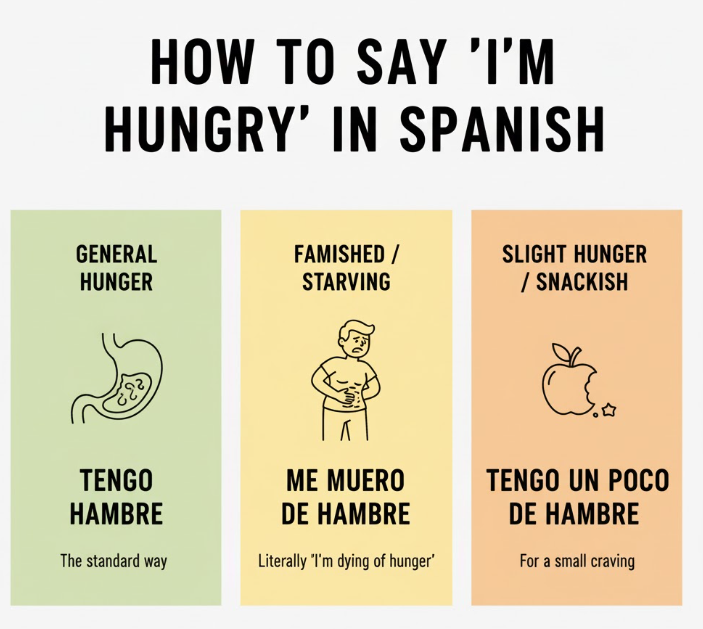
In Spanish, expressing hunger goes beyond a simple direct translation. The most common way to say “I’m hungry” is Tengo hambre. However, there are numerous other expressions that convey different levels of hunger, cultural nuances, and idiomatic usage. Understanding these variations enhances your ability to communicate effectively and naturally in Spanish.
The phrase Tengo hambre literally translates to “I have hunger.” This construction is important because it uses the verb tener (to have) rather than ser or estar (both meaning to be). Hunger is treated as a state of possession, not a quality of being. This distinction is key to understanding the grammatical structure of expressing hunger in Spanish.
Beyond Tengo hambre, other expressions include using verbs like estar with adjectives that describe hunger, or using idiomatic phrases to emphasize the intensity of your hunger. Each expression carries its own connotation and is appropriate in different contexts. We will explore these in detail throughout this article.
Structural Breakdown: The Grammar Behind “I’m Hungry”
The most basic structure for expressing hunger in Spanish involves the verb tener (to have) and the noun hambre (hunger). The personal pronoun (yo, tú, él, etc.) is often omitted because the verb conjugation indicates who is speaking. Understanding the conjugation of tener is crucial for using this expression correctly.
Here’s the conjugation of tener in the present tense:
| Pronoun | Verb (Tener) | Example | Translation |
|---|---|---|---|
| Yo | Tengo | Yo tengo hambre. | I am hungry. |
| Tú | Tienes | Tú tienes hambre. | You are hungry. |
| Él/Ella/Usted | Tiene | Él tiene hambre. | He is hungry. |
| Nosotros/Nosotras | Tenemos | Nosotros tenemos hambre. | We are hungry. |
| Vosotros/Vosotras | Tenéis | Vosotros tenéis hambre. | You (plural, informal) are hungry. |
| Ellos/Ellas/Ustedes | Tienen | Ellos tienen hambre. | They are hungry. |
As you can see, the verb tener changes depending on the subject. However, in many cases, the pronoun is omitted, and the verb conjugation alone makes it clear who is hungry. For example, Tengo hambre is perfectly acceptable and commonly used instead of Yo tengo hambre.
Other structures involve using the verb estar with adjectives. For example, you can say Estoy hambriento/a (I am hungry), where hambriento/a is an adjective meaning “hungry.” The choice between tener and estar depends on whether you view hunger as a state of possession or a temporary condition.
Types of Hunger: Degrees of Hunger in Spanish
Spanish offers various ways to express different degrees of hunger, from a mild appetite to extreme starvation. Understanding these nuances can help you communicate more precisely and add depth to your Spanish vocabulary.
Mild Hunger
To express a slight appetite or mild hunger, you can use phrases like:
- Tengo un poco de hambre – I’m a little hungry.
- Me está entrando hambre – I’m starting to get hungry.
- Podría comer algo – I could eat something.
Moderate Hunger
For a more noticeable level of hunger, the following phrases are suitable:
- Tengo hambre – I’m hungry. (The most common and neutral expression)
- Ya tengo hambre – I’m already hungry.
- Me ruge el estómago – My stomach is growling.
Intense Hunger
To convey a strong feeling of hunger, you can use these expressions:
- Estoy hambriento/a – I am very hungry.
- Me muero de hambre – I’m starving (literally, “I’m dying of hunger”).
- Tengo muchísima hambre – I’m extremely hungry.
Extreme Hunger
For situations where you are extremely hungry and have not eaten in a long time, consider these phrases:
- Estoy famélico/a – I am famished.
- Tengo un hambre canina – I’m as hungry as a dog (an idiomatic expression).
- No he comido nada en todo el día y me muero de hambre – I haven’t eaten anything all day and I’m starving.
Examples: Ways to Say “I’m Hungry” in Spanish
This section provides numerous examples of how to express hunger in Spanish, categorized by intensity and context. Each example is accompanied by its English translation to aid understanding.
Examples Using “Tener Hambre”
The following table provides examples of using “Tener hambre” in various contexts. This is the most common way to express hunger.
| Spanish Phrase | English Translation | Context |
|---|---|---|
| Tengo hambre. | I am hungry. | General statement of hunger. |
| Yo tengo hambre, ¿y tú? | I am hungry, and you? | Asking someone else if they are hungry. |
| Tenemos hambre después de correr. | We are hungry after running. | Expressing hunger after physical activity. |
| ¿Tienes hambre ya? | Are you hungry yet? | Asking if someone is hungry already. |
| Él tiene mucha hambre. | He is very hungry. | Describing someone else’s hunger. |
| Tengo un poco de hambre, pero no mucho. | I’m a little hungry, but not much. | Expressing mild hunger. |
| Tengo hambre de comida italiana. | I’m hungry for Italian food. | Expressing a craving for a specific type of food. |
| ¿Por qué tienes tanta hambre? | Why are you so hungry? | Asking about the reason for someone’s hunger. |
| Tengo hambre, vamos a comer. | I’m hungry, let’s eat. | Suggesting to eat because of hunger. |
| Si tienes hambre, hay fruta en la cocina. | If you’re hungry, there’s fruit in the kitchen. | Offering food to someone who is hungry. |
| No tengo hambre ahora, pero comeré luego. | I’m not hungry now, but I’ll eat later. | Expressing lack of hunger at the moment. |
| ¿Quién tiene hambre aquí? | Who’s hungry here? | Asking who among a group is hungry. |
| Tengo hambre como un lobo. | I’m as hungry as a wolf. | Expressing extreme hunger (idiomatic). |
| ¿No tienes hambre después de trabajar tanto? | Aren’t you hungry after working so much? | Expressing surprise that someone isn’t hungry. |
| Tengo hambre de aprender cosas nuevas. | I’m hungry to learn new things. | Using “hambre” metaphorically to express a desire for knowledge. |
| Tengo hambre y sueño. | I’m hungry and sleepy. | Expressing two basic needs. |
| Tengo hambre desde la mañana. | I’ve been hungry since morning. | Indicating a prolonged state of hunger. |
| Tengo hambre, ¿pedimos pizza? | I’m hungry, should we order pizza? | Suggesting a specific food to satisfy hunger. |
| Antes tenía hambre, pero ya no. | I was hungry before, but not anymore. | Indicating that hunger has subsided. |
| Siempre tengo hambre después del gimnasio. | I’m always hungry after the gym. | Relating hunger to a specific activity. |
Examples Using “Estar Hambriento/a”
The following table shows examples of using “Estar hambriento/a” to express being hungry. Remember to use hambriento for masculine and hambrienta for feminine.
| Spanish Phrase | English Translation | Context |
|---|---|---|
| Estoy hambriento. (masculine) | I am hungry. | Expressing hunger (masculine speaker). |
| Estoy hambrienta. (feminine) | I am hungry. | Expressing hunger (feminine speaker). |
| Él está hambriento después del partido. | He is hungry after the game. | Describing someone else’s hunger (masculine). |
| Ella está hambrienta porque no ha comido nada. | She is hungry because she hasn’t eaten anything. | Describing someone else’s hunger (feminine). |
| Estamos hambrientos y cansados. (masculine/mixed group) | We are hungry and tired. | Expressing collective hunger (masculine/mixed group). |
| Estamos hambrientas después de la caminata. (feminine group) | We are hungry after the hike. | Expressing collective hunger (feminine group). |
| ¿Estás hambriento? (masculine) | Are you hungry? | Asking if someone is hungry (masculine). |
| ¿Estás hambrienta? (feminine) | Are you hungry? | Asking if someone is hungry (feminine). |
| Estoy muy hambriento, necesito comer algo ahora mismo. (masculine) | I’m very hungry, I need to eat something right now. | Expressing urgent hunger (masculine). |
| Estoy muy hambrienta, por favor, dame algo de comer. (feminine) | I’m very hungry, please give me something to eat. | Expressing urgent hunger (feminine). |
| Estoy hambriento de éxito. (masculine) | I’m hungry for success. | Using “hambriento” metaphorically (masculine). |
| Estoy hambrienta de nuevas experiencias. (feminine) | I’m hungry for new experiences. | Using “hambrienta” metaphorically (feminine). |
| No estoy hambriento en este momento. (masculine) | I’m not hungry at the moment. | Expressing lack of hunger (masculine). |
| No estoy hambrienta ahora mismo. (feminine) | I’m not hungry right now. | Expressing lack of hunger (feminine). |
| ¿Por qué estás tan hambriento? (masculine) | Why are you so hungry? | Asking about the reason for someone’s hunger (masculine). |
| ¿Por qué estás tan hambrienta? (feminine) | Why are you so hungry? | Asking about the reason for someone’s hunger (feminine). |
| Estoy hambriento después de hacer ejercicio. (masculine) | I’m hungry after exercising. | Relating hunger to a specific activity (masculine). |
| Estoy hambrienta después de estudiar tanto. (feminine) | I’m hungry after studying so much. | Relating hunger to a specific activity (feminine). |
| Si estás hambriento, podemos ir a un restaurante. (masculine) | If you’re hungry, we can go to a restaurant. | Offering a solution to hunger (masculine). |
| Si estás hambrienta, podemos pedir algo de comer. (feminine) | If you’re hungry, we can order something to eat. | Offering a solution to hunger (feminine). |
Idiomatic Expressions for Hunger
Spanish uses several idiomatic expressions to describe hunger, adding a touch of color to your language. The table below illustrates some of the most common ones.
| Spanish Phrase | English Translation | Context |
|---|---|---|
| Me muero de hambre. | I’m starving (literally, “I’m dying of hunger”). | Expressing extreme hunger. |
| Tengo un hambre canina. | I’m as hungry as a dog. | Expressing intense hunger. |
| Me ruge el estómago. | My stomach is growling. | Indicating hunger through a physical sensation. |
| Estoy que me como un caballo. | I could eat a horse. | Expressing extreme hunger and the ability to eat a lot. |
| Tengo el estómago vacío. | I have an empty stomach. | Describing the physical state of being hungry. |
| Se me hace agua la boca. | My mouth is watering. | Expressing anticipation of food. |
| No he probado bocado en todo el día. | I haven’t had a bite to eat all day. | Indicating prolonged hunger due to lack of food. |
| Estoy con el agua al cuello. | I’m in deep water. | This is not related to hunger, but a common idiom. |
| Tengo el alma en un hilo. | I’m on pins and needles. | This is not related to hunger, but a common idiom. |
| Estoy hecho polvo. | I’m exhausted. | This is not related to hunger, but a common idiom. |
| Me estoy quedando sin energías. | I’m running out of energy. | Expressing the need for food to replenish energy. |
| Siento un vacío en el estómago. | I feel an emptiness in my stomach. | Describing the physical sensation of hunger. |
| Tengo ganas de algo rico. | I’m craving something delicious. | Expressing a desire for specific flavorful food. |
| Estoy antojado/a de algo dulce. | I’m craving something sweet. | Expressing a craving for sweets. |
| Me vendría bien algo de comer. | Something to eat would do me good. | Expressing the need for food in a polite way. |
| No aguanto más el hambre. | I can’t stand the hunger anymore. | Expressing the inability to endure hunger. |
| Necesito reponer fuerzas. | I need to regain strength. | Expressing the need for food to restore energy. |
| Tengo el buche vacío. | I have an empty belly. | An informal way to say “I’m hungry.” |
| Estoy que trino. | I’m furious. | This is not related to hunger, but a common idiom. |
| Estoy hasta las narices. | I’m fed up. | This is not related to hunger, but a common idiom. |
Usage Rules: When to Use Each Expression
The choice of which expression to use depends on the context, the level of formality, and the intensity of your hunger. Here are some guidelines:
- Tengo hambre: This is the most common and versatile expression, suitable for almost any situation.
- Estoy hambriento/a: This is a more emphatic way of saying “I’m hungry,” suitable when you want to stress your hunger.
- Me muero de hambre: Use this when you are extremely hungry and want to convey a sense of urgency.
- Tengo un hambre canina: This is an idiomatic expression, best used in informal settings.
- Me ruge el estómago: Use this to describe the physical sensation of hunger, often in a humorous way.
Consider the audience and the situation. In a formal setting, it’s best to stick to Tengo hambre or Estoy hambriento/a. In a casual setting with friends, you can use more colorful expressions like Me muero de hambre or Tengo un hambre canina.
Also, be aware of regional variations. Some expressions might be more common in certain Spanish-speaking countries than others.
Listening to native speakers and observing how they express hunger can help you fine-tune your usage.
Common Mistakes: Avoiding Errors When Expressing Hunger
One of the most common mistakes is using the verb ser or estar instead of tener with hambre. Remember that hunger is treated as a state of possession, not a quality of being.
Incorrect: Soy hambre.
Correct: Tengo hambre.
Incorrect: Estoy hambre.
Correct: Tengo hambre.
Another common mistake is using the wrong gender for the adjective hambriento/a. Remember to use hambriento if you are male and hambrienta if you are female.
Incorrect (male speaker): Estoy hambrienta.
Correct (male speaker): Estoy hambriento.
Incorrect (female speaker): Estoy hambriento.
Correct (female speaker): Estoy hambrienta.
Finally, be careful with idiomatic expressions. Make sure you understand the meaning and context before using them.
Some idioms might not translate directly and could sound odd if used incorrectly.
Incorrect: Tengo hambre como un gato. (This doesn’t make sense in Spanish)
Correct: Tengo hambre como un lobo. (I’m as hungry as a wolf)
Practice Exercises: Test Your Knowledge
Test your understanding with these practice exercises. Fill in the blanks with the correct Spanish phrase to express hunger.
Exercise 1: Fill in the Blanks
Complete the sentences with the correct form of “tener hambre.”
| Question | Answer |
|---|---|
| Yo __________ mucha hambre después de correr. | Tengo |
| ¿Tú __________ hambre ahora? | Tienes |
| Nosotros __________ hambre, vamos a comer. | Tenemos |
| Ellos __________ hambre después de trabajar. | Tienen |
| Él __________ hambre, pero no quiere comer. | Tiene |
| Yo __________ un poco de hambre, pero esperaré. | Tengo |
| ¿ __________ (usted) hambre, señor? | Tiene |
| Vosotros __________ hambre, ¿verdad? | Tenéis |
| Nosotras __________ hambre después del partido. | Tenemos |
| Ella __________ hambre de aprender. | Tiene |
Exercise 2: Translation
Translate the following sentences into Spanish using “tener hambre” or “estar hambriento/a.”
| English Sentence | Spanish Translation |
|---|---|
| I am very hungry. | Tengo mucha hambre. / Estoy hambriento/a. |
| Are you hungry? | ¿Tienes hambre? / ¿Estás hambriento/a? |
| We are starving. | Nos morimos de hambre. / Tenemos mucha hambre. |
| He is a little hungry. | Tiene un poco de hambre. |
| They are not hungry. | No tienen hambre. / No están hambrientos. |
| I’m as hungry as a wolf. | Tengo hambre como un lobo. |
| She is hungry for success. | Tiene hambre de éxito. / Está hambrienta de éxito. |
| My stomach is growling. | Me ruge el estómago. |
| I haven’t eaten all day and I’m starving. | No he comido nada en todo el día y me muero de hambre. |
| I’m starting to get hungry. | Me está entrando hambre. |
Exercise 3: Choose the Correct Phrase
Select the most appropriate phrase to express the degree of hunger in each situation.
| Situation | Options | Answer |
|---|---|---|
| You haven’t eaten in 12 hours. | A) Tengo un poco de hambre. B) Me muero de hambre. C) Me está entrando hambre. | B) Me muero de hambre. |
| You feel a slight appetite. | A) Estoy famélico. B) Tengo un hambre canina. C) Tengo un poco de hambre. | C) Tengo un poco de hambre. |
| Your stomach is making noises. | A) Tengo hambre. B) Me ruge el estómago. C) Estoy hambriento. | B) Me ruge el estómago. |
| You want to stress that you are very hungry. | A) Tengo hambre. B) Estoy hambriento. C) Podría comer algo. | B) Estoy hambriento. |
| A neutral way to express hunger. | A) Me muero de hambre. B) Tengo hambre. C) Tengo un hambre canina. | B) Tengo hambre. |
| You are at a fancy restaurant. | A) Tengo un hambre canina. B) Me ruge el estómago. C) Tengo hambre. | C) Tengo hambre. |
| You are with your closest friends. | A) Tengo un poco de hambre. B) Me muero de hambre. C) Tengo hambre. | B) Me muero de hambre. |
| You are starting to feel hungry. | A) Tengo un hambre canina. B) Me está entrando hambre. C) Tengo hambre. | B) Me está entrando hambre. |
| You are so hungry you could eat a horse. | A) Tengo hambre. B) Me muero de hambre. C) Estoy que me como un caballo. | C) Estoy que me como un caballo. |
| You didn’t eat anything all day. | A) Tengo un poco de hambre. B) No he probado bocado en todo el día. C) Me está entrando hambre. | B) No he probado bocado en todo el día. |
Advanced Topics: Nuances and Regional Variations
Spanish, being a language spoken across many countries, has regional variations in how hunger is expressed. While Tengo hambre is universally understood, some expressions are more common in certain regions.
In some Latin American countries, you might hear phrases like Me está dando hambre, which is similar to Me está entrando hambre. In Spain, you might encounter more idiomatic expressions that are less common in the Americas.
Another nuance is the use of diminutives. You might hear someone say Tengo un poquitín de hambre, which means “I’m just a tiny bit hungry.” Diminutives add a touch of affection or understatement to the expression.
Furthermore, the context can influence the choice of words. In a very formal setting, you might use more polite and indirect ways of expressing hunger, such as Me vendría bien algo de comer (Something to eat would do me good).
Listening to native speakers from different regions and paying attention to their expressions will help you develop a more nuanced understanding of how to express hunger in Spanish.
FAQ: Frequently Asked Questions
Here are some frequently asked questions about expressing hunger in Spanish:
- Is Tengo hambre the only way to say “I’m hungry” in Spanish?
No, it’s the most common, but there are many other ways to express hunger, as discussed in this article. The best option will depend on the context and the intensity of your hunger. - What’s the difference between Tengo hambre and Estoy hambriento/a?
Tengo hambre (I have hunger) treats hunger as a state of possession, while Estoy hambriento/a (I am hungry) treats it as a temporary condition. Both are acceptable, but Tengo hambre is more versatile. - How do I express extreme hunger in Spanish?
You can use phrases like Me muero de hambre (I’m starving), Tengo un hambre canina (I’m as hungry as a dog), or Estoy famélico/a (I am famished). - Is it rude to say “I’m hungry” in Spanish?
No, it’s not rude to express hunger, but consider the context and your audience. In a formal setting, you might use a more polite expression, such as Me vendría bien algo de comer. - How do I ask someone if they are hungry in Spanish?
You can ask ¿Tienes hambre? or ¿Estás hambriento/a? Both are acceptable ways to ask if someone is hungry. - Can I use “hambre” in a metaphorical sense?
Yes, you can use “hambre” metaphorically to express a strong desire for something, such as Tengo hambre de conocimiento (I’m hungry for knowledge). - Are there regional variations in how hunger is expressed?
Yes, some expressions are more common in certain Spanish-speaking countries than others. Listening to native speakers from different regions can help you learn these variations. - What should I say if someone offers me food but I’m not hungry?
You can say No tengo hambre, gracias (I’m not hungry, thank you) or No estoy hambriento/a, gracias (I’m not hungry, thank you).
Conclusion
Mastering how to say “I’m hungry” in Spanish involves understanding not only the basic phrases but also the nuances of expressing different degrees of hunger and the cultural contexts in which these expressions are used. By learning the various options, from Tengo hambre to more idiomatic phrases, you can communicate your needs effectively and naturally in any Spanish-speaking environment. Remember to consider the formality of the situation and the regional variations to ensure your message is well-received.
Continue practicing these expressions and listening to native speakers to refine your understanding and usage. Pay attention to the context and the subtle differences in meaning to become more confident and fluent in expressing hunger in Spanish.
With practice, you’ll be able to confidently communicate your hunger and understand others when they express theirs, enhancing your overall Spanish communication skills.