Understanding the nuances of language involves not only knowing what words mean but also grasping their opposites. Exploring the antonyms of “reticent” – a word describing someone reserved or unwilling to speak freely – opens a world of expressive possibilities.
This article delves into various words that stand in contrast to reticence, enhancing your vocabulary and empowering you to articulate a wide range of personalities and communication styles. Whether you’re an English language learner, a writer seeking precise vocabulary, or simply someone fascinated by the intricacies of language, this comprehensive guide will equip you with the knowledge to confidently use the antonyms of “reticent.”
This guide will help you understand how to describe the opposite of being quiet and reserved, providing a richer understanding of different personality types and communication styles. By the end of this article, you will be able to confidently identify and use the antonyms of reticent, enabling you to express a wider range of ideas and descriptions with greater accuracy and flair.
Table of Contents
- Defining “Reticent”
- Structural Breakdown of Related Words
- Types and Categories of Antonyms
- Examples of Antonyms in Sentences
- Usage Rules and Considerations
- Common Mistakes to Avoid
- Practice Exercises
- Advanced Topics: Nuances and Context
- Frequently Asked Questions
- Conclusion
Defining “Reticent”
“Reticent” is an adjective that describes someone who is reserved, uncommunicative, or reluctant to speak freely. A reticent person might hold back their thoughts and feelings, preferring to listen rather than contribute to a conversation. This characteristic can stem from shyness, caution, or a deliberate choice to remain silent. The word implies a certain degree of restraint and a tendency to keep one’s own counsel.
The term often carries a neutral or slightly negative connotation, suggesting a lack of openness or a difficulty in building rapport. However, in some contexts, reticence can be seen as a virtue, especially when discretion is valued.
Understanding the nuances of “reticent” is crucial before exploring its antonyms, as it provides a solid foundation for appreciating the contrasting qualities.
Consider these example scenarios where “reticent” might be used:
- “The witness was reticent to provide details about the incident.”
- “Despite repeated questioning, she remained reticent about her past.”
- “His reticent nature made it difficult to get to know him.”
Structural Breakdown of Related Words
To fully understand the antonyms of “reticent,” it’s helpful to examine the word’s etymology and related forms. “Reticent” comes from the Latin word reticere, meaning “to keep silent.” This root provides insight into the core meaning of the word and its connection to silence and restraint.
Related forms of “reticent” include:
- Reticence (noun): The state of being reticent; reserve; unwillingness to speak freely.
- Reticently (adverb): In a reticent manner; with reserve.
By understanding these related forms, we can better appreciate the range of meanings associated with “reticent” and its antonyms. Examining the prefixes and suffixes of related words can also help in deciphering the meanings of new words encountered in the antonym lists.
Types and Categories of Antonyms
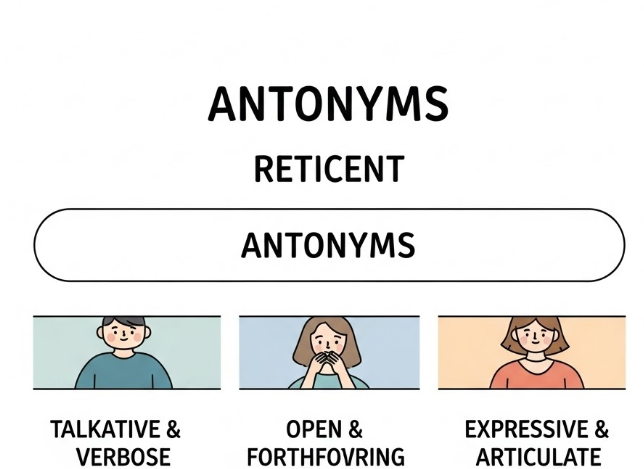
The opposite of reticent can be expressed through a variety of words, each with slightly different connotations. We can categorize these antonyms into several groups based on the specific aspect of reticence they negate:
Outgoing and Extroverted
These words describe individuals who are sociable, energetic, and enjoy being around others. They readily engage in conversation and are not afraid to express themselves.
Talkative and Loquacious
These terms refer to people who speak frequently and at length. They enjoy talking and often dominate conversations.
Forthcoming and Open
These words describe individuals who are willing to share information and express their opinions. They are transparent and honest in their communication.
Candid and Frank
These terms refer to people who are direct and honest in their speech, even if it means being blunt or critical.
Expressive and Articulate
These words describe individuals who communicate their thoughts and feelings effectively and clearly. They are skilled at conveying their ideas through language.
Examples of Antonyms in Sentences
To illustrate the usage of these antonyms, let’s examine them in context. The following tables provide examples of each category, showcasing how they can be used to describe individuals who are the opposite of reticent.
Each table contains at least 20 examples.
The following table presents examples of words related to being outgoing and extroverted, showcasing how they contrast with “reticent.”
| Antonym | Example Sentence |
|---|---|
| Outgoing | She’s an outgoing person who loves meeting new people. |
| Extroverted | His extroverted personality made him a natural leader. |
| Sociable | They are sociable and enjoy attending parties and gatherings. |
| Gregarious | He’s a gregarious individual who thrives in social situations. |
| Affable | Her affable nature made her popular among her colleagues. |
| Amiable | He was an amiable host, making everyone feel welcome. |
| Cordial | The atmosphere was cordial and inviting. |
| Warm | She has a warm and welcoming personality. |
| Friendly | He’s always friendly and approachable. |
| Personable | Her personable demeanor made a great impression. |
| Communicative | A communicative leader can bridge gaps between teams. |
| Responsive | The customer service representative was very responsive to my inquiry. |
| Engaging | The speaker gave an engaging presentation that captivated the audience. |
| Interactive | The workshop was designed to be interactive, encouraging participation from everyone. |
| Open | She is very open about her experiences and feelings. |
| Approachable | He has an approachable demeanor, making it easy to ask him questions. |
| Receptive | The audience was receptive to the new ideas presented. |
| Participative | A participative approach to management encourages employee involvement. |
| Interactive | The online course was highly interactive, including quizzes and discussion forums. |
| Social | She is a very social person who enjoys being around others. |
| Convival | The company outing was a convivial event, filled with laughter and camaraderie. |
| Extrovert | As an extrovert, he always looks forward to social events. |
| Exuberant | Her exuberant personality brightened up the room. |
This table showcases various antonyms that emphasis a person’s readiness to engage with others and share their thoughts.
| Antonym | Example Sentence |
|---|---|
| Talkative | She’s a talkative person who always has something to say. |
| Loquacious | The loquacious professor often digressed from the main topic. |
| Garrulous | He became garrulous after a few drinks. |
| Voluble | She’s a voluble speaker who can talk for hours. |
| Chatty | The chatty students disrupted the class. |
| Verbose | His verbose writing style made his essays difficult to read. |
| Effusive | She gave an effusive welcome to her guests. |
| Outspoken | He’s an outspoken critic of the government’s policies. |
| Blabby | She’s a blabby person who can’t keep a secret. |
| Gushing | She was gushing with praise for the new movie. |
| Prolix | The prolix speech bored everyone in the audience. |
| Long-winded | His long-winded explanations often confused people. |
| Rambling | The rambling conversation went on for hours. |
| Glib | His glib answers made him seem insincere. |
| Fluent | She is fluent in several languages, and enjoys using them all. |
| Eloquent | The lawyer gave an eloquent closing statement that swayed the jury. |
| Vocal | She is a vocal advocate for environmental protection. |
| Expansive | He gave an expansive account of his travels. |
| Communicative | A communicative leader can build trust and rapport within the team. |
| Vivid | The author provided a vivid description of the landscape, bringing it to life for the reader. |
| Open-mouthed | The tourists were left open-mouthed after the guide revealed a shocking historical fact. |
| Gossipy | The gossipy neighbor always knew the latest news. |
| Chatterbox | The girl was a chatterbox, always talking with her friends. |
The following table details examples of words that describe someone who is open and forthcoming, showcasing how they are the opposite of someone reticent.
| Antonym | Example Sentence |
|---|---|
| Forthcoming | He was forthcoming with information about the project. |
| Open | She’s an open person who shares her feelings easily. |
| Candid | His candid remarks surprised everyone. |
| Frank | She was frank about her mistakes. |
| Honest | He gave an honest assessment of the situation. |
| Sincere | Her sincere apology was well-received. |
| Genuine | He’s a genuine person who cares about others. |
| Transparent | The company is committed to transparent business practices. |
| Direct | She gave a direct answer to the question. |
| Straightforward | His straightforward approach was appreciated. |
| Unreserved | She expressed her opinion in an unreserved manner. |
| Uninhibited | He danced with uninhibited joy. |
| Unrestrained | Her unrestrained laughter filled the room. |
| Free-spoken | She is a free-spoken advocate for women’s rights. |
| Outspoken | The senator is known for being outspoken on controversial issues. |
| Articulate | An articulate speaker can effectively convey complex ideas. |
| Expressive | Her expressive eyes conveyed a range of emotions. |
| Vocal | The community was vocal in their opposition to the proposed development. |
| Explicit | The instructions were explicit, leaving no room for confusion. |
| Commuicative | A communicative environment fosters better understanding and collaboration. |
| Forthright | The CEO was forthright about the company’s challenges and opportunities. |
| Plain-spoken | The plain-spoken farmer didn’t mince words when describing the drought. |
| Candid | Her candid feedback helped me improve my presentation skills. |
Below is a table with antonyms that describe a person that is expressive and articulate, directly contrasting with reticence.
| Antonym | Example Sentence |
|---|---|
| Expressive | She’s an expressive dancer who conveys emotions through movement. |
| Articulate | He’s an articulate speaker who can explain complex ideas clearly. |
| Eloquent | Her eloquent speech moved the audience to tears. |
| Fluent | She’s fluent in several languages and enjoys using them all. |
| Vivid | He gave a vivid description of his travels. |
| Clear | She gave a clear explanation of the problem. |
| Lucid | His lucid writing style made the complex topic easy to understand. |
| Persuasive | He’s a persuasive speaker who can convince anyone. |
| Forceful | She made a forceful argument in favor of the proposal. |
| Poignant | The poignant story touched the hearts of many readers. |
| Compelling | He presented a compelling case for change. |
| Evocative | Her evocative writing style brought the scene to life. |
| Impassioned | He delivered an impassioned speech about social justice. |
| Dramatic | She gave a dramatic performance on stage. |
| Vocal | The community was vocal in their support for the new school. |
| Outspoken | She is an outspoken advocate for animal rights. |
| Forthright | The manager was forthright about the company’s financial situation. |
| Candid | The interviewer appreciated the candidate’s candid responses. |
| Unreserved | She expressed her opinion in an unreserved manner, without hesitation. |
| Uninhibited | The children danced with uninhibited joy at the party. |
| Unrestrained | Her unrestrained laughter filled the room, bringing smiles to everyone’s faces. |
| Free-spoken | She is a free-spoken advocate for environmental protection, never afraid to voice her concerns. |
| Open | She is very open about her experiences and feelings, making it easy to connect with her. |
Usage Rules and Considerations
While these antonyms offer a range of options, it’s important to choose the word that best fits the context. Consider the specific nuance you want to convey.
For example, “talkative” might be appropriate for someone who speaks frequently, while “forthcoming” is better suited for someone who shares information willingly. “Candid” implies honesty and directness, while “expressive” suggests an ability to communicate effectively.
It’s also important to be aware of the connotations of each word. “Garrulous” and “blabby” can have negative connotations, suggesting excessive or indiscreet talking.
“Outspoken” can be positive or negative, depending on whether the speaker’s views are well-received. The choice of antonym should reflect the speaker’s intent and the overall tone of the communication.
Consider these additional usage notes:
- Formality: Some antonyms are more formal than others. “Loquacious” and “verbose” are more formal than “talkative” and “chatty.”
- Intensity: Some antonyms are stronger than others. “Effusive” and “gushing” suggest a greater degree of enthusiasm than “friendly” or “amiable.”
- Context: The best antonym will depend on the specific situation. Consider the speaker, the audience, and the purpose of the communication.
Common Mistakes to Avoid
A common mistake is using antonyms interchangeably without considering their subtle differences. For example, using “talkative” when “forthcoming” is more appropriate, or vice versa.
Another mistake is using antonyms with negative connotations when a more neutral term is intended.
Here are some examples of common mistakes and their corrections:
| Incorrect | Correct | Explanation |
|---|---|---|
| He was very reticent and garrulous at the same time. | He was very outgoing and garrulous. | “Reticent” and “garrulous” are contradictory. |
| She was reticent about her feelings, so she was very blabby. | She was forthcoming about her feelings, so she was very blabby. | “Reticent” and “blabby” are contradictory in this context. |
| He is a reticent extrovert. | He is an outgoing extrovert. | “Reticent” and “extrovert” are generally opposing traits. |
| She was reticent, so she gave an eloquent speech. | She was outgoing, so she gave an eloquent speech. | “Reticent” and “eloquent” are unlikely to occur together. |
| He is reticent, so he is candid. | He is outgoing, so he is candid. | “Reticent” and “candid” are generally opposing traits. |
| She is reticent, but very talkative. | She is not reticent, and very talkative. | “Reticent” and “talkative” are opposing traits. |
By understanding these common mistakes, you can avoid errors in your own writing and speech.
Practice Exercises
Test your understanding of the antonyms of “reticent” with these practice exercises:
Exercise 1: Fill in the Blanks
Choose the best antonym of “reticent” to complete each sentence.
| Question | Answer |
|---|---|
| 1. Unlike her _________ sister, Sarah was always the quiet one. | outgoing |
| 2. The _________ politician was known for his long speeches. | loquacious |
| 3. The witness was _________ in answering the lawyer’s questions. | forthcoming |
| 4. The journalist was known for his _________ reporting. | candid |
| 5. The _________ actress conveyed a wide range of emotions. | expressive |
| 6. Because he was not _________, it was hard to know what he was thinking. | communicative |
| 7. The CEO was _________ about the company’s financial difficulties. | transparent |
| 8. She is a _________ person who enjoys meeting new people. | sociable |
| 9. The _________ professor often digressed from the main topic of the lecture. | voluble |
| 10. The _________ child eagerly shared every detail of her day at school. | chatty |
Exercise 2: Sentence Rewriting
Rewrite each sentence, replacing “reticent” with an appropriate antonym.
| Question | Answer |
|---|---|
| 1. He was reticent about his past. | He was forthcoming about his past. |
| 2. She remained reticent during the meeting. | She actively participated during the meeting. |
| 3. His reticent nature made it hard to get to know him. | His outgoing nature made it easy to get to know him. |
| 4. The witness was reticent to provide details. | The witness was forthcoming with details. |
| 5. The company was reticent about its plans. | The company was transparent about its plans. |
| 6. She was reticent about her opinion. | She was outspoken about her opinion. |
| 7. The student was reticent to ask questions. | The student was eager to ask questions. |
| 8. He was reticent, so no one knew his thoughts. | He was expressive, so everyone knew his thoughts. |
| 9. She was reticent during the presentation. | She was engaging during the presentation. |
| 10. The author was reticent in his writing. | The author was vivid in his writing. |
Exercise 3: Multiple Choice
| Question | Answer |
|---|---|
| 1. Which word is the closest antonym of “reticent”? A) Shy B) Quiet C) Outgoing D) Reserved | C) Outgoing |
| 2. Which of the following is NOT an antonym of “reticent”? A) Talkative B) Loquacious C) Taciturn D) Forthcoming | C) Taciturn |
| 3. Which word suggests a willingness to share information? A) Reticent B) Forthcoming C) Secretive D) Reserved | B) Forthcoming |
| 4. What word describes someone who speaks frequently and at length? A) Reticent B) Garrulous C) Quiet D) Shy | B) Garrulous |
| 5. Which term implies honesty and directness in speech? A) Reticent B) Candid C) Secretive D) Reserved | B) Candid |
| 6. Which word describes someone who communicates effectively and clearly? A) Reticent B) Expressive C) Mute D) Reserved | B) Expressive |
| 7. What term describes a person who is sociable and enjoys being around others? A) Reticent B) Introverted C) Sociable D) Reserved | C) Sociable |
| 8. Which word suggests a greater degree of enthusiasm? A) Friendly B) Effusive C) Amiable D) Cordial | B) Effusive |
| 9. What term describes someone who is open and transparent in their communication? A) Reticent B) Secretive C) Transparent D) Reserved | C) Transparent |
| 10. Which word is most similar in meaning to “chatty”? A) Reticent B) Quiet C) Talkative D) Reserved | C) Talkative |
Advanced Topics: Nuances and Context
At an advanced level, understanding the antonyms of “reticent” goes beyond simple definitions. It involves recognizing the subtle nuances of each word and how context influences their meaning.
For example, “outspoken” can be a positive trait in a democracy where freedom of speech is valued, but it can be negative in a hierarchical organization where conformity is expected.
Similarly, “talkative” can be endearing in social settings but annoying in formal situations. The key is to develop a sensitivity to the social and cultural context in which these words are used.
This requires exposure to a wide range of texts and conversations, as well as a willingness to reflect on the impact of your own communication choices.
Consider these advanced concepts:
- Cultural differences: Communication styles vary across cultures. What is considered “forthcoming” in one culture might be seen as “rude” in another.
- Situational appropriateness: The best antonym will depend on the specific situation. A formal presentation requires a different communication style than a casual conversation.
- Personal preferences: Some people prefer direct communication, while others prefer a more subtle approach. Be mindful of individual differences when choosing your words.
Frequently Asked Questions
Here are some frequently asked questions about the antonyms of “reticent”:
- What is the main difference between “talkative” and “loquacious”?While both words describe someone who talks a lot, “loquacious” is more formal and suggests a greater fluency and ease of speech. “Talkative” is a more general term, while “loquacious” implies a certain skill and eloquence in speaking.
- Is “outspoken” always a positive trait?No, “outspoken” can be positive or negative, depending on the context and the speaker’s views. It can be positive when it describes someone who stands up for their beliefs, but it can be negative when it describes someone who is rude or insensitive.
- How do I choose the best antonym of “reticent” for a given situation?Consider the specific nuance you want to convey, the formality of the situation, and the potential impact of your words on the audience. Choose the word that best reflects your intent and the overall tone of the communication.
- What are some other words that are similar to “reticent”?Similar words include reserved, quiet, shy, taciturn, uncommunicative, and withdrawn. These words all describe someone who is reluctant to speak freely.
- Can “reticent” ever be a positive trait?Yes, in some contexts, reticence can be seen as a virtue, especially when discretion is valued. For example, a lawyer might be reticent to share confidential information, or a diplomat might be reticent to reveal sensitive details.
- How can I improve my vocabulary of antonyms?Read widely, pay attention to the words that others use, and make a conscious effort to incorporate new words into your own writing and speech. Use a dictionary or thesaurus to look up unfamiliar words and explore their antonyms.
- What is the difference between “candid” and “frank”?Both “candid” and “frank” mean honest and direct, but “frank” can sometimes imply a level of bluntness or even rudeness that “candid” does not. “Candid” suggests honesty and sincerity, while “frank” can sometimes suggest a lack of tact.
- Is it possible to be both outgoing and reticent?While seemingly contradictory, it is possible for someone to be outgoing in certain situations (e.g., social gatherings) but reticent in others (e.g., discussing personal matters). This depends on the individual’s personality and comfort level in different contexts.
Conclusion
Mastering the antonyms of “reticent” is a valuable step in expanding your vocabulary and enhancing your communication skills. By understanding the nuances of words like “outgoing,” “talkative,” “forthcoming,” “candid,” and “expressive,” you can articulate a wider range of personalities and communication styles with greater accuracy and flair.
Remember to consider the context, formality, and potential impact of your words when choosing the best antonym for a given situation. With practice and attention to detail, you can confidently use these words to express yourself effectively and engage with others in a meaningful way.
Continue to explore the richness of the English language, paying attention to the subtle differences between words and how they can be used to create a more vivid and nuanced picture. By embracing the power of language, you can unlock new opportunities for self-expression and connection.