
Knowing how to say “I’m lost” in German is crucial for any traveler or language learner. This simple phrase can be a lifesaver when navigating unfamiliar places.
This article provides a comprehensive guide to expressing this sentiment in German, covering various ways to say “I’m lost,” along with grammatical explanations, examples, and practice exercises. Whether you’re a beginner or an advanced learner, this guide will equip you with the necessary tools to confidently communicate your location needs in German-speaking environments.
This article will benefit anyone learning German, particularly those planning to travel to German-speaking countries. It breaks down the different ways to say “I’m lost,” explaining the nuances and contexts in which each phrase is appropriate.
This knowledge enhances communication skills and promotes a deeper understanding of the German language and culture.
Table of Contents
- Introduction
- Definition and Explanation
- Structural Breakdown
- Types and Categories
- Simple Statements
- Formal vs. Informal
- Adding Details
- Examples
- Basic Examples
- Detailed Examples
- Varied Contexts
- Usage Rules
- Verb Conjugation
- Case Agreement
- Word Order
- Common Mistakes
- Practice Exercises
- Exercise 1: Translation
- Exercise 2: Fill in the Blanks
- Exercise 3: Sentence Building
- Advanced Topics
- Idiomatic Expressions
- Regional Variations
- FAQ
- Conclusion
Definition and Explanation
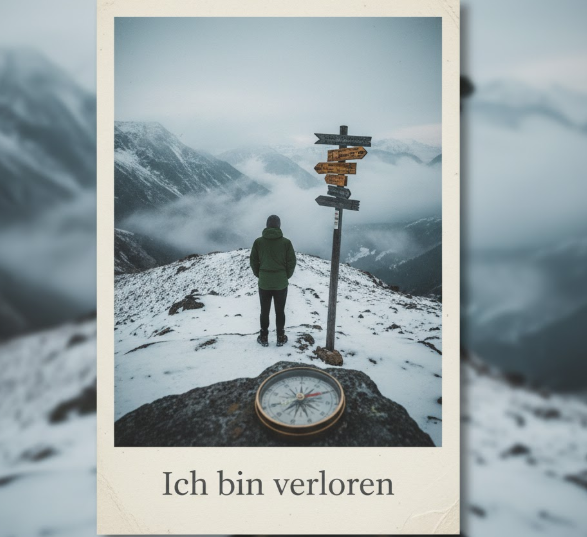
The phrase “I’m lost” in German can be expressed in several ways, each carrying slightly different connotations or levels of formality. The most common and direct translation is “Ich bin verloren.” This phrase uses the verb sein (to be) and the past participle verloren (lost). It’s a straightforward and universally understood way to communicate that you don’t know where you are.
Another common way to express being lost is by using the verb sich verirren (to get lost). In this case, you would say “Ich habe mich verirrt.” This phrase is more active, implying that you actively lost your way. Both phrases are perfectly acceptable and widely used.
The choice between “Ich bin verloren” and “Ich habe mich verirrt” often depends on personal preference or the specific context. “Ich bin verloren” is a more static statement, while “Ich habe mich verirrt” suggests a process of becoming lost. Understanding these nuances allows for more precise and natural communication.
Structural Breakdown
Let’s break down the structure of the two main phrases:
- Ich bin verloren:
- Ich: I (subject pronoun)
- bin: am (conjugated form of the verb sein – to be)
- verloren: lost (past participle, used as an adjective here)
- Ich habe mich verirrt:
- Ich: I (subject pronoun)
- habe: have (conjugated form of the verb haben – to have, used as an auxiliary verb here)
- mich: myself (accusative reflexive pronoun)
- verirrt: gotten lost (past participle of the reflexive verb sich verirren)
In the first phrase, “Ich bin verloren,” the verb sein acts as a linking verb, connecting the subject (Ich) to the adjective (verloren). The word order is Subject-Verb-Adjective. In the second phrase, “Ich habe mich verirrt,” the verb haben acts as an auxiliary verb, forming the perfect tense. The reflexive pronoun mich is necessary because the verb sich verirren is reflexive, meaning the action is directed back to the subject.
Understanding these structural elements is key to constructing grammatically correct sentences. It also helps in recognizing and interpreting similar phrases in German.
Types and Categories
There are several ways to express being lost in German, which can be categorized based on formality, level of detail, and specific context.
Simple Statements
These are the most basic and straightforward ways to say “I’m lost.” They are universally understood and suitable for most situations.
- Ich bin verloren. (I am lost.)
- Ich habe mich verirrt. (I got lost.)
Formal vs. Informal
While the basic phrases are generally acceptable in both formal and informal settings, adding certain phrases can indicate a more formal or informal tone. For instance, adding “Entschuldigung” (Excuse me) at the beginning can make the statement more polite and formal.
- Formal: Entschuldigung, ich bin verloren. Könnten Sie mir helfen? (Excuse me, I’m lost. Could you help me?)
- Informal: Ich bin total verloren! (I’m totally lost!)
Adding Details
You can add details to your statement to provide more context and help the person you’re speaking to understand your situation better. This might include specifying where you think you are or where you were trying to go.
- Ich bin verloren. Ich wollte zum Bahnhof, aber… (I’m lost. I wanted to go to the train station, but…)
- Ich habe mich verirrt. Ich glaube, ich bin in der falschen Straße. (I got lost. I think I’m on the wrong street.)
Examples
Here are some examples of how to say “I’m lost” in German, categorized by different situations and levels of detail.
Basic Examples
This table provides basic examples of expressing “I’m lost” in German.
| German | English |
|---|---|
| Ich bin verloren. | I am lost. |
| Ich habe mich verirrt. | I got lost. |
| Ich weiß nicht, wo ich bin. | I don’t know where I am. |
| Ich kenne mich hier nicht aus. | I’m not familiar with this area. |
| Wo bin ich? | Where am I? |
| Können Sie mir helfen? Ich bin verloren. | Can you help me? I’m lost. |
| Ich suche… und ich bin verloren. | I’m looking for… and I’m lost. |
| Ich habe den Weg verloren. | I lost my way. |
| Ich habe die Orientierung verloren. | I lost my bearings. |
| Ich bin hier fremd. | I’m a stranger here. |
| Entschuldigung, ich bin verloren. | Excuse me, I’m lost. |
| Ich glaube, ich bin verloren. | I think I’m lost. |
| Ich bin völlig verloren. | I’m completely lost. |
| Ich bin total verirrt. | I’m totally lost. |
| Hilfe! Ich bin verloren! | Help! I’m lost! |
| Ich habe mich verlaufen. | I wandered off and got lost. |
| Ich bin vom Weg abgekommen. | I strayed from the path. |
| Ich finde den Weg nicht mehr. | I can’t find my way anymore. |
| Ich brauche Hilfe. Ich bin verloren. | I need help. I’m lost. |
| Könnten Sie mir sagen, wo ich bin? Ich bin verloren. | Could you tell me where I am? I’m lost. |
| Ich wollte zu [Ort], aber ich bin verloren. | I wanted to go to [place], but I’m lost. |
| Ich habe keine Ahnung, wo ich bin. Ich bin verloren. | I have no idea where I am. I’m lost. |
| Ich bin in der Gegend nicht ortskundig. | I’m not familiar with the area. |
| Ich bin ein bisschen verloren. | I’m a little bit lost. |
| Ich habe mich ein wenig verirrt. | I got a little bit lost. |
This table provides a variety of basic phrases to express being lost in German, suitable for different situations and levels of urgency. You can use these phrases as a starting point and add more details as needed.
Detailed Examples
This table provides detailed examples, adding context to the statement “I’m lost.”
| German | English |
|---|---|
| Ich bin verloren. Ich wollte zum Museum, aber ich habe mich verirrt. | I’m lost. I wanted to go to the museum, but I got lost. |
| Ich habe mich verirrt. Ich glaube, ich bin in der falschen Straße gelandet. | I got lost. I think I ended up on the wrong street. |
| Ich bin verloren. Könnten Sie mir bitte sagen, wo das Rathaus ist? | I’m lost. Could you please tell me where the town hall is? |
| Ich habe den Weg verloren. Ich wollte zum Bahnhof, aber jetzt weiß ich nicht mehr, wo ich bin. | I lost my way. I wanted to go to the train station, but now I don’t know where I am. |
| Entschuldigung, ich bin verloren. Ich suche das Hotel “Zum Goldenen Löwen”. | Excuse me, I’m lost. I’m looking for the hotel “Zum Goldenen Löwen”. |
| Ich bin völlig verloren. Ich habe keine Ahnung, wie ich zurück zum Hotel komme. | I’m completely lost. I have no idea how to get back to the hotel. |
| Ich habe mich verirrt. Ich wollte nur einen kurzen Spaziergang machen, aber jetzt finde ich nicht mehr zurück. | I got lost. I only wanted to take a short walk, but now I can’t find my way back. |
| Ich bin verloren. Ich sollte eigentlich am Marktplatz sein, aber ich sehe ihn nirgends. | I’m lost. I should actually be at the market square, but I don’t see it anywhere. |
| Ich habe die Orientierung verloren. Ich glaube, ich bin im falschen Viertel. | I lost my bearings. I think I’m in the wrong neighborhood. |
| Ich bin verloren. Ich habe versucht, der Karte zu folgen, aber es hat nicht funktioniert. | I’m lost. I tried to follow the map, but it didn’t work. |
| Ich habe mich verirrt. Ich bin von meiner Reisegruppe getrennt worden. | I got lost. I got separated from my tour group. |
| Ich bin verloren. Ich wollte nur die Stadt erkunden, aber jetzt bin ich hilflos. | I’m lost. I just wanted to explore the city, but now I’m helpless. |
| Ich habe mich verlaufen. Ich bin vom Wanderweg abgekommen. | I wandered off and got lost. I strayed from the hiking trail. |
| Ich bin verloren. Ich habe mein Handy verloren und kann niemanden anrufen. | I’m lost. I lost my phone and can’t call anyone. |
| Ich habe mich verirrt. Ich wollte zum Dom, aber ich bin in einer Sackgasse gelandet. | I got lost. I wanted to go to the cathedral, but I ended up in a dead end. |
| Ich bin total verirrt. Ich habe keine Ahnung, in welcher Richtung das Hotel liegt. | I’m totally lost. I have no idea in which direction the hotel is. |
| Ich habe mich verirrt. Ich bin mit dem Fahrrad unterwegs und habe mich verfahren. | I got lost. I’m traveling by bicycle and took the wrong turn. |
| Ich bin verloren. Ich habe gedacht, ich kenne mich hier aus, aber ich habe mich geirrt. | I’m lost. I thought I knew my way around here, but I was wrong. |
| Ich habe mich verirrt. Es tut mir leid, dass ich Sie störe, aber ich brauche Ihre Hilfe. | I got lost. I’m sorry to bother you, but I need your help. |
| Ich bin verloren. Ich bin neu in der Stadt und kenne mich überhaupt nicht aus. | I’m lost. I’m new to the city and don’t know my way around at all. |
| Ich habe mich verirrt. Ich wollte nur eine Abkürzung nehmen, aber das war ein Fehler. | I got lost. I just wanted to take a shortcut, but that was a mistake. |
| Ich bin verloren. Ich habe versucht, dem Fluss zu folgen, aber ich habe mich verlaufen. | I’m lost. I tried to follow the river, but I got lost. |
| Ich habe mich verirrt. Ich wollte zum Schloss, aber ich bin in einem Park gelandet. | I got lost. I wanted to go to the castle, but I ended up in a park. |
This table provides more detailed examples of how to explain your situation when you are lost in German. You can adapt these phrases to fit your specific circumstances.
Varied Contexts
This table demonstrates how to use “I’m lost” in different contexts, such as asking for directions or explaining your situation to someone.
| German | English | Context |
|---|---|---|
| Entschuldigung, ich bin verloren. Könnten Sie mir den Weg zum Bahnhof zeigen? | Excuse me, I’m lost. Could you show me the way to the train station? | Asking for directions |
| Ich habe mich verirrt. Ich wollte zum Hotel, aber ich weiß nicht mehr, wo es ist. | I got lost. I wanted to go to the hotel, but I don’t know where it is anymore. | Explaining to a hotel employee |
| Ich bin verloren. Ich suche die Bushaltestelle. Wissen Sie, wo sie ist? | I’m lost. I’m looking for the bus stop. Do you know where it is? | Asking a local resident |
| Ich habe den Weg verloren. Ich war auf dem Weg zum Supermarkt, aber jetzt bin ich völlig orientierungslos. | I lost my way. I was on my way to the supermarket, but now I’m completely disoriented. | Talking to a shopkeeper |
| Ich bin verloren. Ich habe versucht, der Karte zu folgen, aber ich habe es nicht geschafft. | I’m lost. I tried to follow the map, but I didn’t manage to. | Explaining to a police officer |
| Ich habe mich verirrt. Ich bin mit dem Fahrrad unterwegs und habe mich verfahren. Können Sie mir helfen? | I got lost. I’m traveling by bicycle and took the wrong turn. Can you help me? | Asking for help while cycling |
| Ich bin verloren. Ich wollte nur eine kurze Wanderung machen, aber jetzt finde ich nicht mehr zurück. | I’m lost. I just wanted to take a short hike, but now I can’t find my way back. | Explaining to another hiker |
| Ich habe mich verirrt. Ich bin vom Wanderweg abgekommen und brauche Hilfe, um zurückzufinden. | I got lost. I strayed from the hiking trail and need help finding my way back. | Asking for assistance on a hiking trail |
| Ich bin verloren. Ich habe mein Handy verloren und kann niemanden erreichen. Können Sie mir helfen? | I’m lost. I lost my phone and can’t reach anyone. Can you help me? | Seeking help when you’ve lost your phone |
| Ich habe mich verirrt. Ich war mit meiner Familie unterwegs, aber jetzt sind wir getrennt. | I got lost. I was traveling with my family, but now we’re separated. | Explaining a family separation |
| Ich bin verloren. Ich sollte eigentlich in der [Straße] sein, aber ich finde sie nicht. | I’m lost. I’m supposed to be on [street name], but I can’t find it. | Asking for a specific street |
| Ich habe mich verirrt. Ich wollte nur die Stadt erkunden, aber jetzt bin ich hilflos. | I got lost. I just wanted to explore the city, but now I’m helpless. | Expressing helplessness |
| Ich bin verloren. Wissen Sie, ob hier in der Nähe eine Touristeninformation ist? | I’m lost. Do you know if there’s a tourist information center nearby? | Asking for tourist information |
| Ich habe mich verirrt. Ich bin neu in der Stadt und kenne mich überhaupt nicht aus. | I got lost. I’m new in town and don’t know my way around at all. | Explaining you are new to the city |
| Ich bin verloren. Ich wollte nur eine Abkürzung nehmen, aber das war ein großer Fehler. | I’m lost. I just wanted to take a shortcut, but that was a big mistake. | Explaining a bad decision |
| Ich habe mich verirrt. Ich bin mit dem Auto unterwegs und mein Navi funktioniert nicht. | I got lost. I’m traveling by car, and my GPS isn’t working. | Explaining a GPS malfunction |
| Ich bin verloren. Ich habe versucht, dem Fluss zu folgen, aber ich habe mich verlaufen. | I’m lost. I tried to follow the river, but I got lost. | Explaining a failed navigation attempt |
| Ich habe mich verirrt. Ich bin auf dem Weg zu einem Vorstellungsgespräch, aber ich bin zu spät. | I got lost. I’m on my way to a job interview, but I’m going to be late. | Explaining lateness due to being lost |
| Ich bin verloren. Ich habe mein Gepäck verloren und weiß nicht, wo ich bin. | I’m lost. I lost my luggage and don’t know where I am. | Explaining lost luggage |
| Ich habe mich verirrt. Ich bin mit meiner Schulklasse unterwegs, aber ich habe sie verloren. | I got lost. I’m traveling with my school class, but I lost them. | Explaining separation from a school group |
This table provides examples of using “I’m lost” in various real-life scenarios. Understanding the context helps in choosing the most appropriate phrase and providing relevant details.
Usage Rules
Understanding the grammatical rules governing the use of these phrases is essential for accurate communication.
Verb Conjugation
The verb sein (to be) and haben (to have) must be conjugated correctly according to the subject pronoun. Here’s a quick review:
| Pronoun | Sein (to be) | Haben (to have) |
|---|---|---|
| Ich (I) | bin | habe |
| Du (you, informal) | bist | hast |
| Er/Sie/Es (he/she/it) | ist | hat |
| Wir (we) | sind | haben |
| Ihr (you, plural informal) | seid | habt |
| Sie (you, formal/they) | sind | haben |
For example, you would say “Du bist verloren” (You are lost) or “Sie haben sich verirrt” (They got lost, formal).
Case Agreement
When using reflexive verbs like sich verirren, the reflexive pronoun must agree in case with the subject. In the case of “Ich habe mich verirrt,” mich is in the accusative case because it’s the direct object of the verb. For other pronouns, the reflexive pronouns change accordingly:
- Ich: mich
- Du: dich
- Er/Sie/Es: sich
- Wir: uns
- Ihr: euch
- Sie: sich
Therefore, you would say “Du hast dich verirrt” (You got lost) or “Wir haben uns verirrt” (We got lost).
Word Order
German word order can be flexible, but in simple statements, the verb usually comes second. In sentences with auxiliary verbs (like haben in the perfect tense), the conjugated auxiliary verb comes second, and the past participle comes at the end of the sentence.
- Ich bin verloren. (Subject – Verb – Adjective)
- Ich habe mich verirrt. (Subject – Auxiliary Verb – Reflexive Pronoun – Past Participle)
Understanding these word order rules helps in constructing grammatically correct and understandable sentences.
Common Mistakes
Here are some common mistakes learners make when expressing “I’m lost” in German, along with corrections.
| Incorrect | Correct | Explanation |
|---|---|---|
| Ich bin verirrt. | Ich habe mich verirrt. | Verirrt is the past participle of a reflexive verb and requires the auxiliary verb haben and the reflexive pronoun. |
| Ich habe verloren. | Ich bin verloren. | Verloren is an adjective here and requires the verb sein. |
| Ich bin mich verirrt. | Ich habe mich verirrt. | Reflexive verbs require the auxiliary verb haben, not sein. |
| Ich habe mich verloren. | Ich habe mich verirrt. | Sich verlieren means ‘to get lost’ in the sense of losing something of oneself. Sich verirren is the appropriate reflexive verb for getting physically lost. |
| Wo ich bin? | Wo bin ich? | In direct questions, the verb comes before the subject. |
| Ich weiß nicht wo bin ich. | Ich weiß nicht, wo ich bin. | In subordinate clauses, the verb comes at the end. |
Avoiding these common mistakes will help you communicate more effectively and accurately in German.
Practice Exercises
Test your understanding with these practice exercises. Answers are provided below.
Exercise 1: Translation
Translate the following sentences into German.
| No. | English | Your Answer | Correct Answer |
|---|---|---|---|
| 1 | I am lost. | Ich bin verloren. | |
| 2 | I got lost. | Ich habe mich verirrt. | |
| 3 | Excuse me, I’m lost. | Entschuldigung, ich bin verloren. | |
| 4 | I don’t know where I am. | Ich weiß nicht, wo ich bin. | |
| 5 | I’m completely lost. | Ich bin völlig verloren. | |
| 6 | Can you help me? I’m lost. | Können Sie mir helfen? Ich bin verloren. | |
| 7 | I wanted to go to the train station, but I’m lost. | Ich wollte zum Bahnhof, aber ich bin verloren. | |
| 8 | I think I’m lost. | Ich glaube, ich bin verloren. | |
| 9 | I’m a little bit lost. | Ich bin ein bisschen verloren. | |
| 10 | I got a little bit lost. | Ich habe mich ein wenig verirrt. |
Exercise 2: Fill in the Blanks
Fill in the blanks with the correct form of the verb and pronoun.
| No. | Sentence | Your Answer | Correct Answer |
|---|---|---|---|
| 1 | Ich ______ verloren. (sein) | Ich bin verloren. | |
| 2 | Ich ______ ______ verirrt. (haben, sich) | Ich habe mich verirrt. | |
| 3 | Du ______ ______ verirrt? (haben, sich) | Du hast dich verirrt? | |
| 4 | Wir ______ verloren. (sein) | Wir sind verloren. | |
| 5 | Sie (formal) ______ ______ verirrt. (haben, sich) | Sie haben sich verirrt. | |
| 6 | Er ______ verloren. (sein) | Er ist verloren. | |
| 7 | Ihr ______ ______ verirrt. (haben, sich) | Ihr habt euch verirrt. | |
| 8 | Sie (they) ______ verloren. (sein) | Sie sind verloren. | |
| 9 | Ich ______ nicht, wo ich ______ (wissen, sein) | Ich weiß nicht, wo ich bin. | |
| 10 | ______ du verloren? (sein) | Bist du verloren? |
Exercise 3: Sentence Building
Combine the given words to form a grammatically correct sentence expressing “I’m lost.”
| No. | Words | Your Answer | Correct Answer |
|---|---|---|---|
| 1 | ich, bin, verloren | Ich bin verloren. | |
| 2 | habe, mich, ich, verirrt | Ich habe mich verirrt. | |
| 3 | Entschuldigung, bin, ich, verloren | Entschuldigung, ich bin verloren. | |
| 4 | weiß, ich, nicht, wo, bin, ich | Ich weiß nicht, wo ich bin. | |
| 5 | völlig, ich, bin, verloren | Ich bin völlig verloren. | |
| 6 | können, helfen, sie, ich, verloren, bin | Können Sie helfen? Ich bin verloren. | |
| 7 | wollte, ich, Bahnhof, zum, aber, verloren, ich, bin | Ich wollte zum Bahnhof, aber ich bin verloren. | |
| 8 | glaube, ich, verloren, ich, bin | Ich glaube, ich bin verloren. | |
| 9 | ein, ich, bisschen, verloren, bin | Ich bin ein bisschen verloren. | |
| 10 | ein, mich, verirrt, ich, wenig, habe | Ich habe mich ein wenig verirrt. |
Advanced Topics
For advanced learners, understanding idiomatic expressions and regional variations can further enhance their communication skills.
Idiomatic Expressions
While there aren’t direct idiomatic equivalents for “I’m lost,” some expressions convey a similar sense of disorientation or confusion. For example:
- Ich stehe auf dem Schlauch. (I’m standing on the hose.) – This means “I’m not understanding” or “I’m clueless.”
- Ich blicke nicht durch. (I don’t see through it.) – This means “I don’t understand” or “I can’t make sense of it.”
These expressions aren’t direct translations of “I’m lost,” but they can be useful in expressing a similar feeling of being out of one’s depth.
Regional Variations
While the standard phrases “Ich bin verloren” and “Ich habe mich verirrt” are universally understood, some regional dialects might have their own preferred expressions. However, these are less common and not essential for basic communication.
For example, in some regions, you might hear variations in pronunciation or slight differences in word choice, but the core meaning remains the same. It’s always best to stick to the standard phrases unless you’re very familiar with the local dialect.
FAQ
Here are some frequently asked questions about expressing “I’m lost” in German.
- Is it better to say “Ich bin verloren” or “Ich habe mich verirrt”?Both phrases are correct and widely used. “Ich bin verloren” is a more static statement, while “Ich habe mich verirrt” suggests a process of becoming lost. Choose the one that feels more natural to you.
- How do I ask for directions after saying “I’m lost”?