Learning how to express your age is a fundamental aspect of communicating in any language, and Italian is no exception. This seemingly simple phrase involves grammatical nuances that are essential for accurate and fluent conversation.
Mastering this skill allows you to introduce yourself effectively, participate in basic conversations, and understand age-related information. Whether you’re a beginner or an intermediate learner, understanding the correct way to say “I’m … years old” in Italian will significantly enhance your communicative abilities and build a stronger foundation for your language journey.
This guide is designed to equip you with the necessary knowledge and practice to confidently express your age in Italian.
This article will benefit students of all levels who are learning Italian, as well as tourists seeking to engage in basic conversations. We will cover the essential grammar, common mistakes, and provide ample examples and exercises to solidify your understanding.
Table of Contents
- Definition: Expressing Age in Italian
- Structural Breakdown: The Verb Avere
- Examples: Saying Your Age and Others’ Ages
- Usage Rules: Agreement and Context
- Common Mistakes to Avoid
- Practice Exercises
- Advanced Topics: Nuances and Variations
- Frequently Asked Questions
- Conclusion
Definition: Expressing Age in Italian
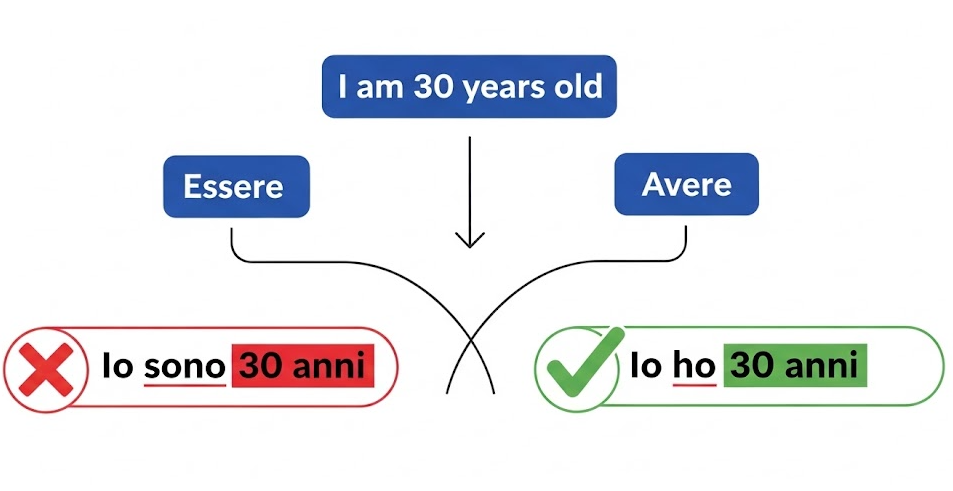
In Italian, to express age, you don’t use the verb “to be” (essere) as you do in English. Instead, you use the verb avere, which means “to have.” The literal translation of “I am … years old” is “I have … years.” This might seem counterintuitive at first, but it’s a fundamental difference between the two languages.
The basic structure is: Avere + (age in numbers) + anni. Anni is the plural form of anno, which means “year.” Therefore, you are literally saying “I have … years.”
Understanding this concept is crucial because using essere to express age is a common mistake for English speakers learning Italian. Mastering the use of avere in this context is a key step toward speaking Italian correctly and fluently.
Structural Breakdown: The Verb Avere
The verb avere (to have) is an irregular verb in Italian, meaning its conjugation doesn’t follow a predictable pattern. Therefore, it’s essential to memorize its different forms. Here’s the conjugation of avere in the present tense:
| Pronoun | Verb Form (Avere) |
|---|---|
| Io (I) | Ho |
| Tu (You, singular informal) | Hai |
| Lui/Lei/Lei (He/She/You, singular formal) | Ha |
| Noi (We) | Abbiamo |
| Voi (You, plural) | Avete |
| Loro (They) | Hanno |
This table illustrates the different forms of the verb *avere* that are used with various pronouns. It is essential to understand how to conjugate *avere* according to the appropriate pronoun to construct grammatically correct sentences when expressing age.
Components of the Phrase
Let’s break down the components of the phrase “I am … years old” in Italian:
- Pronoun: This indicates who is being referred to (e.g., io – I, tu – you).
- Conjugated form of avere: This matches the pronoun (e.g., ho for io, hai for tu).
- Age (number): This is the person’s age in numerical form (e.g., 25, 40, 62).
- Anni: This is the plural form of anno (year) and is always used after the age.
For example, to say “I am 30 years old,” you would say Io ho 30 anni. While the pronoun *io* is often omitted, it is technically correct to include it.
Examples: Saying Your Age and Others’ Ages
Here are several examples of how to express age in Italian, covering different pronouns and ages. Note that the pronoun is often omitted, especially in spoken language.
Examples with Different Pronouns
The following table provides examples of how to express age using different pronouns and the corresponding conjugation of the verb *avere*. This section demonstrates the versatility of the phrase and provides a solid foundation for constructing various sentences.
| Pronoun | Italian Phrase | English Translation |
|---|---|---|
| Io (I) | Io ho 20 anni. (or simply, Ho 20 anni.) | I am 20 years old. |
| Tu (You, singular informal) | Tu hai 25 anni. (or simply, Hai 25 anni.) | You are 25 years old. |
| Tu (You, singular informal) | Tu hai 31 anni. (or simply, Hai 31 anni.) | You are 31 years old. |
| Lui (He) | Lui ha 30 anni. | He is 30 years old. |
| Lei (She) | Lei ha 35 anni. | She is 35 years old. |
| Lei (You, singular formal) | Lei ha 40 anni. | You are 40 years old. (formal) |
| Noi (We) | Noi abbiamo 45 anni. | We are 45 years old. |
| Voi (You, plural) | Voi avete 50 anni. | You are 50 years old. (plural) |
| Loro (They) | Loro hanno 55 anni. | They are 55 years old. |
| Io (I) | Ho 62 anni. | I am 62 years old. |
| Tu (You, singular informal) | Hai 18 anni. | You are 18 years old. |
| Lui (He) | Lui ha 78 anni. | He is 78 years old. |
| Lei (She) | Lei ha 90 anni. | She is 90 years old. |
| Lei (You, singular formal) | Lei ha 22 anni. | You are 22 years old. (formal) |
| Noi (We) | Noi abbiamo 15 anni. | We are 15 years old. |
| Voi (You, plural) | Voi avete 33 anni. | You are 33 years old. (plural) |
| Loro (They) | Loro hanno 88 anni. | They are 88 years old. |
| Io (I) | Ho 41 anni. | I am 41 years old. |
| Tu (You, singular informal) | Hai 28 anni. | You are 28 years old. |
| Lui (He) | Lui ha 54 anni. | He is 54 years old. |
Examples with Different Ages
This table presents a variety of ages expressed in Italian, providing learners with a comprehensive understanding of how to apply the verb *avere* across different numerical values. This helps reinforce the concept and improves fluency.
| Age (Number) | Italian Phrase | English Translation |
|---|---|---|
| 1 (Uno) | Ho un anno. | I am one year old. |
| 12 (Dodici) | Ho dodici anni. | I am twelve years old. |
| 18 (Diciotto) | Ho diciotto anni. | I am eighteen years old. |
| 21 (Ventuno) | Ho ventuno anni. | I am twenty-one years old. |
| 28 (Ventotto) | Ho ventotto anni. | I am twenty-eight years old. |
| 33 (Trentatré) | Ho trentatré anni. | I am thirty-three years old. |
| 44 (Quarantaquattro) | Ho quarantaquattro anni. | I am forty-four years old. |
| 55 (Cinquantacinque) | Ho cinquantacinque anni. | I am fifty-five years old. |
| 66 (Sessantasei) | Ho sessantasei anni. | I am sixty-six years old. |
| 71 (Settantuno) | Ho settantuno anni. | I am seventy-one years old. |
| 77 (Settantasette) | Ho settantasette anni. | I am seventy-seven years old. |
| 82 (Ottantuno) | Ho ottantadue anni. | I am eighty-two years old. |
| 88 (Ottantotto) | Ho ottantotto anni. | I am eighty-eight years old. |
| 93 (Novantatré) | Ho novantatré anni. | I am ninety-three years old. |
| 99 (Novantanove) | Ho novantanove anni. | I am ninety-nine years old. |
| 100 (Cento) | Ho cento anni. | I am one hundred years old. |
| 3 (Tre) | Ho tre anni. | I am three years old. |
| 15 (Quindici) | Ho quindici anni. | I am fifteen years old. |
| 48 (Quarantotto) | Ho quarantotto anni. | I am forty-eight years old. |
| 51 (Cinquantuno) | Ho cinquantuno anni. | I am fifty-one years old. |
Asking Someone’s Age
To ask someone’s age in Italian, you would say: Quanti anni hai? (How old are you? – informal) or Quanti anni ha? (How old are you? – formal). The phrase literally translates to “How many years do you have?”
Here are some examples of asking someone’s age and responding:
| Scenario | Italian Question | Italian Answer | English Translation | |
|---|---|---|---|---|
| Informal | Quanti anni hai? | Ho 27 anni. | How old are you? | I am 27 years old. |
| Formal | Quanti anni ha? | Ho 52 anni. | How old are you? | I am 52 years old. |
| Informal | Quanti anni hai? | Ne ho 30. | How old are you? | I am 30 years old. |
| Formal | Quanti anni ha? | Ne ho 65. | How old are you? | I am 65 years old. |
| Informal | Quanti anni hai? | Non te lo dico! | How old are you? | I’m not telling you! |
| Formal | Quanti anni ha? | È scortese chiederlo. | How old are you? | It’s rude to ask. |
| Asking about a male friend | Quanti anni ha Marco? | Marco ha 29 anni. | How old is Marco? | Marco is 29 years old. |
| Asking about a female friend | Quanti anni ha Giulia? | Giulia ha 31 anni. | How old is Giulia? | Giulia is 31 years old. |
| Asking about parents | Quanti anni hanno i tuoi genitori? | Mio padre ha 60 anni e mia madre ne ha 58. | How old are your parents? | My father is 60 years old and my mother is 58. |
| Asking about siblings | Quanti anni ha tuo fratello? | Mio fratello ha 25 anni. | How old is your brother? | My brother is 25 years old. |
In the phrase *Quanti anni hai?*, *quanti* means “how many,” *anni* means “years,” and *hai* is the second-person singular form of the verb *avere* (to have). The formal version *Quanti anni ha?* uses the third-person singular form *ha* to show respect.
Usage Rules: Agreement and Context
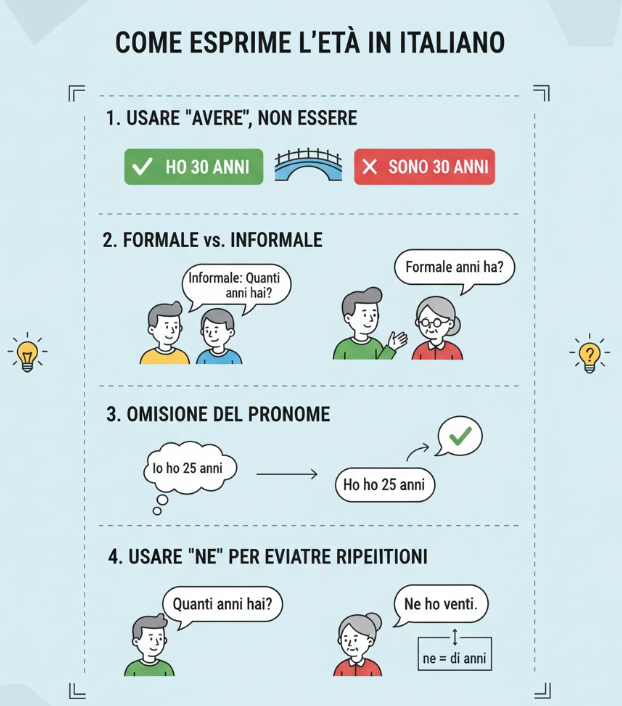
The main rule to remember is to always use the verb avere (to have) when expressing age, not essere (to be). Also, always include anni after the number representing the age.
Formal vs. Informal
As mentioned earlier, the choice between hai (informal “you”) and ha (formal “you”) depends on your relationship with the person you’re addressing. Use hai with friends, family, and people you know well. Use ha with strangers, elders, or people in positions of authority.
Omission of Pronoun
In many cases, the pronoun (io, tu, lui, etc.) is omitted because the verb conjugation already indicates who is being referred to. For example, instead of saying Io ho 25 anni, you can simply say Ho 25 anni.
However, including the pronoun can add emphasis or clarity, especially when there’s a possibility of ambiguity.
Using “Ne”
The word “ne” can be used as a pronoun that replaces “anni.” It is often used in conversation to avoid repetition. For example:
- Quanti anni hai? – Ne ho venti.
- How old are you? – I am twenty (years old).
Common Mistakes to Avoid
Here are some common mistakes that English speakers make when expressing age in Italian:
| Incorrect | Correct | Explanation |
|---|---|---|
| Io sono 25 anni. | Io ho 25 anni. | Using essere (to be) instead of avere (to have). |
| Ho 25 anno. | Ho 25 anni. | Using the singular form anno instead of the plural form anni. |
| Quanti anni sei? | Quanti anni hai? | Using essere instead of avere when asking someone’s age. |
| Lei è 30 anni. | Lei ha 30 anni. | Again, using essere instead of avere. |
| I have 30 years. (literal translation) | Ho 30 anni. | Remembering to use the correct Italian phrase. |
| Sono 40 anni. | Ho 40 anni. | Using essere (to be) instead of avere (to have). |
| Ho 20 year. | Ho 20 anni. | Using the singular form anno instead of the plural form anni. |
| Quanti anni tu hai? | Quanti anni hai? | The word order is incorrect. |
| Lei sono 50 anni. | Lei ha 50 anni. | Again, using essere instead of avere. |
| I am 60 years. (literal translation) | Ho 60 anni. | Remembering to use the correct Italian phrase. |
Avoiding these mistakes will significantly improve the accuracy of your Italian and prevent misunderstandings.
Practice Exercises
Test your understanding with these practice exercises. Translate the following English sentences into Italian, expressing age correctly.
Exercise 1
Translate the following sentences into Italian, using the correct form of *avere*.
| Number | English Sentence | Your Answer | Correct Answer |
|---|---|---|---|
| 1 | I am 22 years old. | Ho 22 anni. | |
| 2 | You are 35 years old (informal). | Hai 35 anni. | |
| 3 | He is 48 years old. | Lui ha 48 anni. | |
| 4 | She is 19 years old. | Lei ha 19 anni. | |
| 5 | We are 55 years old. | Noi abbiamo 55 anni. | |
| 6 | You are 61 years old (plural). | Voi avete 61 anni. | |
| 7 | They are 73 years old. | Loro hanno 73 anni. | |
| 8 | I am 9 years old. | Ho 9 anni. | |
| 9 | You are 80 years old (formal). | Lei ha 80 anni. | |
| 10 | We are 2 years old. | Noi abbiamo 2 anni. |
Exercise 2
Ask the age of the following people in Italian, both formally and informally where applicable.
| Number | Person | Informal Question | Formal Question | Possible Answer |
|---|---|---|---|---|
| 1 | Your friend (Marco) | Quanti anni hai, Marco? | Ho 28 anni. | |
| 2 | Your teacher (Signora Rossi) | Quanti anni ha, Signora Rossi? | Ho 45 anni. | |
| 3 | Your neighbor (Signor Bianchi) | Quanti anni ha, Signor Bianchi? | Ho 60 anni. | |
| 4 | Your colleague (Giulia) | Quanti anni hai, Giulia? | Ho 32 anni. | |
| 5 | A stranger on the street | Quanti anni ha? | Ne ho 50. | |
| 6 | Your grandmother | Quanti anni hai, nonna? | Ho 85 anni. | |
| 7 | Your grandfather | Quanti anni hai, nonno? | Ho 90 anni. | |
| 8 | A police officer | Quanti anni ha? | Ho 42 anni. | |
| 9 | Your barista | Quanti anni hai? | Ne ho 25. | |
| 10 | Your doctor | Quanti anni ha? | Ho 55 anni. |
Exercise 3
Fill in the blanks with the correct form of the verb *avere* and “anni.”
| Number | Sentence | Your Answer | Correct Answer |
|---|---|---|---|
| 1 | Io _______ 30 _______. | Io ho 30 anni. | |
| 2 | Tu _______ 15 _______? | Tu hai 15 anni? | |
| 3 | Lui _______ 67 _______. | Lui ha 67 anni. | |
| 4 | Lei _______ 2 _______. | Lei ha 2 anni. | |
| 5 | Noi _______ 44 _______. | Noi abbiamo 44 anni. | |
| 6 | Voi _______ 100 _______. | Voi avete 100 anni. | |
| 7 | Loro _______ 23 _______. | Loro hanno 23 anni. | |
| 8 | Quanti _______ tu? | Quanti anni hai tu? | |
| 9 | Quanti _______ Lei? | Quanti anni ha Lei? | |
| 10 | _______ 50 anni. | Ho 50 anni. |
Advanced Topics: Nuances and Variations
Beyond the basic structure, there are some more advanced nuances to expressing age in Italian.
Approximating Age
To express an approximate age, you can use the word circa (approximately) before the age. For example: Ho circa 30 anni (I am approximately 30 years old).
Another option is to use sui (about) before the age. For example: *Ho sui vent’anni* (I am about twenty years old).
Age Ranges
To express an age range, you can use tra…e… (between…and…). For example: Ho tra i 25 e i 30 anni (I am between 25 and 30 years old).
“Years Old” in Adjectival Form
You can use the phrase as an adjective. For instance: “un bambino di tre anni” (a three-year-old child).
Frequently Asked Questions
- Why do Italians use avere instead of essere to express age?This is simply a linguistic difference between Italian and English. In Italian, age is conceived as something you “have” rather than something you “are.” It’s a matter of convention and how the language has evolved over time. There isn’t a specific logical reason, but it’s a fundamental aspect of the language that must be learned.
- Can I omit anni when expressing age?While it might be understood in some contexts, it’s generally not grammatically correct to omit anni. It’s best to always include it to avoid confusion and ensure clarity. Omitting “anni” can make the sentence sound incomplete or awkward.
- Is it rude to ask someone’s age in Italy?Like in many cultures, asking someone’s age can be considered impolite, especially if you don’t know the person well. It’s best to avoid asking unless you have a good reason or a close relationship with the person. In formal settings, it’s generally advisable to avoid the question altogether.
- How do I respond if I don’t want to reveal my age?You can politely decline to answer by saying something like Non te lo dico! (I’m not telling you!) or È un segreto! (It’s a secret!). You can also change the subject or make a lighthearted joke to avoid answering directly. Another option is to say *Non sono affari tuoi* (It’s none of your business), but this is quite direct and could be considered rude.
- What’s the difference between Quanti anni hai? and Quanti anni ha??Quanti anni hai? is the informal way to ask “How old are you?” and is used with people you know well, like friends and family. Quanti anni ha? is the formal way and is used with strangers, elders, or people in positions of authority. The difference lies in the conjugation of the verb avere (to have): hai is the second-person singular informal form, while ha is the third-person singular formal form.
- How do I say “almost [age]”?You can use the word “quasi” (almost) before the verb. For example, “Ho quasi 30 anni” (I am almost 30 years old). You can also use “sto per compiere” (I am about to turn). For example, “Sto per compiere 30 anni” (I am about to turn 30 years old).
- Can I use “circa” or “intorno a” when talking about age?Yes, both “circa” and “intorno a” can be used to indicate an approximate age. “Circa” means “approximately,” and “intorno a” means “around.” For example, “Ho circa 30 anni” (I am approximately 30 years old) and “Ho intorno ai 30 anni” (I am around 30 years old). Both are perfectly acceptable ways to express an estimated age.
- Is there a way to ask someone’s age without directly asking “How old are you?”Yes, you can use indirect questions or make general observations. For example, you could say, “Sembri molto giovane” (You seem very young) or “Da quanto tempo lavori qui?” (How long have you been working here?). These questions can give you an idea of someone’s age without directly asking them. However, be mindful of the context and your relationship with the person to avoid being intrusive.
Conclusion
Expressing age in Italian is a fundamental skill that requires understanding the use of the verb avere instead of essere. By mastering the conjugation of avere, remembering to include anni, and avoiding common mistakes, you can confidently and accurately express your age and ask others about theirs.
Remember to practice regularly and pay attention to the context to choose the appropriate level of formality. With consistent effort, you’ll become more comfortable and fluent in expressing age in Italian, enhancing your overall communication skills.
Continue practicing the examples and exercises provided in this guide, and don’t hesitate to seek out opportunities to use your new knowledge in real-life conversations. With dedication and perseverance, you’ll master this essential aspect of Italian grammar and take another step closer to fluency.