Mastering the nuances of expressing reassurance and acceptance in French is essential for effective communication. Saying “It’s okay” may seem simple, but French offers a variety of expressions, each with its own subtle meaning and appropriate context.
This article will delve into the different ways to say “It’s okay” in French, providing detailed explanations, examples, and practice exercises. Whether you’re a beginner or an advanced learner, this guide will equip you with the knowledge and confidence to navigate various situations where you need to convey understanding and acceptance.
Understanding these phrases not only enhances your vocabulary but also deepens your understanding of French culture and communication styles.
This comprehensive guide is designed for anyone learning French, from beginners to advanced students. It’s particularly useful for those who want to improve their conversational skills and understand the subtle differences between various expressions.
By the end of this article, you will be able to confidently choose the most appropriate phrase to say “It’s okay” in any given situation.
Table of Contents
- Introduction
- Definition and Context
- Structural Breakdown
- Types and Categories of “It’s Okay” in French
- Examples
- Usage Rules
- Common Mistakes
- Practice Exercises
- Advanced Topics
- FAQ
- Conclusion
Definition and Context
The concept of “It’s okay” in French encompasses a range of meanings, including: reassurance, acceptance, forgiveness, and acknowledgement. The specific phrase used depends heavily on the context of the situation. Understanding the nuances of each expression is crucial for effective communication. For example, saying “C’est pas grave” after someone spills a drink is appropriate, while saying “Pas de problème” might be more suitable when acknowledging a request.
In French, like in English, the phrase used to convey “It’s okay” can also depend on the level of formality. You might use “Ne t’en fais pas” with a friend, but “Ne vous en faites pas” with someone you don’t know well or someone older than you. Consider the situation, your relationship with the person you’re speaking to, and the overall tone you want to convey.
Structural Breakdown
The phrases used to say “It’s okay” in French often involve negation (pas, ne…pas) or expressions of reassurance (ça va). Understanding the grammatical structure of these phrases helps in recognizing and using them correctly. Many of these phrases are idiomatic, meaning their overall meaning is not simply the sum of their individual words’ meanings. For example, “C’est pas grave” literally translates to “It’s not serious,” but it functions as “It’s okay” or “No worries.”
The structure can consist of simple statements like “C’est bon” (It’s good) or more complex constructions like “Il n’y a pas de quoi” (There is nothing to thank me for). The key is to understand the underlying meaning and the appropriate context for each phrase. This understanding will allow you to choose the most suitable expression in various situations. You will also be able to appreciate how French speakers convey reassurance and acceptance.
Types and Categories of “It’s Okay” in French
There are several ways to say “It’s okay” in French, each with its own nuance and appropriate context. Here’s a breakdown of some common expressions:
C’est pas grave / Ce n’est pas grave
“C’est pas grave” (informal) and “Ce n’est pas grave” (formal) are among the most common ways to say “It’s okay” in French. It literally translates to “It’s not serious” or “It’s not a big deal.” It’s used to reassure someone that a mistake or accident is not a problem.
This expression is highly versatile and can be used in a wide range of situations, from minor mishaps to more significant errors. The informal version, “C’est pas grave,” is suitable for use with friends, family, and people you know well. The formal version, “Ce n’est pas grave,” is more appropriate for formal settings or when speaking to someone you don’t know well.
C’est rien / Ce n’est rien
“C’est rien” (informal) and “Ce n’est rien” (formal) translate to “It’s nothing” or “It’s no big deal.” It’s used to minimize the importance of something, often to reassure someone who is worried or feels guilty.
Similar to “C’est pas grave,” this expression is versatile and can be used in various contexts. It’s particularly useful when someone apologizes for a minor inconvenience or expresses concern over something insignificant. The choice between the informal and formal versions depends on the relationship between the speakers and the level of formality required by the situation.
Pas de problème
“Pas de problème” means “No problem.” It’s a straightforward way to say “It’s okay” or “You’re welcome” in response to a thank you or an apology.
This expression is widely used in both formal and informal settings. It’s a simple and direct way to convey acceptance and reassurance. “Pas de problème” is particularly useful when acknowledging a request or offering assistance.
Il n’y a pas de quoi
“Il n’y a pas de quoi” literally translates to “There is nothing to thank me for.” It’s a polite way to say “You’re welcome” or “It’s okay” after someone thanks you.
This expression is more formal than “Pas de problème” and is often used in situations where you want to express humility or downplay your contribution. It’s a gracious way to acknowledge someone’s gratitude while indicating that the action was no trouble.
C’est bon
“C’est bon” means “It’s good” or “It’s okay.” It can be used to indicate that something is acceptable, satisfactory, or sufficient. It can also mean “That’s enough.”
The meaning of “C’est bon” depends heavily on the context. It can be used to reassure someone that everything is alright, to indicate that you’ve had enough food, or to confirm that something meets your expectations. The tone of voice and the surrounding conversation will provide clues to the intended meaning.
D’accord
“D’accord” means “Okay” or “Agreed.” While it doesn’t directly translate to “It’s okay,” it can be used to express agreement or acceptance of a situation.
This expression is useful when you want to indicate that you understand and accept what someone has said or proposed. It’s a versatile word that can be used in a wide range of contexts, from simple agreements to more complex negotiations.
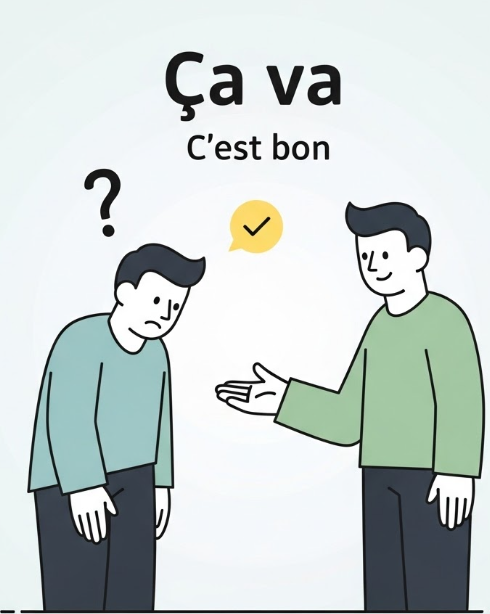
Ça va
“Ça va” means “It’s going well” or “It’s okay.” It can be used as a question (“Ça va?” – Are you okay?) or as a statement to indicate that everything is alright.
The meaning of “Ça va” depends on the context and intonation. When used as a statement, it can convey reassurance or acceptance. When used as a question, it’s a common way to inquire about someone’s well-being.
Ne t’en fais pas / Ne vous en faites pas
“Ne t’en fais pas” (informal) and “Ne vous en faites pas” (formal) mean “Don’t worry.” It’s used to reassure someone who is anxious or concerned.
This expression is particularly useful when someone is worried about a problem or situation. The informal version, “Ne t’en fais pas,” is suitable for use with friends and family, while the formal version, “Ne vous en faites pas,” is more appropriate for formal settings or when speaking to someone you don’t know well.
Aucun souci
“Aucun souci” means “No worries” or “No problem.” It’s a casual way to say “It’s okay” and is often used in informal settings.
This expression is a more relaxed alternative to “Pas de problème.” It’s suitable for use with friends, family, and colleagues in informal situations. It conveys a sense of ease and reassurance.
Tout va bien
“Tout va bien” means “Everything is fine” or “All is well.” It’s used to reassure someone that a situation is under control or that there’s nothing to worry about.
This expression is particularly useful when you want to provide a strong sense of reassurance. It’s often used in situations where someone is anxious or uncertain about the outcome of something.
Examples
To better understand how to use these phrases, let’s look at some examples in context. The following tables illustrate different scenarios and the appropriate way to say “It’s okay” in French.
Table 1: Responding to Apologies
This table shows how to respond to an apology using different variations of “It’s okay” in French. Note the context and formality of each response.
| Scenario | French Response | English Translation |
|---|---|---|
| Someone accidentally bumps into you. | C’est pas grave. / Ce n’est pas grave. | It’s okay. / It’s not a big deal. |
| Someone spills a drink. | C’est rien. / Ce n’est rien. | It’s nothing. / It’s no big deal. |
| Someone is late for a meeting. | Pas de problème. | No problem. |
| Someone apologizes for a minor mistake. | Aucun souci. | No worries. |
| Someone is worried about a delayed project. | Ne t’en fais pas. / Ne vous en faites pas. | Don’t worry. |
| Someone says “Sorry for the inconvenience”. | Il n’y a pas de quoi. | It’s nothing. / You’re welcome. |
| A child breaks a toy and apologizes. | C’est pas grave, mon chéri. | It’s okay, honey. |
| Your friend forgets to bring something you asked for. | C’est pas grave, je vais m’en occuper. | It’s okay, I’ll take care of it. |
| Someone accidentally steps on your foot. | Ce n’est rien, ça arrive. | It’s nothing, it happens. |
| A colleague apologizes for sending an email late at night. | Pas de problème, je comprends. | No problem, I understand. |
| A guest apologizes for being a few minutes late to dinner. | Ce n’est pas grave, on vient de commencer. | It’s okay, we just started. |
| Someone scratches your car by accident. | C’est pas grave, c’est juste une égratignure. | It’s okay, it’s just a scratch. |
| A waiter apologizes for a slight delay in bringing your order. | Ce n’est pas grave, on n’est pas pressés. | It’s okay, we’re not in a hurry. |
| Your roommate apologizes for using the last of the milk. | C’est pas grave, j’en achèterai demain. | It’s okay, I’ll buy some tomorrow. |
| Someone sends you the wrong file by mistake. | Pas de problème, renvoie-le moi. | No problem, just send it to me again. |
| A friend apologizes for not being able to attend your party. | Ce n’est pas grave, on se verra une autre fois. | It’s okay, we’ll see each other another time. |
| Someone confuses your name. | C’est pas grave, ça arrive souvent. | It’s okay, it happens often. |
| A student apologizes for not completing the homework on time. | Ce n’est pas grave, mais essaie de le faire la prochaine fois. | It’s okay, but try to do it next time. |
| A colleague apologizes for missing a deadline. | Pas de problème, on peut rattraper le temps perdu. | No problem, we can make up for lost time. |
| Someone apologizes for interrupting you. | Ce n’est rien, j’avais fini de toute façon. | It’s nothing, I was finished anyway. |
| A child breaks a glass accidentally. | C’est pas grave, on va nettoyer ensemble. | It’s okay, we’ll clean up together. |
| Your friend cancels plans at the last minute. | C’est pas grave, on remettra ça. | It’s okay, we’ll reschedule. |
| Someone forgets your birthday. | Ce n’est rien, le plus important c’est qu’on soit ensemble. | It’s nothing, the most important thing is that we are together. |
Table 2: Reassuring Someone
This table illustrates how to use different French phrases to reassure someone who is worried or anxious.
| Scenario | French Response | English Translation |
|---|---|---|
| Someone is nervous about a presentation. | Ne t’en fais pas, tout va bien se passer. / Ne vous en faites pas, tout va bien se passer. | Don’t worry, everything will be fine. |
| Someone is concerned about a medical test. | Ça va aller. | It’s going to be okay. |
| Someone is worried about a job interview. | Tout va bien. Tu vas assurer. | Everything is fine. You’ll do great. |
| Someone is anxious about traveling alone. | Ne t’en fais pas, c’est facile de voyager seul. | Don’t worry, it’s easy to travel alone. |
| Someone is concerned about their grades. | Ce n’est pas grave, tu peux toujours t’améliorer. | It’s okay, you can always improve. |
| Someone is worried about a family member’s health. | Ça va aller, ils sont entre de bonnes mains. | It’s going to be okay, they are in good hands. |
| A child is afraid of the dark. | Ne t’en fais pas, il n’y a rien à craindre. | Don’t worry, there’s nothing to fear. |
| Someone is stressed about moving to a new city. | Tout va bien se passer, tu vas t’adapter rapidement. | Everything will be fine, you’ll adapt quickly. |
| Someone is nervous about meeting new people. | Ne vous en faites pas, les gens sont amicaux ici. | Don’t worry, people are friendly here. |
| Someone is concerned about a potential storm. | Ça va aller, on est en sécurité ici. | It’s going to be okay, we are safe here. |
| Someone is worried about missing a flight. | Ne t’en fais pas, on va trouver une solution. | Don’t worry, we’ll find a solution. |
| Someone is feeling overwhelmed with work. | Ne vous en faites pas, on va vous aider. | Don’t worry, we will help you. |
| Someone is scared of dogs. | Ne t’en fais pas, il est gentil. | Don’t worry, he’s friendly. |
| Someone is anxious about public speaking. | Tout va bien se passer, respire et parle lentement. | Everything will be fine, breathe and speak slowly. |
| Someone is worried about their financial situation. | Ça va aller, on va trouver des solutions ensemble. | It’s going to be okay, we will find solutions together. |
| Someone is nervous about a first date. | Ne t’en fais pas, sois toi-même. | Don’t worry, just be yourself. |
| Someone is concerned about a potential earthquake. | Ça va aller, on a des mesures de sécurité. | It’s going to be okay, we have safety measures. |
| Someone is worried about losing their job. | Ne vous en faites pas, on va vous soutenir. | Don’t worry, we will support you. |
| Someone is anxious about starting a new school. | Tout va bien se passer, tu vas te faire des amis rapidement. | Everything will be fine, you will make friends quickly. |
| Someone is nervous about driving in a new city. | Ne t’en fais pas, suis les indications du GPS. | Don’t worry, follow the GPS directions. |
| Someone is feeling sick and worried. | Ça va aller, repose-toi et prends tes médicaments. | It’s going to be okay, rest and take your medicine. |
| Someone is concerned about a power outage. | Ne t’en fais pas, ça ne va pas durer longtemps. | Don’t worry, it won’t last long. |
| Someone is nervous about taking an exam. | Tout va bien se passer, tu as bien étudié. | Everything will be fine, you have studied well. |
Table 3: Accepting Thanks
This table shows how to respond to “Thank you” using appropriate French phrases that convey “It’s okay” or “You’re welcome.”
| Scenario | French Response | English Translation |
|---|---|---|
| Someone thanks you for helping them. | Pas de problème. | No problem. |
| Someone thanks you for a gift. | Il n’y a pas de quoi. | You’re welcome. / Don’t mention it. |
| Someone thanks you for your time. | De rien. | You’re welcome. |
| Someone thanks you for your advice. | Avec plaisir. | With pleasure. / My pleasure. |
| Someone thanks you for your hospitality. | Je vous en prie. | You’re welcome. / Don’t mention it. (Formal) |
| Someone thanks you for lending them money. | Pas de souci. | No worries. |
| Someone thanks you for driving them home. | C’était un plaisir. | It was a pleasure. |
| Someone thanks you for your support. | C’est normal. | It’s normal. / It’s nothing. |
| Someone thanks you for your understanding. | Je comprends. | I understand. / It’s okay. |
| Someone thanks you for a pleasant evening. | À bientôt. | See you soon. (Implies it was also your pleasure) |
| Someone thanks you for a delicious meal. | J’en suis ravi(e). | I’m delighted. |
| Someone thanks you for your quick response. | C’était mon plaisir de vous aider. | It was my pleasure to help you. |
| Someone thanks you for your patience. | Il n’y a pas de quoi, j’avais le temps. | You’re welcome, I had the time. |
| Someone thanks you for your kindness. | C’est tout naturel. | It’s only natural. |
| Someone thanks you for your encouragement. | Je suis content(e) d’avoir pu aider. | I’m happy to have been able to help. |
| Someone thanks you for your generosity. | Ce n’est rien, j’avais envie de faire plaisir. | It’s nothing, I wanted to make you happy. |
| Someone thanks you for your advice. | J’espère que ça va aider. | I hope it will help. |
| Someone thanks you for your help with a project. | C’était un travail d’équipe. | It was teamwork. |
| Someone thanks you for your support during a difficult time. | Je suis toujours là pour toi. | I’m always here for you. |
| Someone thanks you for a thoughtful gift. | J’espere que ça te plait. | I hope you like it. |
| Someone thanks you for listening. | C’est important d’être là pour les autres. | It’s important to be there for others. |
| Someone thanks you for understanding their situation. | Je sais ce que c’est. | I know how it is. |
| Someone thanks you for your efforts. | J’ai fait de mon mieux. | I did my best. |
Usage Rules
When using these expressions, it’s important to consider the context and your relationship with the person you’re speaking to. Use informal phrases like “C’est pas grave” and “Ne t’en fais pas” with friends and family. Use formal phrases like “Ce n’est pas grave” and “Ne vous en faites pas” with people you don’t know well or in professional settings.
Pay attention to your tone of voice. Even if you use the correct phrase, a sarcastic or dismissive tone can convey the wrong message.
Be genuine and empathetic when reassuring someone or accepting an apology. Consider the specific situation and choose the phrase that best reflects your intention.
Common Mistakes
One common mistake is using the wrong level of formality. For example, saying “Ne t’en fais pas” to your boss would be inappropriate. Another mistake is using the literal translation of “It’s okay” (“C’est correct“), which is not commonly used in French to convey reassurance.
Another frequent error is confusing “C’est bon” with “It’s okay” in all contexts. While “C’est bon” can mean “It’s okay,” it’s also used to indicate that something is sufficient or that you’ve had enough. Be mindful of the context to avoid misunderstandings.
Here are some examples of common mistakes and their corrections:
| Incorrect | Correct | Explanation |
|---|---|---|
| C’est correct. (Responding to an apology) | C’est pas grave. or Ce n’est pas grave. | “C’est correct” is not a natural way to say “It’s okay” in French when responding to an apology. |
| Ne vous en fais pas (To a friend) | Ne t’en fais pas. | “Ne vous en fais pas” is the formal version and is not appropriate for friends. |
| C’est bon, merci. (When someone apologizes) | Pas de problème. or C’est pas grave. | “C’est bon, merci” is more appropriate when refusing something or indicating that you’ve had enough. |
| Il n’y a pas de quoi (To a close friend who helped you a lot) | De rien | “Il n’y a pas de quoi” is too formal for a close friend. De rien would be more fitting. |
| Ça va? (Responding to someone apologizing) | C’est pas grave. | “Ça va?” means “Are you okay?” It is not an appropriate response to someone apologizing. |
Practice Exercises
Test your understanding with these practice exercises. Choose the most appropriate way to say “It’s okay” in French for each scenario.
Exercise 1: Choose the Correct Response
Select the most appropriate response in French for each scenario.
| Scenario | Options | Answer |
|---|---|---|
| Someone accidentally spills coffee on your shirt. | a) Pas de problème. b) C’est pas grave. c) D’accord. | b) C’est pas grave. |
| Your colleague apologizes for missing a deadline. | a) Ne t’en fais pas. b) Ce n’est rien. c) Pas de problème. | c) Pas de problème. |
| A friend thanks you for helping them move. | a) Il n’y a pas de quoi. b) Ça va. c) C’est bon. | a) Il n’y a pas de quoi. |
| Someone is worried about an upcoming exam. | a) Tout va bien. b) C’est rien. c) D’accord. | a) Tout va bien. |
| Someone says “Sorry for being late”. | a) C’est bon. b) Aucun souci. c) D’accord. | b) Aucun souci. |
| A child breaks a vase accidentally. | a) C’est pas grave. b) Pas de probleme. c) Ne t’en fais pas. | a) C’est pas grave. |
| A waiter apologizes for the delay in your order. | a) C’est rien. b) Ce n’est pas grave. c) Il n’y a pas de quoi. | b) Ce n’est pas grave. |
| A friend cancels the plan last minute. | a) Pas de problème. b) C’est bon. c) Ce n’est rien. | a) Pas de problème. |
| Someone thanks you for your help. | a) Ne t’en fais pas. b) De rien. c) Ça va. | b) De rien. |
| Someone is nervous about a presentation. | a) D’accord. b) Ne vous en faites pas. c) C’est bon. | b) Ne vous en faites pas. |
Exercise 2: Fill in the Blanks
Complete the following sentences with the most appropriate expression.
| Sentence | Possible Answers | Answer |
|---|---|---|
| Tu as oublié mon anniversaire? ________, l’important c’est que tu sois là! | a) Pas de problème b) C’est pas grave c) De rien | b) C’est pas grave |
| Merci de m’avoir aidé avec mes devoirs. – ________. | a) Ça va b) Il n’y a pas de quoi c) Tout va bien | b) Il n’y a pas de quoi |
| Je suis désolé d’avoir cassé ton vase. – ________. | a) Ne t’en fais pas b) C’est bon c) Pas de souci | c) Pas de souci |
| Je suis très inquiet pour mon examen. – ________, tu vas réussir. | a) D’accord b) Tout va bien c) C’est rien | b) Tout va bien |
| Merci pour votre aide. – ________. | a) Ca va? b) Je vous en prie c) C’est bon. | b) Je vous en prie |
| Je suis désolé d’être arrivé en retard. – ________, entre. | a) Il n’y a pas de quoi b) Ne t’en fais pas c) Ce n’est pas grave | c) Ce n’est pas grave |
| Merci d’avoir fait le ménage. – ________. | a) D’accord. b) De rien. c) Ça va. | b) De rien. |
Advanced Topics
Beyond the basic phrases, there are more nuanced ways to express “It’s okay” in French. These often involve idiomatic expressions or regional variations. For example, in some regions, you might hear “T’inquiète” (short for “Ne t’inquiète pas“), which is an informal way of saying “Don’t worry.”
Another advanced topic is understanding the cultural context behind these expressions. In French culture, politeness and consideration for others are highly valued.
Therefore, choosing the right phrase and using it with the appropriate tone is crucial for maintaining positive relationships.
FAQ
Here are some frequently asked questions about saying “It’s okay” in French:
Q: What’s the difference between “C’est pas grave” and “Ce n’est pas grave”?
A: “C’est pas grave” is the informal version, while “Ce n’est pas grave” is the formal version. Use “C’est pas grave” with friends and family, and “Ce n’est pas grave” in formal situations or with people you don’t know well.
Q: When should I use “Il n’y a pas de quoi”?
A: Use “Il n’y a pas de quoi” as a polite way to say “You’re welcome” after someone thanks you, especially when you want to downplay your contribution or express humility.
Q: Can I use “C’est bon” to respond to an apology?
A: “C’est bon” can be used in some contexts, but it’s more commonly used to indicate that something is acceptable or sufficient. It’s generally better to use “C’est pas grave” or “Pas de problème” when responding to an apology.
Q: How do I say “It’s okay” in a very informal way?
A: You can use “Aucun souci” or “T’inquiète” (short for “Ne t’inquiète pas“) in very informal situations.
Q: Is “De rien” formal or informal?
A: “De rien” is generally considered informal but is widely acceptable in most situations. It’s a safe and versatile way to say “You’re welcome.”
Q: What is the best way to reassure someone who is very worried?
A: Use “Ne t’en fais pas” (informal) or “Ne vous en faites pas” (formal) followed by a reassuring statement like “Tout va bien se passer” (Everything will be fine).
Q: Can “Ça va” mean “It’s okay”?
A: Yes, “Ça va” can mean “It’s okay” when used as a statement to indicate that everything is alright. However, it’s more commonly used as a question (“Ça va?” – Are you okay?).
Q: What does “Pas de souci” mean?
A: “Pas de souci” means “No worries” or “No problem.” It’s a casual way to say “It’s okay” and is often used in informal settings.
Q: How do I choose the right phrase in a specific situation?
A: Consider the context, your relationship with the person you’re speaking to, and the level of formality required. Choose the phrase that best reflects your intention and conveys the appropriate tone.
Q: Are there regional variations in how people say “It’s okay” in French?
A: Yes, there can be regional variations. For example, you might hear “T’inquiète” in some regions as an informal way of saying “Don’t worry.”
Conclusion
Mastering the various ways to say “It’s okay” in French is a valuable skill for any language learner. By understanding the nuances of each expression and considering the context in which it’s used, you can communicate more effectively and build stronger relationships with French speakers.
Remember to pay attention to your tone of voice and choose the phrase that best reflects your intention. With practice and attention to detail, you’ll be able to confidently navigate any situation where you need to convey reassurance and acceptance.