Saying “no” is a fundamental part of any language, and German is no exception. While the simplest way to negate something is by using “nein,” the German language offers a rich variety of ways to express negation depending on the context.
Understanding these nuances is crucial for effective communication and comprehension. This article provides a comprehensive guide to negation in German, covering basic usage, different negative words, common mistakes, and advanced topics.
Whether you’re a beginner or an advanced learner, this guide will help you confidently navigate the world of German negation.
This article is designed for students of all levels, from beginners just starting their German journey to advanced learners looking to refine their understanding of negation. It’s particularly useful for those preparing for German language exams or anyone who wants to speak more naturally and accurately.
Table of Contents
- Introduction
- Definition of Negation in German
- Structural Breakdown of Negation
- Types of Negation in German
- Examples of Negation in German
- Usage Rules for Negation
- Common Mistakes in German Negation
- Practice Exercises
- Advanced Topics in German Negation
- Frequently Asked Questions
- Conclusion
Definition of Negation in German
Negation in German, like in any language, is the process of expressing the opposite of a statement or concept. It involves using specific words or grammatical structures to indicate that something is not true, does not exist, or did not happen. The primary words for negation in German are nein, nicht, and kein. Each of these words has specific functions and usage rules, making it essential to understand their differences.
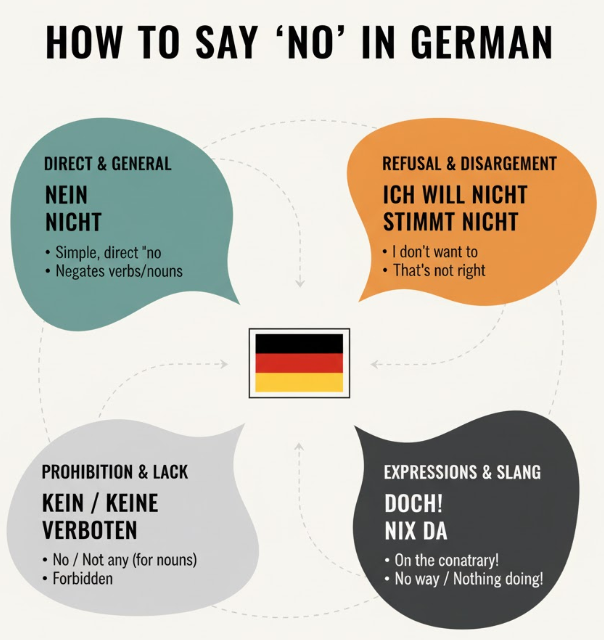
Negation in German can apply to various parts of speech, including verbs, nouns, adjectives, and adverbs. The choice of negative word depends on what you are negating. For example, you might use nicht to negate a verb (“Ich gehe nicht” – I am not going) or kein to negate a noun (“Ich habe kein Geld” – I have no money). Understanding the correct use of these negative words is crucial for forming grammatically correct and meaningful sentences.
Structural Breakdown of Negation
The structure of negation in German depends on the negative word used and the element being negated. Let’s break down the structure for the main negative words: nein, nicht, and kein.
- Nein: This is the simplest form of negation and typically stands alone as an answer to a question. It doesn’t require any specific sentence structure.
- Nicht: The placement of nicht in a sentence can be tricky. Generally, it comes before the element it negates. This could be a verb, an adjective, an adverb, or even a prepositional phrase. However, it usually comes at the end of the sentence if it negates the entire sentence.
- Kein: This word is used to negate nouns, functioning as the negative form of the indefinite article “ein” (a/an). It takes the same endings as “ein” based on the noun’s gender, number, and case.
The placement of nicht is particularly important. Consider these examples:
- Ich gehe nicht ins Kino. (I am not going to the cinema.) – Negates the verb phrase.
- Das ist nicht gut. (That is not good.) – Negates the adjective.
- Ich spreche nicht schnell. (I don’t speak quickly.) – Negates the adverb.
Types of Negation in German
German employs several key words to indicate negation, each with its specific role. The primary negative words are nein, nicht, and kein. Understanding how and when to use each of these is crucial for accurate and natural communication in German.
Nein: The Basic “No”
Nein is the most straightforward way to say “no” in German. It’s used as a direct response to a question, indicating disagreement or refusal. It stands alone and doesn’t require any additional grammatical structure.
Example:
“Gehst du ins Kino?” – “Nein.” (Are you going to the cinema? – No.)
Nicht: Negating Verbs, Adjectives, and Adverbs
Nicht is used to negate verbs, adjectives, adverbs, and prepositional phrases. Its placement in the sentence is crucial and depends on what you are negating. Typically, it comes before the element it negates, but it can also come at the end of the sentence to negate the entire statement.
Examples:
- Ich gehe nicht. (I am not going.) – Negates the verb.
- Das ist nicht teuer. (That is not expensive.) – Negates the adjective.
- Er spricht nicht laut. (He doesn’t speak loudly.) – Negates the adverb.
Kein: Negating Nouns
Kein is used to negate nouns and is the negative form of the indefinite article “ein” (a/an). It agrees in gender, number, and case with the noun it modifies. Therefore, you must pay attention to the noun’s grammatical properties to use kein correctly.
Examples:
- Ich habe kein Geld. (I have no money.) – “Geld” is neuter.
- Ich habe keine Zeit. (I have no time.) – “Zeit” is feminine.
- Ich habe keinen Bruder. (I have no brother.) – “Bruder” is masculine, accusative.
Other Negative Words
Besides nein, nicht, and kein, German has other negative words that add further nuance to negation. These include:
- Nie: Never
- Niemals: Never (more emphatic than “nie”)
- Nirgends: Nowhere
- Niemand: Nobody, no one
- Nichts: Nothing
These words often have a fixed position in the sentence and can sometimes replace nicht, depending on the context.
Examples of Negation in German
To fully understand negation in German, it’s essential to see it in action. The following examples illustrate the use of nein, nicht, kein, and other negative words in various contexts.
Examples with Nein
As mentioned earlier, nein is a straightforward “no” used as a direct response. Here are some examples in table format:
The following table presents 25 examples of using “Nein” in response to various questions. Each example includes the original question in German, its English translation, the response using “Nein”, and the translation of the response.
| Question (German) | Question (English) | Response (German) | Response (English) |
|---|---|---|---|
| Ist das dein Buch? | Is that your book? | Nein. | No. |
| Hast du Hunger? | Are you hungry? | Nein. | No. |
| Willst du Kaffee? | Do you want coffee? | Nein. | No. |
| Bist du müde? | Are you tired? | Nein. | No. |
| Kannst du Deutsch sprechen? | Can you speak German? | Nein. | No. |
| Warst du gestern im Kino? | Were you at the cinema yesterday? | Nein. | No. |
| Magst du Schokolade? | Do you like chocolate? | Nein. | No. |
| Hast du Geschwister? | Do you have siblings? | Nein. | No. |
| Spielst du gern Fußball? | Do you like playing football? | Nein. | No. |
| Brauchst du Hilfe? | Do you need help? | Nein. | No. |
| Ist das Wetter schön? | Is the weather nice? | Nein. | No. |
| Hast du Zeit? | Do you have time? | Nein. | No. |
| Ist das dein Auto? | Is that your car? | Nein. | No. |
| Gefällt dir die Musik? | Do you like the music? | Nein. | No. |
| Hast du das verstanden? | Did you understand that? | Nein. | No. |
| Bist du ein Student? | Are you a student? | Nein. | No. |
| Arbeitest du heute? | Are you working today? | Nein. | No. |
| Wohnst du in Berlin? | Do you live in Berlin? | Nein. | No. |
| Sprichst du Englisch? | Do you speak English? | Nein. | No. |
| Möchtest du etwas essen? | Would you like to eat something? | Nein. | No. |
| Fährst du gern Fahrrad? | Do you like riding a bicycle? | Nein. | No. |
| Hast du einen Hund? | Do you have a dog? | Nein. | No. |
| Kannst du schwimmen? | Can you swim? | Nein. | No. |
| Hörst du gern Musik? | Do you like listening to music? | Nein. | No. |
| Bist du verheiratet? | Are you married? | Nein. | No. |
Examples with Nicht
The placement of nicht can change the meaning of the sentence. The following table showcases different sentences with the word nicht.
This table provides 25 examples of sentences using “Nicht” to negate different parts of speech. Notice how the placement of “Nicht” can change the meaning of the sentence.
| Sentence (German) | Sentence (English) | Negated Element |
|---|---|---|
| Ich gehe nicht ins Kino. | I am not going to the cinema. | Verb phrase (ins Kino) |
| Das ist nicht gut. | That is not good. | Adjective (gut) |
| Er spricht nicht schnell. | He doesn’t speak quickly. | Adverb (schnell) |
| Sie kommt heute nicht. | She is not coming today. | Verb (kommt) |
| Wir sind nicht zu Hause. | We are not at home. | Prepositional phrase (zu Hause) |
| Ich habe das nicht gesagt. | I didn’t say that. | Verb (gesagt) |
| Das ist nicht mein Auto. | That is not my car. | Possessive adjective (mein) |
| Wir fahren nicht nach Italien. | We are not going to Italy. | Prepositional phrase (nach Italien) |
| Sie ist nicht meine Schwester. | She is not my sister. | Noun (Schwester) |
| Er hat den Brief nicht geschrieben. | He didn’t write the letter. | Verb (geschrieben) |
| Ich mag das nicht. | I don’t like that. | Pronoun (das) |
| Das ist nicht wichtig. | That is not important. | Adjective (wichtig) |
| Er arbeitet nicht gern. | He doesn’t like to work. | Adverb (gern) |
| Sie singt nicht gut. | She doesn’t sing well. | Adverb (gut) |
| Wir sind nicht bereit. | We are not ready. | Adjective (bereit) |
| Ich habe ihn nicht gesehen. | I didn’t see him. | Verb (gesehen) |
| Das ist nicht richtig. | That is not correct. | Adjective (richtig) |
| Sie wohnt nicht hier. | She doesn’t live here. | Adverb (hier) |
| Wir sprechen nicht darüber. | We don’t talk about it. | Prepositional phrase (darüber) |
| Ich verstehe das nicht. | I don’t understand that. | Pronoun (das) |
| Er liest nicht viel. | He doesn’t read much. | Adverb (viel) |
| Sie isst nicht Fleisch. | She doesn’t eat meat. | Noun (Fleisch) |
| Wir trinken nicht Alkohol. | We don’t drink alcohol. | Noun (Alkohol) |
| Ich schlafe nicht gut. | I don’t sleep well. | Adverb (gut) |
| Sie rennt nicht schnell. | She doesn’t run fast. | Adverb (schnell) |
Examples with Kein
Kein must agree with the noun it negates. Here are some examples, illustrating the agreement in gender, number, and case.
The following table provides 25 examples demonstrating the use of “Kein” to negate nouns. Note how “Kein” changes its form to agree with the gender, number, and case of the noun.
| Sentence (German) | Sentence (English) | Noun (Gender, Number, Case) |
|---|---|---|
| Ich habe kein Geld. | I have no money. | Geld (neuter, singular, accusative) |
| Ich habe keine Zeit. | I have no time. | Zeit (feminine, singular, accusative) |
| Ich habe keinen Bruder. | I have no brother. | Bruder (masculine, singular, accusative) |
| Wir haben keine Kinder. | We have no children. | Kinder (plural, nominative/accusative) |
| Das ist kein Problem. | That is not a problem. | Problem (neuter, singular, nominative) |
| Ich sehe keinen Mann. | I see no man. | Mann (masculine, singular, accusative) |
| Sie hat keine Katze. | She has no cat. | Katze (feminine, singular, accusative) |
| Er hat kein Auto. | He has no car. | Auto (neuter, singular, accusative) |
| Wir haben keinen Garten. | We have no garden. | Garten (masculine, singular, accusative) |
| Ich brauche keine Hilfe. | I need no help. | Hilfe (feminine, singular, accusative) |
| Das ist kein Haus. | That is not a house. | Haus (neuter, singular, nominative) |
| Sie hat keine Fragen. | She has no questions. | Fragen (feminine, plural, accusative) |
| Er hat keinen Job. | He has no job. | Job (masculine, singular, accusative) |
| Wir haben keine Lust. | We have no desire. | Lust (feminine, singular, accusative) |
| Das ist kein Buch. | That is not a book. | Buch (neuter, singular, nominative) |
| Ich kenne keinen Lehrer. | I know no teacher. | Lehrer (masculine, singular, accusative) |
| Sie hat keine Ahnung. | She has no idea. | Ahnung (feminine, singular, accusative) |
| Er hat kein Interesse. | He has no interest. | Interesse (neuter, singular, accusative) |
| Wir haben keinen Plan. | We have no plan. | Plan (masculine, singular, accusative) |
| Ich habe keine Geduld. | I have no patience. | Geduld (feminine, singular, accusative) |
| Das ist kein Problem. | That is not a problem. | Problem (neuter, singular, nominative) |
| Sie hat keine Angst. | She has no fear. | Angst (feminine, singular, accusative) |
| Er hat kein Glück. | He has no luck. | Glück (neuter, singular, accusative) |
| Wir haben keine Zeit. | We have no time. | Zeit (feminine, singular, accusative) |
| Ich habe kein Verständnis. | I have no understanding. | Verständnis (neuter, singular, accusative) |
Examples with Other Negative Words
Other negative words like nie, niemals, nirgends, niemand, and nichts add variety and emphasis to negation. Let’s look at some examples.
The following table provides examples of sentences using other negative words such as “nie,” “niemals,” “nirgends,” “niemand,” and “nichts.”
| Sentence (German) | Sentence (English) | Negative Word |
|---|---|---|
| Ich war nie in Berlin. | I have never been to Berlin. | Nie (never) |
| Er kommt niemals zu spät. | He is never late. | Niemals (never) |
| Wir finden das nirgends. | We can’t find that anywhere. | Nirgends (nowhere) |
| Niemand hat das gesehen. | Nobody saw that. | Niemand (nobody) |
| Ich habe nichts gesagt. | I said nothing. | Nichts (nothing) |
| Nie wieder! | Never again! | Nie (never) |
| Niemals würde ich das tun. | I would never do that. | Niemals (never) |
| Nirgends ist es so schön wie zu Hause. | Nowhere is as beautiful as home. | Nirgends (nowhere) |
| Niemand kennt die Antwort. | Nobody knows the answer. | Niemand (nobody) |
| Es gibt nichts zu tun. | There is nothing to do. | Nichts (nothing) |
| Ich habe nie daran gedacht. | I never thought of that. | Nie (never) |
| Er wird niemals aufgeben. | He will never give up. | Niemals (never) |
| Wir waren nirgends willkommen. | We were not welcome anywhere. | Nirgends (nowhere) |
| Niemand hat mich gefragt. | Nobody asked me. | Niemand (nobody) |
| Ich will nichts davon wissen. | I want to know nothing about it. | Nichts (nothing) |
| Sie hat nie gelogen. | She has never lied. | Nie (never) |
| Niemals hätte ich das gedacht. | I would have never thought that. | Niemals (never) |
| Nirgends habe ich das gefunden. | Nowhere have I found that. | Nirgends (nowhere) |
| Niemand hat geantwortet. | Nobody answered. | Niemand (nobody) |
| Es gibt nichts Besseres. | There is nothing better. | Nichts (nothing) |
| Ich werde das nie vergessen. | I will never forget that. | Nie (never) |
| Er würde niemals so etwas tun. | He would never do something like that. | Niemals (never) |
| Nirgends kann man das kaufen. | You can’t buy that anywhere. | Nirgends (nowhere) |
| Niemand hat mich gewarnt. | Nobody warned me. | Niemand (nobody) |
| Ich habe nichts zu verlieren. | I have nothing to lose. | Nichts (nothing) |
Usage Rules for Negation
Mastering negation in German requires a clear understanding of the usage rules for nicht and kein, including their placement in sentences and the contexts in which they are used. These rules ensure that your sentences are grammatically correct and convey the intended meaning.
Placement of Nicht
The placement of nicht is crucial for correct negation. Here are the general rules:
- Before the element it negates: This is the most common rule. Nicht usually precedes the verb, adjective, adverb, or prepositional phrase it is negating.
- At the end of the sentence: If nicht negates the entire sentence, it typically comes at the end, especially in spoken German.
- Before prepositional phrases: Nicht comes before the prepositional phrase it negates.
- Exception with separable verbs: With separable verbs, nicht usually comes before the prefix.
Here’s a table summarizing the placement rules with examples:
| Rule | Example (German) | Example (English) |
|---|---|---|
| Before the verb | Ich gehe nicht. | I am not going. |
| Before the adjective | Das ist nicht teuer. | That is not expensive. |
| Before the adverb | Er spricht nicht laut. | He doesn’t speak loudly. |
| Before prepositional phrase | Ich gehe nicht nach Hause. | I am not going home. |
| At the end of the sentence (negating the whole sentence) | Ich gehe ins Kino nicht. (less common, but acceptable) | I’m not going to the cinema. |
| Before separable verb prefix | Ich stehe nicht auf. | I am not getting up. |
Kein vs. Nicht: A Detailed Comparison
Choosing between kein and nicht can be confusing. Here’s a detailed comparison to clarify their usage:
- Kein: Used to negate nouns, functioning as the negative of the indefinite article “ein.” It agrees in gender, number, and case with the noun.
- Nicht: Used to negate verbs, adjectives, adverbs, and prepositional phrases. Its placement varies depending on what it’s negating.
Here is a table that highlights the differences between the usage of “Kein” and “Nicht” and provides examples for contrast.
| Feature | Kein | Nicht |
|---|---|---|
| What it negates | Nouns | Verbs, adjectives, adverbs, prepositional phrases |
| Agreement | Agrees with the noun in gender, number, and case | Does not agree |
| Function | Negative indefinite article | General negator |
| Example | Ich habe kein Auto. (I have no car.) | Ich fahre nicht. (I am not driving.) |
| Example | Das ist kein Problem. (That is not a problem.) | Das ist nicht schwer. (That is not difficult.) |
Exceptions and Special Cases
While the rules for negation are generally consistent, there are some exceptions and special cases to keep in mind:
- Negating the verb “sein” (to be): When negating “sein,” nicht usually comes after the verb. Example: “Ich bin nicht müde.” (I am not tired.)
- With modal verbs: Nicht usually comes before the infinitive verb. Example: “Ich kann das nicht machen.” (I cannot do that.)
- Fixed expressions: Some expressions have fixed negation patterns. Example: “Nicht wahr?” (Isn’t that right?)
Common Mistakes in German Negation
Even experienced learners make mistakes with negation. Here are some common errors and how to correct them:
| Incorrect (German) | Correct (German) | Explanation |
|---|---|---|
| Ich habe nicht Geld. | Ich habe kein Geld. | “Geld” is a noun; use kein. |
| Ich gehe kein ins Kino. | Ich gehe nicht ins Kino. | “Ins Kino” is a prepositional phrase; use nicht. |
| Das ist kein gut. | Das ist nicht gut. | “Gut” is an adjective; use nicht. |
| Ich weiß nichts. | Ich weiß nicht. | Incorrect use of “nichts” instead of “nicht” to negate the verb. |
| Er ist nicht gehen. | Er geht nicht. | Incorrect word order; “nicht” should be placed correctly. |
| Sie hat nicht Zeit. | Sie hat keine Zeit. | “Zeit” is a noun; use “keine” (feminine accusative). |
| Wir sind nicht Hause. | Wir sind nicht zu Hause. | Missing preposition “zu” in the phrase “zu Hause.” |
| Ich mag nicht das. | Ich mag das nicht. | Incorrect word order; “nicht” should be before “das.” |
| Das ist kein richtig. | Das ist nicht richtig. | “Richtig” is an adjective; use “nicht.” |
| Er spricht nicht gut Deutsch. | Er spricht kein gut Deutsch. | Incorrect; “gut” modifies “Deutsch” (noun) but “nicht” is needed. |
Practice Exercises
Test your understanding of German negation with these exercises.
Exercise 1: Fill in the blanks with nicht or kein.
| Question | Answer |
|---|---|
| Ich habe ______ Zeit. | keine |
| Das ist ______ gut. | nicht |
| Er kommt ______ mit. | nicht |
| Wir haben ______ Auto. | kein |
| Sie ist ______ müde. | nicht |
| Ich verstehe das ______. | nicht |
| Er hat ______ Geschwister. |